
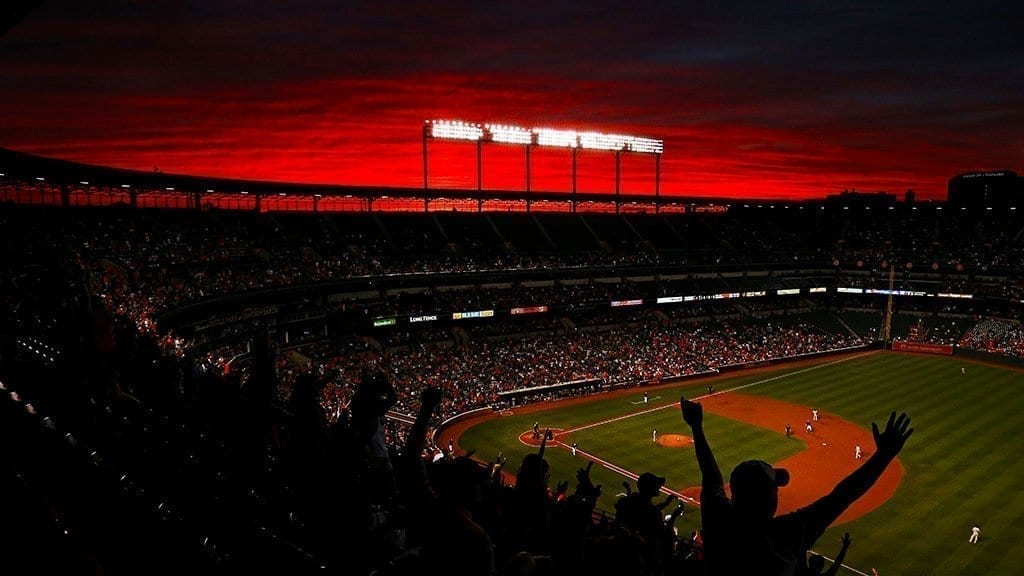
It’s the last day of the 2016 Regular Season, and Baltimore Orioles are fighting to reach the playoffs for the third time in five years.
Baltimore Sports and Life (BSL) has reached out to some analysts across the game for their thoughts on a number of O’s related topics.
Our thanks each of the analysts below for participating in this Q&A.
Joe Sheehan – Sports Illustrated, The Joe Sheehan Newsletter
Matthew Kory – Baseball Prospectus
Eno Sarris – FanGraphs
Scott Spratt – Baseball Info Solutions
Jim Callis – MLBPipeline.com
Nick Faleris – 2080 Baseball
Zach Spedden – Baltimore Sports and Life
Reggie Yinger – Baltimore Sports and Life
Anthony Castronvince – Sports on Earth, MLB Network
Bryan Grosnick – Baseball Prospectus
Matt Perez – Camden Depot
Rob Shields – Baltimore Sports and Life
Mike Axisa – CBS Sports
(You can discuss this on the BSL Board here.)
GENERAL DISCUSSION & DAN DUQUETTE
BSL: The Orioles are finishing up a 5th consecutive non-losing season, and if they secure a Wild Card will have reached the post-season for the 3rd time in this span. From the beginning of 2012 through 10/1/16; the Orioles have 443 total wins, which is the most of any AL East team in that same time-frame (New York 435, Toronto 411, Boston 408, Tampa Bay 406).
Since ’12, some of the names have changed – but consistently the O’s have been a team with plus slugging, mediocre to below average on-base % ability, below average starting pitching (aside from the 2nd half of ’14), a strong bullpen, and quality defense (at-least maintained in the infield here in ’16).
Regularly they’ve exceeded the prognostications from Baseball Prospectus (PECOTA), and FanGraphs.
In-general, what are your thoughts on what the O’s have been these last 5 years? Do you believe in the way the rosters have been constructed? Or think their flaws are inexcusable? The key for them remaining competitive in the Division over the next half-decade is what?
Sheehan: The Orioles have sustained performance in areas — like defense, particularly in the infield, and bullpen — that usually regress rapidly to a mean. They’re a bit like the Royals in that way, if less extreme and over a longer period. Those strengths, which are tuned by a strong tactical manager in Buck Showalter, have enabled them to play above expectations. We’ve seen some of that chipped away at this year, as the outfield defense has been the team’s worst in this stretch.
Under Duquette and Showalter, the Orioles have done the little things very well, finding gems like Steven Pearce and Brad Brach, trading air for J.J. Hardy, picking up Nelson Cruz on the cheap. That work has been the difference, in some years between .500 and the better records, the postseason trips, they’ve had.
It’s the big moves that have been disastrous, and where Dan Duquette has put the team behind. Ubaldo Jimenez and Yovani Gallardo cost the team money, wins and draft picks, a crushing combination. Chris Davis’s contract is heavily deferred, but the player himself carries enormous collapse risk in his thirties.
They’ve also failed to get full value from what, five years ago, looked like the core of a championship team. Manny Machado has become one of the 16 best players in baseball; behind him, though, Matt Wieters, Dylan Bundy and Kevin Gausman have never had sustained success. Adam Jones, a star at the beginning of this run, is now more or less an average player at 30 (and a big reason for that terrible outfield defense). Looking ahead to 2017 and ’18, the Orioles’ core is Machado, Gausman, Schoop, Zach Britton, Chris Tillman and Chris Davis. That’s too good to warrant a tanking-flavored rebuild, but not good enough to match up with what the Red Sox have. They have a lot of money coming off the payroll, but very little on the free-agent market fits their needs: a center fielder (so Jones can move to a corner); a leadoff hitter, plus one more player who gets on base at a high rate; an above-average starting pitcher.
Hanging over all of this is the Manny Machado problem. It is probably — though not certainly — too late to get Machado to sign a long-term deal to stay in Baltimore. If the Orioles don’t contend in 2017, the question of whether to trade Machado while he has two pennant races’ worth of control left will be the biggest, maybe the only, Orioles issue next summer.
BSL: Orioles Executive VP Dan Duquette was hired November 6th, 2011. He inherited a core of players to build around from former O’s GM Andy McPhail. To me, the primary positive of Duquette’s tenure has been his ability to have a productive working relationship with O’s Manager Buck Showalter, and O’s Majority Owner Peter Angelos. With Showalter, that has been best shown by their combined ability to ‘extend’ the roster with quality manipulation of existing player options. With Angelos, Duquette has been able to operate autonomously with lower-level day-to-day moves – a luxury not afforded to several of Duquette’s predecessors.
Beyond that, Duquette has also had some quality acquisitions. Players such as Chen, Cruz, Trumbo, Miguel Gonzalez, Kim. Trading Guthrie for Hammel and Lindstrom. Trading for Bud Norris. Regularly adding depth to the fringes of the roster. Some Rule V success. Obtaining Steve Pearce (multiple times). Obtaining Andrew Miller in ’14 (even at the cost of Eduardo Rodriguez).
He also gets credit for his ’12 promotion of Machado, and using him at 3rd. (That decision helped propel the O’s to the ’12 WC.) Should get some credit for the players he didn’t give away. Should get some credit for adding some brainpower to the rest of his Baseball Operations department.
He operates in a fairly unique situation by being in a division with the revenue streams of NY & Boston, coupled by having an Owner who influences things even when he is not directly meddling.
On the negative side the Mil System ends ’16 in poor shape. In particular very little has be done to improve what the O’s do Internationally. (Reasonably it can be asked if this is an organizational decision from above his pay grade.) The upside of Arrieta (and Strop) was traded for a weak band-aid in Feldman. Zach Davies was traded for Parra. The Jimenez signing has not worked. The Gallardo signing had red flags everywhere with the veterans declining peripherals. The O’s made zero attempt to resign Miller.
It would have been preferential to have seen larger efforts at extending Machado, earlier in Machado’s career. Similarly, we would have liked to have seen more concerted efforts with extending Gausman, and Schoop.
MacPhail built a lot of the core, and gets the deserved credit for that.
Buck is one of the best managers in the game, and gets the deserved credit for that.
There has been more talent on the roster these last 5 years than often gets recognized, and the players get the credit they deserve for that.
I continue to think Duquette is a league average GM.
Agree or disagree with the idea of Duquette being a league average GM?
Sheehan: That’s about right. Duquette has the same set of strengths and weaknesses he’s always had — good at the small moves, bad at the big ones. The Orioles’ apparent unwillingness to play at the top of the free-agent market has hurt him, but while you can’t blame him, perhaps, for not signing David Price, you can blame him for signing Jimenez and Gallardo. “Just sign the mid-market guys you can afford” has been, for 40 years, the worst possible approach to free agency. Jimenez and Gallardo combine to make a bit less than what David Price makes, a bit less than what Max Scherzer makes. It’s Bad GM 101.
It’s particularly galling because Duquette is very good at filling out the bottom 17 spots on a roster. The value in doing that is usually that you can pay retail on the top eight spots. The Orioles’ refusal to do that wastes some of what Duquette brings to the table.
He’s not the Orioles’ problem, and until the Orioles go into a rebuild — which may then necessitate the hiring of a younger GM in the mold of David Stearns or Matt Klentak — he should keep his job.
MARK TRUMBO & PEDRO ALVAREZ
BSL: Mark Trumbo had a strong first half, and a poor second half. Historically the defensive metrics have liked him at 1st, and disliked him in the OF. The O’s have used him in RF this year, and be it by metrics or the eye test he’s below average. Jon Heyman recently projected Trumbo to get a 3 year $45M contract as a FA this Winter. At that level, is that a contract you would advocate for the O’s, or believe they should walk away from? If he has the Qualifier attached, do you think he has any trouble getting that level of contract on the open market?
Kory: Trumbo is one of those players who probably looks much better than he really is. People remember the home runs, they don’t remember the strikeouts, the too many outs he creates, and the sub-par defense. That said, he isn’t without value, but it’s more limited than some probably think. Three years, $15 million wouldn’t kill the Orioles if they did give that to him, but I’d advocate giving him the qualifying offer and seeing if he accepts it. If he doesn’t, you get a pick. With a player of limited value, already into his 30s like Trumbo, it becomes more important to hold down the number of years he gets so the team isn’t stuck paying for past performance on the back end. The O’s could stash him at DH but with Chris Davis signed between now and eternity, putting Trumbo at first doesn’t help the team as it eats into Davis’s value.
As to the last part of the question, I honestly don’t know if there is a team out there willing to give up a first round pick to sign a 31-year-old Trumbo. I sure wouldn’t, but the Diamondbacks still exist so, maybe…
Sarris: If you look at this current season of Trumbo’s and make him a first baseman instead of an outfielder, he could be worth almost two more wins. If you call him a three win guy this year at first, then you’d expect about six wins over the next three years, which would be worth around $50 million, I think. You do have to look at the teams that might have that money and a need at first, though, because everyone can see his outfield defense is a little suspect. Would the Angels want him back even though they have a cheaper C.J. Cron there? I doubt the Mariners would pay that to get him back, since they seem to be focusing more on dynamic, versatile players with on-base skills. The Marlins have Justin Bour, the Astros have a ton of guys at the position and have put Marwin Gonzalez there in the past. It’s just not a skill set that’s as valued in today’s market place. That said, Nelson Cruz got a pretty good deal and there’s always someone that might pony up. With the QO attached, I’d offer him that 3/45 or so and hope he bites because the other teams aren’t drooling. Given the changes he made to his approach — upping his launch angle and focusing on exit velocity — I believe in him, it’s just….
I’d take him back at DH in tandem with Chris Davis and let Pedro Alvarez go. With Trumbo, you get a guy that can hit against both lefties and righties, and can actually play in the field, and has a similar bat-only projection. That versatility is just better for the team. It’s more money, though, so you may just see Trumbo go and Alvarez back in town. That would fit what the Orioles did with Cruz and others before him, after all.
BSL: In that same aforementioned link; Heyman has Pedro Alvarez pegged at getting a 1 year $8M contract. Alvarez has basically become a platoon DH. Would you bring him back on that deal?
Kory: No, though if they did it wouldn’t kill them. Alvarez is like Trumbo-lite. The value he provides is so limited and he’ll be 30 next year so expecting improvement isn’t realistic. Ultimately it depends on what the team has to replace him with — he’s not valueless — but there should be better, more flexible options out there for Baltimore.
THE DEFENSE
BSL: With a couple of games left in the 2016 regular season, the Baltimore Orioles are just 25th overall in Baseball Info Solutions’ Defensive Runs Saved measurement. By FanGraphs UZR/150, the O’s are 23rd overall. By Baseball Prospectus’ Defensive Efficiency metric the O’s are 4th. The perception locally has been that the ’16 O’s have had a quality infield defense, and the overall numbers have been dragged down by sub-par Corner OF defense during the year from Hyun Soo-Kim, and Mark Trumbo. (This issue recently improved by the acquisitions of Michael Bourn, and Drew Stubbs.) A further look shows that after positive defensive numbers in ’14, and ’15; Adam Jones ’16 metrics were negative. (Any thoughts on how his ’16 has differed from two previous years defensively?) How would you evaluate the O’s defense as a whole?
Spratt: You characterized the Orioles’ defense quite well in your question. Their outfield has -51 DRS, which is 2nd worst in baseball ahead of only the Tigers. However, their infield has 43 DRS (including Shift Runs Saved), which is 3rd best in baseball.
Adam Jones has -11 DRS this season. And while he had been a bit positive in the previous two years, he was below average the 4 years before that. The major difference for Jones this year compared to the last two is his outfield throwing. He has just 2 outfield kills this year, which is when he throws out a baserunner without a relay man. The last two years, he had 13 kills. Meanwhile, Jones has allowed 54.3 percent of baserunners to take an extra base when they had an opportunity this year; that’s not bad for a center fielder (average is 55.2 percent), but it’s up significantly from the last two years. In general, Jones’ DRS totals have looked worse than “the eye test” of him as a fielder in part because he positions himself much more shallowly than an average fielder, and that results in a lot of extra base hits over his head. He’s saved 16 fewer plays than an average CF on deep balls this year; he saved 17 fewer last year.
BSL: In a previous interview, your colleague Ben Jedlovec advised that at BIS you “.. credit teams for their making of plays when in a defensive shift in a statistic we call Shift Runs Saved rather than individuals. So a player’s Defensive Runs Saved will be based solely on their plays made (and not made) in traditional defensive alignments.” Where do the ’16 O’s rank in-terms of Shift Runs Saved?
Spratt: The Orioles have 14 Shift Runs Saved, which is tied for 10th most in baseball.
INTERNATIONAL EFFORTS & THE 2016 MLB DRAFT
BSL: Under the Ownership of Peter Angelos, the leadership in the Baseball Operations has changed numerous times. No matter who has been in-charge of Baseball Ops. a common theme has been that International Scouting efforts have been minimal. To me this points to a decree from above their pay grade. The benefits of producing as much cheap team-controlled talent as possible seem self-evident. As the 2016 season ends, the Baltimore Orioles MiL system is clear in the lower 1/3. If you were in-charge of the O’s Baseball Ops. Department with the autonomy to make the moves you wanted; what changes would you make to the O’s International efforts?
Faleris: Specific actions on the international front are less important than being involved in some manner. If Baltimore is reticent to join in the crowd of teams periodically blasting through caps and paying penalties, that is understandable. So long as Baltimore is looking at the market and bringing in some quality talent that is all that matters, and I think you can point to signings such as Chen and Kim that have produced good major league value in.
That said, if Baltimore leans away from spending on young international talent then I’d think there has to be some equal shift in focusing on bringing in young talent through the draft. While I’m wary of critiquing front offices from afar, the one issue I keep coming back to in Baltimore is sustainability. I understand the logic behind trading away international cap money if Baltimore is not otherwise intending to use it. Once you’ve committed to that route, however, I think it makes it more and more important that you maximize your draft spending and even get a little aggressive in pursuing additional picks wherever you can. Baltimore has, conversely, traded away picks routinely to help shore up money for the big league club, which at times has helped to plug some holes but ultimately is not a sustainable model for keeping a pipeline of young talent flowing.
Finally, I’d sure spend a lot of time unpacking any changes to the CBA as soon as they are finalized. There’s a real first mover advantage in figuring out beneficial strategies before the crowd.
Spedden: I would look to build and fund a strong international scouting department, with the intention of trying to find better values. The Orioles have also been very willing to trade international pool money. That is fine, to a point (they have to make up for the lack of farm system depth somehow), but there should be a limit to how much they’re willing to throw into deals.
Yinger: Expand and increase scouting in the Latin American market. The Orioles won’t be able to build their farm system until they look past just signing folks from the MLB Draft.
BSL: The Orioles first selection in the 2016 Draft was Cody Sedlock. Is it realistic to expect the advanced college arm to begin ’17 at High A Frederick, and progress to AA Bowie at some point? The O’s next two selections were also college arms in Keegan Akin, and Matthias Dietz (JUCO). Out of Akin and Dietz, which arm are you more excited about as you project forward?
Callis: I’m not sure what the Orioles’ plans are, but Sedlock is capable of starting 2017 in high Class A and ending it in Double-A. He has a deep repertoire, throws strikes and has had success against top-tier college hitters and in pro ball. I like both Akin and Dietz, so it’s tough to pick between the two. If I’m forced to, I’ll go with Dietz because he has a better body and I think his slider will be better in the long run, but Akin is a lefty who can reach 96 mph and really pitch too.
Faleris: I spoke with a scout a month after the draft who thought Sedlock could potentially help out Baltimore out of the pen this summer, then drop back to Double-A to stretch out the arm next year in a starter’s role. Given how he was implemented this year, I’d say more likely than jumping to High A would be a short stint in Delmarva and then promotion as quickly through Frederick and Bowie as his performance warrants. I certainly wouldn’t feel any need to take it slow with him. If he is executing I would keep pushing him until he meets real resistance.
With regards to Akin/Dietz, I really liked Dietz as a high-upside JUCO target and Akin is a non-traditional starter build with the stuff to stick in a rotation. Dietz has the higher upside for me and more potential to really take off if things come together for him. Big lefty who works off tough angles and can have two legit swing-and-miss offerings in his fastball and breaking ball. Akin is more polished and I imagine will put up better comparative numbers early on, but will be challenged by more advanced hitters who can take advantage of his lack of plane. For me, Dietz is a potential number 3 with a solid pen future as a back-up, while Akin is more of a back-end guy with a potential to move quickly through the system.
Spedden: Starting with Sedlock, a move to Frederick is very realistic. Given that he’s a fairly polished college pitcher, the Carolina League will represent a more challenging step and probably reflect his value than an assignment to Delmarva. Out of Dietz and Akin, Akin intrigues me a bit more to this point. He was a little more polished coming out of the draft, which I think showed in both pitcher’s performances in Aberdeen. There’s definitely upside with Dietz, but the Orioles should–and probably will–take a little more time with him.
Yinger: Absolutely realistic to be at High-A Frederick. He’s older and has put in the innings and work to develop pitches. If he does start in Delmarva, I don’t expect that to last long.
MANNY MACHADO: EXTENSION PROSPECTS
BSL: Manny Machado is one of the premier all-around players in the game, and he just turned 24 in July. He’s arbitration eligible the next two seasons, and would be a Free Agent after 2018. Ideally the Orioles would have reached an extension with Machado earlier in his career. Since that didn’t occur, the cost of an extension will only be higher now. If the O’s make an offer this Winter; I’m picturing something like $15M a year for the two arbitration years, with a 4 year extension through ’22 at $30M plus annually. Likely also including an opt out(s), and deferred money. This would have him again hitting FA at age 30.
A realistic structure to you? If not, what do you picture? The O’s 2016 team salary was +/- $150M. If the O’s maintain that level of team spend, would you have any issue of allocating 20% of that annual spend to Machado?
Castrovince: What you’re proposing is very similar to the Mike Trout extension in terms of length and dollars, except that Trout’s covered three arbitration years and three free agent years (not two and four, respectively). Maybe familiarity and past knee issues would compel Machado to embrace the security provided by such a deal, but I just can’t help but doubt that he’d sell off four free agent years, even if it would put him position to “cash in” again at age 30. Honestly, we might have reached a point in which buying out any of his free-agent years is a really difficult to do, because he’s just two seasons away, and there are already multiple teams – the Yankees and Phillies among them – that potentially linger as sleeping giants in the free-agent marketplace. There were suggestions earlier this year that Machado could wind up with a $400M price tag. After the Giancarlo Stanton extension, who knows?
As far as allocating 20% to a single player, that’s always going to be dicey and potentially problematic, though there are certainly worse options to tie such a significant chunk of your fate to. The O’s have risen their player payroll each year of the Dan Duquette era, with an especially large leap from 2015-16, but there’s no telling if that trend will continue.
BSL: If the Orioles present their best offer to Machado this Winter, and the 3rd baseman declines; should they trade him, or play out the next two years? i.e. do you go the next two seasons with the MVP talent on the roster, or move him this Winter when the obtaining team would have him for two seasons? If he was traded, can you suggest an appropriate return of young, team controlled talent back to the O’s?
Castrovince: No way would I trade him at this juncture. They’ve proven this year that they have the pieces to contend, and if they can find some cost-effective solutions in starting pitching for 2017, there’s no reason to believe they can’t contend again. I would take every opportunity I can to win with Machado before I’d consider dealing him.
MATT WIETERS
BSL: Following the 2015 season, Matt Wieters was projected by MLBTR to receive a 4 year $64M contract from someone, even with him having been offered the Qualifying offer by the Orioles. The market for a contract at that level never developed for the switch-hitter, thus he accepted the 1 year $15.8M qualifier from the O’s. Presumably part of the issue Wieters faced last Winter was questions about his ability to regularly be available to catch. In ’16, he’s caught more innings than the last two years combined. That helps, but the pitch framing numbers remain below average, and his bat really only plays as a Catcher. If the O’s were to again offer the Qualifier, is anyone giving Wieters a multi-year deal? What makes more sense to you from the perspective of the Orioles? Giving Wieters something like 3 years $30-$36M, or parting ways with the veteran and allowing Chance Sisco to take over? Should Baltimore make the QO?
Grosnick: Given the way the metrics shake out, I think it might be time to move on from Matt Wieters. Given that he’s got the reputation of an All-Star, and still is a name in a woefully-thin catching market, there’s a chance he still has value. At the same time, it’s possible he’s aging out of the position, and his 0.8 Baseball Prospectus WARP leaves quite a bit to be desired. If the Orioles do want to move on from Wieters, I’d hesitate to give him the qualifying offer, which may sit at something close to $17 million next season. Wieters has proven that he will take the qualifying offer–he did that last year–and I’d doubt his performance was good enough to cause him to take his chances on the open market. An extension would make sense if the dollar amount was reasonable … maybe something less than $10 million per season … where he could transition into a reserve role, but that’s a lot to pay for a backup catcher, especially in Baltimore where the money could go to another part of the team. (Like, I dunno, pitching.)
Matt Wieters has been a terrific contributor to Baltimore for a long time, but he’s probably too ineffective and expensive now, especially with Sisco and Joseph in the org. It’s time to move on, and that means no QO.
THE MASN DISPUTE
BSL: Can you summarize where things stand with the Baltimore Orioles / Washington Nationals MASN dispute, and what you see as the likely end resolution?
Perez: They’re in the middle of the appeals process. MLB and the Nationals have failed to get Justice Marks to force MASN to either pay the rights fees that they demand or force MASN to go in front of the RSDC for a second arbitration, so they’ll go in front of a second court and the parties will see if they can’t get this court to agree with them. The appellate court is in no hurry to judge this case, as they just denied a request by the Nationals to expedite the process.
In the meantime, Kenneth Feinberg, a legal expert on arbitration has filed an amicus curiae brief in favor of MASN. This probably won’t have much impact, but certainly won’t hurt MASN. In addition, the fact that a truly neutral expert has weighed in on the side of MASN should give people pause about whether they fully understand the case or whether they’ve been unfairly judging the case because Angelos is involved.
At this point, things are very much up in the air. But there’s a lot of bad blood between the two parties. It’s fair to say that one side will be extremely happy with the end resolution, while the other side will be extremely unhappy. Expect more difficulties coming to an agreement for 2017-2021.
BSL: Is there anything you think has been missed, generally over looked by most in coverage on the dispute to-date?
Perez: The thing that’s been overlooked the most in the coverage up to-date is that Comcast made an offer for MASN. As part of that offer, they wanted the Nationals and Orioles to agree to a set amount of rights fees for the next twenty years. Those rights fees started at $42.5M and increased 4% every year after. This would have likely ultimately resulted in each team receiving hundreds of millions dollars fewer than MASN is willing to pay. Comcast showed no willingness to sweeten its offer either.
MASNs existence gives the Nationals and Orioles leverage to negotiate with Comcast, but they still couldn’t get a good deal, in part because the Nationals have poor ratings for a baseball club. If Comcast is willing to low-ball the clubs now when they do have leverage, then what would Comcast do to them if they had no other option but sell their media rights to Comcast because Comcast controls the market?
Zach Britton
BSL: As compared to ’15, Britton’s K% is slightly lower, his BB% is slightly higher. His xFIP is slightly higher. The biggest positive differences are his BABIP, and LOB%’s. He leads all relievers in WPA, with considerable distance between him and Andrew Miller who is 2nd. Of course his perfection in save opportunities this season also stands out. Overall he’s been outstanding for two straight years, and his ’14 was high quality as well. Relievers can be volatile, but do you see any reason to believe Britton will not remain elite for the foreseeable future?
Shields: He has the best pitch in baseball. He misses bats, inducing a lot of ground balls and weak contact. He isn’t a sun 1 ERA pitcher on a year in and year out basis (no one is or ever will be) but he should continue to be one of the top relievers in baseball for the foreseeable future, assuming he stays healthy of course.
BSL: There have been several high profile trades in the last year of relievers, with those relievers bringing back significant returns. Britton isn’t a FA until after ’18, so the O’s don’t face any immediate contract decisions with their Closer. However, if the choice was extending him a year or two, or trading him this off-season; what do you think would be the wiser decision? If the O’s were going to trade him, presumably they would be looking for cheap cost controlled talent. What would be the appropriate value back to Baltimore if he were traded?
Shields: You have to trade him IMO. First of all, he is with the team for 2 more seasons and will probably cost somewhere in the area of 25-30 million for those seasons. So, if you trade him, you save that money. Secondly, with the return we have seen for closers in the last year (starting with the Kimbrel deal), you have to do that if you are the Orioles. As great as Zach is, hes giving you 60-70 innings a year. Yes, those are mostly high leverage innings but still, he is rendered useless to the team if the Orioles are struggling to win games or if they are winning big. Now, because of the Orioles style of play and the fact that they keep games close, he is more important to us than a lot of closers on other teams are. However, if you just put out a better team, you won’t have to put so much weight on your closer. A better offense and starting pitching will help with that and the Orioles can help speed that up through a big trade or two.
Add to that the fact that the Orioles have a barren MiL system that is in need of an infusion of talent and it adds up to the Orioles having to deal him if the right trade comes along…which it will.
DYLAN BUNDY, KEVIN GAUSMAN, JONATHAN SCHOOP
BSL: One of the most encouraging aspects of the Orioles 2016 season has been what they got out of Dylan Bundy. Bundy ended 2012 as one of the premier prospects in the game. He was lost to injury in ’13, and had 60 ish combined innings at the MiL level over ’14, and ’15. Here in ’16 he had to be on the ML roster to start the year due to his contract. My hope for him going into the season was 75 +/- innings out of the bullpen, and month-to-month improvement. As the year began, his stuff was flat. Minimal movement, and swing and miss ability. As the weather warmed, he progressed. Due to need he was inserted into the rotation in mid-July. He had some starts where he flashed everything – mid 90’s heat with control and movement, a plus change, and a plus breaking ball – before noticeably tiring a bit in September.
Your thoughts on Bundy? Any issue from your perspective of how the O’s have handled him in ’16? He’s going to finish ’16 with +/- 115 innings. What is a reasonable inning target for him in ’17?
Axisa: I saw an awful lot of Bundy when he was in the minors, and even when he was at his best this season, his breaking ball wasn’t as good as it had been and there wasn’t as much fluidity in his delivery. We can blame the injuries for that. I’m encouraged the velocity is still there and he didn’t lose feel for his changeup. Chances are Bundy will never be the ace he was projected to be as a prospect, but there’s still enough there to start long-term.
Bundy is still pretty young so the O’s are going to have to watch his workload next season. I hate the one size fits all “an increase of no more than X innings from last season” approach. They Orioles should monitor him throughout the season, build in some extra off-days when possible, and generally just let his body tell you when enough is enough. If he ends up with 115 IP this year, a target of 150 IP or so next season would be good. I wouldn’t be surprised if they push him to 170 IP or so.
BSL: Kevin Gausman has been strong after the All-Star break, putting things together, and looking like a guy that can lead a rotation for some time. At the minimum, he’s a very competent starter with high-end upside. Gausman remains years away from Free Agency. If you were part of the O’s Front Office, would you be looking to do a deal this off-season through his arbitration years, tacking on a year or two? If so, what would be a reasonable deal in your eyes? Production wise, should the expectation be a guy definitely capable of leading the staff next year? What’s the biggest question you have about Gausman going forward?
Axisa: Yes, locking him up would be smart. Pitching is going to be very hard to come by in the next few years. The upcoming free agent classes stink and there will be a lot of competition on the trade market. Gausman will be a Super Two, so he’ll be eligible for four years of arbitration instead of the usual three, which complicates an extension. The only Super Two pitcher to sign an extension four years before free agency recently is Gio Gonzalez, and he’d already gone to an All-Star Game by that point. Gio got five years and $42 million with two clubs options. Similar framework could work for Gausman, especially when you factor in inflation.
With Gausman, the biggest question is command. His stuff is excellent. He just needs to locate a little better going forward. There’s throwing strikes and there’s hitting the corners and avoiding the heart of the plate. Gausman has to do a better job at the latter. Like a lot of young pitchers, it seems like when he makes a mistake, it’s in the zone and out over the plate, not in the dirt or somewhere less dangerous.
BSL: 2nd base is a deep position in the game currently. Jonathan Schoop probably has premier arm at the position at this time (sorry Robbie Cano). He’s got great power. He’s never going to have patience. O’s Mgr. Buck Showalter regularly talks about him being excellent around the bag. His range is not great, but it’s much better than what was advertised when he was in the Minors. He’s a guy that visibly has a lot of fun, and wants to play every day. Does he reach another level, or does get consistently held back by his limitations? An upper 1/3 2nd baseman overall going into next year?
Axisa: Plate discipline can be learned but it’s not easy and not guaranteed to happen. Schoop seems to do a good job squaring up all kinds of pitching. He’s not a guy who feasts on mistake fastballs. So the pitch recognition is there. It’s just a matter of learning which pitches are the ones to offer at and which ones to let go by. Chances are he’ll settle in as a .310 OBP guy with 25+ homers regularly. The tools are there for much more. I just feel like when you have to count on a guy making drastic approach changes to reach his full potential, it’s probably too much to ask. Schoop is still a very good player even with the super low walk rate.

Owner
Chris Stoner founded Baltimore Sports and Life in 2009. He has appeared as a radio guest with 1090 WBAL, 105.7 The Fan, CBS 1300, Q1370, WOYK 1350, WKAV 1400, and WNST 1570. He has also been interviewed by The Baltimore Sun, Baltimore Business Journal, and PressBox (TV). As Owner, his responsibilities include serving as the Managing Editor, Publicist, & Sales Director.