
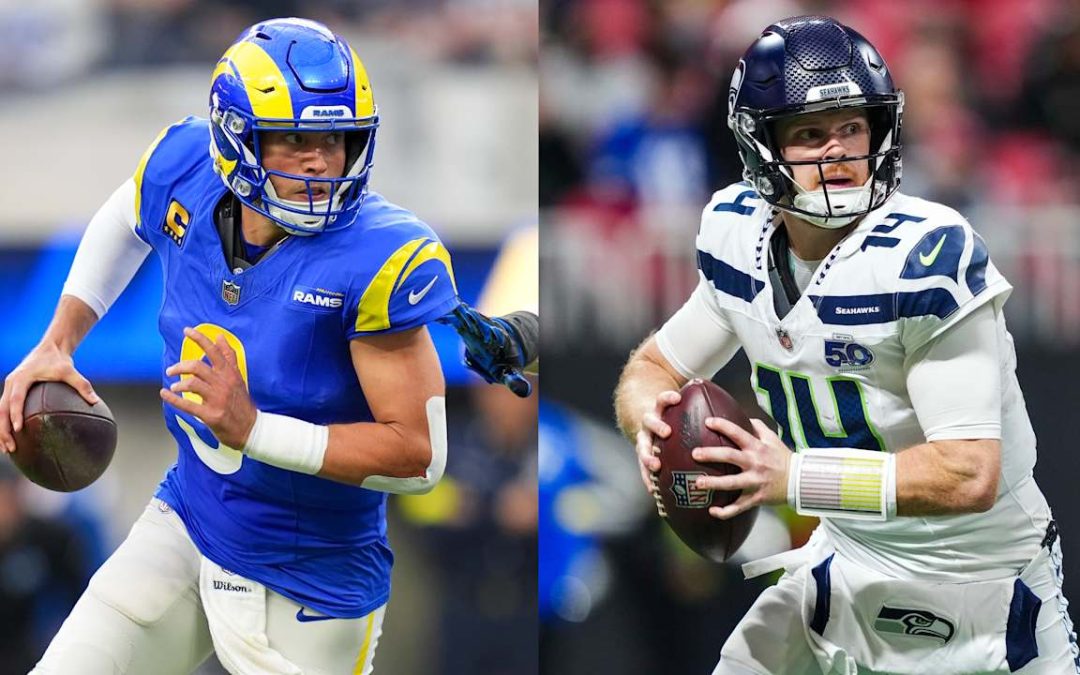
The season opens Wednesday, September 9th, when Seattle raises its Super Bowl LX banner and hosts New England at Lumen Field. The Ravens begin four days later in Indianapolis. Super Bowl LXI will be played at SoFi Stadium — meaning the preseason favorite is chasing a Lombardi in its own building.
Below: full power rankings against the market and the models, over/under calls on all 32, a ranking of the eight divisions, the trench units that decide January, the ten best coaching staffs, division-by-division projections with a defining question for each team, and the five storylines that will shape the year.
Three outside inputs get referenced throughout. Clay is Mike Clay’s ESPN projection guide (updated August 12th), which produces a projected win total and 1-to-10 unit grades at ten positions for all 32 teams. Sharp is Warren Sharp’s work — both his strength-of-schedule model, where 1 is the easiest slate and 32 the hardest, and Raymond Summerlin’s Sharp Football power rankings. Line is the DraftKings win total. Where 2025 EPA rankings appear, they’re from The Ringer’s team pages; note that both Diante Lee’s power rankings and Steven Ruiz’s quarterback rankings there are February snapshots taken before free agency and the draft, so we’ve used the underlying data and film analysis rather than the orderings or the team labels.
Power Rankings Entering 2026
| BSL | Team | NFL.com | Sharp | Clay Proj. Wins |
|---|---|---|---|---|
| 1 | Los Angeles Rams | 1 | 1 | 13.3 (1st) |
| 2 | Seattle Seahawks | 3 | 3 | 11.2 (4th) |
| 3 | Buffalo Bills | 5 | 2 | 10.0 (9th) |
| 4 | Philadelphia Eagles | 4 | 9 | 11.0 (5th) |
| 5 | Baltimore Ravens | 6 | 8 | 11.5 (3rd) |
| 6 | Denver Broncos | 2 | 6 | 10.9 (6th) |
| 7 | Houston Texans | 9 | 7 | 9.5 (14th) |
| 8 | Los Angeles Chargers | 17 | 5 | 9.5 (15th) |
| 9 | Detroit Lions | 14 | 14 | 12.0 (2nd) |
| 10 | New England Patriots | 12 | 10 | 10.0 (10th) |
| 11 | Kansas City Chiefs | 15 | 13 | 9.9 (11th) |
| 12 | Cincinnati Bengals | 8 | 11 | 10.7 (7th) |
| 13 | Green Bay Packers | 13 | 4 | 9.5 (13th) |
| 14 | San Francisco 49ers | 16 | 12 | 9.5 (12th) |
| 15 | Dallas Cowboys | 11 | 16 | 10.1 (8th) |
| 16 | Chicago Bears | 10 | 17 | 9.3 (16th) |
| 17 | Jacksonville Jaguars | 7 | 15 | 8.5 (20th) |
| 18 | Tampa Bay Buccaneers | 22 | 18 | 9.0 (17th) |
| 19 | Minnesota Vikings | 18 | 19 | 7.6 (21st) |
| 20 | Pittsburgh Steelers | 20 | 20 | 8.6 (18th) |
| 21 | New Orleans Saints | 21 | 25 | 7.2 (24th) |
| 22 | Indianapolis Colts | 19 | 21 | 8.5 (19th) |
| 23 | Carolina Panthers | 23 | 22 | 5.9 (27th) |
| 24 | New York Giants | 27 | 24 | 7.2 (23rd) |
| 25 | Washington Commanders | 29 | 23 | 6.4 (25th) |
| 26 | Atlanta Falcons | 25 | 28 | 5.7 (28th) |
| 27 | Tennessee Titans | 24 | 26 | 4.8 (30th) |
| 28 | New York Jets | 30 | 27 | 7.3 (22nd) |
| 29 | Las Vegas Raiders | 31 | 29 | 5.1 (29th) |
| 30 | Arizona Cardinals | 26 | 30 | 3.6 (31st) |
| 31 | Cleveland Browns | 28 | 31 | 6.2 (26th) |
| 32 | Miami Dolphins | 32 | 32 | 2.4 (32nd) |
On the Chargers. NFL.com has them 17th and Clay projects 9.5 wins against what he rates the fourth-hardest schedule. But Sharp Football has them fifth, and we have them eighth — so this isn’t as lonely a position as it looked a week ago. Joe Alt and Rashawn Slater both missed most of a season in which Los Angeles still won 11 games, and both are back. Mike McDaniel replaced Greg Roman as play-caller. Camp reports describe motion, constant personnel churn, and Justin Herbert diagnosing coverage pre-snap — from a team that ranked 24th in red-zone passer rating a year ago.
On the Packers. Sharp has Green Bay fourth, calling it an out-on-a-limb pick built on Jordan Love ranking sixth in EPA per dropback over three seasons. We can’t get there with Micah Parsons, Devonte Wyatt, Tucker Kraft and Zach Bako-Bewele all rehabbing and Josh Jacobs’ legal status unresolved.
Ranking the Eight Divisions
| BSL | Division | Projected Wins | NFL.com |
|---|---|---|---|
| 1 | NFC West | 38 | 2 |
| 2 | NFC North | 37 | 1 |
| 3 | AFC West | 36 | 3 |
| 4 | AFC North | 34 | 4 |
| 5 | AFC South | 33 | 5 |
| 6 | NFC East | 32 | 6 |
| 7 | NFC South | 31 | 8 |
| 8 | AFC East | 31 | 7 |
We have the NFC West first on top-end quality — the Rams, the champs, and a perennial January team — while NFL.com takes the NFC North for depth, and that’s a fair argument in a division where the 2025 champion (Chicago) finished ahead of a Lions team that tied for last at 9-8.
Our one real departure is at the bottom. NFL.com has the NFC South eighth, and the case is obvious: the 2025 division was decided by a three-way tiebreaker among 8-9 teams. But we’d rather have four teams that could all finish 8-9 than a division housing two of the league’s five worst rosters. Buffalo and New England are both very good. The Jets and Dolphins are projected for 9.7 combined wins by Clay’s model, and we have them at nine.
The Quarterback Tiers
Two industry surveys landed this summer, and they disagree in useful ways. Mike Sando’s annual tiers at The Athletic polled 50 coaches and executives on 35 veteran quarterbacks; ESPN separately surveyed more than 70 execs, coaches and scouts for a straight top 10.
Sando’s Tier 1 is four deep: Patrick Mahomes, Josh Allen, Matthew Stafford, Joe Burrow. ESPN’s poll has Allen first and Mahomes second, with Stafford third — the two surveys agree almost entirely on who the elite are, and both moved Stafford up on the strength of his MVP season.
Tier 2 ballooned to 13, the largest in the survey’s history, and the ordering is where the interesting arguments live: Lamar Jackson (5), Justin Herbert (6), Dak Prescott (7), Drake Maye (8A), Jared Goff (8B), Jordan Love (10), Brock Purdy (11A), Caleb Williams (11B), Jayden Daniels (13), Baker Mayfield (14A), Sam Darnold (14B), Trevor Lawrence (16), Jalen Hurts (17). The lettered pairs are ties in Sando’s voting — Maye and Goff are jointly eighth and ninth, which is why the next name is 10th.
One caveat before anyone uses these as rankings: this is a perception survey, not a measurement. It tells you what evaluators believe, which is genuinely useful — those are the people who set trade markets and build game plans — but a coach’s ballot is not a metric.
With that said, three placements are worth flagging. Herbert at 6 is the highest any survey has put him. Hurts at 17, last in Tier 2 behind Darnold and Mayfield, tells you league evaluators remain dramatically less convinced by him than his team’s accomplishments would suggest — a gap that has persisted through a Super Bowl. And Nix at 18 says the league credits Denver’s 14 wins mostly to the roster around him — a reading the numbers both support and complicate, which we get into in the Broncos section. Our counter on Hurts is in the Eagles section below; the survey is worth reporting, not worth adopting.
Below the veterans: Jaxson Dart debuts at the top of Tier 3, Tua Tagovailoa fell to 26, Deshaun Watson sits 31st with brutal commentary attached, Michael Penix Jr. is 32nd, and J.J. McCarthy is 34th, with one voter offering that football looks hard for him.
Win Totals: Our Over/Under Call on All 32
AFC East
| Team | Line | Sharp SOS | Clay | BSL | Call |
|---|---|---|---|---|---|
| Bills | 10.5 | 14 | 10.0 | 12-5 | Over |
| Patriots | 10.5 | 10 | 10.0 | 10-7 | Under |
| Jets | 5.5 | 4 | 7.3 | 5-12 | Under |
| Dolphins | 4.5 | 31 | 2.4 | 4-13 | Under |
AFC North
| Team | Line | Sharp SOS | Clay | BSL | Call |
|---|---|---|---|---|---|
| Ravens | 11.5 | 5 | 11.5 | 11-6 | Under |
| Bengals | 10.5 | 2 | 10.7 | 10-7 | Under |
| Steelers | 8.5 | 17 | 8.6 | 8-9 | Under |
| Browns | 5.5 | 6 | 6.2 | 5-12 | Under |
AFC South
| Team | Line | Sharp SOS | Clay | BSL | Call |
|---|---|---|---|---|---|
| Texans | 9.5 | 22 | 9.5 | 11-6 | Over |
| Jaguars | 8.5 | 18 | 8.5 | 9-8 | Over |
| Colts | 7.5 | 9 | 8.5 | 7-10 | Under |
| Titans | 6.5 | 16 | 4.8 | 6-11 | Under |
AFC West
| Team | Line | Sharp SOS | Clay | BSL | Call |
|---|---|---|---|---|---|
| Chargers | 9.5 | 20 | 9.5 | 10-7 | Over |
| Broncos | 9.5 | 11 | 10.9 | 10-7 | Over |
| Chiefs | 10.5 | 12 | 9.9 | 10-7 | Under |
| Raiders | 5.5 | 13 | 5.1 | 6-11 | Over |
NFC East
| Team | Line | Sharp SOS | Clay | BSL | Call |
|---|---|---|---|---|---|
| Eagles | 10.5 | 8 | 11.0 | 10-7 | Under |
| Cowboys | 9.5 | 28 | 10.1 | 9-8 | Under |
| Commanders | 7.5 | 29 | 6.4 | 7-10 | Under |
| Giants | 7.5 | 21 | 7.2 | 6-11 | Under |
NFC North
| Team | Line | Sharp SOS | Clay | BSL | Call |
|---|---|---|---|---|---|
| Lions | 10.5 | 1 | 12.0 | 11-6 | Over |
| Packers | 9.5 | 24 | 9.5 | 10-7 | Over |
| Bears | 9.5 | 26 | 9.3 | 8-9 | Under |
| Vikings | 8.5 | 15 | 7.6 | 8-9 | Under |
NFC South
| Team | Line | Sharp SOS | Clay | BSL | Call |
|---|---|---|---|---|---|
| Buccaneers | 8.5 | 25 | 9.0 | 9-8 | Over |
| Saints | 7.5 | 3 | 7.2 | 8-9 | Over |
| Panthers | 7.5 | 30 | 5.9 | 8-9 | Over |
| Falcons | 6.5 | 19 | 5.7 | 6-11 | Under |
NFC West
| Team | Line | Sharp SOS | Clay | BSL | Call |
|---|---|---|---|---|---|
| Rams | 11.5 | 27 | 13.3 | 13-4 | Over |
| Seahawks | 10.5 | 23 | 11.2 | 11-6 | Over |
| 49ers | 9.5 | 7 | 9.5 | 10-7 | Over |
| Cardinals | 3.5 | 32 | 3.6 | 4-13 | Over |
Fifteen overs, seventeen unders, summing to 272 wins — so the standings that follow are internally consistent.
Five Teams Projected to Regress
1. Denver Broncos (14 wins → 10). Denver went 11-2 in one-score games last season and posted an NFL-record 12 comeback wins. That is not a repeatable baseline — but it’s also not luck alone, and the article’s earlier framing overstated it. Nix finished fourth in the NFL in red-zone QBR (82.6) and led the league outright in winning drives with seven. Payton’s teams are built to not take sacks, and Nix was sacked the ninth-fewest times among starters despite leading the league in both attempts (612) and dropbacks (667). Give them credit for the skill and still expect the record to come down. The Broncos remain excellent — a Bo Nix ankle fracture in the divisional round probably cost them a Super Bowl trip — but the close-game ledger evens out, and five of their first six opponents made the 2025 playoffs.
2. New England Patriots (14 → 10). New England rode one of the league’s softest schedules to Super Bowl LX and lost a long list of contributors: Stefon Diggs, Garrett Bradbury, K’Lavon Chaisson, Jahlani Tavai, Anfernee Jennings. Drake Maye is a legitimate top-five quarterback and A.J. Brown is a real addition — Clay still grades this the No. 4 roster in football. Ten wins and a wild-card berth is a good season here, and we’re less certain than most that Maye is ready to be the reason a team wins rather than a quarterback you can win with.
3. Jacksonville Jaguars (13 → 9). The Jaguars didn’t lose from Week 11 through Week 18, and there’s a turnover-luck component to that nobody should ignore. They lost Travis Etienne and All-Pro linebacker Devin Lloyd, had no cap space and no draft capital after the Travis Hunter trade, and spent their only premium pick on a rotational blocking tight end. Trevor Lawrence’s surge was real; the roster around him is worse.
4. Chicago Bears (11 → 8). The reigning NFC North champions forced a league-leading 33 turnovers, which masked a defense that was ordinary down to down. Then came the third-hardest schedule by Sharp’s model, Drew Dalman’s surprise retirement, the DJ Moore trade to Buffalo, a groin injury costing Luther Burden III the preseason, and injuries to offseason signing Coby Bryant and Kyler Gordon in the secondary. We still believe in Ben Johnson. We don’t believe in this number.
5. Seattle Seahawks (14 → 11). Regression, not decline. Klint Kubiak left for Las Vegas, Super Bowl MVP Kenneth Walker III left for Kansas City, Zach Charbonnet is working back from a torn ACL, and Nick Emmanwori opened camp on PUP. ESPN’s FPI cut Seattle’s defensive rating from 4.6 points per game to 2.1 on the general principle that elite defenses don’t stay elite. Note that John Schneider spent a first-round pick on Notre Dame’s Jadarian Price to address the backfield. Eleven wins and a deep January is still the likeliest outcome.
Five Teams That Look Improved
1. Baltimore Ravens (8 → 11). No returning player changes his team’s baseline more than a healthy Lamar Jackson. Trey Hendrickson is the most impactful edge addition any contender made, and Nnamdi Madubuike is back after neck surgery cost him nearly all of 2025. The schedule is fifth-easiest. Clay grades this the second-best roster in football.
2. Kansas City Chiefs (6 → 10). Kansas City went 1-9 in one-score games and lost Patrick Mahomes to a torn ACL in December. He was cleared to practice fully at the start of camp. Kenneth Walker III gives Andy Reid and returning coordinator Eric Bieniemy the early-down run game they haven’t had in three years. The rebuilt secondary leaning on rookie Mansoor Delane is the real worry.
3. Cincinnati Bengals (6 → 10). Joe Burrow has compared this roster to his 2019 LSU team, which is a lot, but Cincinnati finally invested on defense: the No. 10 overall pick to the Giants for Dexter Lawrence, plus Jonathan Allen, Boye Mafe, Bryan Cook and Kyle Dugger. Clay projects 10.7 wins and the No. 3 offense with the second-easiest schedule, and we’ve landed essentially on the number. The defense doesn’t have to be good — it has to be average, which it has not been since 2022.
4. Los Angeles Chargers (11 → 11, but far better). Alt and Slater are healthy, McDaniel is calling plays, and the skill group — Ladd McConkey, Omarion Hampton, Oronde Gadsden II, David Njoku, Charlie Kolar, with Kimani Vidal and Keaton Mitchell behind Hampton — is the deepest of the Herbert era.
5. Tennessee Titans (3 → 6). Six wins isn’t a playoff team, but Robert Saleh with Gus Bradley on defense and Brian Daboll on offense is the most credible staff Tennessee has assembled in a decade. The front office added as many as six new defensive starters, and Carnell Tate at No. 4 overall finally gives Cam Ward a downfield weapon alongside Wan’Dale Robinson and Calvin Ridley.
Top 8 Projected Offensive Lines
Our eight and Clay’s eight are the same eight teams, which is unusual and probably meaningful. Denver stands alone at the top with an 8 grade; the other seven all grade out at 7.
- Denver Broncos — PFF’s No. 1 unit for a second straight year, with All-Pro guard Quinn Meinerz inside and Garett Bolles still holding up at left tackle. The foundation of everything Sean Payton does.
- Philadelphia Eagles — All five starters return, including Lane Johnson, who has graded above 80.0 as a pass blocker for six consecutive seasons, and Jordan Mailata. Losing longtime line coach Jeff Stoutland to retirement is the wild card.
- Los Angeles Rams — Arguably the best-performing line in football last year: second in pressure rate allowed, first in adjusted line yards, second-lowest stuff rate. Alaric Jackson’s availability is the question.
- Tampa Bay Buccaneers — Tristan Wirfs earned a career-high 92.7 grade in 2025, and Luke Goedeke allowed neither a sack nor a hit across 416 pass-blocking snaps.
- Buffalo Bills — Fourth in pressure rate, second in time to pressure, second in adjusted line yards, three years of continuity. Losing David Edwards costs them a spot.
- San Francisco 49ers — Trent Williams turns 38 and posted his sixth straight 85-plus grade. San Francisco allowed the third-lowest pressure rate in football and added real depth behind the starters.
- Los Angeles Chargers — Elite at tackle with Alt and Slater healthy, unproven on the interior with Cole Strange and rookie Jake Slaughter. The distance between those two facts is the Chargers’ season.
- Chicago Bears — Joe Thuney grades a 9, Darnell Wright an 8. Dalman’s retirement drops them from top-three to here.
Just missed: Detroit, which added Cade Mays specifically to fix its interior and will now be without him for 8-10 weeks with a wrist injury, and Indianapolis, where Quenton Nelson and Bernhard Raimann anchor a group some outlets have inside their top five.
Top 8 Projected Defensive Lines
Clay grades interior and edge separately. Baltimore, Seattle, Pittsburgh and Philadelphia lead the interior at 7; Pittsburgh and the Giants lead the edge at 8, with Houston and the Rams at 7. Combining both:
- Los Angeles Rams — Myles Garrett won his second Defensive Player of the Year award and set the single-season sack record with 23 last year in Cleveland. He joins Kobie Turner, Poona Ford and Braden Fiske, with Byron Young opposite. Clay projects Garrett for 12.6 sacks. Aaron Donald has already worked out for the team.
- Pittsburgh Steelers — The best pure pass-rush collection in football: T.J. Watt, Alex Highsmith, Nick Herbig, plus Cameron Heyward (a 9 grade at 37) and Derrick Harmon. Older than the rest of this tier and it hasn’t stopped mattering yet.
- Philadelphia Eagles — A healthy Jalen Carter with Jordan Davis and Moro Ojomo may be the best interior trio in football, with Jalyx Hunt behind Jonathan Greenard. Greenard’s pec strain is the near-term concern.
- Baltimore Ravens — Clay’s top-graded interior in the NFL: Madubuike and Travis Jones both grade 8, Calais Campbell a 7 in his 19th season. Hendrickson grades 8 on the edge. The questions are Madubuike’s health after neck surgery and whether Mike Green, coming off 3.5 rookie sacks, becomes the second rusher.
- Seattle Seahawks — Leonard Williams grades a 9, Byron Murphy II a 7, Jarran Reed a 7. DeMarcus Lawrence still sets an edge. Losing Boye Mafe stings.
- Houston Texans — Danielle Hunter and Will Anderson Jr. both grade 8, with Jadeveon Clowney at 6 as the third rusher. The backbone of Clay’s No. 2 defense.
- New York Giants — Brian Burns (8), Abdul Carter (7) and Kayvon Thibodeaux (6) is the second-best edge room in football. The interior, after the Dexter Lawrence trade, is not.
- Cincinnati Bengals — Lawrence grades a 9, B.J. Hill a 7, Jonathan Allen a 5, with Mafe added outside. The most aggressive front-line rebuild any team attempted.
Top 10 Coaching Staffs (Not Just Head Coaches)
CBS Sports polled twelve of its writers on the league’s best offensive and defensive play-callers, and the results reshaped this list. Only four teams placed a coordinator in the top ten on both sides: the Rams, Chiefs, Jaguars and Vikings. We’ve weighted that heavily, because a staff is a pair of units, not just a Head Coach.
- Los Angeles Rams — McVay was the near-unanimous top offensive play-caller (105 points, never ranked lower than third) and Chris Shula finished seventh on defense, appearing on all but one ballot. The Rams ran 13 personnel on 30.5% of snaps last season, more than double the second-place Steelers.
- Kansas City Chiefs — The best combined pair in football on the voting: Reid fourth on offense, Spagnuolo second on defense. Even in a six-win season Spagnuolo’s unit finished 10th in total defense and sixth in scoring. Bieniemy’s return replaces Matt Nagy, whose second Kansas City stint coincided with the offensive decline.
- Seattle Seahawks — Macdonald was the unanimous No. 1 defensive play-caller, the only coach in either poll to appear first on every ballot. The lone reason Seattle isn’t higher is that Brian Fleury drew no votes and has never called plays.
- Los Angeles Chargers — McDaniel was the only non-head-coach to make the offensive top ten, at fifth. Harbaugh’s .679 career win percentage does the rest; Chris O’Leary inherits the defense Minter built.
- Philadelphia Eagles — Fangio placed fourth on defense, and his units have finished first and fifth in the relevant categories in his two Philadelphia seasons. Sean Mannion is the unknown.
- San Francisco 49ers — Shanahan finished second on offense, and nobody has scheme-created more open receivers over the last decade. Raheem Morris drew votes on defense.
- Denver Broncos — Vance Joseph placed eighth on defense after a unit that led the NFL with 68 sacks, eleven more than any other team and four short of the 1984 Bears’ record. Payton handing play-calling to Davis Webb is either smart delegation or the year’s biggest unforced error.
- Houston Texans — Matt Burke took over play-calling early last season and Houston finished first in total defense and second in scoring. He placed tenth. Nick Caley’s offense is the open question.
- Jacksonville Jaguars — One of the four staffs with both coordinators ranked: Coen seventh on offense, Campanile ninth on defense after a debut year with the Jaguars eighth in scoring defense and second in takeaways.
- Chicago Bears — Ben Johnson finished third on offense and got a first-place vote. Chicago graded fifth in both PFF pass blocking and run blocking last year, which is the tell on his line schemes. Dennis Allen’s defense is the swing.
Just missed: Minnesota, the fourth team with both coordinators ranked (O’Connell eighth, Flores fifth after a defense that led the league in pressure rate); Green Bay, where LaFleur placed ninth on offense; and Detroit, where neither Drew Petzing nor Kelvin Sheppard drew a vote.
And a note on Baltimore, since this is a Ravens site and the temptation is obvious: we left them off. Jesse Minter has never been a head coach, Declan Doyle is 30 and has never called an NFL offense, and the two of them have never coached a game together. The pieces are genuinely intriguing, and one of them is better than intriguing: Minter finished third among all defensive play-callers in the CBS poll, behind only Macdonald and Spagnuolo and ahead of Fangio and Flores, on the strength of disciplined units and excellent secondary play under Jim Harbaugh. That is a real endorsement. But Doyle received no votes and has never called an NFL offense, and half a staff isn’t a staff. This group could be top-five by December. It hasn’t earned the ranking yet.
Projected Finishes by Division
AFC East
1. Bills 12-5 | 2. Patriots 10-7 | 3. Jets 5-12 | 4. Dolphins 4-13
Buffalo. Joe Brady inherits a perennial contender, Clay’s No. 2 offense, a top-five offensive line, and a new stadium. The pass-catching group is genuinely good now — DJ Moore arriving from Chicago alongside Khalil Shakir and Keon Coleman, with Dalton Kincaid and Dawson Knox at tight end — and James Cook, the reigning rushing champion, plus Ray Davis is a strong backfield. Buffalo finished first in the NFL in rushing offense by EPA last season and 31st in rushing defense — the widest split of any contender, and the reason the McDermott firing followed a four-turnover divisional-round loss in Denver. Strength: Allen, both lines, and a division that is functionally a head start. Weakness: edge depth behind Gregory Rousseau and Bradley Chubb is thin, and Clay grades the linebacker corps a 3, the lowest mark of any contender at any position. The question: how does this defense adjust to Jim Leonhard’s scheme? Nineteen different defensive play-callers drew a vote in CBS’s poll — the widest spread of any category they surveyed — and Leonhard finished with exactly one point, from a single tenth-place ballot. Buffalo is our AFC favorite, and the case against them rests almost entirely on that answer.
New England. The A.J. Brown trade genuinely upgraded a skill group that was underwhelming a year ago, and Rhamondre Stevenson with TreVeyon Henderson is a complementary backfield worth watching. Alijah Vera-Tucker, first-round tackle Caleb Lomu and Jared Wilson moving back to his natural spot at center should make life easier up front. Strength: a secondary where Christian Gonzalez, Carlton Davis, Craig Woodson and Kevin Byard all grade 8. Weakness: heavy defensive attrition and an offseason dominated by Mike Vrabel’s off-field problems. The question: Maye finished second in MVP voting — is that who he is, or did everything around him go right at once? He’s clearly good enough to win with; we’re not yet convinced he’s the reason a team wins, which is why we’re below the market here. In fairness to the other side: Maye led the entire NFL in both EPA per dropback and completion percentage over expectation last season, and his +10.8 CPOE wasn’t close to anyone else’s. The case against him is the postseason, where New England’s offense was overmatched by a run of elite defenses.
New York Jets. The most interesting bad team in football. New York did not record a single interception in 2025 — an almost impossible statistic — and finished 32nd in passing defense by EPA per dropback, and responded by rebuilding most of the defensive starting lineup, with Aaron Glenn taking over play-calling himself. Clay now grades the Jets’ linebackers eighth-best in the league and their defense 10th, with Minkah Fitzpatrick at safety and T’Vondre Sweat, Harrison Phillips and David Onyemata inside. Strength: the front seven, plus a draft class of David Bailey, Kenyon Sadiq, Omar Cooper Jr. and D’Angelo Ponds. Weakness: Smith threw a league-high 17 interceptions last season and finished 34th in EPA per dropback; Clay projects 14 more picks. The question: can this defense drag a 7-win roster into relevance?
Miami. This was a 7-10 team a year ago. Then Tyreek Hill was cut, Tua Tagovailoa and Minkah Fitzpatrick were moved out, and Jaylen Waddle and Bradley Chubb were traded. Clay now projects 2.4 wins — the lowest number in the guide — with the 32nd-ranked offense, 32nd-ranked defense, and roughly $180 million in dead cap. Strength: De’Von Achane, Zach Sieler and Jordyn Brooks are legitimate players. Weakness: a receiving corps with no threat above a 3 grade, and the second-hardest schedule. The question: how does Miami even evaluate Malik Willis with these weapons?
AFC North
1. Ravens 11-6 | 2. Bengals 10-7 | 3. Steelers 8-9 | 4. Browns 5-12
For the first time since 2021, the AFC North champion won with just 10 wins, and it took a Week 18 classic in Pittsburgh to settle it. Three of the four teams have new Head Coaches. The division needs to be better than it was.
Baltimore. Eighteen years of John Harbaugh ended in January, and Jesse Minter walks into as much pressure as any first-year coach in the league. He inherits a two-time MVP, Clay’s second-best roster, the fifth-easiest schedule, and a mandate that isn’t “make the playoffs” but “win in them.”
The strengths are enormous and specific, and last year’s EPA splits describe the team precisely: Baltimore finished first in rushing offense and third in rushing defense, and 21st in passing offense and 18th in passing defense. Clay’s model projects them to lead the NFL in both rushing attempts and rushing yards while ranking dead last in pass attempts — a run-first bully team by design, with Derrick Henry projected for 1,482 yards and 13 touchdowns at 32. Kyle Hamilton grades a 9, and the safety group is the best-graded unit at any position on any roster in the league. Madubuike, Travis Jones and Campbell give Minter the interior he needs, and Hendrickson gives him the edge rusher the last two Ravens teams lacked. Clay has the defense fourth overall and second in sacks.
The soft spots are equally specific: receiver and tight end both grade 5. Zay Flowers just got $35 million a year and needs to prove he’s a true No. 1 rather than an excellent No. 2, and behind him it’s a rehabilitating Rashod Bateman, a 31-year-old Mark Andrews coming off a quiet year, and a draft class asked to contribute immediately — Ja’Kobi Lane in the third round, Elijah Sarratt in the fourth, Matthew Hibner in the fourth, Josh Cuevas in the fifth. Here is the cleanest way to state the problem: exactly three players on this roster have ever caught more than ten passes from Lamar Jackson. Flowers, Bateman and Andrews. That’s it. The interior offensive line is a projection: Ethan Pocic replacing Tyler Linderbaum while returning from a torn Achilles, John Simpson at left guard, rookie Vega Ioane at right guard. Marlon Humphrey has to bounce back at 30. And Madubuike’s neck surgery means nobody really knows what this defense is until October. The question: how much of the last two seasons was actually coaching?
The Lamar question nobody in Baltimore wants to ask. Start with the disagreement: The Ringer’s Diante Lee ranked Jackson the third-best quarterback in football this offseason, ahead of Herbert, Maye, Prescott and Burrow. That is the high end of his range, and it’s a real evaluation. But three other measures docked him this summer, and they all point at the same thing. Before doing that, note what actually happened: Jackson opened 2025 completing better than 70 percent of his throws at 9.1 yards per attempt with a 14-to-1 touchdown-to-interception ratio, then hurt his hamstring. After he returned he was visibly slower, scrambled less, held the ball longer and stopped pushing it downfield. Steven Ruiz’s read at The Ringer was that Jackson’s decision-making itself appeared to be a function of his health. He slid 67 spots to No. 69 on the players’ Top 100. He dropped out of Sando’s Tier 1 back to the top of Tier 2 after making his Tier 1 debut a year ago. And the stated reason wasn’t the missed games — it was that his rushing yards per game fell by roughly half year over year. One opposing coach told Sando “I’m not sure how much he wants to run and take hits anymore,” adding that Jackson can’t be special without the threat of the run.
Jackson has spent three years becoming a better pocket passer specifically so he doesn’t have to absorb that punishment, and at 29, protecting his body is rational — he’s now been limited to 13 games or fewer in three of five seasons. But Clay’s model projects him for 671 rushing yards on 122 carries, which would be a meaningful bounce-back, and it projects Baltimore to lead the NFL in rushing attempts and rushing yards. Declan Doyle’s first real job is finding ways to make Jackson a run threat without making him a target.
And here’s the case nobody is making loudly enough. The knock on Baltimore is a rookie head coach and a 30-year-old first-time play-caller. But Jackson has won MVP in the first season of each of his last two new offensive coordinators — unanimously under Greg Roman in 2019, the second unanimous winner in league history, and again under Todd Monken in 2023. Twenty-two teams have a new offensive coordinator this year. There is no quarterback in football with a better track record of absorbing one.
The schematic details are more interesting than the personnel questions. Doyle has Jackson taking more snaps under center than in any previous camp, and Jackson expects that to carry into the season. He has been under center for five percent of his career snaps; since 2018 his 226 under-center snaps are the second fewest of any quarterback with 50 starts, behind Kyler Murray. And over those same eight seasons, Jackson has posted the highest QBR in the NFL from under center — 81.2, with 20 touchdowns and one interception. It’s the least-used and most productive part of his game. Doyle is also drilling cadence, which is a strange thing to have to fix and an obvious place to find yards: since 2019 Baltimore has drawn defenses offside 33 times, fewer than every team but New Orleans and New England, and Jackson has exactly one career completion on a free play. The transition isn’t seamless — the offense false-started eight times in a single August practice varying its cadences, and Jackson spiked his helmet after a two-minute drill ran out of clock — but the direction is clear, and Jackson attended the voluntary spring work to get a head start on it.
Cincinnati. Burrow missed nine games and the defense still couldn’t get out of its own way. The Dexter Lawrence trade is the swing this franchise needed, with second-rounder Cashius Howell arriving to push Myles Murphy for snaps opposite Boye Mafe. Strength: Clay’s No. 3 offense — Burrow, one of only four quarterbacks voted into Sando’s Tier 1, plus Ja’Marr Chase and Tee Higgins — and the second-easiest schedule. Weakness: a linebacker room grading 4, a defense Clay still ranks 25th, and an offensive line with real questions inside. The question: how good is Amarius Mims in Year 3? If he’s a legitimate starting tackle, the bookends are set and the interior becomes solvable. Worth noting on that front: Cincinnati’s line actually allowed the third-lowest pressure rate in football last season, and Burrow’s own reluctance to give up on plays is part of why the sack and hit totals stay high. He also posted the league’s lowest off-target throw rate. And while everyone spends August discussing Lamar Jackson’s missed time, Burrow has missed a comparable amount over the same stretch — that’s the quieter version of the same problem.
Pittsburgh. The defending division champions. Mike Tomlin never had a losing season in 20 years; Mike McCarthy inherits the streak. Rodgers returns for a 22nd season and turns 43 in December, and the arm is still there — but the ability to escape and extend is not. Expect defenses to crowd the line and dare him to get the ball out immediately, over and over. The tape already says they will: in 2025 Rodgers posted both the lowest average time to throw and the lowest average depth of target in the NFL, and he has essentially stopped working the middle of the field. He finished 23rd in EPA per dropback and 33rd in success rate. Around him is a real supporting cast: Michael Pittman Jr. and Rico Dowdle join DK Metcalf, Jaylen Warren and Pat Freiermuth, with first-round tackle Max Iheanachor added up front. Strength: Clay’s No. 3 defense, headlined by the league’s best edge group and a secondary with Jalen Ramsey, Joey Porter Jr., Jamel Dean, Jaquan Brisker and Darnell Savage. Weakness: Clay ranks the offense 26th. The question: can Rodgers be a middle-of-the-pack starter? If so, this is a division threat, not a third-place team — and that’s the single biggest swing in the AFC North.
Cleveland. Todd Monken finally landed a top job — a hire that drove respected DC Jim Schwartz out of the building — and inherits a four-way quarterback competition between Deshaun Watson, Shedeur Sanders, Dillon Gabriel and rookie Taylen Green. Strength: Cleveland finished first in the NFL in passing defense by EPA per dropback last season, and the 2025 draft class delivered Defensive Rookie of the Year Carson Schwesinger plus Quinshon Judkins and Harold Fannin Jr., with Jared Verse arriving in the Garrett trade as a cost-controlled young edge who fits the timeline. Weakness: the offense finished 32nd in that same metric — dead last, and not close — which is what Clay’s 31st-ranked projection is built on, alongside a presumptive starter in Watson who ranked 31st of 35 in the tiers with some of the harshest commentary in the survey. The question: is this a competition or an audition for the 2027 draft?
AFC South
1. Texans 11-6 | 2. Jaguars 9-8 | 3. Colts 7-10 | 4. Titans 6-11
Houston. After an 0-3 start, Houston won 12 of 14 including a nine-game closing streak before losing to New England in the divisional round. The offseason went entirely into the offense: Braden Smith and Wyatt Teller signed, David Montgomery acquired from Detroit, Keylan Rutledge drafted. Woody Marks is usable but he isn’t Jahmyr Gibbs, which means Montgomery should see more touches here than he did in his last couple of years in Detroit. Strength: a defense that finished first in total defense and second in scoring after Ryans handed play-calling to Matt Burke early last season, with a corner group grading 8 — Derek Stingley Jr., Kamari Lassiter and Jalen Pitre. Weakness: Clay ranks the offense 22nd, and Stroud’s 2023 turnover avoidance looks more like an outlier every year. The question: from October on, Stroud ranked seventh in EPA per dropback behind a bad line and no run game, then had a disastrous playoff run. Analysts loved his rookie season; entering 2026 he has a long list of detractors. If he’s average, Houston probably wins the South. If he’s a top-third quarterback, Houston can win the AFC. Montgomery giving this offense a consistent play-action game is the likeliest bridge between those outcomes.
Jacksonville. The popular sleeper of the summer, on the strength of how they closed 2025 — unbeaten from Week 11 through Week 18 — and of a roster people keep describing in terms of collective team speed. GM James Gladstone was content to run it back. Strength: Coen’s scheme, a defense that ranked first in EPA per play from Week 11 on, and Joshua Hines-Allen grading a 9. Weakness: everyone says running backs are replaceable, and we still didn’t like losing Travis Etienne; Devin Lloyd is gone too, and there was no cap space or draft capital to replace either. The question: it comes down to how you evaluate Trevor Lawrence. From November on he ranked fourth in the NFL in total EPA and success rate and drew MVP votes, with the midseason Jakobi Meyers trade a real catalyst — though he still finished 27th in completion percentage over expectation on the full season. If you believe better coaching has turned the corner, be optimistic. Secondary questions: does Brian Thomas Jr. rebound, and what does Travon Walker actually give this defense?
Indianapolis. The Colts were the most explosive offense in football through two months, then Daniel Jones got hurt, the season collapsed, and they were reduced to unretiring Philip Rivers. Jones was legitimately good in the first half of last season, and the play-action game built off Jonathan Taylor — newly paid at two years, $44 million, and grading a 9 — is the foundation. Tyler Warren, Alec Pierce and Josh Downs won’t frighten anyone, but it’s a usable group. Strength: an offensive line with Quenton Nelson and Bernhard Raimann, plus DeForest Buckner. Weakness: Clay grades the linebackers 3, and the receiving room thinned when Pittman went to Pittsburgh. The question: there’s a clear path to this defense being better than last year, and it starts with availability — several projected starters missed significant time, none more important than 2025 trade acquisition Sauce Gardner.
Tennessee. New coach, new coordinators, new uniforms harking back to the Oilers. Saleh builds dominant defenses; Daboll got one great year out of Josh Allen and one good year out of Daniel Jones. Strength: a front anchored by Jeffery Simmons, who grades a 9 and projects for a league-leading 9.3 sacks among interior linemen. Weakness: Clay’s 29th offense and 28th defense — the roster is still two drafts away. The question: Ward finished 33rd of 33 qualifying quarterbacks in EPA per dropback, success rate and yards per dropback — and improved in all three over the back half of the season while nearly halving his sack rate after Brian Callahan was fired. How much of that carries into Year 2 with a real No. 1 receiver and simplified reads?
AFC West
1. Chargers 10-7 | 2. Broncos 10-7 | 3. Chiefs 10-7 | 4. Raiders 6-11
Three teams projected at 10-7, and only two of them get in. It’s the tightest division in football and the one most likely to embarrass us.
Los Angeles. Eleven wins without both All-Pro tackles for most of the year. Now they’re back, and McDaniel is calling plays. Losing Minter to Baltimore should matter, and as Ravens fans we’d like to think it will — but Harbaugh has always found a path, and he always builds physical teams. First-round pick Akheem Mesidor was a good add to a front where Tuli Tuipulotu’s 13 sacks last season have gone strangely unnoticed; the open question is what Khalil Mack has left after 17 sacks in 2023 and 11.5 combined since. The Chargers ranked 23rd in passing offense by EPA per dropback last season, which is the whole explanation for the McDaniel hire — though the context matters. Herbert took 54 sacks behind the league’s highest pressure rate, playing through a broken hand that required midseason surgery, in front of a line that shuffled through nearly three dozen starting combinations. He responded by setting a career high in scramble rate and averaging nine yards per dropback outside of structure. Strength: Herbert, who checked in sixth in Sando’s tiers and fourth on The Ringer’s board, ran for 498 yards last year — also underdiscussed — and behind two returning All-Pro tackles has the deepest skill group of his era, with Derwin James anchoring the back end. Weakness: the interior offensive line, and two models that read the schedule very differently — Sharp has it middle-of-the-pack (20th-easiest), Clay the fourth-hardest in football. The question: does Tre Harris take a step? If he does, this receiver room is a problem for people. And for what it’s worth: contracts and age aside, if we were building a team to win one season, we’d take Herbert over Maye.
Denver. Denver has gone 25-11 with Nix starting, made the playoffs in both his seasons after missing eight straight, and returns 20 of 22 starters from an AFC Championship Game roster. Since drafting him 12th overall they’ve committed more than $300 million in guarantees to the players around him — Zach Allen, Quinn Meinerz, Nik Bonitto, Courtland Sutton, Pat Surtain II, Garett Bolles — and sent first-, third- and fourth-round picks to Miami for Jaylen Waddle. J.K. Dobbins had injury trouble again but was productive when available, and whether RJ Harvey’s 3.7 yards per carry climbs in Year 2 matters. Strength: the best offensive line in football, Bonitto coming off a 14-sack season, and a unit that led the NFL with 68 sacks — eleven clear of the field and four short of the 1984 Bears’ record.
The honest case on Nix runs both ways, and it’s more interesting than his tier placement. He’s the third quarterback in league history with 3,500 yards and 25 touchdowns in each of his first two seasons, after Peyton Manning and Justin Herbert, and he leads all six first-round quarterbacks from the 2024 class in wins, passing touchdowns, rushing touchdowns and total touchdowns — ahead of Caleb Williams, Drake Maye and Jayden Daniels. He was also, in Ruiz’s reading, one of the NFL’s best fourth-quarter quarterbacks and mediocre outside of it, finishing 30th in success rate. He finished 26th in completion percentage over expectation at minus-2.1%, completed 44.1% of throws travelling 10-plus air yards and 36.1% of throws travelling 20-plus, and attempted only 40 passes between the hashmarks all season against 234 outside the numbers. Opposing coordinators have noticed, and they’ll keep making him look at the middle of the field. First-year coordinator Davis Webb spent the offseason working on getting him off his first read faster.
Weakness: the ankle. Nix has fractured one in high school, college and the NFL, and has had three surgeries in two Denver seasons including an April cleanup for bone spurs. The question: is Waddle the missing piece? There’s a contract underneath all of this — Nix carries a $5.076 million cap charge, the 19th-highest on his own team, and the top twelve quarterbacks now average north of $51 million a year. A big season makes that a nine-figure guarantee. A flat one probably means Denver picks up the fifth-year option and waits.
Kansas City. Six wins, 1-9 in one-score games, a torn ACL. Mahomes was cleared to practice fully when camp opened. This offense may never be explosive again, but it will remain productive as long as he’s available — and adding Kenneth Walker III gives them a downhill thumper and, with it, a real play-action game. Two first-round picks and a second went into the defense, which is the kind of investment that tends to show up gradually; Spagnuolo’s units almost always look better in December than September. Strength: Mahomes, Reid, Creed Humphrey (a 9), Chris Jones, and genuine speed at receiver. Weakness: a rebuilt secondary leaning on rookie Mansoor Delane, and Xavier Worthy nursing another shoulder issue. The question: even if he stays available, what does Mahomes look like scrambling on a repaired knee — and does he start getting the ball out quicker?
Las Vegas. Klint Kubiak asked for a veteran quarterback so he wouldn’t have to throw the No. 1 overall pick into the fire, and got Kirk Cousins. Tyler Linderbaum fixes the center spot; Nakobe Dean and Quay Walker rebuild the linebacker room. Strength: Maxx Crosby (a 9, projected for 10.9 sacks), Brock Bowers (a 9), Ashton Jeanty. Weakness: no receiver above a 5 grade. The question: how long can they justify keeping Mendoza on the bench?
NFC East
1. Eagles 10-7 | 2. Cowboys 9-8 | 3. Commanders 7-10 | 4. Giants 6-11
Philadelphia. Eleven wins, a division title, a wild-card exit against San Francisco, and negative vibes throughout. A.J. Brown is gone, Dontayvion Wicks and Riq Woolen arrive, Sean Mannion installs the Shanahan-McVay system after Kevin Patullo was fired, and Fangio still runs the defense. Dallas Goedert is coming off an 11-touchdown season, and we liked the Eli Stowers pick in the second round behind him. Strength: All-Pros in the secondary with Quinyon Mitchell and Cooper DeJean, Jalen Carter and Jordan Davis up front — that’s the start of any good defense — plus Saquon Barkley and Zack Baun both grading 9. Weakness: an unsettled receiver room, and a safety group grading 3. The question: does Makai Lemon produce right away, and does Barkley bounce back from 4.1 yards per carry after 5.8 the year before? On Hurts: the scrutiny has gotten excessive. Finishing second in MVP voting in 2022 was hyperbole, and so is the criticism now. He’s been to two Super Bowls, won one, was its MVP, and has three Pro Bowls. You can fixate on the flaws or appreciate what he is. Ruiz’s film read lands in the same place: the efficiency decline in 2025 traced to a bad scheme rather than any regression in Hurts’s skill set, and Patullo lost his job over it. Our guess is he remains good enough.
Dallas. The Cowboys had the league’s second-best offense — two 1,000-yard receivers in CeeDee Lamb and George Pickens, the NFL’s third-rated passer in Dak Prescott, and a quietly very productive year from Javonte Williams — and finished 7-9-1 because they couldn’t stop anybody — 31st in passing defense and 30th in rushing defense by EPA. So they threw the kitchen sink at the defense: Rashan Gary, Dee Winters, Otito Ogbonnia, Jalen Thompson and Cobie Durant via free agency and trade, first-round picks on Caleb Downs and edge rusher Malachi Lawrence, and Christian Parker hired from Philadelphia to coordinate. The run defense in particular looks improved. Strength: Clay’s No. 6 offense — if Dallas can block, this unit puts up points. Weakness: they’ll still likely have to scheme pressure rather than generate it, and the schedule is fifth-hardest. The question: can this defense be merely average? If it is, Dallas is a playoff team.
Washington. In 2024 they reached the NFC Championship Game and everyone was in love with Jayden Daniels. In 2025 they slipped to 5-12 and nobody believes in them. Dan Quinn overhauled both coordinator spots — David Blough on offense, Daronte Jones on defense — and there’s a heavy Maryland flavor to the additions: former Terps Stefon Diggs and Chigoziem Okonkwo should both help immediately, and Nick Cross joins the secondary. Former Raven Odafe Oweh gets a chance to build on what he did in Los Angeles. We loved the Sonny Styles selection. Strength: Daniels grades a 7 and is an MVP-caliber player when upright. Weakness: Laremy Tunsil tore a triceps and is likely to miss a significant portion of the season, and Washington finished dead last in the NFL in yards allowed. The question: can Daniels stay on the field? If he does, he can probably drag this roster to .500.
New York. John Harbaugh’s second act should at minimum be more organized, and paired with a manageable schedule there’s a version of this that surprises people. Under new coordinator Dennard Wilson, the front seven pairs Brian Burns and Abdul Carter with Kayvon Thibodeaux, rookie Arvell Reese and Tremaine Edmunds — Clay’s second-best edge group. Isaiah Likely and Patrick Ricard followed Harbaugh from Baltimore and should both be productive, and Odell Beckham Jr. is back in a Giants uniform. Strength: real defensive talent, plus Cam Skattebo and Jaxson Dart, who debuted atop Tier 3. Weakness: Dart has obvious talent and a playing style that doesn’t inspire confidence about his availability; Malik Nabers isn’t practicing fully; the interior line thinned after the Lawrence trade. The question: probably too many unknowns to project a leap — but if Dart, Nabers and Skattebo are mostly available, this becomes a team nobody enjoys facing in the second half of the season.
NFC North
1. Lions 11-6 | 2. Packers 10-7 | 3. Bears 8-9 | 4. Vikings 8-9
The best division in football by most accounts, and the one where all four teams have a credible argument.
Detroit. Nine-and-eight and tied for last in the division a year ago, and now the easiest schedule in football by both models — which is why Clay projects 12 wins and the NFL’s second-best record. The Lions added to both lines in the draft, and this offense remains formidable, especially at home on the turf. Goff keeps posting gaudy numbers; he’s another quarterback who isn’t elite and is unquestionably good enough to win with. Strength: Amon-Ra St. Brown (9), Aidan Hutchinson (9), Jack Campbell (9), Penei Sewell (8) moving to left tackle, Sam LaPorta (8). Weakness: Cade Mays out 8-10 weeks, Terrion Arnold gone, both starting safeties opening camp on PUP — Sharp dropped Detroit three spots on the secondary alone. The questions: Gibbs no longer has David Montgomery to share the load, so does Isiah Pacheco — who hasn’t looked right in two years — revert to anything like his 2023 form? And what do D.J. Wonnum and Derrick Moore actually give Detroit opposite Hutchinson?
Green Bay. The Packers were 9-3-1 on December 7 and top-five in several defensive categories. Then Micah Parsons tore his ACL, they lost four straight, and they blew a 21-3 lead to Chicago in the wild card. We like this team, starting with Jordan Love, who has enormous ability; a healthy Tucker Kraft is a top-tier tight end, and Christian Watson, Jayden Reed and Matthew Golden all have talent and all have questions. It falls to Love to elevate that group. Strength: Parsons and Xavier McKinney both grade 9; Zach Tom grades 8. Weakness: Josh Jacobs’ unresolved legal situation sours the outlook, and the contingency is MarShawn Lloyd — the former DeMatha standout who had six carries in 2024 and missed 2025 entirely. The question: Parsons is eyeing a Week 6 return. How good is this defense without him, how long does the rust last, and does he get back to his prior peak in 2026?
Chicago. The defending division champion, and Year 3 for Caleb Williams is bringing a lot of hype. To his credit he made marked improvement from Year 1 to Year 2, and Ben Johnson fixed the sack problem in a single offseason. Feeding D’Andre Swift, who averaged 4.9 yards per carry last season, would only help him further. Rome Odunze and Luther Burden III are a solid duo, and Colston Loveland’s emergence as a rookie first-rounder is a big reason Cole Kmet fell from 73 catches in 2023 to 30 last year. It’s still a good group — just not as deep without DJ Moore, and third-rounder Zavion Thomas has to be integrated. Strength: an offensive line grading 7, with Joe Thuney at 9. Weakness: Chicago brought in multiple options at left tackle without an obvious answer, Burden misses the preseason with a groin injury, Coby Bryant and Kyler Gordon are hurt, and Sharp ranks the schedule third-hardest. The questions: Williams completed 58.1 percent of his throws last season — nowhere near Ben Johnson’s stated preseason goal of 70 percent — and ranked 34th in completion percentage over expectation even while setting the franchise single-season passing record and winning Chicago’s first playoff game since 2011. That gap between the highlight throws and the routine ones is the step. Also: that secondary generated a mountain of turnovers in 2025 — is any of that sustainable? They had losses at safety and added first-rounder Dillon Thieneman to replace them. And can Williams take another step?
Minnesota. Kyler Murray won the job outright; J.J. McCarthy’s camp was described by one veteran beat writer as the football yips. Murray has started multiple seasons hot enough to draw MVP chatter by Week 6 and has never sustained it, with the usual explanation being that he wears down over a full year given his size. But the skill talent here is better than anything he’s had. Minnesota spent its first three picks on defense, and Jonathan Greenard’s departure for Philadelphia will be felt. Strength: Justin Jefferson grades a 9, and Brian Flores — whose defense finished third in the NFL in passing EPA allowed while the offense finished 29th — is the best coordinator alive at extracting production from a unit without stars. Weakness: Clay grades the quarterback room a 4. The question: is it crazy to think Murray could approximate what Sam Darnold did here in 2024? And if he doesn’t reach those highs but lands somewhere near average, is that enough in this division?
NFC South
1. Buccaneers 9-8 | 2. Saints 8-9 | 3. Panthers 8-9 | 4. Falcons 6-11
Last year this division produced a three-way tie at 8-9, with Carolina taking the crown on a tiebreaker. It’s the closest race on the board and the division where we’ve changed our mind the most.
Tampa Bay. We’re taking the talent. Baker Mayfield called the club’s reported two-year, $100-million-plus offer disrespectful and will play out his deal — and a healthy Mayfield playing with a chip on his shoulder is not the worst thing that could happen to this offense. Vita Vea has requested a trade and is holding in, Mike Evans left for San Francisco and Lavonte David retired. But Emeka Egbuka is back after drawing 127 targets as a rookie, Wirfs and Goedeke anchor a top-four line, and Antoine Winfield Jr. and Tykee Smith are one of the best safety duos in football. Zac Robinson arrives from Atlanta as Mayfield’s newest coordinator. Strength: the trenches on both sides. Weakness: the vibes, which are objectively terrible. The questions: Bucky Irving played all 17 games as a rookie in 2024 and averaged 5.4 yards per carry on 207 attempts; last year he was limited to 10 games and 3.4 yards on 173. Which is the real number? And Chris Godwin has played 16 total games across two seasons — this offense looks meaningfully better if he’s available.
New Orleans. The under-the-radar pick that nearly became our division pick. The Saints went 5-4 in games Tyler Shough started and 1-7 otherwise, added Travis Etienne and guard David Edwards, drafted Jordyn Tyson eighth overall, and paid Chris Olave up to $132 million. Kellen Moore is in Year 2 with a defined starter, Brandon Staley runs the defense, and Chase Young is coming off 10 sacks in 12 games. Strength: schedule and trajectory. Weakness: over $112 million in dead cap, no depth in the trenches, and Bryan Bresee lost for the year. The question: Shough had the league’s worst pressure-to-sack ratio and a bottom-ten off-target rate, which is a real ceiling on a quarterback who otherwise showed enough. Is he good enough to make the leap this roster is quietly built for?
Carolina. The defending champs overcame a 1-3 start with a 7-6 finish, then had the best offseason in the division — Jaelan Phillips, Devin Lloyd, Rasheed Walker, first-round tackle Monroe Freeling — and have been bitten harder by the injury bug than any team in football. Nic Scourton and rookie receiver Chris Brazzell are out for the year; Taylor Moton and Ikem Ekwonu are on uncertain timetables. Add the third-hardest schedule and Clay’s 5.9-win projection, and we’re taking the over mostly on Derrick Brown (a 9), Devin Lloyd and Tetairoa McMillan. The question: is last year’s version of Bryce Young the real one — and does it matter given the circumstances?
Atlanta. Raheem Morris and GM Terry Fontenot are gone; Kevin Stefanski, Ian Cunningham and team president Matt Ryan inherit a quarterback position that was largely dreadful in 2025. Nobody believes Tua Tagovailoa gets through a season unscathed, and this is Year 3 for Michael Penix Jr., who still hasn’t been cleared for 11-on-11 work — which is why Atlanta signed Cooper Rush in late July. But neither has to be excellent. Tua’s Miami offenses had real stretches, particularly early in seasons; Penix was the eighth pick two years ago. The film reads are unkind to both. Penix completed 60.1 percent of his throws and ranked 35th in completion percentage over expectation, with Drake London and Kyle Pitts bailing out a lot of high misses, and his knee injury was the third ACL tear of his career. Tagovailoa was among the league’s least productive passers between the numbers from 10 to 25 air yards, with a 1-to-6 touchdown-to-interception ratio on those throws. Strength: the surrounding talent is legitimately good — Bijan Robinson grades a 9 on a new deal worth nearly $67 million, with Drake London (8), Kyle Pitts (7) and Jahan Dotson, plus Jessie Bates and Xavier Watts on the back end. Weakness: right tackle could be a limiting issue, which matters more than usual given both quarterbacks are left-handed and Jawaan Taylor is protecting the blind side.
We’ve projected 6-11, and it’s worth being explicit about why, because it isn’t a verdict on the roster. Tagovailoa’s medical history is what it is — he has been one significant hit away from the end of his career for two years running — and Penix has his own long injury record on top of a knee that still hasn’t cleared him for 11-on-11 work. There’s a genuine scenario where one of them settles in as something like the 20th-best quarterback in the league, the surrounding talent does the rest, and Atlanta finishes near .500. We just can’t project it. The median outcome for a team whose two options both carry this much availability risk is a season spent cycling through quarterbacks, and that’s what 6-11 represents. The questions: can either one simply be available and avoid turnovers? Does edge rusher James Pearce Jr. miss time behind Jalon Walker, already lost for the year? And can this run defense stop anybody?
NFC West
1. Rams 13-4 | 2. Seahawks 11-6 | 3. 49ers 10-7 | 4. Cardinals 4-13
Los Angeles. The closest thing to a preseason superteam the league has had in years: +550 to win it all, 14.9 percent in ESPN’s FPI, and the No. 1 offense and No. 1 defense in Clay’s grades — the only team in the guide to lead both. Stafford is the reigning MVP and projects for 4,282 yards and 35 touchdowns. Puka Nacua led the league in receptions and receiving yards per game and grades a 9, with Davante Adams opposite. Strength: no obvious below-average starting unit anywhere on the roster. Weakness: off-field uncertainty around Nacua, and a schedule both models rank among the six hardest. The question: is Aaron Donald coming back — and is there any acceptable excuse if this team doesn’t finish the job in its own building?
Seattle. Fourteen wins, the NFC’s top seed, three losses by a combined nine points, and a Super Bowl blowout. DVOA rated them the third-best champion ever. Strength: Macdonald’s defense, with Leonard Williams, Devon Witherspoon and reigning Offensive Player of the Year Jaxon Smith-Njigba all grading 9, and Julian Love, Emmanwori, Charles Cross and Abraham Lucas at 8. Weakness: a first-time play-caller, and the departure of a Super Bowl MVP who ran for 135 yards in the title game, with Charbonnet still rehabbing and Emmanwori on PUP. Second is aggressive for a team that lost a Super Bowl MVP — but Sharp has them third, NFL.com third and Clay fourth in projected wins, and nobody has actually beaten them yet. The question: what does this offense look like when nobody is propping Sam Darnold up?
San Francisco. A twelve-win season, a road playoff win in Philadelphia, and a divisional-round exit against the eventual champions. In most divisions the 49ers would be expected to contend. In this one they feel destined for third behind the Rams and Seahawks. The offense has recognizable names and real talent, and also a lot of age: Mike Evans, Deebo Samuel, Christian Kirk, George Kittle and Kyle Juszczyk are all older and none of them are finished. Christian McCaffrey was excellent as a receiver out of the backfield last year but averaged 3.9 yards per carry as a pure runner, well below his career norms. Strength: Shanahan, plus McCaffrey, Fred Warner and Nick Bosa all grading 9. Weakness: Ricky Pearsall’s surgery was damaging, Trent Williams is 38, and Kittle is still working back from an Achilles tear. The questions: Brock Purdy was limited to nine games last season and this team can’t surprise anyone if that repeats — though Mac Jones played well in his opportunities. Where are Bosa and Warner physically after their 2025 injuries? And can 2026 second-rounder De’Zhaun Stribling get involved early enough to matter?
Arizona. Mike LaFleur inherits the hardest schedule in the league by both models. Jacoby Brissett is QB1 with Gardner Minshew behind him and third-round pick Carson Beck lurking; Clay grades the room a 3. Strength: more weapons than the record will suggest — Trey McBride grades a 9, No. 3 overall pick Jeremiyah Love an 8, with Marvin Harrison Jr., Michael Wilson, Paris Johnson Jr. and Isaac Seumalo. Josh Sweat and Walter Nolen give the front real juice when healthy. Weakness: everything else. The question: can Arizona get Harrison back on track after two years of offensive dysfunction?
Projected Playoff Seeding
BSL AFC: 1. Bills · 2. Ravens · 3. Texans · 4. Chargers · 5. Broncos · 6. Patriots · 7. Bengals BSL NFC: 1. Rams · 2. Lions · 3. Eagles · 4. Buccaneers · 5. Seahawks · 6. Packers · 7. 49ers
Buffalo is our AFC favorite outright; Baltimore is the North favorite and close behind, with Denver, the Chargers and Houston in the next group. The Chargers win the West at 10-7 in a three-way scrum with Denver and Kansas City, which is about as thin a division title as we could project. The sixth and seventh seeds are a genuine coin flip between New England and Cincinnati, and the argument runs in both directions: Cincinnati has the better schedule and the higher ceiling, New England the better bet that its quarterback plays all seventeen games. If Burrow is available for a full season, the Bengals are almost certainly a playoff team. The Chiefs are our first team out at 10-7, which remains the call in this piece we’d most expect to be wrong. Dallas is the NFC’s first team out at 9-8.
For comparison, Clay’s model produces: AFC: Ravens, Broncos, Bills, Texans, Bengals, Patriots, Chiefs. NFC: Rams, Lions, Eagles, Buccaneers, Seahawks, Cowboys, 49ers.
Breakout Watch: Five Names to Know
- Abdul Carter, EDGE, Giants. Seventy-two pressures as a rookie — including a league-best 48 in under 2.5 seconds — and only four sacks. Clay projects 7.9 this year. The finishing will come.
- Mike Green, EDGE, Ravens. Three and a half sacks as a rookie, and now gets to attack opposite of Hendrickson in an attacking scheme.
- Travis Hunter, CB, Jaguars. Full-time corner, part-time offensive weapon, on a defense that was first in EPA per play down the stretch. Clay projects him as the top fantasy corner in football.
- Cedric Gray, LB, Titans. Fifth in the NFL with 160 tackles as a first-time starter, now the centerpiece of a Saleh-Bradley zone scheme.
- Colston Loveland, TE, Bears. The 2025 first-rounder was good enough as a rookie to cut Cole Kmet from 73 catches in 2023 to 30 last season. Now DJ Moore’s targets are in Buffalo, Luther Burden III missed the preseason, and Clay projects Loveland for 118 targets and 898 yards — fourth among all tight ends. Ben Johnson built his Detroit offenses around tight end usage, and this is the first year he has the personnel to do it in Chicago.
Five Biggest Storylines Entering Week 1
1. The Rams are a superteam, and the NFL hasn’t had one of these in a while. Los Angeles carries an implied 12.5 percent championship probability after adjusting for the vig, more than five points clear of the Bills and Ravens. Les Snead traded Jared Verse and three picks for the reigning Defensive Player of the Year, traded for Trent McDuffie, signed Jaylen Watson, extended Stafford, and has Aaron Donald working out in the building. Clay’s model has them first in scoring offense and first in scoring defense. Historically, teams that separate this dramatically before September have a mixed record of finishing the job — and the Super Bowl is at SoFi. The Ty Simpson pick at No. 13 will read as foresight or hubris depending entirely on February.
2. A coaching carousel that reshaped the league’s power structure. John Harbaugh is with the Giants after 18 seasons in Baltimore. Mike Tomlin is out in Pittsburgh after 20. Sean McDermott was fired in Buffalo, Raheem Morris in Atlanta. Jesse Minter, Joe Brady, Mike McCarthy, Todd Monken, Kevin Stefanski, Robert Saleh, Klint Kubiak, Mike LaFleur and Jeff Hafley are all running teams for the first time in their current chairs. Mike McDaniel is calling plays for the Chargers instead of running the Dolphins. Sean Payton handed play-calling to Davis Webb. Twenty-two teams — more than two-thirds of the league — will open the season with a new offensive coordinator. The AFC North alone has three new head coaches, two of them first-timers.
3. The skill-position market has fully broken. Jaxon Smith-Njigba reset the receiver market at $42.15 million per year. Zay Flowers got $35 million on two 1,000-yard seasons. Chris Olave signed for up to $132 million without a Pro Bowl. There are now a dozen receivers making at least $30 million annually and exactly one offensive tackle. And after years of being told they don’t matter, Bijan Robinson (nearly $67 million), Jonathan Taylor (two years, $44 million) and Jahmyr Gibbs ($22.5 million per year) all cashed in inside a two-week window. Puka Nacua’s next deal may reset everything again.
4. Quarterback second chances, everywhere you look. Kyler Murray beat out J.J. McCarthy in Minnesota. Rodgers is back in Pittsburgh at 42 for a final season. Cousins is holding the seat for Mendoza in Las Vegas. Tagovailoa, Penix and Cooper Rush are sorting it out in Atlanta. Watson, Sanders, Gabriel and Green are sorting it out in Cleveland. Malik Willis gets his first Week 1 start in Miami. Jacoby Brissett is bridging to Carson Beck in Arizona. Geno Smith is back where he started, in New York. A third of the league has organized its season around a player somebody else gave up on.
5. The AFC hierarchy is genuinely open — and Kansas City isn’t at the top of it. The Chiefs enter ninth in FPI, their worst preseason ranking since 2018, and Clay has them as the No. 7 seed. Baltimore, Buffalo, Denver, Houston, New England and now the Chargers all have credible paths to the top seed. Mahomes is coming off a torn ACL behind a roster that is objectively less talented than a year ago. For the first time since he took over, the road to the Super Bowl does not obviously run through Arrowhead. Our answer is that it runs through Orchard Park, with Baltimore close enough behind that a single January afternoon decides it.

Owner
Chris Stoner founded Baltimore Sports and Life in 2009. He has appeared as a radio guest with 1090 WBAL, 105.7 The Fan, CBS 1300, Q1370, WOYK 1350, WKAV 1400, and WNST 1570. He has also been interviewed by The Baltimore Sun, Baltimore Business Journal, and PressBox (TV). As Owner, his responsibilities include serving as the Managing Editor, Publicist, & Sales Director.