
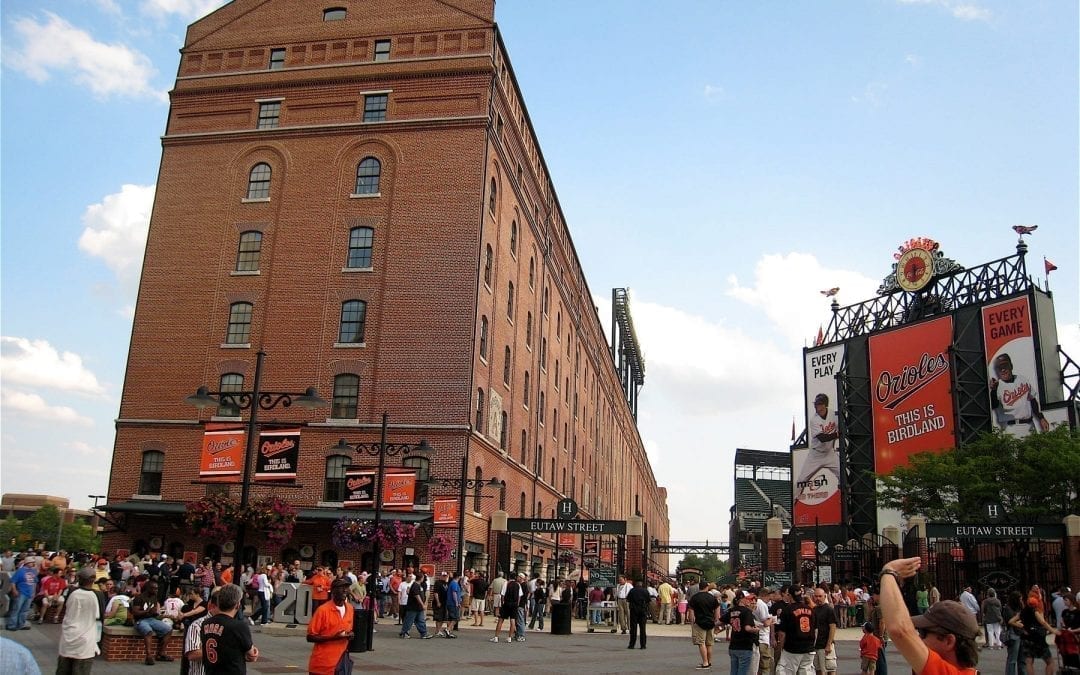
With the hiring of Mike Elias as Executive Vice President and General Manager, optimism abounds at Camden Yards.
OK that might be a slight exaggeration. Still, this is the best possible sign for many Baltimore fans who have watched the Orioles refuse to innovate – or even copy the innovators – as the rest of Major League Baseball passed them by.
This is the sign that Peter Angelos has passed the reins to his sons John and Louis and that they are in turn willing to cede power to bright young people who know how to succeed in the modern age.
As wonderful as the hiring of Elias is, however, there is still a ton of work to be done. Yes, he needs to hire a manager and he needs to fill his roster with better players. But that’s like putting furniture in a house that has been torn down to the studs. This house needs more than furniture, it needs plumbing and wiring, it needs insulation and wallboard, and it needs flooring and paint.
The hiring of a guy like Elias is proof itself that everything is about to change — new culture, a new strategy, a new way of thinking and doing business. It’s a mammoth task, and there are a zillion questions left to be answered.
Here are just a few that come to mind – I guarantee that Elias has already considered all of this.
(You can discuss this on the BSL Board here.)
How do you plan to deal with analytics and integrate it into your scouting and player evaluation?
This is a huge area of need, largely neglected in Baltimore. As my colleague John Perrotto wrote about a month ago, Elias has a deep history with analytics. (It should be noted that he’s not just a stats guy, but also a scouting guy. The Astros, like all good organizations, know that you need both. The stats vs. scouts debate was always a false choice).
There has been a lot of buzz that Elias is going to bring Sig Mejdal with him from Houston (though technically Mejdal left Houston before Elias did). It’s unclear what Mejdal’s title would be – assistant general manager? – but his main task would most likely be to build an analytics department. Like a lot of upper level MLB executives these days, Mejdal has a hefty academic resume. He has worked for Lockheed Martin’s satellite division and also for NASA. He’s smart and worked in analytics for both the Cardinals and Astros. You’d be hard-pressed to find a better person to build out an analytics system for the Orioles.
Mejdal would be a great addition, but even if the Orioles don’t land him, it seems likely that Elias will find someone of a similar bent to take on the task.
What is your plan to bolster international scouting?
This is another area in which the Orioles have been behind. In fact, they’ve been frustratingly ambivalent to the whole thing. They used to have an international scouting director, Fred Ferreira, but he wasn’t retained for the 2018 season and they didn’t even bother to replace him. This has to change ASAP. But even if the Orioles decide to spend more money on signing international prospects, that money won’t do much good if you don’t invest in boots on the ground.
The situation reminds a little bit to what former Dodgers general manager Ned Colletti faced in Los Angeles under owner Frank McCourt. As he was cutting expenses in order to deal with his divorce, McCourt slashed the international scouting team down to four scouts, and had Logan White in charge of it all — both domestic and international scouting. When new ownership came in, President Stan Kasten asked Colletti what he needed.
Colletti mentioned two things: They needed to improve the big league roster and get back involved in Latin America. “I said we could not wait another year, or even another month or two,” Colletti wrote in 2015. “We had to do it now, and they agreed.”
The Dodgers tripled their international scouting department, which led to the signing of Yasiel Puig, Julio Urias, Kenta Maeda and others. They’ve also used some of that talent in trades, including Yusniel Diaz and Breyvic Valera, who were sent to Baltimore in the Manny Machado deal.
Elias should feel the same urgency that Colletti did in this regard. You can’t wait for tomorrow. The Orioles need to add an international scouting director and boost staff. Every day you don’t, you remain behind everybody else in tapping into a well of talent that is deep and relatively cheap.
What will the front office power structure look like?
The one thing that’s a bit odd about the Elias hire is that he’s been hired as VP and GM and given the keys to run everything. There is no president of baseball operations and apparently are no plans to hire one. So it looks like Elias will report directly to ownership and is on a path to being team president at some point. That means he effectively is both VP/GM and president, just without the latter title. It’s weird.
So how much autonomy will Elias have? How many layers of leadership will report directly to him? Will there be multiple assistant GM/director types – stats, domestic scouting, international scouting, player development? And what in the world do you do with Brady Anderson, who is basically assistant GM?
It will be interesting to see how this is all sorted out. But if you believe that Elias will bring a follow-the innovators approach, then you can expect several more hires and a possible diminishment of Anderson’s role. The Cubs, Red Sox, Astros, Dodgers (and probably now the Giants) have made it a priority to collect as much brain power as possible and foster a collaborative environment in which new ideas and outside-the-box thinking are encouraged and debated. This seems like the direction the Orioles are heading.
What style of manager will you be looking to hire?
Pointing to the preceding question and sticking to some of the assumptions I’ve mentioned, Elias will probably target a new-wave style candidate. That doesn’t mean the manager will have to be as smart as A.J. Hinch, as TV-friendly as Dave Roberts or as great at consensus-building as Craig Counsell, but he’ll have to be an open-minded sort.
For this reason, I don’t think you’re going to see Elias bring in a veteran like Joe Girardi or Mike Scioscia, despite their resumes. I’ve seen names like Mark DeRosa, Mike Bordick and Joe Espada mentioned, and they seem to make sense. Whoever is hired will have to understand this is going to be quite a process before there is any success. Is a candidate up for that, even understanding there is a real possibility he won’t be around when the expected turnaround occurs?
How will you use the money you’re going to save as the roster is parred down further over the next couple of years?
We’ve already noted that the Orioles are probably going to invest heavily in an analytics department and hopefully in international scouting as well. But how else will they use the money that should be freed up as expensive veterans are traded or see their contracts expire?
Will they bulk up on player development with more coaches and trainers, as well as better facilities? Invest in staff and programs to help foreign players better adjust to the U.S.? Create in-house dietary/health programs? Upgrade facilities to attract future free agents?
The Orioles are going to see a huge drop in gate money over the next couple of years, so they’ll have to account for that, but if there was ever a time to spend money to prepare for the future, this is it.
— — —
The Orioles have a gigantic task ahead of them. They need to build a new front office, form a new culture both in business and in the clubhouse, and they need to get the right people in place across the organization. Then, ultimately, they need to build a new minor league system and a new Major League roster.
There is going to be a lot of losing over the next few years, but that’s OK. This transformation needs to come with a long-term view and requires patience. Hoping for a third-place finish in the AL East every year just isn’t going to cut it. The Orioles needed to take drastic steps and find a new way. They’ve done that with Mike Elias.

Orioles Analyst
Bob Harkins is a veteran journalist who has worked as a writer, editor and producer for numerous outlets, including 13 years at NBCSports.com. He is also the creator of the Razed Sports documentary podcast and the founder of Story Hangar, a network of documentary podcasters.