

Someone in the Warehouse must have their office decorated with horseshoes, rabbits’ feet, and four-leaf clovers. Or maybe the front office knows something the projection systems don’t. Or maybe these Orioles players are better than anyone thought. It’s hard to tell how this team got here (again), other than by doing the little things right and playing solid, if unspectacular, baseball.
(You can discuss this on the BSL Board here.)
The offseason losses of Nick Markakis, Nelson Cruz, and Andrew Miller stung for a little while. They all left early enough in the winter for fans to feel like there was an opportunity to replace the production that each brought to the table. This was particularly true for Cruz and Miller: the former’s 40 home runs led all of baseball, while the latter was as close to a sure thing in the late innings as anyone has seen. Dan Duquette must have done his homework before deciding to let them walk without a fight. Cruz’s 26 home runs for Seattle would have been just fourth on the Orioles roster, and Miller – who still had a great season in 2015! – had trouble staying at the top of the bullpen mountain and saw his WHIP fall all the way to 0.75. And Markakis, well, we won’t even go there. The Braves are sure to regret that four-year deal to a formerly-always-healthy outfielder already.
No, instead, the Orioles played the “guys returning from injuries are just like free agent pickups!” card. That phrase gets repeated every year by a team in every sport, though few apparently believe it as completely as the Orioles. Three of the Orioles’ four most important players in 2015 missed significant time in 2014, and each one bounced back spectacularly.
Following offseason Tommy John surgery, Matt Wieters started the season with some hiccups throughout April and May, slowly easing back into action, but picking up the bat nearly where he put it down in 2014. He may not have matched his .308 batting average pace (but, realistically, would he have done so for 150 games last year?), but Wieters put up a .250/.310/.425 line in 135 games that marks his best season since 2011.
Machado’s injury and subsequent surgery was no less devastating for an Orioles team that relies so heavily on its defense. After a second consecutive season that ended with a knee injury, Machado rebounded better than anyone could have hoped. He still hasn’t taken walks the way he did in the minors, but an extra year of a Major League training regimen has turned all of the doubles Manny hit in 2013 into home runs. Having Machado jump to 21 home runs in 2015 was a big help toward the Orioles’ covering up the departure of Cruz and again leading the league by mashing 215 homers. The defense never left, either. Any concerns about Machado’s range or speed evaporated after he made what’s rapidly becoming a classic play in the Manny era at the hot corner.
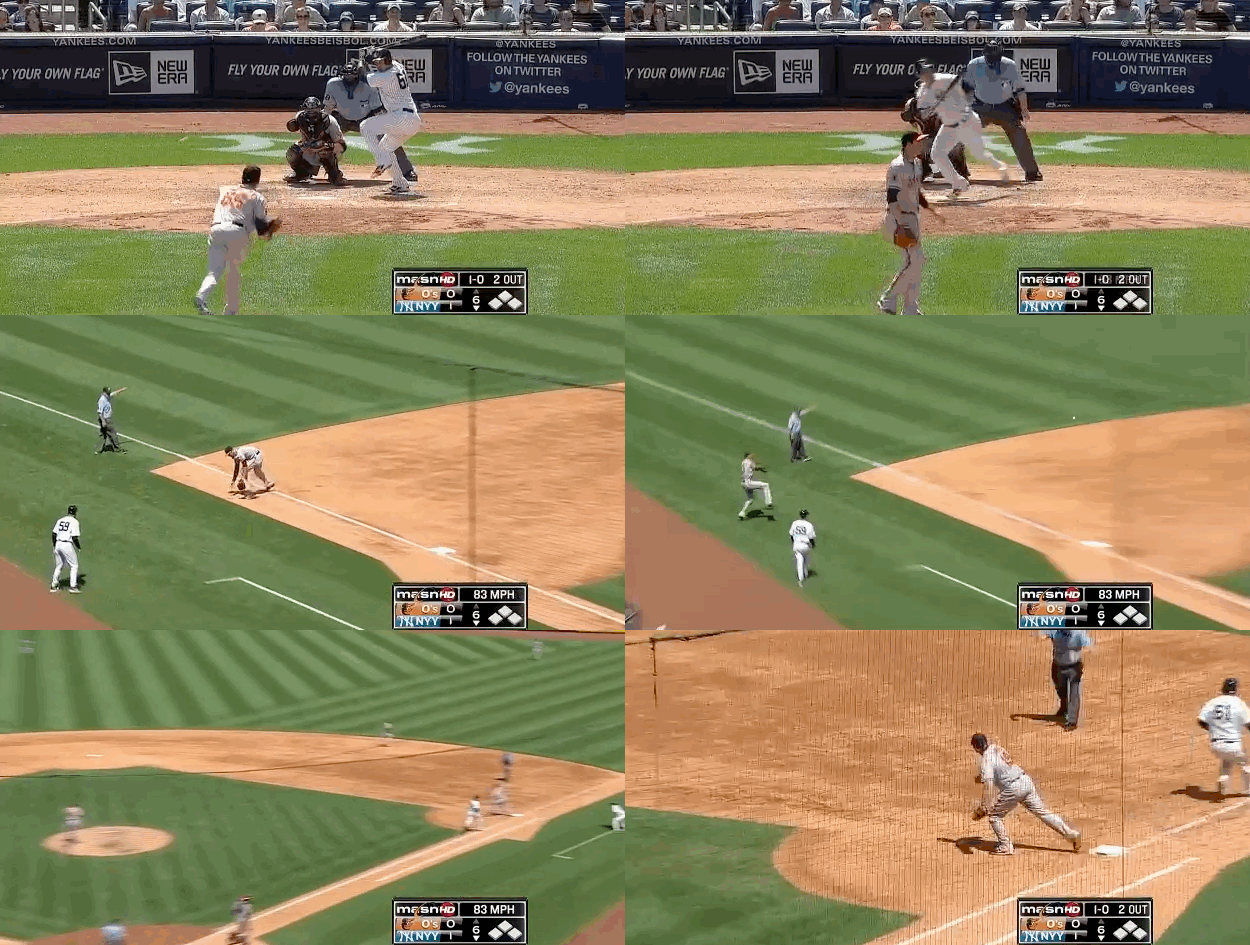
You know the one I’m talking about.
Add in a Davis bounceback that saw his batting average floating above respectable and his 35 home runs pacing the Orioles and you start to see a recipe for how things went so right in 2015.
Of course, not everything was peaches. It never is. Hardy suffered nagging minor ailments and a continued case of the pop-ups that saw him spend a few weeks on the DL and yet another dip in his home run total. When the Orioles signed Hardy, he was a real threat to win a Gold Glove and a Silver Slugger every season. In today’s Major Leagues, he’s only a threat to win a Gold Glove every year and just a decent offensive option at a position otherwise known for a dearth of capable bat wielders. But hey, if that’s the biggest problem the Orioles have all season, everyone in Baltimore will take it.
Speaking of great problems to have, the Orioles’ better-than-average rotation had something of a logjam through May. Ubaldo Jimenez may not have been the Jimenez of 2009-2010, but he pitched well enough to earn a rotation spot. This, of course, left the Orioles with the tough decision regarding how to deal with Kevin Gausman and his suddenly diverse array of pitches. The nasty slider that Gausman has only thrown 9% of the time coming into 2014 suddenly became a favorite second pitch. It seemed like Gausman suddenly learned to throw it with consistent control in May, and made even more batters miss for the ever-important strikeouts. Diversifying his repertoire a bit helped the young flamethrower go from promising prospect to truly terrifying presence on the mound. While Bud Norris and Miguel Gonzalez were each touch and go at times, no one pitcher was clearly a better fit for the bullpen.
So they made a trade. Jimenez looked correct enough for another team to bite, and the Orioles flipped him for bullpen help ahead of the All Star break. It’s a weird position for any team to be in – typically the teams in playoff contention are looking to add to their rotation, not take away from it, but such is life in the suddenly abundant adequacy of the Orioles’ rotation. I’m not going to sit here and tell you that the Orioles’ rotation was one of the best in baseball in 2015. It wasn’t. But it was good enough, or well-rounded enough or deep enough or avoided enough mistakes, to get the Orioles to a second consecutive AL East title.
It wasn’t a runaway title this time; fighting off the Red Sox, the AL East’s odd year answer to the San Francisco Giants’ even year voodoo, was a challenge, but Boston’s sub-standard rotation couldn’t quite match up with the Orioles’ group of overachievers. Boston’s offseason additions were hailed as transformative hitters, and rightly so. Hanley Ramirez and Pablo Sandoval each had good seasons at the plate in the hitter-friendly confines of Fenway Park, but Sandoval was too inconsistent and Ramirez faced a steep learning curve in left field. The pennant came down to two great offenses against two lackluster rotations (though Baltimore’s was clearly better than Boston’s), and the Orioles’ strong defense made the difference.
Playoff games and series might as well be a series of coin flips, so I won’t spoil the excitement by telling you what happens in the fall. I will say that the Orioles have as good a chance as anybody, and no matter what the talking heads say about needing a staff ace, Baltimore is ready to compete. I’ll also say that Buck Showalter had a productive, successful career that lacked a few pieces of validation – until now.
The best part? The Orioles go into another offseason on a high note, and have cash and positions to play with. With only Jones and Hardy locked into long-term, big-money deals (and one coming for Machado), Dan Duquette and Buck Showalter have announced that they finally have the flexibility to construct their roster in their image and to their liking. Between its winning ways, its likeable manager (surprising to some, given the nature of his departure from previous trams), and its faithful fans, Baltimore is rapidly becoming a premier destination for free agents. Suddenly, the Orioles are the new darling of the baseball world. Like the Rays of 7 years ago, Baltimore has grown into a model for how to build a modern baseball team. We saw it starting in 2014 with the Royals and Yankees trotting out back-heavy bullpens that shortened games and made the team nearly impossible to come back against, and more teams are now opting for the extreme short-term lock-down pitching option. That is, when they don’t have two-time NL MVP Clayton Kershaw.

Patrick was the co-founder of Observational Studies, a blog which focused on the analysis and economics of professional sports. The native of Carroll County graduated with a Bachelor’s degree in Economics from Loyola University Maryland. Patrick works at a regional economic development and marketing firm in Baltimore, and in his free time plays lacrosse.