
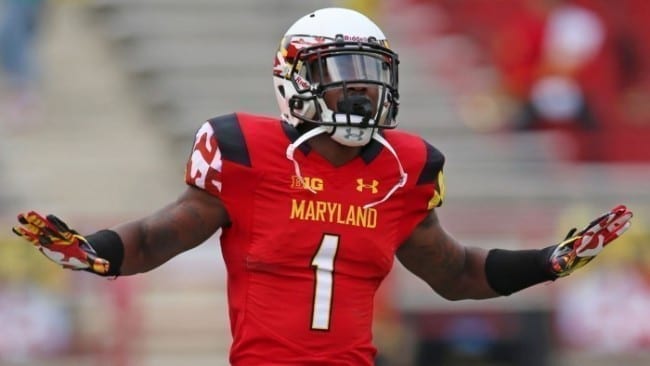
This is the second article in our “Where Recruits Come From” series. Last week, we took a look at which coaches on Randy Edsall’s staff do the majority of the recruiting, and which regions they are assigned to both locally and across the country. This week, we will take a position-by-position look at what type of recruits Maryland is looking for, and their top targets for the 2016 class.
(Discuss this article on the BSL Message Board here.)
Quarterback
Projected 2015 Starter: Caleb Rowe
Top 2016 Target: Dwayne Haskins (Potomac, MD)
The quarterback position is obviously important in any offense. Mike Locksley’s offense emphasizes decision-making ability. The offensive scheme is built on an option running game with play-action passes and screens off of those runs. The quarterback must be able to make the right decisions quickly and get the ball to his playmakers either at running back or at wide receiver.
The ideal quarterback in Locksley’s system is a player who can make all of the necessary throws while also possessing some running ability. He doesn’t have to be a burner with his legs, but he has to be enough of a threat with the ball in his hands to force the defense to account for him. C.J. Brown didn’t quite have the arm talent to be able to run Locksley’s offense the way that he wanted to, and Caleb Rowe doesn’t quite have the running ability. Locksley will certainly alter his offense to fit the skill-set of his quarterback, but his ideal quarterback likely looks something like Haskins.
Haskins has good size at 6-foot-3, and is listed by most recruiting services as a pro-style quarterback. But don’t let that classification fool you. He is a more than capable runner, evidenced by the fact that he is being recruited heavily by option-heavy teams such as Ohio State and Notre Dame. But while his legs are a great asset, his specialty is throwing the football. His arm talent would make him one of the best quarterback recruits to step foot in College Park in recent memory. He can make all of the throws necessary to succeed in Locksley’s offensive system. Maryland will be competing with Ohio State, LSU, and Notre Dame for Haskins’ commitment, but the Terrapins are considered the leader for him right now.
While the DMV area tends to feature great high school athletes, quarterbacks from this area are usually tougher to find. Haskins is obviously the top DMV quarterback in the 2016 class, but Maryland tends to look elsewhere for quarterbacks. C.J. Brown and Perry Hills both hail from the state of Pennsylvania, while Caleb Rowe came to College Park from South Carolina. Shane Cockerille is the only local quarterback on Maryland’s roster now that Will Ulmer has moved to wide receiver. Quarterback is a very difficult position to recruit, and I’d expect Maryland to look in a variety of different regions.
Running Back
Projected 2015 Starter: Brandon Ross
Top 2016 Target: Lorenzo Harrison (Hyattsville, MD)
While wide receivers get the majority of the attention in Locksley’s offense (mainly due to the recent influx of talent at the position), the running back position is just as important for Maryland’s scheme. In a perfect world, Locksley would like to run the ball approximately 55% of the time, setting up big play-action pass opportunities for his quarterback and wide receivers.
Locksley’s scheme features a very diverse running game. Like most modern college playbooks, his features inside and outside zone runs, but they are complimented by counter and power runs. He also runs a wide variety of option plays, including options off of the inside zone, outside zone, and power runs. He also likes to call speed option runs out of pistol and shotgun formations. Needless to say, this scheme needs a running back who can execute all of those runs, as well as play a role in the passing game.
While he is not given the most attention on Maryland’s roster, Brandon Ross fits Locksley’s offense very well. The Terrapins’ coaching staff prefers a smaller running back who is just as good between the tackles as he is outside of them. Ross is more of an inside runner, but has more than enough speed to get outside when he needs to. He is also a solid blocker in pass protection, and has had a lot of success catching the ball out of the backfield on slip screens. Maryland has already received a commitment from their top running back target in 2016, Lorenzo Harrison. The DeMatha recruit fits the ideal running back mold for Locksley, as most recruiting analysts rank him as an all-purpose back. He is 5-foot-8 with good speed, but is also strong enough to take the ball between the tackles.
The DMV area is a great region to recruit for running backs. Most of Maryland’s running backs hail from the local region, including Brandon Ross, Albert Reid, Wes Brown, and Jacquille Veii. Randy Edsall’s staff has also attempted to break into Florida to recruit running backs, but they have yet to garner a commitment from any from the Sunshine State.
Fullback
Projected 2015 Starter: Kenneth Goins, Jr.
Top 2016 Target: N/A
While the fullback position is dying across college football with the popularity of the spread offense, Locksley has found a way to keep his fullbacks involved and to use them to his advantage. In Maryland’s multiple spread-to-run system, fullbacks are usually lined up alongside the quarterback in offset pistol formations, providing an extra blocker for the running back. The fullback is also used in the running game as the dive-man on triple-option plays. For this reason, the ideal fullback for Mike Locksley’s offensive system is a smaller player who was usually a bigger running back in high school.
Kenneth Goins, Jr. took over the starting fullback spot in 2013 after Tyler Cierski was injured before the season began. He immediately impressed the coaching staff with his punishing blocking ability, while also featuring a strong running ability from his days as a running back at The Gilman School. He is on the smaller side, weighing in around 230 pounds, but has enough strength and quickness to lead the way for Maryland’s running backs. Goins will be in College Park for another few years, so targeting his replacement is not at the top of Randy Edsall’s recruiting list. However, look for Maryland’s next fullback to be a member of the 2017 class.
While Tyler Cierski was recruited by Ralph Friedgen and his staff from the state of Georgia, all of Randy Edsall’s fullbacks have come from the DMV area. Kenneth Goins, Jr. and Andrew Stefanelli both hail from Maryland. If the Terrapins do go out of state to recruit fullbacks, expect them to head into Pennsylvania and Ohio.
Split End Receiver
Projected 2015 Starter: Amba Etta-Tawo OR Juwann Winfree
Top 2016 Target: Tino Ellis (Hyattsville, MD)
The split-end receiver will feature a new starter for the first time since Deon Long arrived in College Park, and Mike Locksley has some very talented players to fill that hole. The split-end receiver is the one most likely to be in one-on-one matchups, and this offense likes to get the ball to him in a variety of different ways. Locksley will throw the ball to him on middle screens, as well as on intermediate and deep throws. He is the most likely receiver to take the top off of the defense with vertical routes, as he is typically the fastest receiver on the roster.
Deon Long was a great fit for this position. He had the size necessary to take on defensive backs in one-on-one matchups, and also had the speed to take the top off of the defense. Amba Etta-Tawo and Juwann Winfree both have the same skill-set that Long had. Speed is the name of the game for Etta-Tawo. While he is only 6 feet tall, his speed makes him a big weapon at the split-end position. Winfree has a great frame, and is a matchup nightmare for opposing defenses. Tino Ellis is Maryland’s top recruit at the position, and would be a huge get for Edsall and his staff. He has good size at 6-foot-1, and has excellent speed.
Recruiting for wide receivers is also fairly easy in the DMV area. Most of Maryland’s pass-catchers have come from the region, including Stefon Diggs, Levern Jacobs, and Taivon Jacobs. The team also tends to recruit receivers in New Jersey and Florida, home to some very good athletes.
Slot Receiver
Projected 2015 Starter: Levern Jacobs
Top 2016 Target: Trevon Diggs (Bethesda, MD)
The slot receiver position will also feature a new starter, the first one since Stefon Diggs arrived on campus in 2012. Locksley likes to get the ball to his slot receiver in a ton of different ways, as was seen by the number of times Stefon Diggs touched the ball in his three seasons with the Terrapins. Locksley will throw the majority of his screen passes to his slot receiver on bubble screens, and will also use his slot man as the pitch option on triple-option plays. If his slot receiver has good speed and size (as Diggs did), he will also use him as a vertical threat.
The ideal slot receiver in Locksley’s system is likely a bit smaller than Diggs, but with the same skill-set. He needs a receiver who isn’t necessarily speedy, but very agile and shifty. Levern Jacobs fits this mold very well, as his skill-set resembles that of Stefon Diggs. Edsall and his staff are recruiting Stefon’s brother Trevon very hard for their 2016 class. Trevon resembles Stefon in nearly every way. He’d be a massive addition to Locksley’s offense, and would likely be used in a very similar way to his brother.
Flanker Receiver
Projected 2015 Starter: Marcus Leak
Top 2016 Target: Eric Kumah (Woodbridge, VA)
The flanker position has seen many players cycle through it in Edsall’s time in College Park, mainly because it can accommodate a wide variety of different players. Nigel King saw a lot of time as the team’s flanker before transferring to Kansas, and was more of a possession-type receiver, standing 6-foot-3 and posing a major threat in the red zone. Before he was injured last season, Taivon Jacobs was set to start at flanker. He is very much the opposite of King, standing just 5-foot-9 but possessing great speed.
Locksley doesn’t use his flanker receiver nearly as much as his split end or slot receivers, but will alter the routes that his flanker runs depending on what player is running them. A player like Nigel King tended to run more intermediate and deep routes, taking advantage of his size. Marcus Leak would run very similar routes to King due to his similar size. Taivon Jacobs would see more time running shorter routes in an attempt to get the ball into his hands quickly in order for him to use his playmaking ability in space. Eric Kumah fits the larger flanker mold that Locksley tends to prefer, as he stands 6-foot-3 and weighs in at 205 pounds.
Tight End
Projected 2015 Starter: Andrew Isaacs
Top 2016 Target: Naseir Upshur (Philadelphia, PA)
While Locksley rarely uses any two tight ends in the game at any given time, the one that he does use is moved all over the field. A tight end in Maryland’s offense will play on the line, in the wing, in the backfield, and split wide in the slot. Most of his assignments are of the blocking variety, but a balanced player is needed, as he will also be relied upon as a safety net for the quarterback on shorter routes in the flat.
Andrew Isaacs was having a very good year for the Terrapins before suffering a gruesome injury against Syracuse early in the year. He is a better fit for this position than Dave Stinebaugh was, as Isaacs possesses a better receiving ability. He is a more than capable blocker as well, as his 6-foot-2, 240 pound frame can really do some damage against opposing linebackers. Maryland’s top tight end target in the 2016 class is 4-star Naseir Upshur from Philadelphia. He has good size at 6-foot-3, 233 pounds, and would be a major addition to Locksley’s offense.
While the DMV area is great for recruiting running backs and wide receivers, it’s not so great for recruiting tight ends. In fact, only one of Maryland’s tight ends hails from the DMV area, and he himself is a converted linebacker (Derrick Hayward). Pennsylvania is a good state to recruit tight ends, as is Ohio, so I’d expect Randy Edsall’s staff to continue tapping those areas for the position.
Offensive Tackle
Projected 2015 Starters: Michael Dunn and Damian Prince
Top 2016 Target: Jauan Williams (Washington, DC)
Maryland’s offensive line has undergone a bit of a transformation over the past year or so. They have done away with the “lean and mean” strategy that they adopted as members of the Atlantic Coast Conference and, under the leadership of offensive line coach Greg Studrawa, have attempted to add weight and muscle to all of their offensive linemen. Mike Locksley features a number of different blocking schemes, but usually has his linemen execute either zone or power blocking. The Terrapins will run a number of different plays off of these blocking schemes, including most of their option runs. Offensive linemen in this system must be very balanced and able to do a lot of different things.
Locksley and Edsall prefer very big offensive tackles. They have already received commitments from two 6-foot-7 offensive tackles in the Class of 2016, and are heavily targeting another in Jauan Williams. Damian Prince is very small for an offensive tackle at 6-foot-3, but has the skills necessary to play the position. The DMV area has been producing talented offensive linemen at an extremely abnormal rate over the past few years. Luckily for Edsall and his staff, they have been able to tap those resources very well. Damian Prince, Derwin Gray, and Mike Madaras are just a few of the very talented offensive tackles that Mike Locksley and Maryland’s staff have been able to recruit to College Park. However, expect the staff to move into the areas around Pennsylvania and Ohio to recruit many of their linemen once this influx of talent from the DMV area dies down.
Offensive Guard/Center
Projected 2015 Starters: Evan Mulrooney, Andrew Zeller (Guards); Brendan Moore (Center)
Top 2016 Target: Richard Merritt (Washington, DC)
The interior of Maryland’s offensive line is also undergoing a similar transformation to the one mentioned above. The coaching staff is adopting a very different strategy for its linemen this season in order to be able to compete better with the big defensive lines of the Big Ten Conference. While Locksley uses zone blocking most of the time, he will also mix in power and counter plays, which feature a pulling guard. As a rule, interior offensive linemen are quicker, smaller, and more agile than their exterior counterparts. They must be able to control interior pass rushers in the passing game while also leading the way for running backs in the running game. They don’t have to be very quick horizontally, but must have enough power to get a push when the offense runs the ball.
Evan Mulrooney and Andrew Zeller are who I project to be Maryland’s starting offensive guards this season, especially now that Derwin Gray has suffered a torn labrum, forcing Damian Prince and Michael Dunn to the two offensive tackle spots. Brendan Moore has really impressed the coaching staff during his short time in College Park, and I expect him to snag the starting center spot. Richard Merritt is the Terrapins’ top offensive guard target for the class of 2016. He is a massive young man, and is already listed at 6-foot-5, 345 pounds. He is widely expected to commit to Alabama, but Maryland is going after him hard. He is the teammate of top offensive tackle target Jauan Williams at Archbishop Carroll High School, part of this crazy influx of talent at the offensive line positions from the DMV area.

Terps Analyst
Zack is a financial analyst for a defense contractor in Washington, DC. The Owings Mills native focuses most of his efforts on Maryland Football recruiting and individual coach and player pieces; but also covers Terps Basketball. He has established relationships with Big Ten beat reporters across the conference, which he utilizes in his game previews. Now a Sr. Terps Analyst for BSL, Zack can be reached at: zack.kiesel@baltimoresportsandlife.com.