
Do the Orioles need pitching?
Well, in the macro sense, the answer to this question is always “yes.” Quality pitching is the most valuable commodity in baseball, thanks to its rarity and fragility. Even teams like the New York Mets and Washington Nationals could stand for more of it, though they’re not going to go out of their way to acquire it at the moment. But the commonly understood context of that sentence, which is, “would acquiring more pitching make the team better this year without mortgaging Baltimore’s future?” is a bit trickier to unpack. The answer, however, is still “yes.”
(You can discuss this on the BSL Board here.)
A quick glance at the Baltimore staff purports to show a top-heavy rotation with two great-but-not-elite performers — Ubaldo Jimenez and Wei-Yin Chen — a woeful backend comprised of Chris Tillman and Bud Norris (now Kevin Gausman, allegedly, though they demoted him to Norfolk today again), and a generally strong bullpen with Tommy Hunter being the only stand-out negative contributor. This isn’t misleading, precisely; Jimenez has been every bit the pitcher the Orioles hoped they were signing before last season, and Chen’s outings certainly go well on the scoreboard. Norris and Tillman, too, have been about as bad as their ERAs indicate; we can quibble about them underperforming their FIP, but when both pitchers’ FIPs are over 4.50 to begin with, what we’re looking at is just a failure to perform in general.
Of course, neither Jimenez and Chen are guys whose names you want to be writing in at the top of the rotation in ink. Chen’s a flyball pitcher vastly outperforming his own secondary metrics — and while guys like Matt Cain have proved you can, in fact, outperform your FIP for awhile as a flyball pitcher with decent-to-good outfield defense behind you, Matt Cain also saw all of that fall apart over the past three seasons. Chen’s also not likely an Oriole past this season, especially not after that insane stunt Baltimore pulled when they demoted him to Single A in order to get Chris “.279 OBP” Parmelee on the roster.
And Jimenez is always one slight tweak or mechanical hiccup away from a BB/9 over 4 and a long string of disaster outings. A lot of times you hear people talk about a team or a player and they say that they’re never as bad as they look when they’re losing, and they’re never as good as they look when they’re winning. Here is Jimenez’s problem: he is actually as bad as he looks when he’s pitching poorly, and actually as good as he looks when he’s pitching well, because he is an ace talent plagued by inconsistency. A Jimenez/Chen/Gonzalez top three is not going to impress many opponents in the playoffs, should the Orioles make them, and with Chen leaving this offseason the team’s best in-house option to immediately replace him is probably T.J. McFarland, which is a sobering thought given the hype this organization had around Kevin Gausman and Dylan Bundy just two years ago.
We know by now generally what the plan is for the Duquette Orioles at the deadline: to eschew the superstar deals and work in the margins, dumping B and C-list prospects and roleplayers — preferably MacPhail-era guys with a little bit of shine still on them — for cheap, unflashy contributors. Sometimes, like with Jake Arrieta and probably Eduardo Rodriguez, this comes back to bite the Orioles by demonstrating a fundamental truth of the organization: it cannot develop its own pitching. Most of the time, though, guys like L.J. Hoes and Nick Delmonico aren’t missed. The conventional wisdom would be to target more of the same, here: to shore up the rotation at the deadline by trading for a steady arm to plug in the back of the rotation so that Norris can stay in the pen full time, maybe Tillman can join him, and Tommy Hunter can be quietly dispatched on a mission to the heart of the sun.
Up until last few weeks, I was a proponent of a far more radical move: trading a package centering around Dylan Bundy for Cole Hamels. This became even more attractive when it became public that the guy who drafted Bundy, Andy MacPhail, was going to be taking over in Philadelphia — he’d clearly be one of the guys still highest on Bundy’s potential. But now Bundy’s hurt, again. There’s no rule against trading an injured player, but his stock has more or less cratered. Kevin Gausman has pitched himself out of being a centerpiece candidate for that kind of trade (though I wholly expect him to go full Jake Arrieta if he is eventually traded), and Hunter Harvey’s had injury issues of his own.
That puts Baltimore in an unenviable position: they can still make a deal, but now it will be a marginal move just as much due to the reality of their assets as the front office’s ideology. With the way the trade market looks, however, there isn’t much available — the Ian Kennedys and John Danks of the world are hardly upgrades in even a conservative sense, and the Oakland Athletics, who otherwise might be trying to sell, are more likely to bet on a hot second half given that they’re underperforming their win-loss expectancy by 10 games (actual record, 39-47; expected record: 49-37). I thought there were two ways this trade deadline could go, thanks to the fact only a few teams are truly out of it: much, much busier than usual, or dead quiet. So far it’s been pretty quiet.
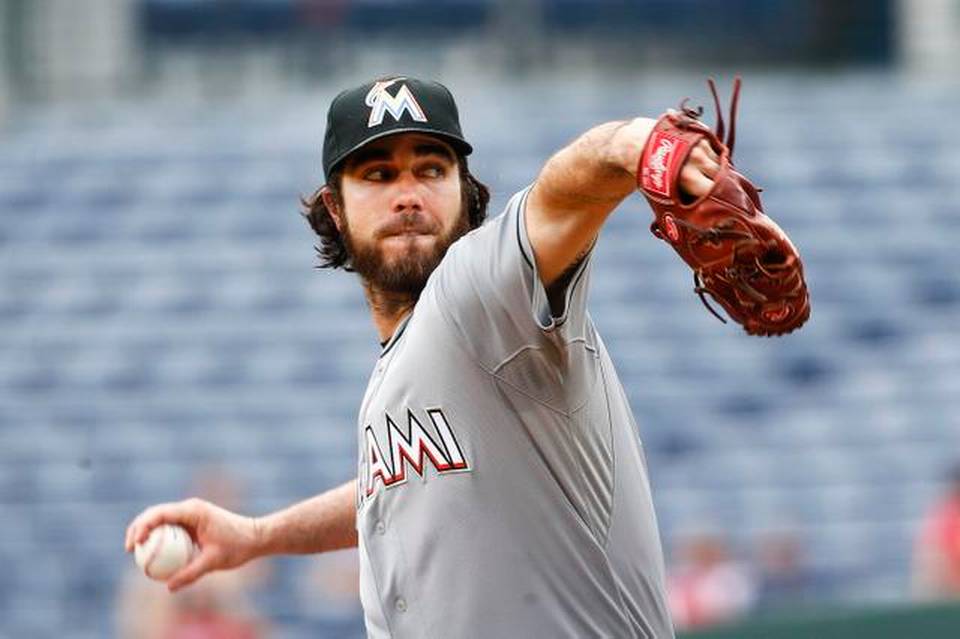
So where is the pitching going to come from, then? Miami’s Dan Haren would likely be the best acquisition from the Baltimore FO’s standpoint, seeing as he is more or less free: the Dodgers have already paid the Marlins his entire salary for this season. Haren would also have the lowest walk rate in the Orioles’ rotation, and hopefully the veteran prerogative to resist any changes the Orioles might try to make to a younger pitcher that could put him off his game.
Another name for the Orioles to look at would be Seattle’s J.A. Happ, though it’s a crapshoot as to whether the Mariners are going to properly sell — the team claims it’s not looking to make major changes, but Happ will be a free agent at the end of the year and it might be prudent for them to get something for him while they can. Happ is a strict downgrade from Haren in every sense except in that he throws left-handed, but he is within that particular tier of pitchers that the Orioles target at this time of the year.
In the end, the team won’t make a splash — the Orioles rarely do. It’s contrary to their nature. But Dan Duquette does address the needs of his team to the best of his ability at the deadline — and despite how quiet the bats have been over the last week or two, the Orioles still need pitching.

Jonathan is a contributing writer for VICE Sports. His work has previously appeared in Sports on Earth, Baseball Prospectus, The Classical, and ESPN’s SweetSpot Network. Born in central Maryland, Bernhardt currently lives in the New York metropolitan area.