
It’s as close to certain as can be at this point that within the next few days, the Baltimore Orioles will sign Yovani Gallardo and forfeit the 14th overall pick in the MLB draft. Perhaps not what I would have done, given god- or video-game-like control over the Orioles FO, and while I generally agree with the points Paul Sporer made about the signing yesterday, at the very least it means Vance Worley isn’t a favorite for the Opening Day rotation.
(Discuss this on the BSL boards here.)
But the Gallardo deal is almost certainly part one of a two-step process: acquiring another outfielder. I went over the reasons why the Orioles need another everyday OF last week — and by glancing at the roster you can probably intuit them yourself — but the long and short of the matter is that between 1B, RF, and DH, Baltimore is currently short one MLB-caliber body. There are a number of ways they could address this, but the chatter around the league has winnowed the Orioles’ current targets down to three: Jay Bruce, currently of the Cincinnati Reds, and Dexter Fowler and Pedro Alvarez, currently free agents. In a vacuum, that’s an easy choice — Dexter Fowler beats out the other two in a walk — but choices in baseball are never, ever made in a vacuum.
Let’s start with Alvarez, the least attractive option. He was non-tendered by the Pittsburgh Pirates in December and has had little to no market since hitting free agency. The reason for that’s obvious: Alvarez is a defensive liability with a one-dimensional bat. He hits for power and nothing else. The O’s have had success with this kind of profile in the past, and Alvarez should come cheap. He’s the fallback option if the other balls that Baltimore is juggling happen to hit the ground, and to be honest, signing him isn’t mutually exclusive with acquiring either Fowler or Bruce. All Alvarez costs is money, and probably not much, relatively speaking. He could even platoon with Trumbo at 1B/DH, theoretically, given that Trumbo’s a right-handed hitter and Alvarez is a lefty — but Trumbo’s splits aren’t so egregious to demand a platoon partner, and keeping two guys with no versatility on the active roster to platoon at DH is a waste of a roster spot.
He’s the fallback. If nothing works out with Fowler and Bruce, then the Orioles sign Alvarez and deal with the consequences.
Then there’s Dexter Fowler. Ryan wrote about signing Fowler recently, though it was in the context of giving up the 14th overall pick for his services — in the current formulation, that pick would be surrendered for Gallardo, and signing Fowler would cost the Orioles what is currently the 29th overall pick. Everything Ryan wrote about Fowler two weeks ago remains true: he’d immediately be the best outfielder on the roster not named Adam Jones, and what’s more, his baserunning prowess, switch-hitting ability and general skillset at the plate would slot him in comfortably as Baltimore’s everyday leadoff hitter. The big on-field issue with signing Fowler is that he’s not a rightfielder. He’s played one inning there his entire MLB career and no one is in love with his arm from that position. He can’t play center — again, Jones — so either the O’s would have to accept him learning to play right and live with whatever warts his arm has, or they’d have to ask Hyun-soo Kim to play there instead. We haven’t seen Kim in MLB action yet, but scouting reports aren’t bullish on his arm either, and he almost certainly has worse range. Whatever choice Baltimore makes with a Fowler-Jones-Kim outfield, they’re probably going to have trouble stopping runners from taking third on hits to right.
And then there’s the off-the-field cost of Fowler: the 29th overall pick. Losing the first two picks of the draft would be a major blow both to the talent coming into the system and the bonus pool money available to sign them. It’s entirely true that the Orioles haven’t been using those picks or that money well anyway, but the solution to a weak system can’t be to completely ignore it. That said, this is an argument about not signing any players requiring compensation at all, and in this scenario that decision will have already been made with the Gallardo signing. If Baltimore commits to giving up the 14th, they’re committing to giving up their only pick in the part of the draft where they’ve had anything approaching success recently: the top half of the first round. By signing Gallardo, Baltimore is choosing to prioritize the current core over the future — a future they’ve shown unable to make good on developmentally. So losing the 29th overall pick hurts, but is understandable for a win-now team.
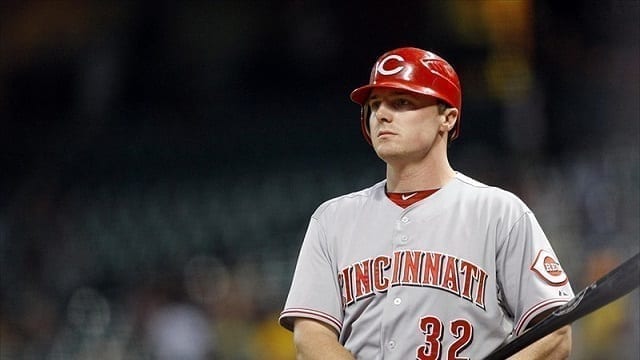
But then there’s Cincinnati’s Jay Bruce. Bruce, of course, is a career rightfielder — over 9000 pro innings there. He doesn’t have Fowler’s range, he certainly doesn’t have his baserunning talents and given his performance at the plate over the last three years, he’s better suited for the back half of the lineup — a 101 OPS+, with most of the production keeping his bat even league average coming in 2013. He’s owed $12.5 million this year and $13 million next year, and the Reds would be looking to get rid of him because after trading Todd Frazier and Aroldis Chapman, they’ve committed to reloading, if not full-on rebuilding.
The 2014-2015 incarnation of Bruce certainly looks like an Orioles hitter: low batting average, low OBP, but 44 homeruns and 56 doubles over the past two seasons. He’s only 29 years old and theoretically, if the Orioles really do have the ability to coach power-heavy guys into contributors at Camden Yards, he’s a far better option than Alvarez or even Trumbo. But it’s hard to bet on the ability of an org to fix players from the outside looking in, and he’s had a very mediocre past two years while still being healthy the entire time.
Jon Heyman reports, however, that the Reds do think the Orioles have the pieces necessary to complete a Jay Bruce trade, which probably speaks more to Cincinnati’s desire to move him than the strength of Baltimore’s farm. With that in mind, the Orioles should probably be open to moving anyone in the high minors not named Hunter Harvey for Bruce, including Dylan Bundy. This has less to do with Bruce’s ability or the inevitability of him bouncing back than it has to do with the mediocrity on display in the current Orioles system, and the wisdom of leveraging it wherever possible for actual major league talent, which Bruce still is. That said, Cincinnati would likely still have to eat money on the deal.
On the whole, Bruce is probably the best choice, followed by Fowler, with Alvarez either a desperation move or non-roster invitee to Spring Training. Bruce would only cost the past and the present: current, fading prospects, none of whom have really made it click in the Baltimore organization, and money. Fowler, despite fitting in the lineup a bit better, would cost the team the future.
Well, even more of the future. After all, the Orioles are still about to spend their first round pick on Yovani Gallardo. It won’t be the last time this happens, either; until Baltimore learns to develop pitching, they’re going to keep making compromises like this one over, and over, and over again.

Jonathan is a contributing writer for VICE Sports. His work has previously appeared in Sports on Earth, Baseball Prospectus, The Classical, and ESPN’s SweetSpot Network. Born in central Maryland, Bernhardt currently lives in the New York metropolitan area.