
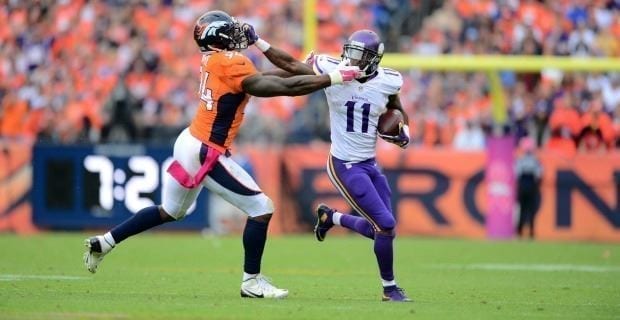
Ravens fans remember the Mike Wallace that was a hated rival in the black and yellow of Pittsburgh. He was solid as a rookie in 2009 and developed quickly to have a stellar sophomore season helping the Steelers reach the Super Bowl. It was his best season to date, receiving for 1,257 yards, averaging 21 yards per catch and finishing with 10 touchdowns. His seven 100-yard receiving games was tops in the NFL that year as well.
A solid, but not as great 2011 followed. Then more regression in a 2012 season that began with holdouts, not coming to training camp until late in August, which resulted in the Steelers deciding to let Wallace walk as he became a free agent.
During the last three seasons that he’s spent with the Miami Dolphins and Minnesota Vikings respectively, Wallace had dropped off Ravens fans radars. That is until mid-March when the ex-Steeler, who admitted “I used to hate purple,” sported a purple Ravens polo shirt to his introductory press conference when Baltimore inked him to a two-year, $11.5M deal.
Without really paying close attention to Mike Wallace over the last couple seasons, I figure Its time to see if things have changed from that streaky speedster. Boy, have they ever changed.
Discuss your thoughts on this topic on our message board.
Wallace will turn 30 prior to the start of the 2016 season. Durability is no question as he’s missed one game in his entire career. This is a trait the Ravens tend to target when you look at some of the acquisitions over the years.
During his time with the Steelers, Wallace averaged 17.2 yards per reception. Typical for a downfield threat with a big arm QB like Ben Roethlisberger throwing to him in Bruce Arians pass happy system with some Air Coryell traits in it. Wallace’s numbers took a decline when Todd Haley came to Pittsburgh with the West Coast offense in 2012. Not to mention Haley’s new system and his players trying to adapt led to some butting heads and heated tempers for a season.
As a matter of fact, Wallace recorded 18.7 yards per reception under Bruce Arians. It dropped to 13.1 under Todd Haley. Somewhat similar to Torrey Smith’s drop off when Gary Kubiak came to Baltimore. But Wallace’s was much more drastic.
Once Wallace took his talents to South Beach, he was greeted by Offensive Coordinator Mike Sherman, another west coaster. The Dolphins had Ryan Tannehill quarterbacking in just his second season. Between the players and coaches feuding there, the Ritchie Incognito and Johnathan Martin saga, 2013 was a circus for the Dolphins and it’s shocking they found a way to even get to 8-8.
Wallace was used differently. Not a 9-route runner, but as a short to intermediate pass catcher in these west coast systems he’s now been in for a couple years. He caught a career high 73 balls in 2013, but for just 930 yards, a 12.7 average per catch.
For those of you keeping score, that’s 18.7 YPR in three seasons of Coryell like systems. 12.9 YPR to this point in two west coast like seasons.
Mike Sherman was fired prior to 2014 and the Dolphins made Bill Lazor the new OC. What did this mean for Wallace? Lazor was the Quarterbacks Coach for the Eagles under Chip Kelly. He brought the less common Kelly style of offense only seen in college to Miami with him. Kelly’s offense is based on power running game with strength in numbers. Bringing more blockers closer to the running back and the quarterback which should take the pressure off of those two skill positions. It brings more defenders in tight as well, which can leave defenses susceptible to the big play if they cheat too much. Kelly and the Eagles led the NFL in “big plays” in his first season in the league.
Kelly’s offense can be called “spread”, but don’t confuse that with “empty”, the term used in Bruce Arians offense where they usually go five-wide, or nobody in the back field. In Kelly and Lazor’s “spread”, it can mean having two wideouts very wide to the line and three people lined up in the backfield. Strength in numbers in the middle, in the trenches, if the defenders have to respect the wideouts enough.
In the 2014 season opener, the Dolphins hung 33 points in victory over a vaunted Patriots defense. They did it by running for 191 yards and throwing for just 169 on the day. It wasn’t even a great day for the Miami offense as they turned it over three times and dropped two other passes in the endzone. One of them was Wallace, who ended up with seven catches for 81 yards and a score on the day regardless.
Eventually defenses catch on to new trends and figure out how to beat them. It didn’t take long as Kelly has now coached his way out of Philly. Lazor and the Dolphins would not rush for a higher total all season, including a mid-season stretch where the rushing game failed to break 100-yards as a team in five out of six games. Teams had them pegged. When the running game sets up the big play, and the running game fails, you know the end result.
Some similar concepts are used in the spread and the west coast as both use runs, or short passes to set up the home run ball. Wallace saw his numbers remain fairly constant in 2014 as he caught 67 balls for 862 yards. 12.9 YPR, although he managed to find the endzone 10 times. The most since his days with Arians.
Enter 2015. Mike Wallace has now been traded to the Minnesota Vikings. Their offense is run by Norv Turner. An Air Coryell staple in the NFL. An offense he’s ran since his days with the Cowboys dynasty of the 90s, through to today. Coupled with Teddy Bridgewater, an accurate young passer, and Adrian Peterson, the model for All-Pro running backs, we would expect Mike Wallace to get back to his old self, right? 15+ yards per catch, 1,200+ yards, double digits in the big play department, right?
Not so fast. Turner treats the Air Coryell style as gospel, but isn’t afraid to adapt either. Air Coryell uses passing attacks deep down field to open up the running game and intermediate passing to tight ends. But if you are Adrian Peterson, do you need that help to open up the running game? Or are you a beast with the ball in your hands, the best offensive player on the team, and in turn the focus of the offense? The later being the case. Turner’s Coryell offense last year ran the football more times than they passed it (474 to 454) which is not often heard of in today’s NFL, no matter the scheme. They also scored 18 TDs on the ground versus 14 through the air. On a per drive basis, Minnesota was the seventh most efficient scoring offense and one of the reasons why they won 11 games and their division. They put the ball in the best player, Adrian Petersons hands, a lot.
Let’s backtrack a little and revisit another Coryell coach. What was it that led to Cam Cameron’s demise in Baltimore? Remember losing to the Steelers at home in 2012 after not being able to run the clock out, allowing the Steelers a last minute drive to pull the upset. Ray Rice, the Ravens best weapon, wasn’t even on the field for the last Ravens drive when they needed to eat clock, get a couple first downs, and get out of there with the win. Cameron opted for throwing the ball around, because it’s prominent in the Coryell playbook, instead of adapting to the situation. That snippet of the Steelers game was a microcosm of the entire slide the team went on leading up to Cameron’s departure one week later.
Norv Turner adapted to his players strengths so much that in the frigid, late season Minnesota temperatures, they ran 36 times versus 20 passes in a week 15, 38-17 win over Chicago. 40 runs to 26 passes in a week 16 win over the Giants, 49-17. 27 runs to 19 passes in a win at Green Bay week 17, 20-13 the final. Three wins that sealed the division crown. The Vikings were a shanked, chip shot field goal away from beating the Seattle Seahawks in the opening round of the playoffs, where Turner leaned on their strength some more, 29 rushes to 24 passes against one of the toughest defenses in the game today.
All that running the Vikings did, it hurt Mike Wallace in the stats department. Career lows across the board. He was targeted just 72 times. The same amount he was in his rookie year. 43 less than he was 2014, and nearly half of what he was in 2013. The drop in targets led to just 39 receptions, also the same as his rookie year. He amassed 473 yards. 12.1 yards per reception, and just two scores. Lowest totals of his seven-year veteran’s career.
Now entering his eighth season, Mike Wallace will be paired up with his sixth offensive coordinator in as many years. Another west coast oriented guy in Marc Trestman. It’s Wallace’s fourth change in offensive philosophy in as many years. West coast in 2013, spread in 14’, Coryell in 15’, back to the west coast this year.
What can we expect from Wallace this year in the purple and black? If I could could tell you, I probably wouldn’t be writing this article. But one place to start is to analyze the strengths on this team. Adrian Peterson isn’t in the Ravens backfield, so I expect the Ravens to throw the ball more than they run it each week.
You could make an argument that Joe Flacco has never been surrounded with more talent than he will have at his disposal in 2016, if everyone breaks camp healthy [knocks on wood]. Steve Smith is slated to be ready training camp but probably won’t be pushed too hard. Breshad Perriman looks ready to roll after missing all of last year. Kamar Aiken proved serviceable in an increased role last year. Michael Campanaro is dangerous in the open field when healthy. At tight end, Dennis Pitta is reportedly in great shape, looking like his old self. Crockett Gillmore showed flashes of toughness and Maxx Williams looks like a Pitta-esque receiving threat. Ben Watson has to figure in the mix too.
That is eight names and I haven’t even mentioned Mike Wallace yet, or the running backs for that matter.
Marc Trestman favors using the running backs as receivers. Matt Forte caught 100 balls on a Bears team with Brandon Marshall, Alshon Jeffery and Martellus Bennett on it. The Ravens with Buck Allen and rookie Kenneth Dixon have receiving threats at the position. Then there is trusty veteran Justin Forsett to get you the tough yards on the ground.
Clearly, the Ravens strength is their depth. They might not have a 1,000-yard receiver on this team, but they might have six guys who reach 700 yards.
I don’t expect Mike Wallace to get back to his early Steelers days as far as the box scores go. Joe Flacco has a big arm. Perriman and Wallace have the ability to stretch the field. But the Ravens and Marc Trestman are likely to operate in the confines of the west coast scheme. Short passing as an extension of running the ball. Then when defenses cheat the short pass, bomb it over the top.
The beauty of all of this is that while it might not appear to be an example of adapting, like Norv Turner did last year, it is an example of the Ravens having all the right the right players to accomplish what makes the west coast system so good. They check every box in Trestman’s version. Running backs who can catch. Offensive line that can stretch. Receivers and tight ends who can go over the middle, and run up the seams on the deep ball when the time is just right. All of it aided by a capable quarterback.
While Mike Wallace hasn’t enjoyed the continuity of coaching and offensive systems in quite some time, Joe Flacco finally gets to, entering his second go round with Trestman and third year of the west coast style. It can only make Flacco better. The receivers become the benefactor on the stat sheet because of that.

Ravens Analyst
Mike was born on the Eastern Shore, raised in Finksburg, and currently resides in Parkville. In 2009, Mike graduated from the Broadcasting Institute of Maryland. Mike became a Baltimore City Fire Fighter in late 2010. Mike has appeared as a guest on Q1370, and FOX45. Now a Sr. Ravens Analyst for BSL, he can be reached at mike.randall@baltimoresportsandlife.com.