
…and this year’s U.S. Open might be the toughest test of golf these players have ever faced.
“Oakmont possesses all the charm of a sock to the head.” – Gene Sarazen
“You can hit 72 greens and not come close to winning.” – Arnold Palmer
“…this [Oakmont] is the USGAs wet dream here.” – Phil Mickleson
“A 10-handicap wouldn’t break 100.” – Tiger Woods
“Pretty good for a par-78” — Sergio Garcia
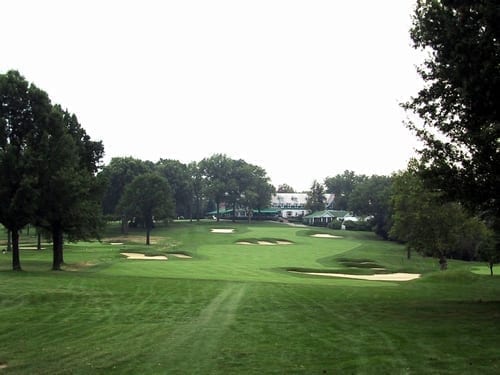
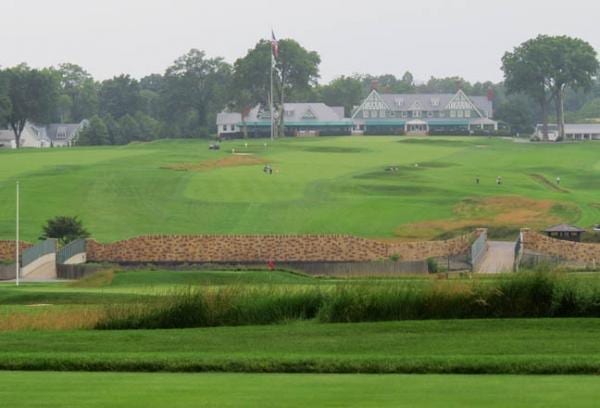
In the suburbs of Pittsburgh, Pennsylvania, divided by the PA Turnpike, lies Oakmont Country Club. It doesn’t contain one single water hazard. It doesn’t have any wicked dog legs. It’s not a club that has to be specially prepared for the U.S. Open. Anytime the private club is open for business, a player can step on the course and play major championship difficulty level golf. It boasts narrow fairways lined with 210 bunkers. Some of them are links style pot bunkers that players will chip out of, even backwards if necessary to continue on. Rough that will measure above ankle deep that players might also have to chip out of to be able attack a green from the fairway. It will be near impossible to swing anything but a wedge out of the deep stuff. Speaking of greens, they are slicker than ice and at times slope away from the player from front to back. The biggest change Oakmont has undergone in the past 20 years give or take, is the cutting down of over 7,500, to 15,000 trees. Depending on which version of folklore you hear. It makes almost the entire course visible from the clubhouse atop a hill. Everything except the 16th green which is guarded by a mound. No tree lined fairways also brings windy conditions back into play like the course intended when it was built like a links style track in 1903.
Oakmont will host a record ninth U.S. Open Championship. It has also played host to three PGA Championships, five U.S. Amateurs and two U.S. Women’s Open Championships. It has been the host venue for the most USGA and PGA Championships in North America. It’s challenging, yet fair. It’s sadistic, but rewarding. Unlike Chambers Bay a year ago, a perfect putt on a perfect line won’t hit a piece of cauliflower and bound eight feet off line. But an imperfect putt might roll until the rough catches it with the slopes of some greens reminiscent of a table missing one of it’s legs. It’s a true test of ability. A player will need to hit every club in the bag and get creative with their shots. That is what U.S. Open golf should be. It won’t be bombing drivers then hitting easy wedges into greens all day.
Discuss your thoughts on the 116th U.S. Open, and join the chatter on our message board.
The History
“A poorly hit shot should be irretrievably lost.” – H.C. Fownes
Henry C. Fownes, known as H.C., was a steel worker from Pittsburgh. In 1896 at age 40, Fownes and his brother, William, sold their furnace company to the Carnegie Steel Corporation and made a fortune. Two years later, H.C. started having vision problems, seeing spots from time to time. Doctors diagnosed Fownes with arteriosclerosis. A nervous system disease. H.C. was given two to three years to live. Given the short time left on his life clock and the fortune he earned, Fownes wanted to take up golf. Spend his time outdoors, trying to master the toughest game.
Fownes got really good at the game in a short period or time. He even played in the 1901 U.S. Open at the Myopia Hunt Club in South Hamilton, Massachusetts. A venue that hasn’t hosted a U.S. Open since 1908.
H.C. would get a new lease on life in the coming years as doctors would later say the spots in his vision were a side effect of welding without a mask on. Not the debilitating disease he feared.
Rejuvenated, given a second chance and love for the game of golf, H.C. Fownes set out to build what would become Oakmont Country Club, 14 miles east of Pittsburgh. Golf courses were not very challenging in this era of the game. Execution, playing the game has always been a challenge. The courses, not so much. Fownes wanted to build his course bigger and make it tougher than any other. It was designed in 1903 and open for play the following year.
The original layout was a links style course with no trees in sight up in the rolling hills of the western PA mountains. Oakmont measured over 6,400 yards. Far longer than courses from the early 20th century. A 560-yard hole was given a par-6. It featured eight par-5s and a total par of 80 for the course. It featured about 100 pot bunkers, synonymous with links golf.
Henry’s son, William C. Fownes Jr., named after his uncle, was an exceptional golfer himself. William Jr. (W.C.), won the U.S. Amateur title in 1910 and soon appointed himself Oakmont’s course consultant, following in dad’s footsteps. W.C. led the first U.S. Walker Cup team in 1922, and become President of the USGA in 1926.
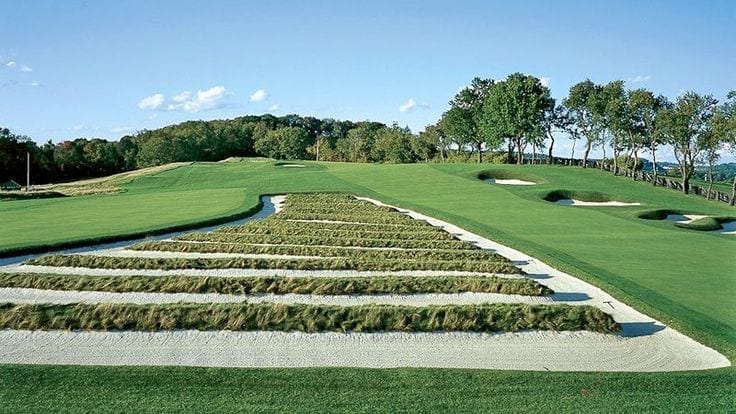
Low and behold, W.C ensured the U.S. Open was held at dad’s course, Oakmont, in 1927. By this time the par of the course was reduced to 72 and the number of bunkers on the course tripled to over 300. None more famous than the “church pew” bunker that lines the third and fourth fairways.
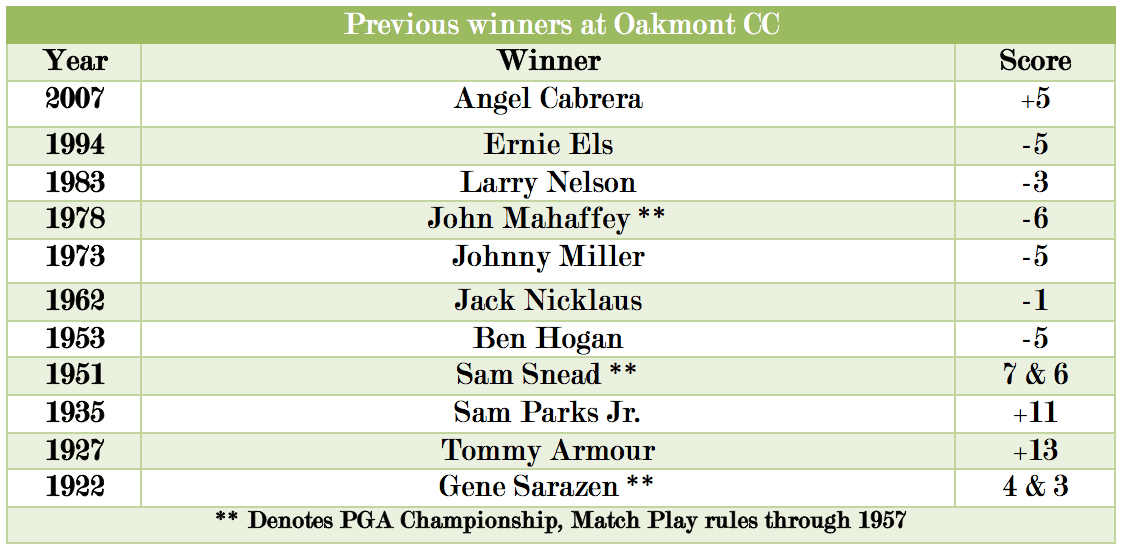
Tommy Armour won the 1927 event and posted a score of +13 to force an 18-hole playoff with Harry Cooper. Armour prevailed in the 18-hole playoff by shooting a +4, 76, winning by three strokes. Armour took home the first place prize of $500.
Ben Hogan won the U.S. Open at Oakmont in 1953. A season where he entered just six events, won five of them, and three of them were the first three major championships of the year. It was a “Triple Crown” year for Hogan, but he would not have the chance to earn the “Grand Slam”. Qualifying for the PGA Championship coincided with the British Open Championship dates. Even with the scheduling conflict, qualifying included the possibility of playing 36-holes a day for five straight days, which Hogan physically would not have been able to handle. An auto accident in 1949 left him weaker in the legs. 18 holes a day is about all he could handle.
1953 was also the year that then amateur and Latrobe, PA resident, Arnold Palmer, made his first U.S. Open appearance. He would win his first and only U.S. Open in 1960.
In the 1962 U.S. Open, 22-year old Jack Nicklaus won his first professional tournament holding off Arnold Palmer in a playoff. Palmer three putted 11 times in the 18-hole playoff on the extremely sloped greens. Nicklaus three putted just once on the day.
During the 60s, trying to spruce up the looks of the wide open, barren look of Oakmont, many trees were planted along the track. Tree lined courses were more commonplace in American golf than the Scottish links style intentions of the Fownes’. Tree lined courses also cut down on how much wind plays a factor during a round. There is nothing wrong with courses with trees. Courses these days are built into wooded areas. They use the trees as objects to draw and fade the ball around on dog leg holes. They give players an option off the tee. Go around them, or sky the ball over them? Oakmont doesn’t have any holes like that. Everything is pretty straight forward with some tough angles into the greens. But nothing resembling a dog leg. The blind shots here are due to the elevation changes.
The U.S. Open returned to Oakmont in 1973 and bore witness to what was known as the greatest round ever played. Johnny Miller shot an -8, 63 (Par 71 at this time) in the final round to win the title. 63 is still a major championship record. 63 has been tied by numerous others in majors over the years that followed. Some have broken the 60 mark in other events. But 63 at a course as demanding as Oakmont, on the tough Sunday pin locations, to win the tournament, is looked upon as the toughest task you could endure and therefore the greatest round ever posted.
Oakmont would later be the site of Arnold Palmer’s last U.S. Open in 1994. The 64-year old was granted an exemption by the USGA to play in his home state. Palmer hadn’t played in a U.S. Open in the previous 11 years, since Oakmont hosted it in 1983. Ernie Els won a three-way playoff in 94’ with Loren Roberts and Colin Montgomerie. It took 20 holes on a Monday to determine a winner. For Els, it was his first PGA Tour win, and the first of his four major titles he would notch.
During the 90s, a restoration project began to take Oakmont back it’s original roots. Over 5,000 trees were starting to get removed some 30 years after they were planted.
2007 was the last time Oakmont was the site of the U.S. Open. Angel Cabrera won the event with a score of +5. Aaron Baddeley led Tiger Woods by two entering play on Sunday nine years ago. Baddeley carded an 80 that day. Cabrera posted a 69 one day after shooting a dreadful 76. But good enough to edge Woods who shot a 72 on Sunday, coming up one shot short. Just another testament of the difficulty, yet fairness of Oakmont. The leader can put up an 80 if they aren’t careful. A third round 76 doesn’t necessarily put you out of contention if you can learn from your mistakes and bounce back.
The course played as a 7,230-yard, par-70. About 800 yards longer and 10 strokes less to reach par than Henry Fownes drew up 104 years prior.
The trees before
The trees after
2016 U.S. Open
Yardage – 7,255. Course rating/slope – 77.5-77.8/147-148
The U.S. Open is just that. Open, to anyone in the U.S. who sports a 1.4 handicap or better and qualifies for the second major championship of the year. 9,877 golfers across the country tried to qualify. The field is set to tee off on Thursday with 156 entries including 11 amateurs.
This week at Oakmont, you won’t hear the criticisms that came with Chambers Bay a year ago. Where the greens were like “putting on broccoli”. However, Oakmont is the reason the Stimpmeter was invented. Expect the greens to once again be a large part of the story this week. They are some of the steepest sloped and fastest in the world. The courses hackers like mysef play on register probably about seven to nine on the Stimpmeter. Regularly on the tour, around 10 to 11. At Oakmont they will try to push it upwards of 14 to 15. Sam Snead claimed once he tried to mark his ball, but his dime slid off the green.
The greens will be the story. They always are in U.S. Open tournaments, but doubly so at Oakmont. Not to be forgotten is the rough. It is deep and thick right off the narrow fairway. There is a first cut which is deep by first cut standards. The moderate and deep rough will leave players nearly chipping back to the fairway as if it’s a penalty stroke. Greenside rough is almost impossible to get up and down from. Many players practicing this week took to social media to show fans pictures of their feet in the rough and a caption resembling something like “my ball is down there somewhere”, invisible under the thick bluegrass/ryegrass mix.
The rough won’t be terribly deep in all places this week though. It will be cut significantly shorter in areas leading into bunkers, enticing more errant shots to roll right into them. “Awesome,” I’m sure is the sarcastic sentiment shared by the players upon hearing that news.
Couse rating is typically a how difficult a course is. If a player is a par golfer (shoots 72 for a round regularly), they would expect to shoot about 78 at Oakmont with the 77.8 rating. Par is actually 70 for the U.S. Open, not 72. For comparison sake, a normal public course might play around 70-73 rating from the tips. So a par golfer would be expected to shoot around 70-73 there.
I wont bore you with the way to find the course slope, 148 at Oakmont. Just know it defines the difference in par golfers and bogey golfers (regularly shoots 90 on a par 72 course). Slope can range from 55 to 155, where 113 is standard. So at Oakmont, a par golfer would expect to shoot 78. A bogey golfer who would shoot 90 normally, would expect to shoot 105, 106. It’s a big difference. Five or six shots worse for a pro. 15 or 16 shots worse for a 10-15-ish handicapper. After some complicated math, that difference is the “slope”.
With par set at 70 at Oakmont, the rating at 77.8, a pro would have to shoot 7.8 shots better than expected to break par. Now you can see why Angel Cabrera won this tournament with a +5 over par final score after the four rounds. Shooting a 70 at Oakmont, would be akin to shooting say a 63 or 65 at a normal public course.
See again why Johnny Miller’s round of 63 here in 1973 is regarded at the best ever. It’s equivalent to shooting maybe 55 or so at your run of the mill public course. That’s without the pressure of hall of famers chasing you on the leaderboard or a prestigious title on the line. The funny thing is that Miller lipped out two putts on that day. Millimeters shy of shooting a 61 which I’d be comfortable saying will never be touched in any major.
Given that the greens are going to be subject to the weather, if the rain stays away and the speeds reach 15 on the Stimp, the course rating could push 80. A rating of 80 on a par 70, I would expect no one to be in red numbers going into round three. Rain is in the forcast for parts of Thursday and early Friday morning. Those will be the times to really be aggressive. Once it dries out, the birdies start to go away.
That’s just a taste of how difficult the course is. Here are some holes you’ll want to keep an eye on at the event.
Signature Holes
Hole #1
Par 4/482 yards
I prefer a nice easy start to a round. First swings of the day, you want some room for error. You want a birdie opportunity to get your confidence going early. Good luck with that. You don’t have that luxury at Oakmont. The opening hole is a straight shot off the tee to a narrow fairway. Just 24 yards wide. Down the left side is five pot bunkers near the landing area, and three down the right side. The approach shot is a downhill blind shot, to a severely sloped green and guarded by two bunkers in the front left. Somehow get on the green in two and two putt for par, consider that a victory.
Hole #3
Par 4/428 yards
The famous “church pew” bunker comes into play on the left side, and five more large bunkers down the right side of the landing area off the tee. A great drive is rewarded with a short iron to an elevated green. Conservative tee shots to avoid the trouble will be penalized with a longer iron in, which will be harder to land soft and stick on the elevated green. The green boasts a false front that will draw balls back into the fairway collection area. The same goes for the rear of the green where the ball catches a slope on rolls off the back. The green is 33 yards from front to back. But you only have about 30 feet that you can land it on where you will actually be putting.
Hole #4
Par 5/609 yards
This is the first realistic birdie chance on the track. The “church pews” are in play again to the left, with bunkers on the right as well (notice a trend yet?). Longer hitters can carry the bunkers and lay up close to a well protected green that angles slight right from the tee shot landing zone. From there up and down for birdie is possible. It’s also the prime example of risk/reward. Errant tee shots nearly assure you’ll make bogey. In 2007 this hole played to a scoring average of 5.06.
Hole #8
Par 3/288 yards
You read that correctly. 288 yards on the par 3. A select few big hitters might be able to reach this green with a long iron, while everyone else will be taking at least a fairway wood out of the bag here, if not driver for some. One of the few bones Oakmont throws you is a pretty flat putting surface, if you can get it there. The green is guarded by bunkers, a large one along the front and left is very intimidating and nearly the size of the entire, iconic par-3 seventh hole at Pebble Beach. A back left pin placement will make it play at 300 yards, with the pin guarded by the large bunker in front. In that scenario it will be near impossible to make birdie.
Hole #12
Par 5/667 yards
Once again, not a typo. 667 yards from the championship tees makes it one of the longest holes the pros will ever play. Any thoughts of making an eagle on this par 5 are quickly dashed. The book recommends a 3-wood off the tee to a bumpy landing zone, making for unpredictable lie for your second shot. Then a long iron to a narrow lay up area affords you a wedge into a very tough green. Up and down for birdie should be counted as eagle as the tough green will lead to three puts and likely bogeys. Pros traditionally love the par-5s as the longer hitters can make birdies in their sleep. But in 2007, this one played to a scoring average worse than the fourth hole, at 5.41.
Hole #15
Par 4/499 yards
Another smaller set of “church pew” like bunkers once again in play on the left side of the landing area off the tee. The fairway slopes severely from left to right, into a group of bunkers off the right of the fairway. This hole asks you to favor the side of fairway where the church pew bunker lies. If that’s not an intimidating tee shot, I don’t know what is. The green is full of undulations making two or three putts common. Par is great here.
Hole #17
Par 4/313 yards
A drivable par 4 makes for excitement come Sunday if the match is close. The green is surrounded by five bunkers on the left, right and back. Shot selections are endless here. You can take the long way and hit two short irons avoiding any trouble. You can challenge short fairway bunkers by hitting a long iron, carrying the bunkers to a small landing area leaving a short pitch up to the green. Or you can try to drive the green and if successful, two putt for a birdie.
Hole #18
Par 4/484 yards
Oakmont’s most picturesque hole, and regarded as one of the toughest finishing par-4s around. You must drive the fairway here to have a good look at the green on your approach. Bunkers here you will have to chip out of to continue on. Wide into the rough will bring front greenside bunkers more into play if you go for the uphill green and leave it short. Another undulating green can lead to more putting frustration. This tournament won’t be over until the last player sinks his putt, in God only knows how many strokes. It played as the toughest hole on the course in 2007 at a scoring average of 4.60.
The Players
Among the favorites win the 116th U.S. Open are the usual suspects. The world’s number one ranked player, Jason Day, is the odds on favorite at 6-1. Jordan Spieth (2) right there at 8-1. But Rory McIlroy (3) is getting 7-1 odds, slightly better than Spieth.
I wonder if Spieth’s Masters meltdown is still in the minds of odds makers. Maybe they should keep in mind that Spieth has finished first or second in four of the last five majors. The odd one out was a fourth place finish at St. Andrews last year, where he was in a position to possibly win right down to the wire.
Jason Day broke through and won his first major, the PGA Championship at Whistling Straits last year. He’s finished in the top ten in his last four majors as well as the last three U.S. Opens. No one is playing better golf right now as Day has won seven of his last 18 tournaments dating back to 2015. His 70.75 scoring average in U.S. Open rounds is best among current players who have a minimum 15 rounds under their belt.
Rory McIlroy is second in that same category at 71.33. McIlroy is boom or bust in the majors, wining four of them in his career, but finishing outside the top 20 in nearly half of his entries. The Masters has eluded him for the career grand slam to this point. In seven U.S. Opens, McIlroy owns one victory (2011) and two top tens. He’s finished outside the top-20 twice and missed the cut twice as well.
The odds drop off steeply from there with Dustin Johnson (6) checking in at 15-1.
Rickie Fowler (5), Justin Rose (10), and Phil Mickleson (17) are at 25-1.
Henrik Stenson (7), Adam Scott (8), Branden Grace (12), and Hideki Matsuyama (15) are 30-1 shots to win the title.
Bubba Watson (4) and 2016 Masters champ, Danny Willett (9) are the other top ten players in the world not mentioned yet. They are getting 40-1 odds.
What it takes to beat Oakmont
Let’s get one thing straight. Unless your name is Johnny Miller that one time, you don’t beat Oakmont. Oakmont beats everyone. But someone survives long enough to be beaten the least of the field. You have to have all of the tools to win this major at this site. It’s why the list of previous winners reads almost like a guest list for a Hall of Fame members only party. It’s also why the odds on favorites are the most well rounded players in the world.
Starting at the tee, it is a must to drive the ball accurately at Oakmont. Some might not even put a driver in the bag this week and make a go with fairway woods and driving irons off the tees. Jason Day has mentioned that he believes there is maybe four holes that he would consider pulling out the big dog on.
If the course dries out over the weekend, the already narrow fairways could get very firm. It would make balls unpredictably roll along the undulations into the rough, or bunkers. Jordan Spieth hinted that guys may need to curve the ball into a slope on the fairway to stick it where they want, which will be tough to do with drivers consistently. This can favor the big hitters if they can pull out the long iron and nail it where they want off the tee, and still get it 280-yards plus out there.
Jason Day carries a 2-iron that he ripped 305 yards at The Players. While Dustin Johnson has the distance that makes the rest of the field jealous of his power, the player with the best combination of distance and accuracy with the lumber is Rory McIlroy. It will be interesting to watch his strategy from the tee box. He too has also made mention of going to the driver on par-5s, and maybe only a couple par-4s.
Long hitters might be able to carry some of the trouble spots with their drivers. If you carry 310, it takes some of bunkers out of play. Do you want to be 260-280 in the fairway a lot with long irons, or 300-320 in the fairway some, but in the rough some as well with driver?
Now that you have found the fairway, it’s on to the approach. You have to study the greens and know where you need to land the ball. You need to know when you can take dead aim at a flag, or when you can’t. You need to know which parts of the greens you can stick it on your approach and which ones you need to run it up on to like the links style players prefer. You need to know where you can miss a green and get away with it, which won’t be many places. Where are the false fronts? Where are the slopes dumping balls right into a bunker? Not only do you need to know these things, but then you need to execute the right shot.
Adam Scott is the purest ball striker in the game. He is a safe bet to hit a lot of greens in regulation this week. If Scott can putt, possibly still learning the transition from the now illegal anchor putter he’s used through his career to the traditional putter, he’ll be in the mix on Sunday.
Short game is going to be crucial because greens will be missed. Greenside rough and bunkers will come into play. This is where knowing where you can miss counts. Trying to hit a tight pin on a green sloping away from you will be near impossible. Hole out, or get ready to three putt. Wedge play when a player comes up short of the green with some false fronts will be key as well to getting up and down for par.
There might not be anyone more creative with the wedges and playing out of the bunkers than Phil Mickleson since the turn of the century. A lot of veterans of the game understand that mastery of the short game is how they keep pace with the young guys who out drive them. You usually find the best wedge players to be seasoned vets like Mickleson, Fred Couples, Jerry Kelly, Jim Furyk, Steve Stricker, David Toms. Youngsters like Patrick Reed and Jordan Speith have found their stroke with the wedges. Neither one being exceptionally long, though plenty good enough off the tee. Ability to scramble will keep you in the tournament, even if it’s not your best day with the irons.
Putting will be paramount on the legendary greens. Lag putting in particular. Leaving yourself an uphill second putt when you miss. It’ll save you strokes as it’s much easier to control the distance uphill at Oakmont rather than facing a downhill putt. Jordan Speith is the magician with the flat stick in the 10-15 feet range. He putts very well on the big stages, on the toughest greens like Augusta. Jason Day has been hot of late with long putts. He’s draining a lot of one-putts most guys would like to lag up to a tap in two-putt. Dustin Johnson’s putter has been his Achilles heel in past years. None more agonizing than the three-putt on the 72nd hole of Chambers Bay, handing the U.S. Open title to Jordan Spieth. Johnson’s putting is getting better over time as he’s gone from 82nd, to 71st, up to 46th now in strokes gained putting from 2014 to today. But the hiccups creep in for D.J. when he’s within ten feet. He leaves too many strokes out there at times, especially in majors where one misstep is the difference in winning and runner-up.
A lot of guys have played practice rounds at Oakmont over the last few months to prepare for “America’s tournament”. Anyone who shows up a couple days ahead of the U.S. Open to practice with a yardage book and prayer has no chance. So who does? Day, Speith, McIlroy, Scott? Any of those men have all the tools to be in the final pairing come Sunday.
What about some guys off the radar? Patrick Reed (11, 40-1) has finished in the top-10, nine times in 17 events this season.
Kevin Chappell (37, 60-1) has finished runner up three times this season, including tour staples like the Arnold Palmer Invitational, and The Players. He finished T3 in the 2011 U.S. Open at Congressional Country Club.
23-year old, and 2015 PGA Tour rookie of the year, Daniel Berger (29, 80-1) is coming into the U.S. Open with the most momentum. Berger won his first career tournament last Sunday in Memphis at the FedEx St. Jude Classic. He’s now finished in the top-10 in four of the last seven events he’s entered, and finished T10 in the Masters.
Emiliano Grillo (46, 150-1) has not three-putted in his last 155 holes. Longest streak of anyone in the field. Two putting your way around Oakmont is one key to victory. Grillo also ranks seventh in driving accuracy and 27th in greens in regulation. He’s Argentinian like the defending U.S. Open at Oakmont winner, Angel Cabrera. Grillo finished T17 in The Masters and now makes his U.S. Open debut.
Thomas Aiken (149, 300-1) is top-10 on the PGA Tour in both driving accuracy and greens in regulation. Yet Aiken hasn’t finished in the top-10 in any PGA event since 2012. His best showing in 2016 was a T15 at the Zurich Classic in New Orleans. He’s not made a cut since. However, Aiken recently finished fourth in the European Tour’s BMW PGA Championship. Other than the Dubai World Championship, it is the European Tour’s flagship event with the most prize money awarded. He finished T25 in last years U.S. Open.
Featured Groups
8:35am – Jordan Spieth, Zach Johnson, Bryson DeChambeau. This traditional grouping features the defending U.S. Open, Open Championship, and U.S. Amateur Champions.
1:36pm – Dustin Johnson, Sergio Garcia, Hideki Matsuyama. All three players are arguably regarded as the best players in the world that have yet to win a major.
2:09pm – Phil Mickleson, Justin Rose, Henrik Stenson. Mickleson looks to complete the career grand slam as he’s been a runner up in America’s championship six times. The last time was in 2013 at Merion where he led for three rounds. But a final round 74 opened the door for Justin Rose, who shot a 70 that day, to take the crown. Think Rose will bring that up as Phil takes to the first tee?
2:20pm – Jason Day, Adam Scott, Louis Oosthuizen. Two Aussies in Day and Scott are also numbers one and two respectively in the Fed Ex Cup standings.
Weather
Thursday: 84 degrees. Isolated T-Storms in the morning, cloudy early afternoon, some T-Storms possible in the late afternoon. 5 mph winds. Friday: 82 degrees. Rain clearing in the morning, Sunshine to follow. 10 mph winds. Saturday: 86 degrees. Sunny. 5 mph winds. Sunday: 87 degrees. Sunny. 6 mph winds.Rain has fallen on Wednesday morning, allowing players to practice on moist conditions. With a soft course on the first couple days, we could see some lower scores. By Sunday, Oakmont could be dried out enough to make par very tough to attain. Despite the tree removal program, wind doesn’t appear to be much of a factor this week. My prediction for a winning score: +1. I think we’ll see some 67s, 68s early. But a 73, 74 will be common in the latter rounds.
Broadcast
Thursday: FS1, 10am-5pm. Fox, 5pm-8pm Friday: FS1, 10am-5pm. Fox 5pm-8pm Saturday: Fox, 11am-7pm Sunday: Fox, 11am-7:30pm
Ravens Analyst
Mike was born on the Eastern Shore, raised in Finksburg, and currently resides in Parkville. In 2009, Mike graduated from the Broadcasting Institute of Maryland. Mike became a Baltimore City Fire Fighter in late 2010. Mike has appeared as a guest on Q1370, and FOX45. Now a Sr. Ravens Analyst for BSL, he can be reached at mike.randall@baltimoresportsandlife.com.