
How well do you know your Ravens players? Think you could name a Ravens player just by looking at some quotes, some stats, some measurables?
Lets find out. We’re going to discuss two Ravens wide receivers without telling you who they are until the end. For now we will call them Player A and Player B.
Discuss your thoughts on this topic on our message board.
Player A
6’1”/206 lbs. 9 3/8” hands. 33 3/8” arms. 37” vertical jump.
Do you know it yet? Come on this is easy!
Ok. In his senior season in college, he saw 33% of his catches go for over 25 yards. He averaged 22 yards per catch over his final two college seasons. As a redshirt freshman he went for 28.7 YPR. His 34.4 YPR on 26 career touchdowns is the highest mark among all college levels.
He’s only the fifth receiver the NFL has drafted out of his school. If you know where Baltimore Colt Jim O’Brien, Denver Bronco Chad Plummer, Atlanta Falcon John Oliger and St. Louis Ram Mardy Gilyard went to school, you may know who this guy is. If you know who Plummer, Oliger, and Gilyard are, then you need to go outside, find a new hobby, something.
He was a track star, he’s speedy, not from a big, nor small school. But the Ravens have a few guys that fit this mold. But then there is this:
He ran the 40-yard dash in his day at the combine in 4.53 seconds. At his pro day he got it down to 4.46.
That eliminates someone if you’re up to date on the current group of receivers. Let’s move on to Player B.
Player B
6’2”/212 lbs. 9 ¼” hands. 32” arms. 36 ½” vertical jump.
Over his last two college seasons, he averaged 20.9 YPC. He was the only player in the country to average over 20 YPC while also catching at least 50 balls. In his final season, he had to transition from playing with an NFL draft pick as his QB, to an unknown, and developed quick chemistry with the newcomer.
Draft scouts compared this receivers game to Josh Gordon. Hope they mean on field and not off it.
So both guys posses deep ball skill sets. Moving on.
Strengths
Player A
Above average height and speed combo. Great deep speed, ball tracking skills, knack for getting behind defenses. Excellent at high pointing the football, hand-eye coordination. Home run threat.
Player B
NFL caliber height and speed that can’t be ignored. Deceptive strider to get behind defenses. Tracks and high points the football well. Great runner after the catch. Home run threat.
Weaknesses
Player A
Lacks polish in route running, getting in and out of breaks. Preferred to bulk up and get more physical. Needs to engage in blocking for his teammates. Tends to body catch. One trick pony.
Player B
Needs to get better in running routes and reading coverages. Relies on speed over precision. Drops can be a factor. Tends to body catch. One trick pony.
Who are we talking about? Well, you can tell from the verbiage there is no mention of NFL experience. That’s giveaway number one. If I gave you Player B’s 40-yard time it would have been dead giveaway number two. It was 4.26 at the combine, 4.22 at his pro day. Now you got it?
Player A = Chris Moore, Cincinnati, fourth round draft pick, 2016
Player B = Breshad Perriman, UCF, first round draft pick, 2015
Why did I choose this exercise to display the receivers this way? For a few reasons.
First, I wanted to take the names away from players in question. When you do that, you get a more objective look at a player. Do the same for Cam Newton and Russell Wilson last year. Put down their numbers without a name and ask people who should the MVP be. You can make a really good argument that Wilson should have been the MVP instead of Newton. But there are biases that saw Newton’s Panthers beat Wilson’s Seahawks in the playoffs. The outspokenness of Newton puts him in front of the camera more than Wilson. Those became subjective determining factors.
Player A – 329/483, 68.1 Cmp%. 4,024 passing yards, 8.3 Y/A. 103 rushes, 5.4 yards per carry, 35 Total TDs. 8 INTs. Player B – 296/496, 59.7 Cmp%. 3,837 passing yards, 7.7 Y/A. 132 rushes, 4.8 yards per carry, 45 Total TDs, 10 INTs.Wilson is “A”, Newton “B”. Newton had more TDs, while Wilson was superior in all other facets. Not sure if there were drops, or penalties that negated some of Wilson’s scores, but there is a good case for Wilson being the better overall QB. Back to the Ravens.
Second, going with the objective look, the resumes are nearly identical. Very close to the same size, same skill set, close to the same stats and now you know from the same NCAA conference. They possess about the same strengths and weaknesses. The glaring difference is the .2 seconds faster Perriman is than Moore. Is that two-tenths the difference in a fourth round pick and a first round pick? That’s in shorts, not in game speed. Does Chris Moore look like quite the steal in the draft? Taken in the fourth round while he possessing apparent first round skills except elite speed, which his 4.46 is still very good.
Third, Breshad Perriman might be on the shelf for some of 2016, if not all of it depending on the circumstances with his knee. But what did the Ravens really lose? Essentially the same guy in Moore is on the roster entering year one, which Perriman would have entered this year for all intents and purposes.
If you say that your missing a first round pick and might have to rely on a fourth round pick to be a difference maker when called upon, it doesn’t look good. It looks like a tall order for a fourth round pick.
If you say that they lost a deep threat receiver, but have another guy capable of being a deep threat receiver, it looks a little less damming. Less doom and gloom.
Subjectively, Perriman looks irreplaceable if he’s going to miss significant time. Objectively, the Ravens replaced him in round four this past draft. The competition would be wide open if both were at 100% health.
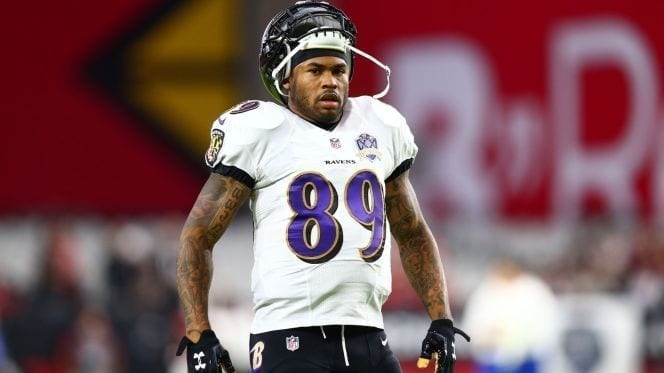
If you picked Steve Smith Sr. as one of the receivers in question because he was pictured above, then you’ve become a victim of the Red Herring.

Ravens Analyst
Mike was born on the Eastern Shore, raised in Finksburg, and currently resides in Parkville. In 2009, Mike graduated from the Broadcasting Institute of Maryland. Mike became a Baltimore City Fire Fighter in late 2010. Mike has appeared as a guest on Q1370, and FOX45. Now a Sr. Ravens Analyst for BSL, he can be reached at mike.randall@baltimoresportsandlife.com.