
The moment of Baltimore Ravens selected him in 2008, quarterback Joe Flacco became the main catalyst behind the team’s offensive attack. A year later, running back Ray Rice produced the first of four consecutive 1,000-yard campaigns, providing the offense with needed balance and, with Flacco, an offensive identity that remained in place until his personal and professional demise in 2014. Though Flacco returns for his ninth season, the team has yet to fully reboot its image on offense.
Part of the Ravens conundrum stems from the lack of established playmakers around Flacco. Of the signal-caller’s triumvirate of field-tilting receivers from the team’s last Super Bowl run — Anquan Boldin, Torrey Smith and Dennis Pitta — only Pitta remains on the roster. Furthermore, Pitta’s role with the team has significantly diminished after badly dislocating his hip and suffering a series of other injuries. In their place, Baltimore has amassed a receiving corps long on potential but featuring no sure-fire options.
(Discuss this article on the BSL board)
Steve Smith Sr. assumed the mantel as the No. 1 receiver upon signing with the team in 2014. Smith has long exceeded expectations for a player his age (37), but a ruptured Achilles suffered last November threatens to reduce the colorful, beloved wideout to a bit contributor going forward. Kamar Aiken seems best equipped to step into Smith’s old role after amassing 944 yards and five touchdowns last season, but he needs to repeat the performance before Baltimore can fully buy in. Meanwhile, 2015 first-round pick Breshad Perriman represents the wildcard of the group, possessing a burner’s speed and after-the-catch ability but coming off a knee injury that robbed him of his entire rookie year.
The tight ends offer a similar combination of promise and mystery, at least in the wake of Benjamin Watson’s season-ending Achilles injury. Crockett Gillmore looked like a quality starter last year, leading all Ravens tight ends in catches (33), receiving yards (412) and yards per reception (12.5). Yet injuries sidelined Gillmore for six games in 2015 and, based on his style of play, could continue to haunt him in the future. Maxx Williams graded as the top tight end in last year’s draft class, but raw route-running skills continue to hold him back. Then, of course, Pitta returns after a nearly two-year hiatus, one of the best stories of the preseason across the league. However, few players reclaim their old form after a lengthy absence from football, and Pitta still has some physical hurdles to overcome.
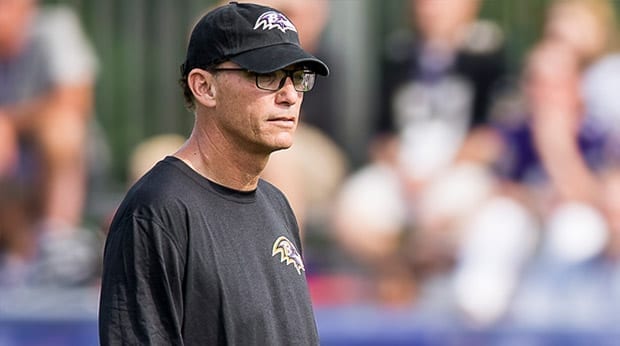
That leaves the Ravens and offensive coordinator Marc Trestman with the burden of rebuilding an offense without fully knowing the tools at his disposal. That could mean Trestman could shift focus to the ground game despite his reputation as an aerial enthusiast.
Like the receiving corps, Baltimore’s backfield doesn’t feature a lead dog. Justin Forsett, the team’s leading rusher each of the past two seasons, saw the Ravens release him during the final cuts before re-signing a day later. Terrance West appears ready to cut into Forsett’s workload if not overtake him as the starter. At the same time, rookie Kenneth Dixon displayed advanced vision as a ball carrier before tearing his MCL. When he returns, all three could realistically battle for the lion’s share of the carries.
Regardless of how Trestman divies up the work, the ground attack probably needs to receive more attention in 2016 to mitigate the limitations of the passing game. Last season, the Ravens finished near the very bottom of the league in rushes (383) and led all teams in pass attempts last season (676). That run/pass split looks the way it does in part because of how often the team had to play from behind. Still, even accounting for situation it skewed too far towards one side. A heavier dose of Baltimore’s multi-headed backfield could help the offense improve.
And while the offensive line lost Kelechi Osemele to free agency during the offseason, it remains one of the league’s stronger run-blocking units. All-Pro guard Marshal Yanda and still-improving tackle Ricky Wagner form a dominant right side, providing the Ravens with an enticing B Gap between them to exploit. The other side of the line features the unproven Ronnie Stanley (No. 6 overall pick in this April’s draft) and John Urschel, but each offers promise of long-term stability at the position. Center Jeremy Zuttah doesn’t dazzle as others at the position can, but he solidifies the group with his heady play. If the line can remain mostly healthy in 2016, Baltimore can and should ride it on the ground to balance out the passing game.
And such balance, if achieved, could redefine how the NFL thinks of the Ravens offense. It would neither fully resemble the units led by Flacco and Rice nor deviate too strongly from them. It wouldn’t automatically fix all the problems experienced in 2015, either. A balanced approach would, though, deliver the offensive identity Baltimore needs if the team has any hope of returning to contention in the near future.

Jason B. Hirschhorn is an award-winning sports journalist and Pro Football Writers of America member. He has bylines at NFL.com, SB Nation, Sports Illustrated, and other outlets.