
As Week 15 of the 2015 regular season came to a close, the Denver Broncos found themselves in a rather precarious situation.
Once the AFC frontrunner with an unblemished 7-0 record, the Broncos dropped four of their next seven games including two in a row. The most recent, a 34-27 road defeat at the hands of the Pittsburgh Steelers, reignited a Peyton Manning vs. Brock Osweiler debate that had come to define their season.
At 10-4, the team appeared to have as good a chance to clinch a first-round bye as miss the playoffs altogether. To pull it all off, Denver needed to knock off the 11-3 Cincinnati Bengals on Monday Night Football and then take care of business against a frisky San Diego Chargers team in the season finale. No easy task, even for a veteran-laded roster like Denver’s.
The mounting losses created an uncomfortable atmosphere, forcing Manning and general manager John Elway to shoot down rumors of locker room dissent. Yet with so much on the line and no safety net, the tension continued to escalate heading into the final two weeks of the season.
(Discuss this article on the BSL board)
Of course, those Broncos did indeed run the table, first by taking out the Bengals and Chargers by 10 combined points then by running through a gauntlet of superstar quarterbacks accounting for six Super Bowl wins and three league MVP awards. In the end, a washed Manning hoisted the Lombardi Trophy in his last NFL game, capping a Hall of Fame career in a most appropriate fashion.
While the 2016 Baltimore Ravens never built up the good will and expectations commensurate with an early undefeated run, they do share more than a passing resemblance with last year’s champions. Not all of those shared qualities reflect well on the Ravens, however.
Like that Denver team, Baltimore possesses one of the league’s better defenses. The defensive front, anchored by outside linebacker Terrell Suggs and interior linemen Timmy Jernigan and Brandon Williams, has stopped the run better than any other unit in the league (ranked No. 1 by DVOA entering Week 16). Opponents attempting to pass their way out of a quagmire haven’t fared much better, as the pass rush and Eric Weddle-led secondary have given up precious few big plays and largely kept opponents out of the end zone (No. 6 pass defense by DVOA). Whenever a team has a defense so dominant and balanced, it has a chance to win any game.
But the Ravens share another trait with the 2015 champs. For as obstructive as their defense has become, they boast little offensive firepower.
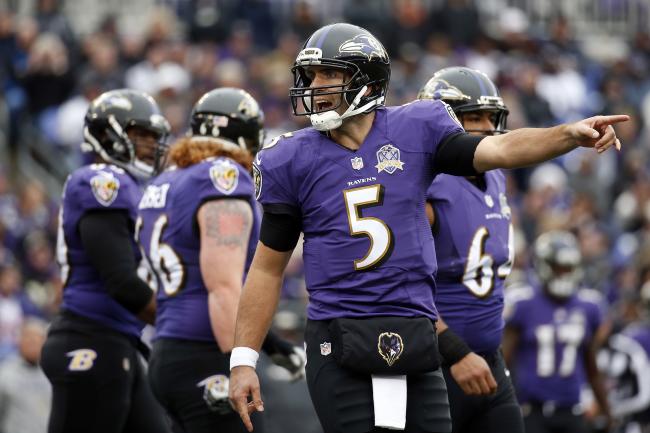
The issues begin with the team’s triggerman, quarterback Joe Flacco, who has endured one of the worst seasons of his professional career. Barring an unexpected tear over the next two games, Flacco will finish the year with his second-lowest marks for yard per attempt (6.54 entering Week 16) and touchdown percentage (3.3) along with one of his worst touchdown-to-interception ratios (19:13). Flacco’s struggles have hindered an already limited passing game, which ranks near the bottom of the league in traditional and advanced metrics alike.
And whether as a result of the floundering aerial attack or as an independent malfunction, the Ravens’ ground game hasn’t fared much better. The team’s starting back at the beginning of the year, veteran Justin Forsett, received his walking papers in early October. The tandem of Terrence West and Kenneth Dixon has seen most of the work in Forsett’s absence, but neither has managed to show more than a passing flash of above-average play. The team collectively averages less than 4 yards per carry on the year.
Those offensive struggles have already cost one coach his job in Baltimore. After scoring a paltry 10 points at home against Washington, the Ravens relieved offensive coordinator Marc Trestman of his duties. The unit has shown some improvement in the time since, but the improved health of players like Steve Smith Sr. and the schedule accounts for most of the difference.
With little working on offense, the Ravens have leaned even more heavily on their defense. And to its credit, the unit has exceeded any reasonable expectation in that department, holding opponents to 21 points or fewer in eight games so far this season. However, like Denver, something has to change late in the year for the Ravens to accomplish more than just sneak into the playoffs, assuming they even make it that far.
While the Ravens can no longer earn a first-round bye, their fate could lie anywhere from the top AFC seed on wild-card weekend or completion out of the postseason. To secure the best possible positioning, Baltimore can win its remaining games against the Steelers and Bengals, both on the road. Doing so would earn not only the AFC South title, but also keep the team ahead of whichever club emerges as the AFC South champion in the conference-record tiebreaker.
Should the games unfold less favorable for the Ravens, they could also land the No. 3 seed if they drop their season finale but maintain an equal overall record to their competitors and hold onto the divisional, conference and strength-of-schedule tiebreakers.
In no scenario can the Ravens lose this weekend in Pittsburgh and garner anything more than a wild-card berth.
All of which may seem awfully familiar for those who watched the Broncos last year. Like them, the end of the season could provide the Ravens a springboard towards an eventual Super Bowl victory. It could also prove to be their undoing, leaving them home in January while the NFL’s best compete for a title. More than likely, their fate falls somewhere in between.
Still, as New Years Day approaches, Baltimore still has a shot to make 2016 a memorable year. As Denver demonstrated last season, sometimes that can be enough.

Jason B. Hirschhorn is an award-winning sports journalist and Pro Football Writers of America member. He has bylines at NFL.com, SB Nation, Sports Illustrated, and other outlets.