
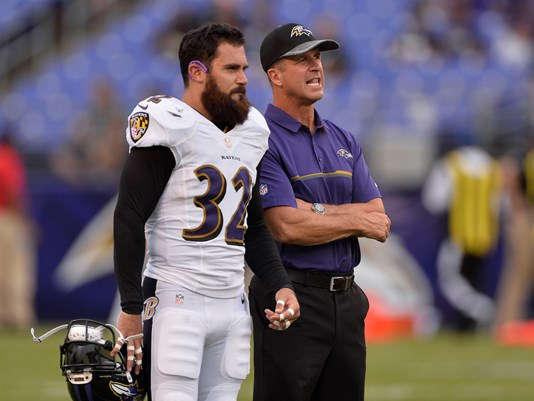
Baltimore Ravens fans took to social media after their 27-10 drubbing at the hands of the Cincinnati Bengals, lamenting the poor performance and the disappointing season. But while the season was disappointing, it can hardly be a surprise. The talent on this team, the star power, was not set up for the Ravens to be extremely successful this year. In fact, after dropping the dead weight that was Marc Trestman, the Ravens overachieved, winning four out of five during one fun stretch.
Discuss in the BSL forums here…
If social media is to be believed, the Ravens’ season was filled only with lows. We will get to those, but there were high points too. And that is where we will start our recap of the 2016.
Highs
1. The Ravens have two cornerbacks
Going into the season, I did not think the Ravens had a single cornerback who was a legitimate NFL starter. By the end of the season, they had proven they have two in Jimmy Smith and Tavon Young.
Smith, who struggled with injuries but played very well when healthy, frequently guarded opponents’ best receivers and held up well. He showcased improved physicality and speed when compared with his 2015 season, when he was still recovering from a foot injury. If Smith can retain this form in 2017, the Ravens can feel secure that they can stack up against most receivers.
Tavon Young was the real story, though, as he came out of nowhere to be an excellent corner. Two skills stood out: Young’s reaction time and his tackling.
In Dean Pees’ preferred off-coverage, the cornerback needs to react quickly to the ball when it’s thrown, and he needs to either play the ball or make the tackle. Young broke up eight passes this year, mostly by breaking quickly on routes and using his quality ball skills to make the play. When he didn’t get there on time, Young was among the most reliable tacklers in the Ravens’ secondary. Despite his slight frame, Young was willing to bring down any player, and he did so well.
The depth remains an issue, one that is intensified by Smith’s injury issues. But at least the Ravens have two quality cornerbacks on the roster, which is two more than I thought they had at the beginning of the seasons.
2. Improved safety play
The key difference in the Ravens’ defense from this year compared with 2015 can be summarized in a simple formula:
Eric Weddle + Lardarius Webb > Kendrick Lewis + Will Hill
Eric Weddle played at an All-Pro level. His ball skills, reliable tackling and intelligence made this years’ Ravens defense the best of the Dean Pees era (which isn’t saying much). Weddle is without question the defensive MVP, and it’s not close.
And though fans remained critical of Lardarius Webb’s play, he was excellent in 2016. Webb’s stiffness, the result of years of injuries, wasn’t as harmful at the safety spot, and his speed, ball skills and tackling helped limit big plays. Prior to this season, Webb would have been a safe bet to not return in 2017. Now? He might still be cut to save $5.5 million next year, but Webb has clearly earned a role on next year’s Ravens.
3. C.J. Mosley learned how to cover
I have been critical of C.J. Mosley early in his career as the athleticism he displayed in the ground game failed to translate to coverage. No longer. Mosley played very well in pass coverage this year, ranking in the top 25 among linebackers on Pro Football Focus.
The Ravens gave up countless passes over the middle in years past. This year, Mosley’s improved play, as well as a talent influx at safety, limited the damage in that area of the field. And Mosley’s four interceptions helped lead a Renaissance in the Ravens’ ability to create turnovers. Now if he could only hold on to the football when he returned interceptions…
4. A healthy Dennis Pitta
Don’t buy the hype that Dennis Pitta had a great season for the Ravens. His only skill at this point is turning around and catching the football for a five-yard gain. That said, seeing Pitta out on the field again was a great story for the Ravens. To come back from two horrifying hip injuries and to take hit after hit over the middle of the field is awe-inspiring.
Maybe a healthy offseason will help Pitta come back in earnest. But even if his athleticism never returns, Pitta was healthy and proved he still has a spot in the NFL. It was a joy to see.
5. The swaggiest kicker in the NFL
Justin Tucker was the best kicker in the league, and it wasn’t close. He did not legitimately miss a single kick all year (his single miss was blocked). This while tying an NFL record or most 50+ yard field goals in a season. The difficulty of Tucker’s kicks was as high as any kicker in the league, yet Tucker literally never missed.
Yes, we’re all sick of hearing that Tucker is an opera singer (you can stop bringing this up, national broadcasts). That’s the only bad thing that can be said about Tucker, and in a league that is suffering from kicking woes, that’s a valuable thing to have.
Lows
1. High draft picks disappointing
Except for C.J. Mosley and Ronnie Stanley, the Ravens’ high draft picks the past few years have ranged from disappointing to complete busts.
Start with this year’s second-round pick Kamalei Correa, who was a healthy scratch for seven games this year. High draft picks are expected to contribute in today’s NFL, and Correa filled a position of dire need. That he couldn’t get on the field, especially considering that the later drafted Matt Judon did, is hugely disappointing.
Step back to the class of 2015 and it looks even worse. Maxx Williams went on IR in October, and he didn’t even catch a single pass before that. First-round pick Breshad Perriman finally confirmed his existence by getting on to the field. Unfortunately, he also confirmed the concerns about his hands, as he dropped 7.6 percent of his passes. He also failed to get open frequently, not showing the burst he was drafted for and lacking craft in his routes.
2014 is the outlier here, as C.J. Mosley had a career year and Timmy Jernigan showed his usual flashes (before tailing of dramatically in the second half of the year).
Finally, 2013 continued to be one of the Ravens’ worst draft classes ever. Matt Elam was injured for much of the year and ineffective for the rest of it. Arthur Brown was finally released after failing to develop. Even the crown jewel of the class, Brandon Williams, had a down year. His inability to push the pocket made life a lot harder for the Ravens’ overmatched edge rushers.
The Ravens’ inability to restock their roster in recent years with young talent has kept the team from getting to the playoffs in three of the past four seasons. The Ravens need to strike gold soon, or they may be irrelevant for many more years to come.
2. Joe Flacco forgot how to play football
“Don’t throw off your back foot. Step in to your throws.” It’s one of the first things young quarterbacks learn, and Joe Flacco completely abandoned that fundamental this season.
Some of Flacco’s struggles this season can be explained away by poor receiver play – you can count on one hand the jump balls won by Ravens’ receivers this year. But there is no excuse for his consistent failure to play with solid fundamentals. Nor is there an excuse for his tendency to miss zone defenders and throw bad interceptions (especially in the red zone).
Joe Flacco will play better when he has actual talent to work with. I’m not worried about that. But the maddening mistakes that have grown more common over the years might not go away, and may put a ceiling on Flacco’s play that was not there in the past.
3. Fourth quarter collapses
My criticism of Dean Pees has always been this – Smart offenses take what the defense gives them, and Dean Pees always gives you something. Sometimes, Pees plays Cover-0 and gives up the deep ball. Most often, Pees lines up his cornerbacks far off the ball, opening up easy throws in the short passing game. That was never more apparent than in the fourth quarter of games this year, when the Ravens consistently gave up chunks of yardage just because they were so conservative.
The sudden tonal shift on defense when the Ravens are protecting a lead has given too many teams an opportunity to get back into the game. We saw it against the Eagles when Carson Wentz, a rookie, picked apart the Ravens’ defense en route to a near upset. Then, the Ravens could not contain the Pittsburgh Steelers in the biggest game of their season. Pro-tip: giving Antonio Brown 10 free yards to work with is not a winning strategy.
It’s hard to envision this problem being solved as long as Dean Pees is in Baltimore lining cornerbacks ten yards off the ball. Maybe the Ravens can live with it. Despite a late season collapse of the rushing defense, the defense was excellent this year despite the late game foibles. But fans will continue to get indigestion in late game situations with Pees calling plays.
4. Where is the star power?
At one point this season, I performed a thought experiment. If I was an opposing coach, how would I gameplan against the Ravens? I concluded that there is not a single Ravens’ player I would fear enough to gameplan for. And that’s a huge problem.
Think about how teams defend the Pittsburgh Steelers. It starts and stops with defending Le’Veon Bell and Antonio Brown, and even concerted efforts to stop them sometimes don’t work. Compare that with the Ravens, who more often have receiver who can’t even break single coverage. And while Terrance West and Ken Dixon flashed this year, they won’t scare anybody until the Ravens commit to running the football.
On the other side of the ball, the aged, slow Terrell Suggs was the Ravens’ best pass rusher. And he was not great. The best skill position player the Ravens have, Eric Weddle, is the closest thing the Ravens have to a star, but he’s more extremely solid than dynamic.
Opposing quarterbacks cannot sit in the pocket unmolested. Joe Flacco cannot keep looking downfield and seeing no one open. This is why the Ravens are stuck in mediocrity.
Excluding Breshad Perriman, the Ravens have settled for safe draft picks, often at the expense of great athleticism. They can’t afford to do that again. The Ravens need speed, athleticism, and star power.
5. No balance
There is no question that Marty Mornhinweg was a vast improvement over Marc Trestman, whose commitment to short out and comeback routes fooled nobody. But Mornhinweg was far from ideal. Despite featuring two running backs who averaged over four yards per carry, Mornhinweg consistently abandoned the running game en route to a 674-attempt season from Joe Flacco.
I like Mornhinweg, but his shotgun, pass heavy scheme was not a fit for Flacco or the Ravens’ talent.
Flacco is not Drew Brees. He cannot will his team to victory by throwing 50 times in a game. Flacco needs a ground game to be successful. That’s why Gary Kubiak, with the help of a career year from Justin Forsett, led Joe Flacco to his best season as a pro.
If the Ravens want to improve on offense, the formula is simple. Joe Flacco has been in the league for nine years now, and how to help him succeed should be clear. Run the football and set up play action. Get Flacco out of the pocket on roll outs. Surround him with players who can make a play on the ball in the air. The Ravens failure to do that is confounding, and it’s the biggest reason the Ravens had to settle for another playoff spent at home.

Shawn began his writing career with Bleacher Report as a Ravens featured columnist and Breaking News Team writer. He moved on to write for Yahoo! and work on the Ravens Central Radio podcast. Most recently, he was an Editor at the Baltimore Wire. Shawn is a 2013 graduate of the Catholic University of America.