
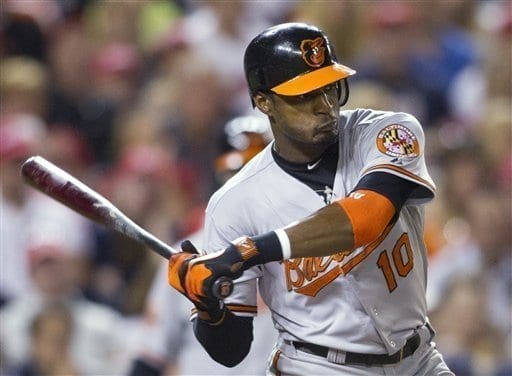
As you might have heard, the Orioles have a bad offense this year. They have .228 batting average, 33rd-worst in history, and many of the batting averages that are worse than the 2018 Orioles occurred in the noted offensive downturn of 1968. The 2018 Orioles’ offense overall is 19% below league average, 174th-worst in history. With Manny Machado traded, their best offensive player is Mark Trumbo, whose offense is only 6% above league average. This is the 25th-lowest total for a “leading” offensive player (Minimum 300 PAs), again, in history. So yes, the Orioles have not only a bad offense, but also historically bad.
Now, the Orioles’ offense has gone through many ups and downs over the years, ranging from this year’s low to top-5 levels in 1998 and 2014. However, there has been one constant since the turn of the millenium. The Orioles have consistently had subpar plate discipline, leading to below-average walk levels and contributing poor results on balls in play.
The Orioles’ lineup in the past few years have seemed to be made in defiance in plate discipline. There were always hackers, players with low walk rates and high ball in play rates. Adam Jones and Jonathan Schoop—and previously J.J. Hardy—were the faces of this idea, with their career walk rates of 4.4% and 3.5% respectively. While one can produce offense at an above average rate without walks, it leaves a player with much less margin for error. A slight downturn in batted ball velocity or luck in general can then decimate a player’s production, as Jones and Schoop can attest in 2018.
Jones and Schoop are just two of the most notable examples of this phenomena on the Orioles. As a team, the Orioles have run a below average walk rate since 2000, with 2017 and 2018 resulting in two of the highest differences from league average.
| Season | BB% | Orioles BB% | Diff |
|---|---|---|---|
| 2009 | 9.1% | 8.3% | -0.8% |
| 2010 | 8.7% | 6.9% | -1.8% |
| 2011 | 8.3% | 7.4% | -0.9% |
| 2012 | 8.1% | 7.8% | -0.3% |
| 2013 | 8.1% | 6.8% | -1.3% |
| 2014 | 7.8% | 6.6% | -1.2% |
| 2015 | 7.8% | 7.0% | -0.8% |
| 2016 | 8.3% | 7.7% | -0.6% |
| 2017 | 8.7% | 6.4% | -2.3% |
| 2018 | 8.7% | 7.2% | -1.5% |
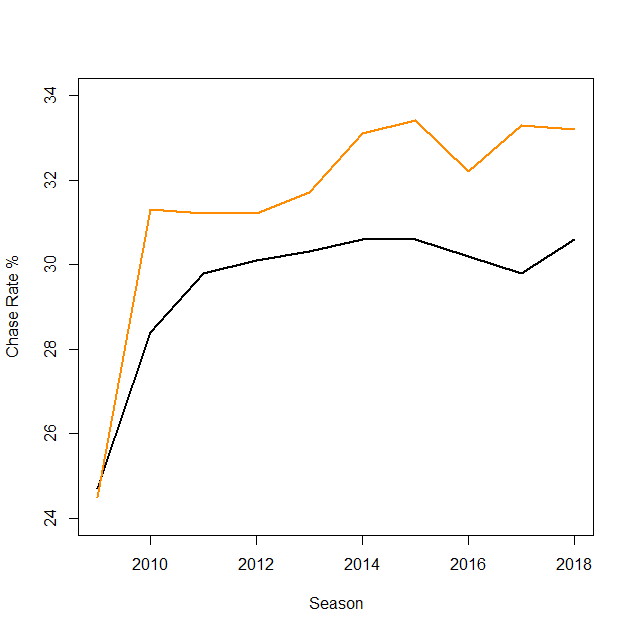
Now, low walk rates are not a problem. They are a symptom of a larger overarching problem, namely a lack of plate discipline. The Orioles have tended to chase pitches outside of the zone at a higher than average rate and make contact with those pitches at a lower than average rate. The difference between the Orioles and league chase rates has only been growing in recent years, peaking at 3.5 percentage points higher than league average in 2017.
Now, chasing pitches outside the zone is not a death sentence to offensive production. If players can make contact on pitches outside the zone, they might be able to do damage. However, in recent years, the Orioles as a team have run a contact rate on pitches outside the zone between 2-4 percentage points below league average. For example, in 2018 the Orioles have made contact on swings on pitches outside the strike zone 59.5% of the time, while league average sits at 63.2%. So, the Orioles chase pitches higher than average and make contact on those pitches lower than average. Unsurprisingly, this means that the Orioles will have more swinging strikes than league average, a fact that has been the case every year since 2010. In 2018, this swing and miss tendency has reached its highest rate, as 1 out of every 8 Orioles swings is a whiff (12.4%). By contrast, the league average is at 10.5%, the highest rate in league history.
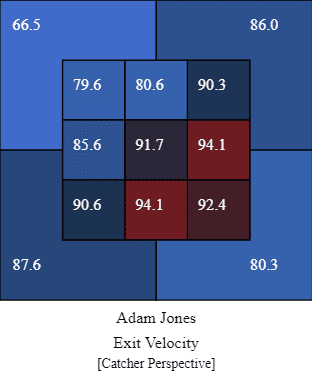
It is of course impossible for a batter to do damage on a whiff, but it is still difficult to do damage on pitches outside the zone. Now, there are bad ball hitters such as Yogi Berra or Vladimir Guerrero, but generally, a player’s production goes up as pitches get closer to the center of the zone. For example, look at Adam Jones’ exit velocity this year. Pitches inside the zone generally result in harder hit balls and are more likely to be dangerous hits.
As the Orioles chase more and more pitches outside the zone, the swings where they do make contact are increasingly likely to result in easy outs for opponents. The Orioles batting average on balls in play since 2008 falls about 6 points below league average and fourth-worst since 2009. While this is likely products of being in the shift-heavy American League East and the Orioles generally lacking speed, chasing pitches outside the zone resulting in poor contact doesn’t help the problem.
It’s hard to say if this is a developmental problem for Orioles’ prospects. Some players, such as the aforementioned Manny Machado, have improved their plate discipline as they have aged. Machado went from a 4.5% walk rate in his rookie year to nearly 11% this year while lowering his swinging strike rate from 11.5% to 8.6%. However, it is telling that four of the five players on the Orioles with better than average chase rates (Machado excluded) were developed outside of the Orioles organization.
This pattern has a chance to change in the future, although it is very uncertain. Chance Sisco is lauded for his strike-zone control, chasing only 23% of the time but making contact on these chases a mere 38% of the time. Yusniel Diaz carries above average walk rate, but does have a tendency to expand the zone on occasion according to Baseball America. On the other hand, Austin Hays and Ryan Mountcastle both sport below average walk rates and Hays chased nearly 45% of pitches in his brief 2017 callup. While it is possible that these two top prospects may grow and learn to temper their aggressive approach like Machado, it is something difficult to bet on.
Walks and on-base percentage were a hallmark of the Moneyball revolution. The platitude that “A walk was as good as a single” was often heard, but there’s more than just that. Improved plate discipline not only leads to increased walks and a larger margin for error offensively, more selective swinging gives hitters a better chance to do damage on balls in play. As the Orioles go forward, they may need to give careful thought to prioritizing these attributes of selection and discretion on chasing than they have in previous years. Doing so will likely yield high benefits for the team as the rebuild eventually comes to an end.

Orioles Analyst
Dr. Stephen Loftus received his Ph.D. in Statistics from Virginia Tech in 2015 and is an Assistant Professor of Mathematical Sciences at Randolph-Macon College. Prior to that, he worked as an Analyst in Baseball Research and Development for the Tampa Bay Rays, focusing on the Amateur Draft. He formerly wrote at FanGraphs and Beyond the Box Score. As a lifelong fan of the Orioles, he fondly remembers the playoff teams of 1996-97 and prefers to forget constantly impending doom of Jorge Julio, Albert Belle’s contract, and most years between 1998 and 2011.