
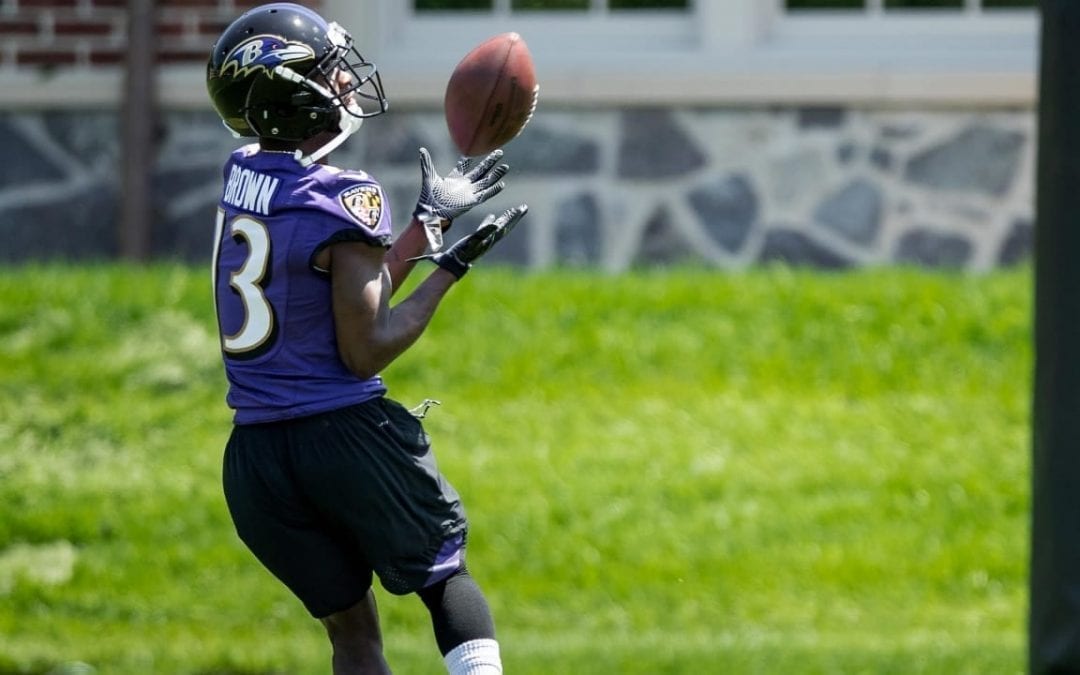
In 2015, the sky was the limit for John Brown. The Cardinals were a high-flying offense led by MVP candidate Carson Palmer, who dragged the offense to the NFC Championship game on his own before David Johnson had really become David Johnson. Arizona lost, but the window had to be considered wide-open. Brown finished the season with the most per-play receiving value of anyone on the Cardinals, nearly 30% above the NFL average. He finished higher than Larry Fitzgerald, and almost caught him on seasonal value despite 45 fewer targets.
(You can discuss this on the BSL Board here.)
Three calendar years later, that entire team has been lost to age and the winds of change. Bruce Arians and Palmer are retired. The offense has been reshuffled. Fitzgerald and Johnson are still around, but their job is to build up Josh Rosen rather than instantly compete for anything.
If you were to take a snapshot in time of that Brown moment, you could believe a lot of bold proclamations about the future of the second-year receiver. The Cardinals stole him in the third round out of Pittsburg State. Brown’s speed was a pain for defenses to deal with, especially in the slot. He was an easy early-round fantasy football pick in the offseason of 2016.
But underneath the surface look, the injuries begun to take a toll on Brown. Playing through shoulder pain in his last few playoff games in 2015, Arians noted that Brown “had about 200 [yards] worth of drops against Philadelphia.” His 2016 camp was slowed by a concussion, but the big revelation came in the middle of the season, when Brown was diagnosed with a rare sickle-cell trait that Arizona believed was causing pain in his legs.
They sent him for additional tests, but the die was cast as far as Brown’s NFL value. Any player with a weird injury is heavily discounted by the authoritarian types that run NFL teams and need players to fit in easy boxes. In news that should hit very close to home for Baltimore fans, Arizona’s front office, coaches, and beat reporters spent the entire 2017 offseason and training camp talking up Brown’s health and skills. They removed a cyst from Brown’s spine that Brown believes was the real culprit. Cardinals president Michael Bidwill said that Brown was very healthy. Beat reporters noted that Brown looked like he was past his health concerns.
…Aaaand then Brown immediately dealt with quad pain, back pain, turf toe, and a variety of other ailments in an injury-hampered, quarterback-devoid, ugly season. He finished with 299 receiving yards, and with Arians retiring, nobody in the room spoke up for him.
For Brown’s future earnings, it would have been better if he’d simply torn his ACL in 2015. Instead, NFL coaches and general managers who didn’t get an easy answer to “what’s wrong with him?” turned their noses up at him. Free agency turned up one-year, prove-it deals. That’s what Brown signed with the Ravens.
So, from a pure projector standpoint, injuries are actually a pretty easy thing to account for. What makes Brown’s case so interesting is that the sickle cell condition makes it hard for an NFL team to accurately gauge what they’ll get from him. Brown may always be a player who needs to have his snaps managed if what the Cardinals felt about his sickle cell condition remains true.
The odd thing about the fantasy football-ification of NFL news is that Brown has creeped back on to their radar at low stakes. The reason is simple: fantasy football teams have no ownership in Brown. They know the signs. They know that if a hamstring injury pops up, they can click eject and it will cost them almost nothing. Most fantasy football leagues churn the back end of their rosters constantly. Brown is a dart throw for them.
An actual projection of Brown from the outside is incredibly complex because we simply don’t have the detailed information that team doctors and medical staffs do. I can tell you that, in studying Brown’s 2017 targets, I thought there were times last season where his injuries sapped the speed right out of him. I can tell you that, should that happen again, all the optimism we’ve seen pumped out of Ravens camp will be for naught. But, nobody really knows how Brown’s body is going to react to NFL regular season football again.
I’ve written more than a few times for this website about things I think could tip the scales one way or the other for the Ravens this season. I have mostly left out Brown because I don’t put a lot of stock in training camp reports. It’s good that he’s healthy, good that he survived camp and preseason without incident, but what happens in the regular season is a different beast of football.
Still, players that have had real empirical success from both a numbers and eye test perspective are pretty rare free agency finds. There’s a reason Brown was available, but 2015 showed the kind of force he can be when healthy and placed in a good offense. A healthy Brown bumps every other receiver down in the pecking order, to a place much more their speed.
To me, it is a bit too much hope at this point. I don’t believe in it. But in researching this, I have to admit that it is on the table. It would not be the first time I’d discounted training camp results and watched someone prove me wrong. Tyrod Taylor’s Bills career was something I entirely dismissed out of hand.
Brown has always been a plus as an NFL receiver. His only missing ability has been availability. If the 2015 version turns up in 2018, the Ravens will have tilted the odds of passing game improvement in their favor.

Ravens Analyst
Rivers McCown is a writer and editor who has written for ESPN.com, Bleacher Report, USA Today, and Deadspin, among other places. He’s edited for Football Outsiders, Rookie Scouting Portfolio, and Pre-Snap Reads Quarterback Catalogue.