

The Orioles have long had a rotation problem. Last year, I looked at the Orioles continual need to find starting pitching. 2018 proved no exception, as the rotation ranks at the bottom of baseball by a number of measures.
2018 is also a season marked by great innovation in roster construction. We’ve seen the Angels manage to put a two-way player on the field somewhat successfully. We’ve seen teams further push for multi-positional players in the field. And of course, we’ve seen the onset of the opener, brought to us by the Tampa Bay Rays.
The concept of the opener is that a relief pitcher “opens” the game against some of the team’s best hitters, allowing what would be the regularly-scheduled starter to face worse hitters, put off the times through the order (TTO) penalty for the top hitters, and play off some obvious matchup advantages often present at the tops of lineups.
With the Orioles clearly having starting pitching problems, is it possible that they could benefit from utilizing the opener? Let’s look at their relief options, both in the majors and minors.
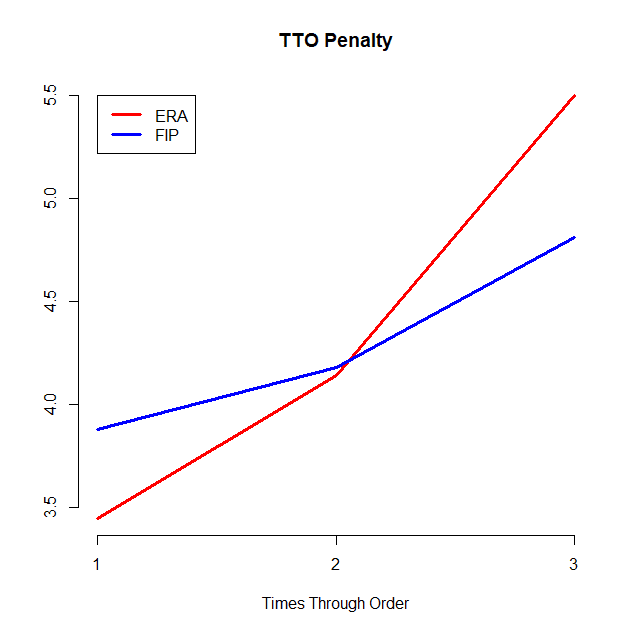
By this point, the TTO penalty is fairly well-known in baseball. That said, here’s a quick refresher. Generally speaking, the more times that batters see a pitcher pitch, the better they perform. The second—and eventually third—times through the order, the offense improves significantly. In 2018, this holds true, as ERA and FIP both go up the second and third times through.
The individual batting components go up as well across the board. Batting average, power numbers, overall offensive performance all get better on a batter’s second and third times facing the same pitcher.

The Orioles’ starters specifically seem to be worse off than many in the league. For MLB starting pitchers, the times through order penalty for first time to second time is 20.1% for ERA and 3.1% for wOBA. For the Orioles, this penalty is 36.7% for ERA and 9.7% for wOBA. The few Orioles’ pitchers that make to a third time through the order continue to fare worse than the league in terms of percentage lost, and they were already starting worse than league average on the first time through the order for most any stat.
This seems to make the team a particularly good candidate for the use of openers. The Rays originated the use in part because they lacked quality pitchers in the starting rotation, although in their case it was more about pitcher injury issues—Jose de Leon and Brett Honeywell needed Tommy John Surgery in the preseason—rather than one of pitcher ability. That said, the Orioles lack quality pitchers as well, leaving them in need of some boost for the flagging rotation.
Going into 2019, there are a few opener options that we can take off the board. Alex Cobb, Andrew Cashner, Dylan Bundy, Yefry Ramirez, and David Hess all probably would be exempt from opener duty. This isn’t necessarily because they are excellent starters that don’t need opener help. Rather, even with an opener teams still need to have pitchers who will eat up a number of innings after the opener has done their job. Realistically, the Orioles would at most employ two openers for the potential Ramirez and Hess spots in the rotation. Mychal Givens is probably out as an opener as well. He is likely to be the best reliever in Baltimore, and even teams that employ the opener regularly often hold their best reliever for late-inning work.
That leaves a combination of players as opening possibilities; Richard Bleier, Tanner Scott, Paul Fry, Mike Wright all have potential claims on such a role. Looking at the Rays, their openers seem to have two distinct traits; they are almost exclusively right-handed pitchers—to combat the often heavy-righty tops of lineups—and they are able to generate high numbers of strikeouts—at least one per inning. Bleier and Scott both lefties and Wright generates around 0.82 strikeouts per inning. None of them seem to be particularly well-suited to the role. Miguel Castro has been mentioned in such a role, but his walk rate combined with lack of strikeouts also makes opening a tough ask for him.
However, Paul Fry presents an interesting case. He is a lefty, but in a very small sample size he actually has a reverse platoon split (.269 wOBA against RHB and .362 against LHB). This is in part due to his ability to bury his slider low and away from righties, helping to keep them off-balance. He doesn’t have the blazing stuff of the Rays two main openers—Ryne Stanek and Diego Castillo—but he has to this point struck out 9.5 batters per nine innings (Just over one an inning). With Fry, there’s the possibility that—if his strikeout and splits translate to a larger sample size—he may be able to be an effective opener for the Orioles.
Finding a second opener is a little tougher, as the team and minor league system isn’t exactly flush with pitching of any kind. One intriguing candidate could be Ryan Meisinger, a righty reliever who has always put up solid strikeout and walk numbers throughout the minors, but has been hit by an incredible 3.38 HR/9. If he can get the home runs under control, he might be another intriguing option for the team, even if he lacks the raw stuff of other openers.
The final possibility is that the team could glean a few openers from the minors, with middling players such as Luis Ortiz or Dillon Tate presumably getting a chance in the majors. While this is a possibility, it is not one that I would recommend for 2019. Pitching a shorter stint is not something that comes naturally to every starting pitcher. It is likely that Ortiz’s or Tate’s stuff would play up in shorter outings, but they have been almost exclusively starters in their minor league career. It is hard to say how they would adjust to shorter, bullpen-like roles. If they become relievers at some point in their career, they might be excellent openers. Until then, they should be allowed to pursue their jobs as starters as long as the team deems it useful.
This discussion, interesting though it may be, may be a moot point. Adopting the opener as a strategy requires strong conviction from the front office of a team. The Rays—a team whose front office mindset and members I know much better than the Orioles—are just such a team. Beyond the analytics department, the members of the Rays’ front office are committed to fully maximizing their roster, looking for every advantage from drafting and developing two-way players, playing pitchers out of position, to the opener itself. They do this to win, using the players on their roster to its full advantage, but again this requires complete buy-in from the front office and management.
While I cannot necessarily speak to the Orioles’ front office, it is hard to see the team convincing Brady Anderson, the Angelos family, or Buck Showalter to take a chance on the opener. Despite the lack of starting options on the team and in the minors, combined with the unlikelihood of the team being able to sign top-flight free agent options, it seems unlikely that the chance will be taken in Baltimore, even if they might be able to draw some benefit from it.

Orioles Analyst
Dr. Stephen Loftus received his Ph.D. in Statistics from Virginia Tech in 2015 and is an Assistant Professor of Mathematical Sciences at Randolph-Macon College. Prior to that, he worked as an Analyst in Baseball Research and Development for the Tampa Bay Rays, focusing on the Amateur Draft. He formerly wrote at FanGraphs and Beyond the Box Score. As a lifelong fan of the Orioles, he fondly remembers the playoff teams of 1996-97 and prefers to forget constantly impending doom of Jorge Julio, Albert Belle’s contract, and most years between 1998 and 2011.