
Joe Flacco is out of Baltimore with the new regime under GM Eric DeCosta somehow receiving a mid-round pick for a player who was beat out by a pretty inaccurate, but effective rushing, rookie quarterback.
Some could argue that Flacco’s supporting casts during his final years in Baltimore weren’t great, and they wouldn’t be wrong, but when you’re paid a record setting contract in 2013, a record breaking extension in 2016, and 14% of the salary cap since 2016, you’re expected to be an elevator of the talent around you. In fact, your quarterback has to be an elevator because his roster isn’t likely to be as strong due to these high costs.
(You can discuss this on the BSL Board here.)
In the case of the Ravens, they decided to invest money and draft picks into their offensive line and defense with the understanding being that they’d have to find late-round talent to combine with wide receiving talent in the latter stages of their career.
Some teams will further invest into the passing game strategy, but the Ravens didn’t necessarily do the best job surrounding Flacco with talent. Gordon McGuinness pointed out that since Flacco was drafted in the first round of the 2008 draft, the Ravens have used just two (!) of their 33 picks that have come in the first three rounds since that time on wide receivers. They were Torrey Smith and Breshad Perriman.
Baltimore hasn’t drafted a running back in the first three rounds since Bernard Pierce in the third round of 2012.
While I understand the Ravens have had success with a strategy focused on finding low-cost contributors at wide receiver, typically on their third contracts or later like Anquan Boldin and Steve Smith. Baltimore’s attempts at replicating this with Mike Wallace and Michael Crabtree that haven’t worked out as it pertains to the win/loss column.
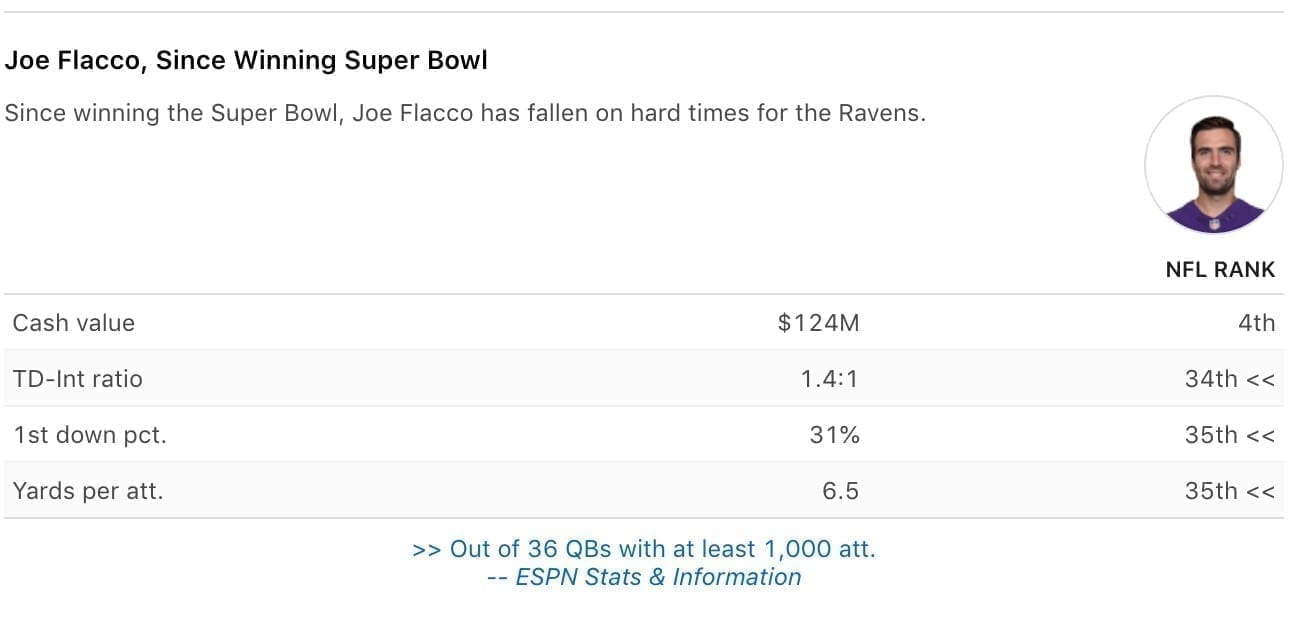
Adam Schefter shared this interesting summary of who Flacco has been since he got off his rookie contract:
The Ravens have moved on and they’re happy because Lamar Jackson is at quarterback and, despite his inefficiencies and issues, he’s a rookie contract quarterback who will cost one to one and a half percent of the cap for the next three years. Where he lacks in accuracy, he adds the ability to run the football and with all that cap space, the organization is in a position to re-create the Super Bowl strategy that has worked for them in the past: a low-cost quarterback with a strong rushing attack to lean on and a phenomenal defense. With the cap space the team has, the front office can now use free agency to really, finally build a more explosive offense.
One could argue the Ravens haven’t had explosive pieces on offense since the 2012 team with Anquan Boldin, Torrey Smith, and Ray Rice or the 2014 team with Steve and Torrey Smith, plus Justin Forsett.
When it came down to it, I wrote in Caponomics: Building Super Bowl Champions that the main two strategies I see in the NFL are the high-cost quarterback strategy, which many teams supplement with going all in on the passing attack, and a low-cost quarterback strategy, which is almost exclusively rookie contract quarterbacks between one and four and a half percent of the cap, that allows an organization to build a more well rounded team that isn’t completely reliant on winning through passing.
Kevin Clark of The Ringer wrote that Howie Roseman once told him that “each offseason he studies the final four teams in the playoffs, examining factors ranging from draft strategy and scheme to the height and weight of players, as a way of identifying strategies his organization might implement.”
In 2017, the final four of New England, Philadelphia, Jacksonville, and Minnesota all had top-5 defenses. While the Vikings had Sam Bradford over 10% of the cap on the bench and Tom Brady was on a discounted cap hit under nine percent of the cap, three of the starters were on deals under four percent of the cap. Two of the teams were rolling with their back-ups at the start of the season and one of the teams had Blake Bortles as their quarterback!
Then the next season, the final four teams were the top four offenses in the NFL. The Patriots and Saints had Hall of Fame quarterbacks on deals at 12 and 13% of the cap, while the Rams and Chiefs had rookie contract quarterbacks.
Clark wrote a great Tweet when the Flacco news broke:
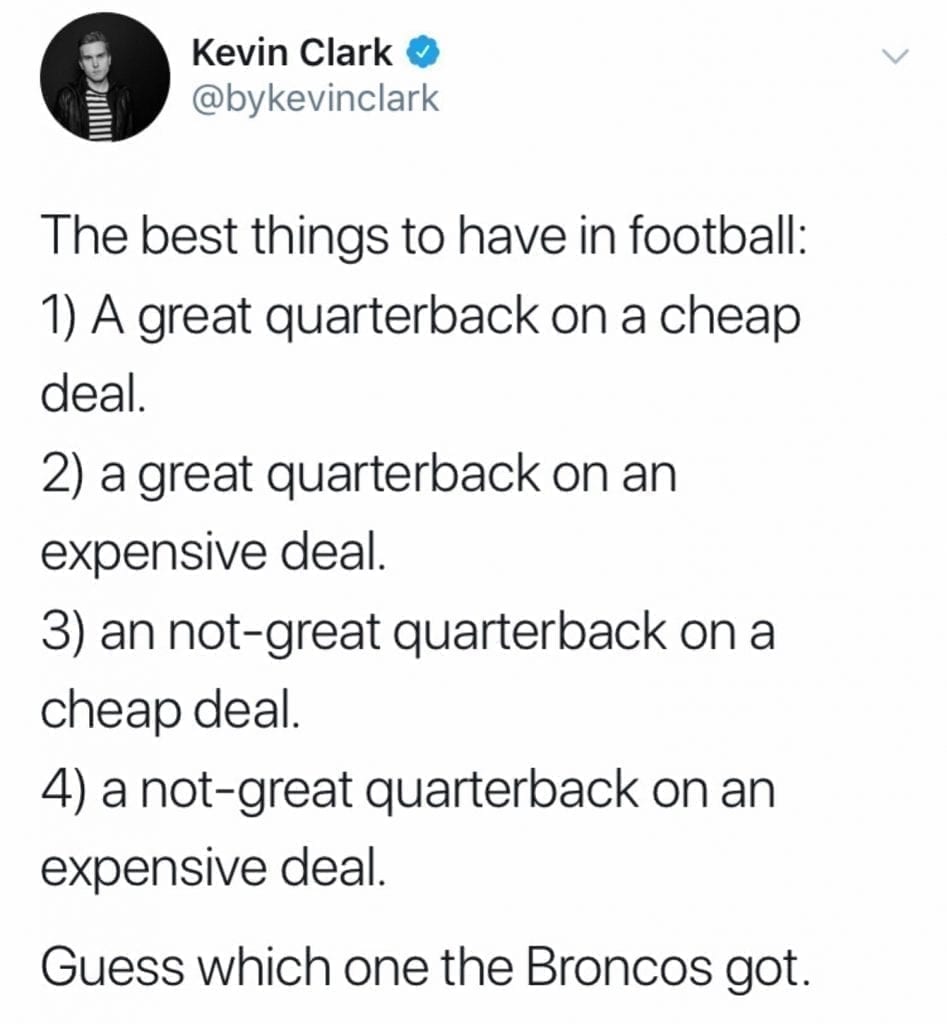
This has become a lesson of these last two seasons: if you’re trying to compete for a Super Bowl, then you’re either going to do it with a Hall of Fame level veteran on an expensive deal (or Tom Brady making a discount) or a rookie contract quarterback.
While the team never surrounded Flacco with elite skill position players, I don’t think anyone thinks he’s a Hall of Fame level veteran or the kind player who can lead a team to a Super Bowl at 14% of the cap, so the team was in a naturally tough position to succeed in.
And herein lies another issue with the huge Flacco contract. You can’t blame the Ravens for signing their Super Bowl winning quarterback to a record contract in the months following his remarkable playoff run to win that Super Bowl. Flacco had 285 yards per game, 9.0 yards per attempt, a 57.9% completion percentage, 11 touchdowns and 0 interceptions. Moving on from him at that time would’ve been seen as a massive mistake across the league, especially prior to the 2013 Seahawks sort of illuminating this strategy of rookie contract success under the 2011 CBA that others are now replicating.
But Flacco was never a top of market type of a quarterback. Over the first five years of his career, he went 54-26, a .675 winning percentage, but he was able to lean on a defense that was ranked third in points allowed for every year of his career until the Super Bowl year where they were ranked 12th. This lower ranking was ikely in large part due to field general Ray Lewis playing in only six games that season.
In 2008, Ray Rice’s rookie season as well, the perfect second round pick to pair with Flacco, the Ravens ranked fourth in the NFL in rushing behind a combination of Le’Ron McClain, Willis McGahee, and Rice. While you don’t want me to remind you of the 23-14 AFC Championship loss to the Steelers, the team made it all the way there with a rookie quarterback, leaning on a rushing attack that was 22nd in the league in yards per attempt. Flacco led a passing offense that was 28th in yards. They made it that far on the back of a defense and volume rushing attack that controlled the pace and style of the game.
In 2009, Ray Rice became the lead back with 1339 rushing yards and 702 receiving yards, plus a 5.3 yard per carry rate that pushed the team to fourth in rushing yards per attempt and fifth in rushing. The team bounced around the top half of the league in yards per rushing attempt through the 2012 season, which gave the offense a balanced attack that could grind out wins because of that great defense.
Ray Rice averaged 1877 scrimmage yards per seasons over these four seasons at 5.4 yards per touch. This is where an idea I’ve been bouncing around comes in. I think much of a running backs’ success comes from his offensive line play and how he’s used, but a player who can create 5.4 yards per touch 22 times per game is a very valuable player.
This may be part of what’s leading to teams investing first round picks in running backs more frequently over the last few seasons. It’s not just the rushing we’re talking about with running backs, some of these guys give you over 700 receiving yards as well, that’s something that’ll cost you some coin on the free agent market at receiver. This is an idea for us to consider within the context of the Ravens not investing in running backs the past few years.
When you look at Flacco’s raw stats as a rookie contract player, you don’t see a 13% of the salary cap, first tier quarterback. He averaged 220 yards per game over the first five years of his career before the veteran contract, 7.1 yards per attempt, a 60.5% completion percentage, 20 touchdowns per season and 11 interceptions. In defense of Flacco though, the team never ranked higher than 15th in passing attempts and was in the bottom third of the NFL his first three seasons.
You could imagine a scenario where Flacco could become this first rate player, but a) it seemed fairly unlikely outside of that Super Bowl run and b) going expensive at quarterback threw the team out of it’s past strategy of a rush based offense with an elite defense. Even as they transitioned to a more pass based strategy, they couldn’t invest enough resources there.
Now, the question here is, is it that Flacco wasn’t or isn’t very good or is it that the Ravens didn’t properly allocate roster construction resources after signing Flacco to that extension? You could argue both ways.
In the Flacco wasn’t very good category there are the raw stats I shared earlier and there’s just the basic stats. Since 2013, his record has sunk to 42-41 due to the roster that surrounded him with his huge contract taking up chunks of cash and cap space that couldn’t be allocated elsewhere, and his not being capable of carrying the roster. In some ways, he was near a first tier level with a 62.6% completion percentage and 248 yards per game in the air, but that 6.5 yards per attempt is such a telling statistic. His 21 touchdowns to 15 interceptions per season is too.
Just as an example, the 2015 and 2016 teams were first in the NFL in passing attempts, but eighth and 12th in passing yards. They were 22nd in net passing yards per attempt at 6.1 in 2015 (when he played 10 of 16 games) and 26th in 2016 at 5.8. From an efficiency standpoint, he wasn’t very good.
But on the other side, maybe they didn’t properly allocate resources considering what has already been explained regarding their lack of talent at receiver and running back.
Tight ends haven’t developed either in Baltimore, since Flacco got his new deal and the Ravens have spent a lot of draft capital at the position. In 2010, Ed Dickson and Dennis Pitta were taken in the third and fourth round, then developed into solid starters with Pitta’s career being derailed by hip injuries.
They spent a 2014 third round pick on Crockett Gillmore, then second and fifth round picks on Maxx Williams and Nick Boyle the next year. None of these players have worked out for Baltimore and, considering the draft capital on Gillmore and Williams, this can’t be excused, some of the onus is on Flacco.
Maybe some of the onus has been on the offensive coordinators the past few years in regards to both Flacco, the tight ends, and the offense. Kubiak got a lot out of Flacco in 2014, but then Marc Trestman and Marty Mornhinwheig haven’t produced great offenses. New OC Greg Roman was brought in specifically for Jackson as the team may have knew they were aiming for a mobile QB in the 2019 draft before they hired him considering his history with Alex Smith, Colin Kaepernick and Tyrod Taylor.
Therein may lie an issue with Roman as an offensive coordinator moving forward. I don’t know if it’s a function of the style of offense he runs or the talent at quarterback for him, but Roman hasn’t been capable of drawing big passing averages out of quarterbacks in his career. Something to keep an eye on when you’re considering what this offense does schematically in a league that does need innovative passing strategies no matter if you plan on running the ball 30 to 35 times a game. That said, Roman is someone with a history of making things work with quarterbacks like Jackson, so the team has the right coordinator to make it work.
The good news for Ravens fans is that with Jackson, they’ve re-vamped the tight end group again with first round pick Hayden Hurst and third round pick Mark Andrews, which means that group looks settled with Jackson as the quarterback, but there’s much left to build around him.
Unlike the Flacco era, the team now will have the cap space to find some of those expensive pieces in free agency at positions that they haven’t drafted well. In their defense, it’s hard to build a roster around that kind of cap hit, while still maintaining the rest of the roster. Flacco was an average to below average quarterback on an expensive deal since winning his Super Bowl and the Ravens front office couldn’t overcome that to create a team that was better than average.
The goal for the 2019 offseason is to focus on the offensive side of the football to give Jackson more to work with and increase the probability of him taking a step forward in the coming season. The defense will be further improved through the mid-rounds of the draft, but cap space should be used in free agency on offense as well as the first round pick. Teams are going to study what the Chargers did to slow down the Ravens in the Wild Card Round all offseason and teams will create their own solutions to the problem this Jackson led offense presents, so the front office needs to make the pieces around him better, something they couldn’t do much of for Flacco.
Now, while Jackson will be inexpensive and it seems he’s the quarterback of the future, he has a long way to go if this team is going to get past AFC foes like New England, Kansas City, the Chargers, Texans, Colts, or even the surging Browns in 2019 to make a Super Bowl appearance. The offense must improve ot take this step.
Moving on from Flacco gave the team $32.5 million in cap space for the upcoming season. If cornerback Jimmy Smith is released, then that number increases to $42 million. No more Michael Crabtree puts the team around $46.67 million in cap space, then releasing Willie Snead would add another $6.2 million if he were released. This would put the organization at $52.87 million in cap space, then after factoring in draft costs for their seven draft picks in 2019, we see the team at about $46.2 million in cap space.
Releasing Brandon Carr could net the team $5 million in cap space. I don’t think that will happen with Smith being gone, but another possibility to clear space if the team has other plans.
Cap space could be between $40 to 46 million dependent on what they decide to do with receivers as getting rid of Crabtree and Snead, with John Brown a free agent, basically clears the whole receiving group out. While the receiving group wasn’t good, it might be a drastic change to have no one coming back next year. If I’m the team though, I’d rather get rid of them and take a new approach through the draft and free agency. The only receiver I’d want to keep would be re-signing John Brown for around $4-5 million a year if I didn’t get one of the other receivers on the market.
Playing with Over The Cap’s salary cap calculator, a restructure of interior defender Brandon Williams’ contract could open up another $5.63 million in cap space. A restructure of safety Tony Jefferson’s contract could create almost $3.6 million in cap space. Point being here, with over $40 million in cap space before considering potential restructures, the Ravens should be able to do whatever they desire in free agency.
The focus of the offseason is that with Jackson at quarterback, the Ravens are looking to succeed with the run-first offense with a strong defense strategy that earned them the 2000 Super Bowl, but with the added benefit of his mobility. While Jackson’s 163.5 passing yards per game aren’t going to win a Super Bowl, he adds 76.3 per game on the ground. That’s 239.8 yards per game. His per pass average of 7.1 isn’t terrible either. There’s room for improvement, but something to build on, and the front office has to know how to best facilitate an offense with the weapons around him to improve.
The main point of focus on defense will be re-signing inside linebacker CJ Mosley to a deal in the $11.5 to $13 million range depending if he hits free agency and someone else starts bidding. Jason Fitzgerald of Over The Cap thinks it will be at that $11.5 million number.
Terrell Suggs says he wants to keep playing, so he’s someone you’d keep around the $4 to $5 million range on a year-to-year basis. Za’Darius Smith became a very solid player this season after three average years and Fitzgerald thinks he’ll cost about $8 million per year. He’d be a player with the potential for value upside as it’s conceivable to think he’s going to continue to improve and, considering the high costs of that market, $8 or even $10 million is a bargain. He may be forgotten about in a deep edge rusher class, which would serve Baltimore.
With a lack of first-rate talent available at wide receiver in free agency, and with these top talents frequently being overvalued on the market due to even first rate WR2s rarely hitting the free agent market, it’s a position I’d look to avoid on in free agency, but one I would target with my first round pick at #22. Names that pop out from draft analysts in this spot are DK Metcalf out of Ole Miss and Kelvin Harmon from NC State.
Metcalf is coming off a neck injury that limited him to just seven games last year, but he is a physical freak and will be ready for the season. Something that jumps out in analysis about Harmon is that he’s had two 1000-yard seasons, Ryan Wilson from CBS Sports says, Harmon has the “ability to get in and out of breaks, sets up cornerbacks with his footwork, can make contested catches, and is a physically after-the-catch runner who also happens to be a willing blocker.” At 6’3”, 215-pounds, he is a big bodied, physical receiver who happens to be a deep threat as well.
Watching film, Harmon looks like a complete receiver to me with the ability to be a complete player with his blocking as well, something that will be important in such a run focused offense. He creates clear separation and really looks like he has the physicality and athleticism to be a #1 WR. He wins on every kind of route.
I’d like to see that kind of field stretching, complete addition to the receiver room to help Jackson take steps forward, but we’re going to need more there as well. If the team doesn’t re-sign Brown, the Ravens could continue their strategy of finding talented third contract receivers with a short-term $5 to $7 million a year pact with Golden Tate and be satisfied with finding a player who can create yards after catch for the young quarterback after short passes. Harmon would serve the team in a more complete role, while stretching the field deep for everything the team could set up underneath with the personnel I think they could secure.
The first big step I’d take in improving the offense in free agency isn’t at a skill spot though; it’s on the offensive line, a position group that didn’t give Jackson time to throw in that game against the Chargers with seven sacks and plenty more pressures.
Right guard Marshal Yanda becomes a free agent in 2020, left tackle Ronnie Stanley will have his fifth year option activated in a couple months and be under contract through 2020, and right tackle Trenton Brown was a rookie last season. If the team can improve at left guard and center, the rushing and passing attack will be further improved next year. In that game against the Chargers, Melvin Ingram moved all over the formation leading an interior pass rush that forced the Ravens to take out starting left guard James Hurst on the team’s second possession of the third quarter for Bradley Boseman. The Chargers had three sacks before his benching and four after according to Jeremy Bergman of NFL.com. Hurst finished the year with a 56.5 PFF rating, while center Matt Skura was rated 58.2.
This has become a theme of many of my analysis this offseason, but center Matt Paradis of the Broncos and left guard Rodger Saffold of the Rams are this year’s top players in the interior offensive line market. Fitzgerald thinks Saffold will see something around $11 million per year, while Paradis should be around $10.7 million a year on a three year deal. Baltimore could afford either one of them and it would help them have stability along the interior of the line with Yanda being a free agent after this season, his 35-year-old season. The loss of center Ryan Jensen to a market setting $10.5 million a year deal in Tampa Bay had an impact on this offensive line, so to potentially be without a veteran with Yanda a free agent next year, this would be a tough place to be with a group made up of cheap pieces. A bad offensive line could end any chance of the Ravens taking advantage of these cheap years for Jackson.
We’ve got some potential money outlays to players: CJ Mosley is going to make $11.5 million per year, an interior lineman at $11 million, Suggs around $5 million, $8 million per year for Za’Darius Smith, then either John Brown or Golden Tate around $5 million. That’s $50.5 million and we spoke of the cap space being between $40 and $46 million dependent on what’s done at receiver. Let’s call that $46 million because we’re factoring in the signing of Brown or Tate for if they got rid of Snead.
These contracts won’t be simply split into every contract year having a cap hit even with the average per year total. The Ravens, like many teams will likely structure the contracts to push some cap charges into the future by providing a sum of the early cash flows of the deal in the form of a signing bonus.
When you look at the average per years on their face, you could think the Ravens are $4.5 million over the cap. This is unlikely, the Ravens would probably give CJ Mosley, the interior lineman, and Za’Darius Smith signing bonuses with lower salaries in the early years because of the signing bonus. That could create $8 to $10 million in cap space right there, which puts the Ravens $3.5 to $5.5 million under the salary cap. The team can create $9.23 million more through re-structuring Williams and Jefferson as we said earlier, so if they did that, then the Ravens could have $12.73 to $14.73 million in cap space.
The Ravens front office could decide to do something different, like find a cheaper interior offensive lineman to improve blocking and have more cap space, but it’s key in my eyes to take advantage of Jackson’s rookie deal by making the best line possible and if they can get Paradis or Saffold. Voices around the industry spend so much time talking about the importance of the quarterback, but recent champions are proving the value of offensive and defensive lines. If you have the money to spend on either line, they are a great place to invest.
With this, the Ravens could make the biggest splash of all in free agency, a move that would help them go all in on this run-first defensive model, and a move that they could afford from a structural perspective in regard to the team roster construction with Lamar Jackson on such a cheap deal. And that move would be signing the 27-year old LeVeon Bell to a deal worth $15 million per year over the next four seasons.
Mosley, the interior offensive lineman, Suggs, and Smith are all safe investments. If they signed Tate at receiver, that’s a safe investment as well, Those five investments have high floors in terms of the probable return on investment, which makes the risks associated with signing Bell more manageable from a risk perspective and the risk may be worth the reward considering what Bell could bring the offense. While running backs may be a bad free agent value typically, free agent wide receivers have proven to be as well and with markets how they are in 2019, I’d rather draft to try and find the game changing receiver and sign Bell if I was in the position Baltimore is in.
There probably is no combination of free agent receivers out there that turn this Ravens passing attack around without the right choice in the first round, but Tyrell Williams of the Chargers is a name we’ll hear in the $12 million range. I’d rather spend $15 million a year on Bell than $12 million a year on Williams.
Signing a free agent running back is almost always seen as a bad decision and for good reason as almost none of them have worked out in the last decade. It’s been a historically bad idea, but if any running back had the raw ability or skill set to make it work, it’s a player who has averaged 81 catches for 686 receiving yards per 16 games over the course of his career. A running back who averaged 1377 rushing yards per 16 games and 11 total touchdowns.
We must also be cognizant of the value a 700-yard receiver at running back is and re-adjust how we perceive the market based on this fact and, like with what I said regarding Rice before, based on a player like Bell potentially producing 1800 to 2000 total yards on a season at 5.5 yards per touch. These playmakers are as important to an offense as a top playmaker at receiver is. I’m not saying every team should go spend a ton of money at running back, but I am seeing teams handle the situation differently, like drafting them in the first wrong, and I don’t think they’re wrong (of course, dependent on the current roster situation).
Although, having played only 12.4 games per season during his career due to missing 18 of 80 possible games over the first five years of his career via suspension or injury, his 1541 touches (308 per season) are a variable that makes you wonder how soon it will be before he breaks down. It’ll make you worry about if he’ll play about 75% of your games for you too.
In defense of the move for the Ravens, the main locations Bell has associated with as potential landing spots are all teams with massive amounts of cap space and two of them have rookie contract quarterbacks as well. The Texans and Jets both have a ton of cap space and rookie contract quarterbacks, while the Colts and Raiders have loads of cap space and draft capital to improve the rest of the roster, thus creating the opportunity to fit Bell into their formula of success. The Ravens make sense in this grouping because of this rookie contract quarterback, because of the almost $50 million in cap space, and, most of all, because of the need to give Jackson a deadly rushing attack with Gus Edwards as well coming on last season, plus an elite pass catching running back to make the young quarterback’s job easier.
Lamar Jackson has the capability of being a 1000-yard rusher. Now consider what this team looks like with another year of steady improvement as a passer, a trend that dates back to college per PFF as he has become more familiar with running an offensive system every year after spending his high school years as a freelancer behind center because his otherworldly athletic ability made that a possible strategy.
With the moves we discussed, the offense would have first round pick Kelvin Harmon out wide, free agent signee Golden Tate in the slot, Mark Andrews and Hayden Hurst at tight end, a backfield tandem of Bell and Gus Edwards, an improved offensive line, and a similar group of players to what produced the NFL’s second best scoring defense in 2018 with some added draft picks, this is a team that can succeed with Jackson at quarterback. And it’s feasible that all of this could be built because of Jackson’s contract.
Furthermore, the Ravens are in a unique position with a quarterback at such a low-cost, plus no top of market expenses at edge rusher, cornerback, wide receiver, and left tackle, until Ronnie Stanley gets paid. The team is projected to have as much as $110 million in cap space during the 2020 offseason before these contracts we discussed are signed, and even then they’ll have about $50 million in cap space left over, meaning room to further improve on what happens in 2019.
If the team weren’t to sign Bell, I’d advocate for taking a running back in the third round, but signing Bell opens the team up to using the three picks in the third and fourth round to secure pass rushers and defensive backs to fortify the defensive group further with the hope they find a starter or two there. Of course, taking a running back in the third round could be a totally valid solution, which then gives the team an extra $15 million per year to spend preferably on that defense.
I’d then use the three picks in the fifth and sixth rounds to fortify the interior of the offensive line and make a bet on a receiver and another defensive back as some talent can be found in these rounds. Caponomics has an analysis of position groups by draft round and their probability of becoming a starter if you want to look deeper into this.
We have seen the 2012 Ravens, 2013 Seahawks, and 2017 Eagles win Super Bowls with rookie contract players at quarterback making far below the veteran market rates. The 2018 Chiefs and Rams were excellent because of the complete rosters around Patrick Mahomes and Jared Goff. The Browns are the talk of the league with budding stars Baker Mayfield, Myles Garrett, Denzel Ward, and Nick Chubb all on low-cost rookie contract quarterbacks.
The Bears made a huge leap forward in 2018 by signing defensive end Khalil Mack to a $23.5 million deal after trading two first round picks for him, wide receiver Allen Robinson to a $14 million deal, re-signing cornerback Kyle Fuller at $14 million per year, and signing former Eagles tight end Trey Burton to an $8 million per year contract. Trubisky was a much better player for a team that ended ninth in points scored and first in points allowed.
This is the Ravens Super Bowl window with Jackson at such a low-cost, so the goal must be to do what these other championship teams have done with rookie contract quarterbacks:
– Provide the quarterback with an offensive line to protect him and help facilitate an elite rushing attack.
– Give that quarterback weapons to facilitate his success.
– Create a defense that puts pressure on the quarterback with a defensive backfield capable of defending a quantity of mismatches.
With the moves discussed in this article, the Ravens would have all of this and the Super Bowl chances could become very real. It’s all on Lamar Jackson though, will he improve as a passer to give this team enough to succeed?
We will see what happens, but what happens over the course of the next three months will determine what kind of team he’ll have around him and the probability of this roster competing for a championship now and through Jackson’s rookie deal.
This team’s Super bowl window is right now. This offseason will help determine if that happens or if the Ravens miss out on capitalizing on one of the greatest values in all of sport: the rookie contract quarterback.
Zack Moore is a writer for OverTheCap.com and author of the recently released book titled, “Caponomics: Building Super Bowl Champions,” which is now available on Amazon. You can follow him on Twitter @ZackMooreNFL.

Zack Moore is a former college football player at the University of Rhode Island. He received his MBA from Rutgers Business School and has written for Over The Cap since 2014. He is the author of Caponomics: Building Super Bowl Champions, which offers insight into how teams use data and analytics to create sustainable, competitive teams through the salary cap that are capable of competing for championships. Zack’s research has appeared on various platforms including ESPN, Sports Illustrated, Bleacher Report, USA Today, and the NFL Network.