

The Baltimore Orioles have been on the clock since last September. Who they choose can drastically change the future of the franchise. Nail the pick—a la Manny Machado in 2010—and the franchise can have a valuable player for years. Miss catastrophically—Billy Rowell was chosen immediately before Tim Lincecum and Max Scherzer in 2006—and the team will likely continue in a rut.
These are the stakes that face Mike Elias and a brand-new front office. While they will surely have a little leeway, there will be many judgements about the ability of the new arrivals based on the results of this 2019 Draft. And it’s more than just Elias, or Elias and Medjal. Involved in this process are dozens of scouts, analysts, and office workers who will make this whole decision-making process possible.
Before I found my way to academia, I spent some time working for the Tampa Bay Rays, an organization often noted for their analytical approach to problem solving throughout all aspects of baseball. Specifically, I worked analyzing the June Draft, one of several analysts considering all aspects of our scouting reports and available data to help the organization make the best possible pick. I lived the draft for the majority of the year, as it’s a process has very few slow moments.
In the 2017 June Draft, the Rays held the 4th pick in the 1st Round as well as the 31st and 40th picks overall. All told, the team had the third-largest draft pool that season at a little over $12.5 million, plenty of ammunition to go many different directions. In what follows, we take a glimpse behind the curtain, seeing parts of the process from my perspective that led to the team selecting a draft class that included a future top-20 MLB prospect in Brendan McKay.
(You can discuss this on the BSL Board here.)
***************
The names of all front office personnel of the Tampa Bay Rays has been removed. There are many aspects and discussions during the process that are not and cannot be discussed, and all the views are from my perspective and may not fully reflect the situation from the entire organization.
The long trek towards June 12th 2017 began well before the end of the 2016 season. Scouts had been following players for years, with J.B. Bukauskas being a perfect example. In 2017 Bukauskas was a right-handed pitcher out of UNC with one of the most advanced arsenals in the draft. But in 2014, he had been a 1st Round talent as a Senior from a Northern Virginia high school, and as such had been on radars since at least 2012. All through the Summer of 2016, talent evaluators from every team traveled to every corner of the country to look over the players whose names most fans would not be familiar with until at least 2020—if they would be familiar with them at all.
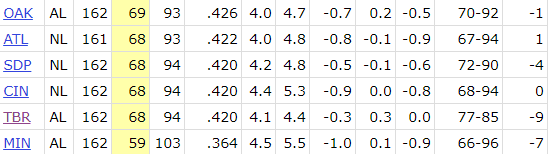
All this had been going on before I became cognizant of all this, but we’ll start on October 2nd. We started the day at 66-95, good for the second-worst record in baseball, tied with many teams. We held the tiebreaker over a few teams, but depending on how things shook out, we could fall anywhere from the 2nd to 6th pick—the Twins having long clinched the top pick. Obviously it’d be nice to have the higher pick, both for the likely increased talent available and the $1.8 million difference in money from 2nd to 6th.
We didn’t get the 2nd pick, but we didn’t fall as far as 6th either. The team pulled out an extra inning win over the Rangers, but fortunately the Braves and A’s also won, leaving us at the 4th pick. In the previous five drafts, 4th picks included Kevin Gausman (Orioles, 2012), Kohl Stewart (Twins, 2013), Kyle Schwarber (Cubs, 2014), Dillon Tate (Rangers, 2015), and Riley Pint (Rockies, 2016). Not horrible, but hardly the most inspiring group—especially in comparison to the 2nd overall counterparts.
I didn’t contemplate #2 versus #4 versus #6 for too long, because the work began quickly. The work, specifically, was trying to predict if a potential draftee would make the majors and how they would perform if they got there. I was one of three analysts directly involved with the model that year, although every analyst in the office contributed in one way or another. In addition to the three of us, we had computer science specialists involved in collecting data, individuals from Amateur Scouting providing expertise on the reliability of the inputs, and Player Development weighing in on developmental possibilities for players. All told, we augmented our statistical capabilities with literal hundreds of years of baseball experience.
That occupied the months of October through December; generate predictions, discuss results with analysts, discuss results with the larger group of people with influence on the Draft process, discuss results with the decision makers, and reassess. And then do it all over again. If it felt like a never-ending process, it’s because it truly never ends. As one statistician once said, “All models are wrong,” or as Yogi Berra put it, “Predictions are hard, especially when they are about the future.”
The first big news about the Draft from the “outside” world came in January, as Baseball America released their top 100 High School and top 100 College players going into the Spring seasons. Leading the way on the high school side was Hunter Greene, a right-handed pitcher out of California who could touch 100 MPH as an 18-year old, and Royce Lewis, another Californian shortstop with an astronomical ceiling. On the college side, leading Florida to the College World Series put Alex Faedo on top, followed by a tools-for-days player in Vanderbilt center fielder Jeren Kendall.
***************
One thing I—and I’m sure many others—didn’t know about the Draft was how work was done on non-Division I college players. Division II, Division III, NAIA, and even Community Colleges/Junior Colleges were often the homes of major league talent. The Rays had found such talent in 2010—drafting Kevin Kiermaier out of Parkland College in the 31st round and developing him into a Gold Glove center fielder—and 2014—Brent Honeywell out of Walter State Community College. With this in mind, it turned out that the first draft-relevant college game of 2017 didn’t involve ACC or Pac-10 teams, but rather the College of Central Florida and State College of Florida.
Each team featured a hard-throwing former D-I pitcher who transferred and found themselves ranked in the top-100 in that first ranking of college players. Nate Pearson—formerly of FIU—and Brendon Little—formerly of UNC—took the mound for CCF and SCF respectively. The matchup didn’t really meet the hype—with both pitchers getting knocked around and out earlier than expected—but it was a reminder that MLB Draft talent could come from anywhere.
***************
Despite being a year away from coming to the majors and despite the fact that he would never be available for the Draft, Shohei Ohtani would have an influence on the the thinking of teams in the Draft. Scouts had seen him dominate the NPB in ways that are normally reserved for Little League. The idea of drafting and developing a two-way player began entering discussions, and with good reason. The aforementioned Hunter Greene paired his 100 MPH fastball with a win in the Perfect Game Home Run Derby while playing a decent shortstop. And even he wasn’t the most talented player in terms of two-way ability in the Draft.
That honor belonged to Brendan McKay, a first baseman and left handed Friday starter for Louisville. He had come to Louisville from western Pennsylvania, where he had put up a 71 2/3 scoreless innings streak over two seasons. My cousin’s husband—who was the baseball coach at a high school in the region—later commented how glad he was after McKay graduated. At Louisville, he continued his impressive play, being named an All-American his Freshman and Sophomore years, also picking up two John Olerud Awards as the nation’s best collegiate two-way player. He wasn’t by any means underrated—Baseball America ranked him the fourth-best college prospect going into the Draft—but the general consensus was that he would likely have to choose one side of the ball once he reached professional ball.
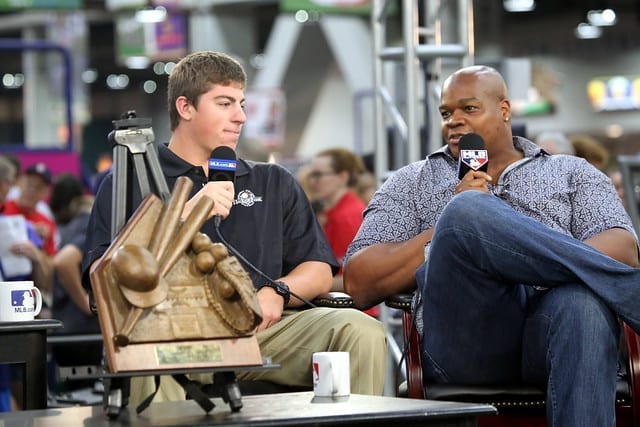
Arturo Pardavlia III
I got to see both aspects of McKay in person to open the college season about a month later. Considering the weather north of Georgia is often not conducive to baseball in February, the opening college tournaments in Florida or Arizona are commonplace for many teams. Even more importantly for us, it gave scouts and other interested persons—like myself—the opportunity to see players against different competition.
This opening tournament—hosted at the Phillies’ High-A affiliate in Clearwater—was highlighted by Louisville and the University of Maryland. Besides McKay, Louisville boasted two other top-100 collegiate players. Maryland, meanwhile, was led by Kevin Smith, a shortstop with some raw power who came in at #21 in Baseball America’s top-100 collegiate players. Seeing these players against decent competition would be enlightening, especially for me as someone brand new to this.
McKay would not disappoint, as he thoroughly dominated an overmatched Alabama State team on the mound—6 IP, 9 K, 4 H, 0 BB, 0 ER—and at the plate—2-3 with a home run pulled to right. Against Maryland, he showed his patience, drawing 3 walks—2 of which were intentional. I left the weekend wondering not which side of the ball McKay would be restricted to, but rather why he couldn’t do both.
Smith had a rougher weekend, as he put up and golden sombrero, whiffing consistently on sliders low and away as it looked like he was trying too hard to elevate and pull the ball.
***************
I sometimes think that scouts get a bad rap, in part due to their portrayal in the movie Moneyball. The representative scene from the movie below shows the analytically-minded Billy Beane—played by Brad Pitt—and Peter Brand—based on Paul DePodesta, played by Jonah Hill—schooling the traditionalist scouts with their newfound enlightenment.
My experience couldn’t have been further from this. Every scout I had the opportunity to interact with at length was both willing to learn and willing to teach from their experience. As one Player Development guy in the front office would always put it to me, “You have a Ph.D. in Statistics, and I have a Ph.D. in Baseball,” and he was 100% right. As such, I never turned down the chance to get out to the games and pick the brains of several incredible baseball men. Even so, I regret not taking the opportunity more often.
One of my favorite memories of this happened that March at the Russmatt Invitational at the Red Sox/Indians former Spring Training home in Winter Haven, Florida. I attended because Daulton Varsho—son of former major leaguer Gary Varsho and 95th in Baseball America’s preseason collegiate prospects—would be playing in the tournament. This would be the only chance I would have to see him play live, and I wasn’t going to turn down the opportunity. The team sent a couple of scouts to the game, including one of our national crosscheckers.
While we of course watched the games carefully, we also spent a lot of time talking. He wanted to understand what I saw in the data on these guys, how that affected predictions, and how we incorporated their assessments of players into the predictions. At the same time, I wanted to understand what he looked for in catchers that led him to believe they would be a “good receiver” of the ball. 10 minutes of discussions about flexibility and working under the ball and I was able to understand his scouting reports a bit better. This continued on a variety of other topics throughout the double-header, as I essentially ended up taking a short course in understanding scouting.
***************
By the beginning of April, the college season had reached full swing, the major league season was about to begin, and it was time for everyone to meet to talk. Regional scouts—representing the four large regions across the country—national crosscheckers, the Director of Amateur Scouting, other members of the Front Office, and myself—representing the analyst’s side of things. We met for a day, talking over many topics, many players, and left with as many questions as we came.
Two of the players who generated the most discussion at this meeting hailed from Vanderbilt. Both Jeren Kendall and Kyle Wright were top-5 collegiate prospects coming into the season, both had got off to slow starts and elicited questions about how much weight we should put on their slow starts. Kendall had more tools than Home Depot but often suffered from bat-to-ball issues, striking out at untenable rates. Wright had impressed his Freshman and Sophomore years, but something had seemed off with his fastball to start the year. While the talent was undeniable, both players would have to answer their questions if they wanted to be drafted in the top 10.
A couple weeks later, after an impressive shutout performance against the University of Florida, Wright was projected to be picked by us at 4th overall by Baseball America’s second mock draft.
***************
Every draft has risers and fallers, regardless of sport. It’s hard to say if being a riser is a good or bad thing; does the rise represent something real or is the longer-term record more indicative. In 2017, one guy who rose steadily through the year was MacKenzie Gore, a left-handed high school pitcher out of Whiteville, North Carolina. He wasn’t completely unknown by any means—he was ranked 38th amongst high schoolers in the preseason—but he did come with questions. At 6’1″ and 170 pounds, he was definitely a touch skinny, leading to some questions about his strength and therefore durability. One of our national scouts who met with him dismissed these concerns, commenting how surprisingly strong his grip was in addition to other corroborating evidence. Further, the competition around Whiteville wasn’t particularly great, leading to possibly inflated numbers.
But those numbers were strong regardless, and the stuff on his pitches were impressive. That curveball (51 seconds into the video) had plus potential, his slider showed flashes, and he had some feel for a changeup. Even more, he could throw strikes and had plus pitchability. All this screamed top-5 pick, and several teams—particularly the Padres and Braves—were showing interest.
***************
The last week before the draft is an insane week-long sprint. Or it at least felt like it for me. The whole group got together just like in early April, but there were a few additions. Player Development sent people, Minor League Operations, Training and Medical, and the main decision makers were all there. We were there to figure out how we were going to spend $14 million—our $12 million draft pool plus the percentage we could go over without penalty—and who we would spend it on.
We definitely had a decent idea where we wanted to go. There seemed to be a clear tier at the top, with Brendan McKay and Royce Lewis representing our best options. On my list, I had McKay at the top hitter and the top pitcher available, all things considered. But that still came with other questions; could McKay actually play both ways? College first baseman haven’t done incredibly well, so should we think about McKay that high? Young shortstops are incredibly valuable—think about Carlos Correa, Manny Machado, or Corey Seager—so should Lewis be the pick? Had Lewis sufficiently adjusted his swing motion to worry some concerns about the hit tool? And most importantly, where do we go if they’re both drafted? All these were valid concerns, especially when we were about to spend $7 million and try to invigorate the fortunes of the franchise.
Discussions weren’t limited to the 4th pick. Hundreds of players were discussed over the seven days of meetings, all with varying questions. For example…
● Evan White—a right-handed batting/lefty throwing first baseman—didn’t hit for much power but had a great hit tool, good speed for the position, and plus defense. Should this atypical profile for a power position be discounted?
● Nick Allen was a 5’8″ 160-pound shortstop with great fundamentals and an instinctual feel about playing the shortstop position. He drew comparisons—thanks in part to his stature—to Dustin Pedroia, but does that size also leave much less margin for error in his possible success?
● Drew Rasmussen—a right-handed pitcher from Oregon State—had returned from Tommy John surgery during the 2017 season to some excellent results. His pitches had great numbers from PitchF/x data both before and after the surgery, but the best predictor of future UCL tears is past tears, so could we expect him to remain healthy?
● Several players—Ernie Clement from UVA is an example—showed great plate discipline numbers in college, with high walk rates and low strikeout rates. However, did this represent patience or passivity at the plate?
● Adam Hasely—an outfielder from UVA—didn’t profile as a power hitter but had great exit velocity numbers. How do we account for and reconcile this difference?
● Blaine Knight—a right-handed starter from Arkansas—was an age-eligible sophomore who had a high asking price. Would he be willing to sign for less?
● Tanner Houck—a right-handed starter from University of Missouri—had some funky delivery with some repeatability concerns. Combine that with his lack of a definite secondary pitch and he could ultimately find his home in the bullpen.
All these questions and many more were discussed, debated, and dissected over that week. Each player had their proponents and detractors. Scouting videos were played, replayed, and slo-moed, continuously. There were moments of levity—joking about Seth Romero’s “high” ceiling—and breaks from the continual discussion. But as the week continued, we slowly moved toward our decisions.
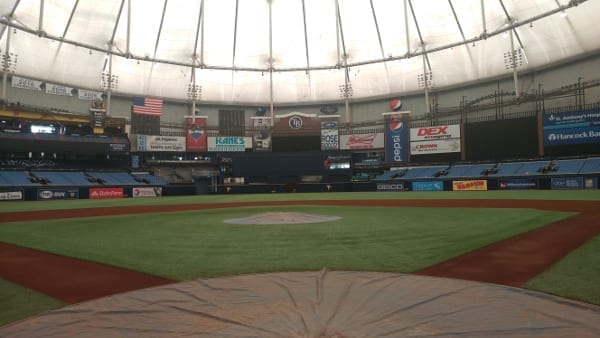
There were more than just discussions though. We invited several groups of players through the week to come and work out at Tropicana Field, giving our scouts one last look at them. The first group included about two dozen pitchers and hitters from high school and college. I spent part of my time talking with Packy Naughton, a left-handed pitcher with a windup inspired by Warren Spahn who also went to Virginia Tech—I had seen him pitch a few years prior. But the highlight of the day was Heliot Ramos a physical high school outfielder from Puerto Rico ranked by Baseball America as a top-25 draft prospect. There were questions about Ramos’ ultimate position—in center or the corner—but his batting practice display left no doubts that if he was available at #31, he would be under consideration.
The two biggest names that came in to work out were Jo Adell and Bubba Thompson. Both toolsy high school outfielders, they were brought in together for a private workout a few days before the draft. Adell was more polished, showing incredible raw power in a batting practice show that resulted in several balls in the seats. Thompson was a two-sport athlete and as such was rawer than Adell, but the potential was there. He even robbed Adell of a home run during the workout, a result that got lots of laughs from everyone on the field, including Adell himself. We knew that Adell probably wouldn’t be available for our second pick, but there was hope that Thompson might fall to #31.
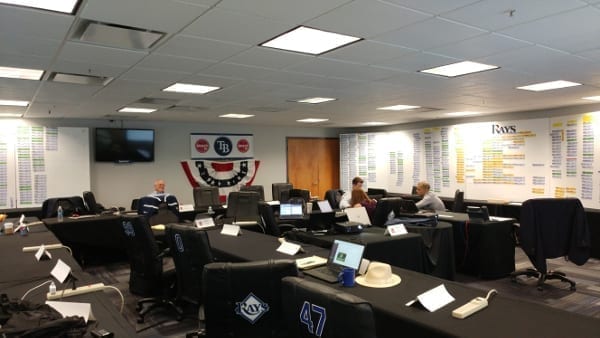
Draft Day, Monday June 12th, finally arrived. We were all in one of the rooms of the Trop, with the main show starting at 7 PM. I was fortunate to sit next to one of our national crosscheckers, a former player who briefly reached the major leagues for one season. Over the next three days, I made sure to continue learning, even though I had already informed the team of my decision to return to academia.
We didn’t know for sure how things would shake out. Baseball America’s final mock draft had McKay going number one to the Twins, although this was unsettled. The mock had us going with Bubba Thompson at 4th—maybe they caught wind of the private workout. However, the same mock had Royce Lewis available to us when our pick came around, so I was convinced we’d lean Lewis if the first three picks went Baseball America’s way.
As the day went on, some cracks emerged in the mock. It seemed that the Twins didn’t want to pay full slot value—$7.7 million—at their first pick, and McKay wasn’t willing to take that much of a discount. We knew what we as an organization were willing to pay, and it was more than what the Twins were allegedly offering. About 4 P.M., it came out that the Twins were moving to picking Royce Lewis at the #1 overall pick, meaning that there was still a chance that we could get the player who we viewed as the best player in the draft at #4.
We just had to wait out the Reds. All reports, both public and private, had the Padres going with MacKenzie Gore regardless of the first three picks. With the Reds, we had less information. They mock had them in on Hunter Greene—the one-time top overall prospect in the draft—but contingent on McKay not being available. Louisville was right across the Ohio River from Cincinnati, leading to a natural connection between the two groups. We had made our best offer, all we could do at that point was wait.
7 P.M. hit, Rob Manfred walked on stage, and the draft officially started. The Twins did indeed select Lewis #1, and then we held our collective breaths…
We would be getting our guy. The Padres stuck to script, taking Gore at #3, and we selected the player we believed to be the best in the draft. We would pay to do so, giving him a $7 million bonus, nearly a $1 million more than the slot. And despite Manfred’s announcement of McKay as a first baseman, we knew that we intended to develop him as a two-way player.
The rest of rounds 1 and 2 went without much fanfare for us. Unfortunately neither Heliot Ramos nor Bubba Thompson were available at #31, so we went with Drew Rasmussen—who we had a fair bit higher than #31—despite potential worries about his medical. At #40, we went with Michael Mercado, a lanky righty with the ability to spin a curveball. Leaving that first day, I definitely felt that we had come away with the best haul.
***************
Rounds 3 through 10—Day 2 of the draft—was all about saving money. We had gone over slot to sign McKay, and we would go over by $500,000 to sign Mercado, so we had to find good players who we were higher on and would take a discount, college Seniors with less leverage, and just generally get creative. I mentioned that talent in the draft can come from anywhere, well, so can draft picks.
● Taylor Walls—a shortstop out of Florida State—was elevated in part by his high predictions from the analysts to be our 3rd round pick and signed underslot by $100,000.
● Drew Strotman didn’t light up predictions and his stats—aside from a nice K/9 of 10.1—weren’t much to write home about, but scouts thought he could be stretched out from a reliever to a starter in pro ball. With that in mind, he went in the 4th round, signing for around $100,000 under slot.
● Josh Fleming was dominating D-III hitters at Webster University when his stats were noticed by a member of the Baseball Operations department. Two months later he was our 5th round pick, again signing underslot for about $100,000.
While Day 2 might not have felt quite like the slam dunk Day 1 was, there was still lots to like about the haul. We just had one more day, although that would be a long one to say the least.
***************
Day 3 was composed of Rounds 11 through 40, and admittedly not much is generally expected of those players. Yes, Albert Pujols was drafted in the 13th round and the Rays found Kiermaier in the 31st round, but these are the exceptions and definitely not the rule. You’ll see plenty of draft-and-follows of high schoolers, drafting seniors to fill out minor league rosters, and the occasional overslot pick—think like Rowdy Tellez going in the 30th round for $850,000 in 2013.
In this scenario, everyone is going to have their guy that they like more than others. One of my late-round favorites that year was a left-handed pitcher out of Duke by the name of James Ziemba. Redshirt Senior, 6’10”, low armslot, some interest in the breaking pitch. I thought that if he switched to pitching from the first base side of the rubber, he could be absolute hell on lefties. Some of the scouts agreed with me, liking the funk that brought. He was a LOOGY, sure, but that’s not bad in the 20th round. I was definitely a little bummed when the Angels grabbed him in the 22nd Round, a few rounds before we would have considered him.
By the time we got to the 40th round, I was exhausted. It had been a long day, and I was ready for the end. What I wasn’t expecting was when our Director of Amateur Scouting—the guy who was running the show and who I had been reporting directly to for 8 months—came up to me and told me that I got to announce our final, 40th-round pick.
Now, the draft that you see on MLB Network isn’t the actual draft. The picks aren’t officially made there, even if they are announced for TV. The draft is actually conducted through a giant conference call; all 30 teams and MLB on the line. When it’s your team’s turn you unmute yourself, announce the team, pick and official draft ID and then—hopefully—remember to mute yourself on the call.
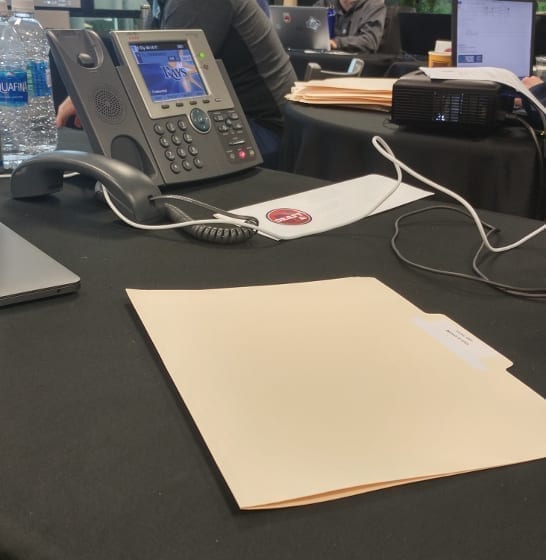
I walked myself over to the phone, and I did think about the whole process. Again, this was the last thing that I’d be doing as a member of the Rays organization. It wasn’t a bad way to go out. To finish our draft—and my time with the Rays—I announced that we were picking Allen Smoot, an redshirt Senior out of the University of San Francisco.
The 2017 Draft has turned out well to date for the teams at the top. Royce Lewis has risen to be a top-10 prospect, putting all concerns about his hit tool to bed. Hunter Greene will be getting Tommy John surgery in a few days, but he’s ridden his power fastball to a top-100 prospect ranking. MacKenzie Gore continues his rise, and is thought to have top of the rotation potential. Brendan McKay has continued his two-way experiment, and currently finds himself pitching and DH-ing in High-A ball will being a top-20 prospect.
Many of the other players we saw along the way were met with success. Kyle Wright turned it around, was drafted 5th overall by the Braves and became on of the first players in the draft class to reach the majors. Jo Adell may be the best player in the class, showing big power and rocketing up to Double-A at age 19. But not every player in the class met with success in professional baseball. Among them was Allen Smoot, who after two seasons topped out in Low-A ball. He returned to the University of San Francisco in 2019, becoming the Director of Baseball Operations for the school.
***************
Two days after the draft ended, I left the offices at Tropicana Field for the last time, the same day that both our 2nd-round pick Michael Mercado showed up to sign with the team. At the same time, the Perfect Game National Showcase began for the 2018 draft class, and with that, another year in the draft began.
Orioles Analyst
Dr. Stephen Loftus received his Ph.D. in Statistics from Virginia Tech in 2015 and is an Assistant Professor of Mathematical Sciences at Randolph-Macon College. Prior to that, he worked as an Analyst in Baseball Research and Development for the Tampa Bay Rays, focusing on the Amateur Draft. He formerly wrote at FanGraphs and Beyond the Box Score. As a lifelong fan of the Orioles, he fondly remembers the playoff teams of 1996-97 and prefers to forget constantly impending doom of Jorge Julio, Albert Belle’s contract, and most years between 1998 and 2011.