
I was watching Felix Hernandez pitch on Saturday night, curious to see how he and his surprisingly hot Seattle Mariners would do against the powerful Houston Astros, and also to see what kind of stuff Felix had these days.
I wanted to see what kind of quality Hernandez was able to produce as a well-worn 33 year old with more than 2,600 big league innings under his belt. What I found was interesting. The high-90s stuff was long gone of course. But on top of that the command was spotty, and he seemed constantly agitated, often shaking his head and muttering to himself, as if he was a scientist trying to cajole a successful result from an experiment, only to find the results below his standards.
He looked like a guy who once had great stuff trying to reinvent himself into a guy who could get by with just decent stuff – which is exactly what he is. His fastball sat in the high-80s for most of the night, ticking up into the low 90s only when the end of his outing drew near. He missed some bats and fooled some guys into watching strikes, but when he made mistakes those mistakes were pounded. He served up a solo home run to Robinson Chirinos in the third, another solo bomb to Jose Altuve in the fifth, but overall acquitted himself well (6 innings, 6 hits, 1 walk, 5 Ks) in a 3-1 defeat.
(You can discuss this on the BSL Board here.)
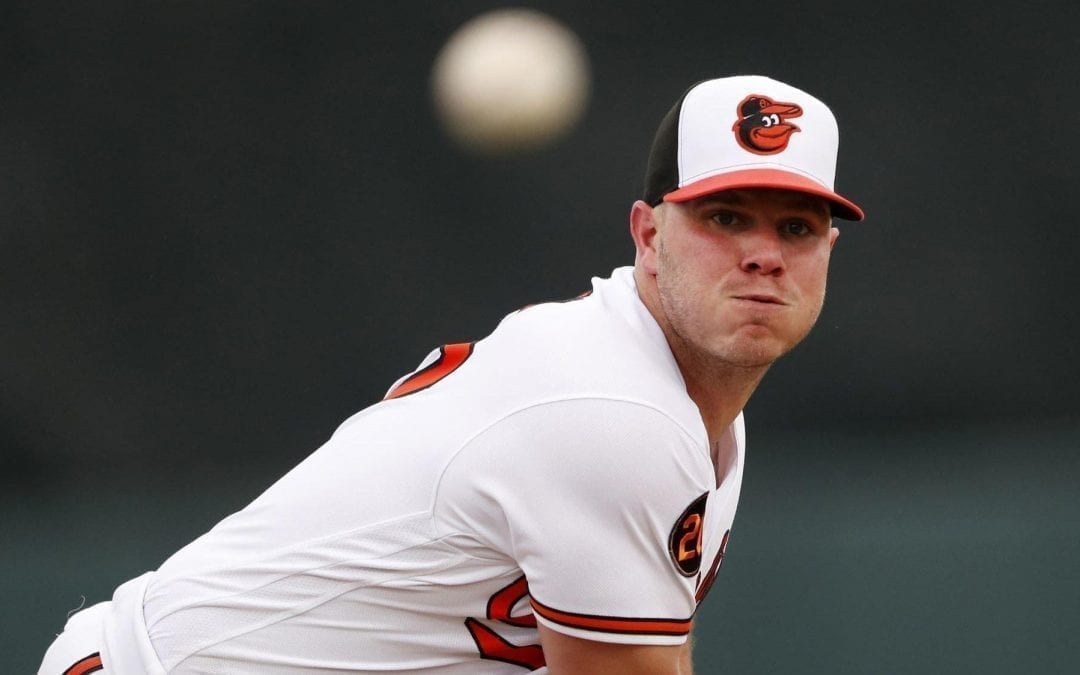
Then it hit me – this is the guy Dylan Bundy needs to get on the phone. Not that Bundy has near the pedigree that Felix has, but both are trying to solve a similar puzzle – how to survive against Major League hitters with reduced velocity. Call it a support group for former flamethrowers.
*** *** ***
Now let’s dig into Bundy and take a look at what might be behind his struggles in 2019 (8.76 ERA, 8.66 FIP, 50 ERA+, -0.3 WAR).
Over the last few years, much has been made of his drop in velocity, and rightly so. Velocity is exciting and sexy. It also helps cover up for mistakes.
When Bundy arrived for his first major MLB stint in 2016, he wasn’t the flamethrower he was when he was drafted, but he was still throwing hard even after three years of arm troubles. His fastball averaged 95 mph, his change was just about a perfect variance at a shade under 86, and his curve was 77. Perhaps the numbers were that high because the Orioles protected him that season as he split time between the bullpen and rotation and made just 14 starts in 36 appearances.
As a full-time starter the next season, Bundy was a different guy, and his pitches all slowed dramatically. His fastball dropped a stunning 2.5 mph to 92.5, and his change (84) and curveball (75) both dropped 2 mph.
Since then, the loss of velocity has continued, though not as drastic, with his change and curve remaining roughly the same, while the fastball dropped to 92 in 2018 and 91 this season.
This is an issue, of course, but in my opinion it’s not the only problem, and maybe not even the main one. And that’s because in 2017, when Bundy’s loss in velocity was its most drastic, he had his best season, with a career-high WAR in both Baseball Reference (2.7) and Fangraphs (2.5). To me, there had to be something else in play.
So I looked deeper, comparing his 2017 season to the limited sample of 2019. I looked at pitch movement, and found a mixed bag. In vertical movement, Bundy’s fastball is about the same, while his curveball has actually gained significant drop (2017, 2019). For horizontal movement, his fastball has slightly less run, while his other pitches have slightly more (2017, 2019). The movement on Bundy’s pitches is more or less steady, and even better is some cases, so there’s not a ton to learn from this, certainly not enough to explain the frightening increase in HR/FB ratio, which has gone from 11.5% in 2017, to 17.8% in 2018, to a don’t-look-if-you’re-squeamish 35.3% so far this season.
Another thing that stands out with Bundy’s numbers is his strikeout (12.4 per 9 inn.) and walk (5.1 per 9 inn.) rates, both career highs if you exclude his brief debut as a 19-year-old in 2012.
So Bundy has career highs in K rate, walk rate and HR rate. What does that all mean? Probably that when he’s hitting spots, he’s missing bats. But also probably that when he’s missing spots he’s missing way too far out of the zone, or way too far in the middle of the zone.
Bundy’s stuff is still good even at a lower velocity, but his command is off. Now the puzzle is starting to come together.
To check this, let’s look at his heat maps on Brooks Baseball.
Here’s 2017. Note that 4.73% of his pitches were right down the middle. Also note the fairly even distribution elsewhere — for the most part he appears to be putting balls where he wants them.
Now let’s look at 2019. Oh my goodness. In his first few starts of the season, Bundy is throwing a lot of pitches outside the zone, but when he’s inside the zone, 7.2% are right down the middle. That’s not a recipe for success, especially when you’re throwing 91 and not 95.
Velocity matters in baseball, but command matters more. Randy Johnson was just a crazy-looking 6-10 guy who had very little going for him until he figured out his mechanics. Once he did that, Cooperstown was beckoning.
Bundy is never going to be Randy Johnson, and it’s probably too late for him to even reach Felix Hernandez territory. But he can be a solid starting pitcher if he can harness his stuff and learn to paint the corners. Velocity can cover for mistakes, so the key is to make fewer of them. Bundy’s stuff is good enough to pull it off, even at 91 or 92, if he can figure out how to locate.
Can the Orioles fix Bundy, at least enough to coax a contender to give up a decent prospect or two? That remains to be seen.
But the key might be to look across the country and see what Hernandez is doing. Like Bundy, Hernandez is trying to reinvent himself, to learn how to make his stuff work at much slower speeds, to learn how to live with the fact he’s no longer going to be able to physically dominant an opponent. Hernandez has about a three-year head start in the process and it’s been pretty bumpy.
It’s not the perfect blueprint for Bundy, but it might be the best one. Here’s hoping he figures it out.

Orioles Analyst
Bob Harkins is a veteran journalist who has worked as a writer, editor and producer for numerous outlets, including 13 years at NBCSports.com. He is also the creator of the Razed Sports documentary podcast and the founder of Story Hangar, a network of documentary podcasters.