
The sudden end to a college basketball season isn’t something that’s particularly surprising. All teams go through it, be it after a conference tournament loss, a loss in a postseason tournament or after cutting down the nets after winning the NCAA tournament (or NIT, CBI or CIT). But what teams across the country have had to deal with this season is nothing like that. The coronavirus has ground much of the world to a screeching halt, and in the case of the NCAA it took the news of Jazz center Rudy Gobert testing positive for the powers that be to understand that playing in an empty arena was no safer than playing in one packed with crazed fans.
(You can discuss this on the BSL Board here.)
Why? Because you can’t control the interactions of the players, coaches, family members (some of whom would have been allowed to attend those “empty arena” games) and other staffers outside of the buildings where the games would be played. And given the reports about this illness, especially those coming from Italy, Gobert’s foolish actions before he tested positive opened some eyes and forced us all to take a step back. Social isolation is the rule right now, not only to keep ourselves healthy but to keep others healthy as well. While Gobert was ill at the time of his test, teammate Donovan Mitchell remains asymptomatic after testing positive himself. So, we really don’t know who has the illness until the symptoms become evident.
When it comes to college basketball, that all complicates matters. And while the NCAA has shown itself to be quite tone deaf when it comes to certain issues, the optics of having amateur athletes on those courts while professional sports leagues are on hiatus would be terrible. Taking all of that into consideration, while it’s unfortunate that the season came to this conclusion (without a champion) it is certainly understandable.
You feel bad for the seniors who didn’t get to “write” their final chapter on the court. Guys like Anthony Cowan Jr., Myles Powell, Cassius Winston and Markus Howard didn’t even get to play a final conference tournament game, much less one in the Big Dance. You feel bad for programs like Dayton, San Diego State and Rutgers, that were in the midst of special seasons with two of those programs fighting for the first 1-seed in school history and the third on track to end a tournament drought that dates back to 1991. And while there appeared to be a clear favorite in this field, Kansas, given how the regular season went one could likely come up with a list of 10-15 schools capable of winning it all even before the bracket was released.
Ahh, the bracket. This has been a point of contention since the NCAA announced that it was cancelling the tournament, as more than a few felt it necessary to release the field. Teams would know where they stood, and for a program like Rutgers (or Hofstra, which was going to be in the field for the first time since 2001) the feeling of accomplishment that comes with hearing your name called is something that cannot be matched. But NCAA VP Dan Gavitt announced that no bracket would be released, noting that there were a lot of moving parts to consider since so many leagues did not play their conference tournaments. Per NCAA rules each league is allowed to determine its automatic qualifier however it seems fit, so those conferences would have simply chosen their regular season champion (or top seed in the case of ties) to be the representative.
I’d argue that the bigger issue was the primary jobs of the selection committee members, rather than having to figure out automatic qualifiers and the like. With conferences calling off competitions and schools either closing abruptly or telling their students that were already off campus for spring break to stay home and “attend” classes online, figuring out where your school’s athletes were going to be in the aftermath of the closures was of far greater importance to the committee members. No issue with those who wanted a bracket, but for me personally it’s understandable why the committee scrapped it all.
That being said, there’s still the question of “what could have been.” There were reports that the NCAA considered going with a scaled-down 16-team field but that would have been an absolute shambles. If teams 69-72 get mad every year, how do they think the 17th team would have felt? Luckily there are still a host of bracket projections available on the internet, but Bracketville’s Dave Ommen has been judged by Bracket Matrix to be the most accurate among those who have been doing the work over the last three-plus years.
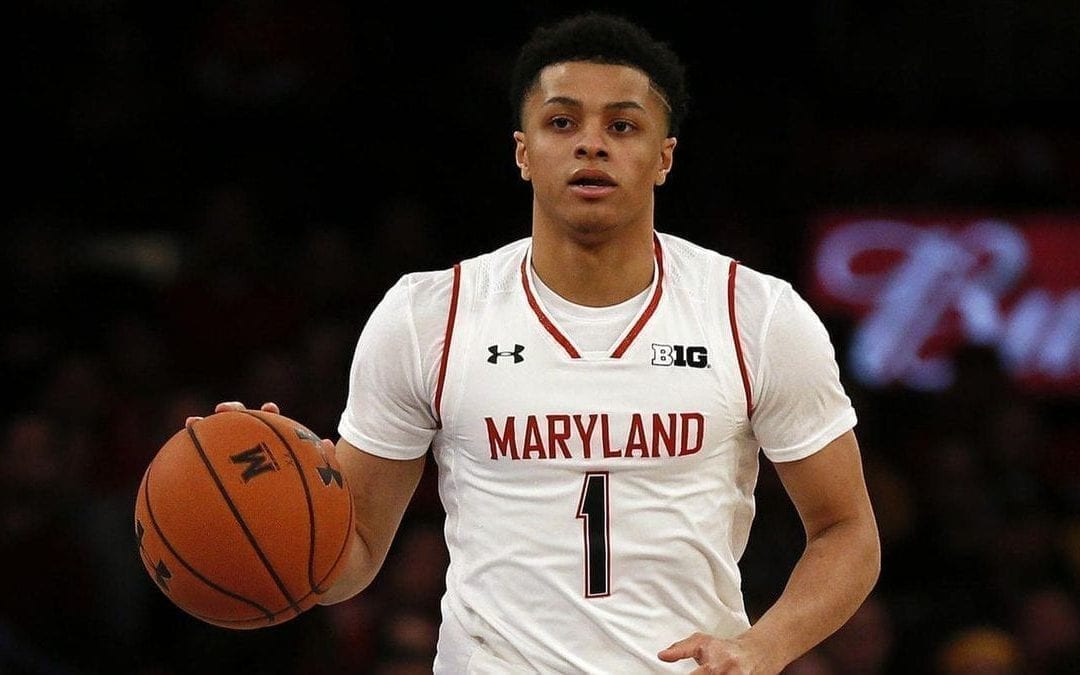
So with that being the case we’ll take a look at his final bracket (March 12th) and take a look at the route that Maryland would have had to navigate in order to win the program’s first national title since 2002.
Maryland was given a 4-seed in the East Region, slotting in behind top-seeded Dayton, Villanova and Duke. Using the NCAA Evaluation Tool (NET) the Terps were a perfect 16-0 in Quadrant 2-4 games, and 11-7 in Quadrant 1 games. Also on the 4-line in Ommen’s bracket were Louisville, Oregon and Wisconsin, the last of which shared the Big Ten title with Maryland and entered the conference tournament on a seven-game win streak.
Maryland’s opponent in the first round would have been Yale, which went 23-7 overall and won the Ivy League regular season title with an 11-3 conference record. The veteran trio of guard Azar Swain and forwards Paul Atkinson and Jordan Bruner led the way for the Bulldogs this season, with Atkinson sharing Ivy League Player of the Year honors with Penn’s AJ Brodeur. James Jones’ team had a shot at reaching the NCAA tournament for the second consecutive season, and Yale was one of the better shooting teams in the country as they shot nearly 53% from two and 37% from three with an effective field goal percentage that ranked 23rd nationally.
Defensively Yale wasn’t great at forcing turnovers, instead working to force opponents into taking challenged shots and closing out those positions with a rebound. The Bulldogs ranked fifth nationally in defensive rebound percentage, and they were also top-50 in both effective and three-point field goal percentage. This would not have been an easy matchup for Maryland by any stretch of the imagination, and playing out in Omaha (per Ommen’s bracket) would have done the Terps no favors when taking the crowd into consideration.
Also in that portion of the bracket were 5-seed Butler and 12-seed Liberty, with the latter having won the Atlantic Sun tournament and knocked off Mississippi State in last year’s tournament. While I could see that quadrant churning out chalk, it wouldn’t be a surprise if either Liberty or Yale were making the trip to New York City the following week either.
Getting out of Omaha, Maryland would have been looking at Dayton, Winthrop, LSU or Arizona State in the Sweet 16. The Flyers were one of the most unselfish teams in college basketball, ranking 14th in assist percentage, and that willingness to share the ball was a big reason why Anthony Grant’s team led the nation in both two-point and effective field goal percentage. Another big reason for the high shooting percentages was sophomore forward Obi Toppin, an above the rim finisher who also shot 39% from beyond the arc. He was surrounded by quality veterans such as junior Jalen Crutcher and senior Trey Landers, and Dayton had a real shot at not only getting to Atlanta but winning the whole thing.
LSU and Arizona State would have been rolls of the dice, as 8- and 9-seeds tend to be. While the Tigers had a befuddling loss to Vanderbilt on its resume, at least they didn’t drop a game by 40 points as ASU did back in mid-December against Saint Mary’s. LSU was a balanced group offensively with five double-digit scorers, led by senior guard Skylar Mays. Deeper than Maryland in the post, the Tigers were ranked fourth in adjusted offensive efficiency and 15th in offensive rebounding percentage. Players such as Emmitt Williams and Trendon Watford could have been a handful for Jalen Smith in the post, as LSU was the deeper team. But that would have been an interesting matchup, not only because of the post play but also the fact that LSU ended Maryland’s 2018-19 season.
Arizona State would have offered up a different challenge, with Bobby Hurley’s Sun Devils being led by junior guard Remy Martin. Also deep in the frontcourt, Arizona State was better at forcing turnovers than they were rebounding the basketball. Add in a microwave-like scoring guard like freshman Alonzo Verge, and that’s a team that could potentially cause trouble…provided they stay out of their own way. Shot selection was an issue at times for the Sun Devils, and that got them in trouble during a three-game skid that cost them a shot at the Pac-12 title.
The opposite side of the East bracket doesn’t appear to be as daunting. While Duke and Villanova don’t lack for talent both teams are young, and in the case of the Wildcats they may have been a year away from being true national title contenders. West Virginia ditched its full-court pressure for more of a half-court approach defensively, but at times this season they were downright brutal on offense. Maybe Florida, who was Dave’s 10-seed in the region, could have gone on a run due to its talent but the Gators were far too inconsistent to bank on that happening.
Getting through the East would have meant a Final Four matchup with the Midwest regional champion, a region headlined by Kansas. But it’s worth noting that Bill Self said during his teleconference on Monday that he would have taken the South region (which finished out in Houston) in order to get a Friday/Sunday location for the second weekend. Regardless of region, Kansas was on track to be the top overall seed in the NCAA tournament. A Kansas/Maryland matchup would have been a rematch of the 2002 Final Four meeting, a game that Gary Williams and company won by a 97-88 final score. I’m not sure this meeting would have been as high-scoring as the original, but I’d favor Kansas there.
And Mark Emmert having to hand the trophy over to Self, whose program is facing an NCAA investigation in the aftermath of the FBI trials, two nights later would have made for a fun image.
Thanks for taking a few minutes to read through all of this, and be sure to stay safe and take care of each other.

BSL Analyst
Raphielle’s been writing about college sports for more than a decade, making the move to college basketball alone in 2013. Beginning his work with the former website CollegeHoops.net in 2003, Raphielle spent 3 years writing for NBCSports.com beginning 2013, covering CBB and the Olympics. In 2016, Raphielle joined Heavy.com. If there’s a game on, there’s a strong likelihood that he’s watching it.