
These are uncertain times for baseball, for the sports world, and for life in general.
When I go out in my neighborhood for walks, I get smiles and waves and polite nods from a safe distance. Run into people I know and I get – and give – offers of help. When I scroll through Twitter, on the other hand, I get the impression that the whole world is on fire.
Both impressions contain elements of truth in our current reality, but the lesson here — aside from avoiding Twitter — is that this is going to be chaotic and difficult and a huge challenge to get through, but that the inherent goodness of most people will see us through.
(You can discuss this on the BSL Board here.)
Baseball will get through this, too.
When is the season going to start? If it does, how many games will there be? How deep into winter will they play? Nobody really knows the answers to these questions. We’re all on the coronavirus’ timeline at this point, and it will let us know when it’s OK to consider playing again.
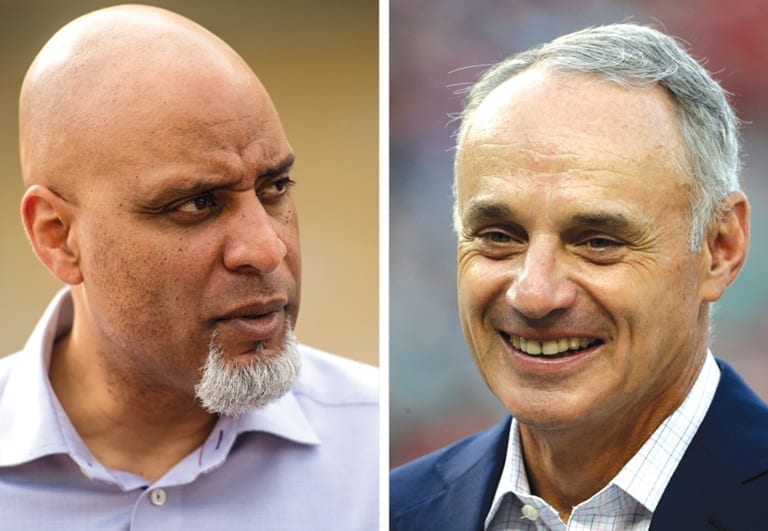
In the meantime, the wheels of planning have wisely been turning. Late this week, MLB and the MLBPA reached an agreement on some key financial issues. Originally reported by ESPN’s Jeff Passan and since confirmed by others, here are some of the items that were hashed out:
– Owners will advance players a portion of salaries over April and May. The players will keep this whether there is a season or not.
– Each team will contribute about $95,000 per day to eligible players for 60 days or until the season begins. This will max out at $170 million.
– Players have agreed not to sue for full salaries.
– Players accrue a full year of service time if active for a shortened season. If there is no season, each player will accrue the same amount of service time they accrued in 2019.
– The sides also agreed on criteria for starting a season, including that there be no ban on mass gatherings (i.e., no games without fans), no travel restrictions and a determination from medical experts that playing games will not endanger fans or players.
– The draft will be pushed back to July and shortened from 40 rounds to just five.
– The 2021 draft can be shortened to 20 rounds.
That’s a lot, and there are some other unconfirmed reports out there floating around that we won’t yet address here. But what we can do is look at what we have here and try to look at who wins in this agreement, as well as who loses.
And we’ll do this with the understanding that as long as there aren’t any games, we are all losing. That’s a given.
The winners
Mookie Betts, and other stars who are impending free agents: The agreement on service time is a huge one for players like Betts, as well as others including Trevor Bauer, Marcus Stroman and J.T. Realmuto, because they’ll become free agents in the coming offseason and can peddle themselves on the open market.
And actually let’s open this up to all players who spent the entire 2019 season in the majors, because even if there are no games at all this year, they’ll march one year closer to arbitration, or to becoming a free agent, etc. It does become more complicated for guys who spent only part of 2019 in the majors, and this is also not such a great development for teams like the Dodgers, which we’ll get into below.
Owners: Of course the owners are losing money every day there aren’t any games. And while I’m not going to sit here and feel sorry for billionaires who have things a lot better than most everybody else during this crisis, it is fair to point out that they run businesses that put food on the table for many people beyond the players, both directly and indirectly. So we obviously want to see them succeed.
The owners received a number of victories in this agreement. They can’t be sued by players over lost salaries if there is no season, which could potentially be a huge deal if things continue to be chaotic, or get even worse.
They will also save a ton of money by turning a 40-round amateur draft into a five-round affair, with an option to make it 20 rounds in 2021. In the short term, owners will save a lot in signing bonuses both in the deferment of 2020 bonuses to 2021 and 2022, and the fact they’ll simply be handing out a lot fewer and smaller ones. Undrafted players, of which there will be many, can sign for $10,000 or less, while in the past many players in rounds 6-40 received a lot bigger bonuses than that.
In the long term, owners get to take one more step toward what they have made clear is a priority – gutting (they want to eliminate 42 minor league teams) and remaking their minor league systems.
College baseball programs: With a drastically reduced draft and drastically reduced amount of signing bonuses to be had, many high school players might opt for college or junior college instead of going pro, and some college players might opt to stay in school longer. This could increase the amount of talent on the college level, and if the trend continued for long enough, turn college baseball into a development system more akin to other high-revenue college sports, especially football. We’re a long way from being there, but it’s something to think about.
Who lost?
Potentially the Dodgers — and other teams that traded for players like Mookie Betts: We already outlined above how impending free agents like Betts win big with the agreement on service time. The Dodgers could be on the flip side of this thing. Keep in mind that they traded a couple of nice pieces in Alex Verdugo and Jeter Downs for one season of Betts. Now they could end up with little or no Betts, and then watch him sign somewhere else as a free agent.
The same goes for the Cincinnati Reds, who gave up Yasiel Puig, Taylor Trammell and Scott Moss to get what could ultimately be 56.1 innings of Trevor Bauer.
Amateurs: Amateur baseball players are probably the biggest losers of all in this agreement, which isn’t surprising when you realize that owners want to cut costs, and the MLBPA doesn’t represent these players until they are professionals.
Cutting the draft to five rounds is brutal for these guys. So is the deferment of bonuses for a year or two for the guys who do get drafted. So is the $10K-or-less bonus standard for undrafted free agents.
As one player rep told Bill Madden of the New York Daily News, “The amateur players are being railroaded. They get to be the only Americans who can be paid less than the minimum wage.”
It’s hard enough for most minor leaguers to make ends meet, but it’s even harder for amateurs trying to find a team without the draft to target. How will they survive the journey? This figures to kill the baseball dreams of a lot of would-be future major leaguers.
TV networks/media outlets: Most baseball teams make a killing off their deals with regional television networks, who in turn make a living off the cable subscribers who sign up to get the network, as well as advertising they sell to show baseball games for six-plus months of the year. Now what happens when there are no games to show? Where will the revenue come from, especially if people cut the cord over this? Who is going to watch, for instance, SportsTime Ohio, during the summer when there are no Indians or Reds games? People will lose jobs because of this.

Orioles Analyst
Bob Harkins is a veteran journalist who has worked as a writer, editor and producer for numerous outlets, including 13 years at NBCSports.com. He is also the creator of the Razed Sports documentary podcast and the founder of Story Hangar, a network of documentary podcasters.