
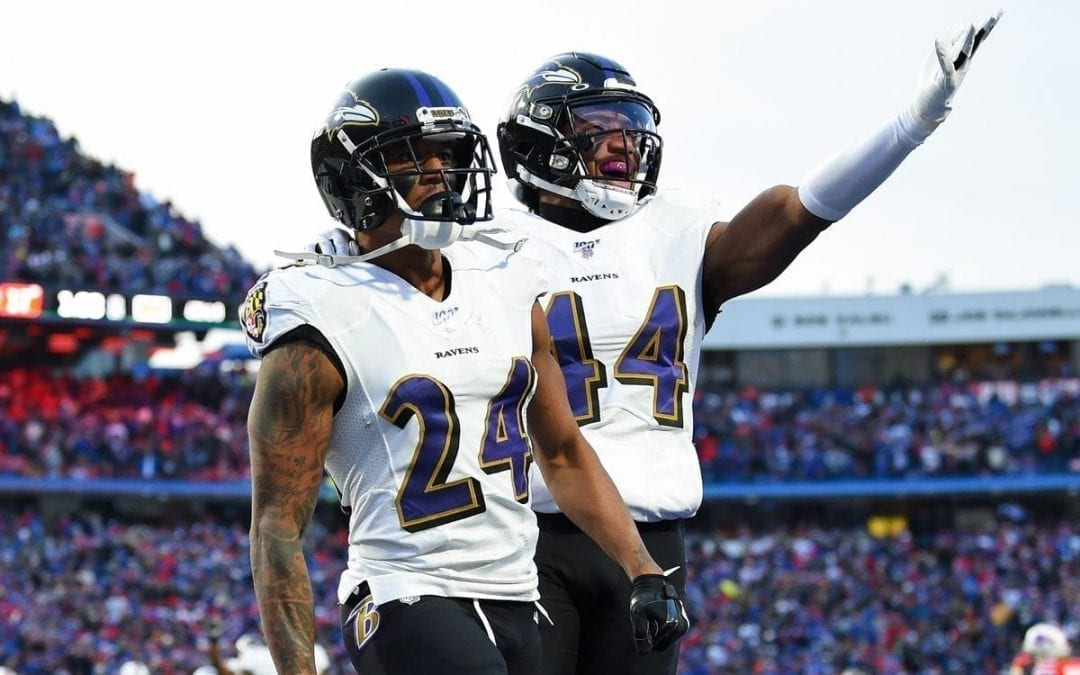
Despite the retirement announcement of right guard Marshal Yanda, a potential Hall of Famer, right before free agency, the Ravens sat as one of the more likely Super Bowl contenders. As of mid-April, Vegas had the Ravens as the second most likely candidate for a championship at +700, just behind Kansas City at +650.
Reasoning behind this is simple, Baltimore heads into 2020 with a steadily improving quarterback with a variable in his legs that will prove impossible to stop as he continues to improve as a passer.
(You can discuss this on the BSL Board here.)
When watching great organizations, common themes come up when it comes time for free agency or trades. One of them is going after cheap players coming off of their most expensive prime years. Another would be trading for a highly productive veteran who is involved in a bad organization’s firesale.
Derek Wolfe comes to Baltimore after eight years in Denver, including a 2015 season where he was a key member of their Super Bowl team, which led to his four-year, $36.7 million contract that just expired after the 2019 season. Wolfe hasn’t been a superstar during the last four years, but he’s an solid player and that’s all Baltimore needs for a $3 million cap hit. He had seven sacks last year and by both Pro Football Focus and Pro Football Reference value metrics, he’s been a viable force throughout his second contract.
Calais Campbell is still a superstar though and a face we might see enshrined with his own Hall of Fame bust in Canton one day. Over the last four years, his PFF grades have all been over 90 and he hasn’t had a grade under 80 since 2013, his 27-year old season. He’s gotten better with age as he has seemed to improve every year. Considering he’s 6’8”, 300-pounds with elite strength, it’s not hard to imagine that Campbell will continue to age well. He’s precisely the type of athlete you would expect to age well. While he will be 34 this season, I don’t expect him to slow down.
The cost for one of the best defensive linemen in the NFL, a player who adds value with the ability to play inside and on the edge, was just a fifth round pick sent to Jacksonville. Having an extra late round pick, which may be unlikely to net a contributor in he draft, can be best utilized as a trade chip to find a veteran or to package with another pick to move up and select someone your team deeply covets.
Per PFF grades, Baltimore had two glaring issues in 2018: the pass rush was ranked 27th in the NFL with a 64.0 grade and a tackling grade of 55.6, which was somehow ranked 16th in the NFL, but evident of the lack of tackling skills in the NFL today driven by lack of practice time in general, plus lack of practice time specifically on the craft of tackling. Jacksonville was last in the NFL with a tackling grade of 35.9, disgusting.
With the two acquisitions they worked to solve the first issue and Matthew Judon is on the tag, although many have suggested he’s a sign and trade candidate. The team does have the cap space to keep Judon for the year, but if an offer blew them away, they’d be tempted to take it. It’d have to be draft capital that could replace his production because this is the second year of a multi-year Super Bowl window.
And that’s part of the equation on a Judon trade, say the Ravens can get a second for him and use that on an edge rusher that becomes a low-cost producer for the next four years, that’s a huge value. If the team believes Judon’s jump forward in 2019 was a sign of things to come and they can agree on a number, then I’d trust the organization’s judgement, but with five picks in the first three rounds, plus whatever they might get from Judon, they’d have multiple cracks at replacing him. The team currently has nine total draft picks, which they could trade back and turn into more as well.
Thinking on the value of trading Judon, the decision to retain him isn’t just a 2020 decision. It’s the difference between potentially getting an earlier pick in the draft now, rather than waiting for him to leave and receive a compensatory pick. Or they could sign him to an extension, then have a veteran expense locked in.
Considering the $15.8 million franchise tag that he’s on, in his case, that might increase the rate of what the Ravens are really trying to pay him. He’s a very good edge rusher, but not a great one, and paying a player like Matt Judon $16 million a year isn’t something I expect a franchise like Baltimore to do. Not when they’ve already made moves and have the draft picks to help facilitate moving on from him.
Value isn’t just in the value of a draft pick. Say the team gets a second for Judon and drafts a edge defender with that pick, that’s now a player who might be an extreme value on his rookie contract for four years versus paying Judon high costs for three to five more years.
Something the top organizations understand is cycling interior defensive linemen and edge rushers to keep the legs that power the attack on the quarterback fresh, which is part of a trend of organizations trading top defensive line talent on franchise tags like Dee Ford, Frank Clark, and Jadeveon Clowney in recent memory. Yannick Ngakoue of the Jaguars may be another. DeForest Buckner’s trade from the San Francisco to Indianapolis is a current example of a defensive lineman under contract being moved, while Khalil Mack got his wish out of Oakland before the 2018 season in the trade to the Bears. Second contract veteran Olivier Vernon just got traded from the Giants to the Browns last offseason.
Wide receiver has been another market where we’ve seen veteran player movement via trades. These last two offseasons saw trades of Odell Beckham, DeAndre Hopkins, Brandin Cooks, and Stefan Diggs.
The issue at both of these positions is an understanding of veteran production, positional value, and styles of spending at the position.
Organizations understand they don’t want defensive ends playing over 90% of snaps, but instead want a group of 7-8 linemen cycling through and playing between 30% and 65% of snaps. Similarly at wide receiver, many are recognizing that a spread of spending and a deep group of pass catchers via tight ends, slot receivers, and pass catching running backs is likely a more productive strategy than investing heavily in one singular player. In both cases, a multitude of mismatches and productive players tends to prove to be more productive for the team than a singular, high paid “star.”
Judon isn’t a star, but a trade of Judon is along this principle. The Ravens feel like an organization that would know better than to put an investment of more than $14 million per year in a player like Judon. And trading away a player like, someone you’d rather not pay long-term because you have options, is on principle with what we’ve seen around the league.
Or, they could keep him for another year, then let him walk in free agency and get a compensatory pick back. Or they could keep him at a reasonable rate. The cap is due to explode next offseason and the team will have a ton of cap space.
With the roster already in place, all core and ancillary needs that still exist could be solved via the draft to put this team in prime position to win a Super Bowl. This is what a potential Super Bowl champion looks like heading into a draft. There are no desperate needs and, while some draft picks will become starters, this team could compete for a championship as it stands now.
In free agency they let linebackers Patrick Onwuasor and Josh Bynes walk. Onwuasor had failing grades against the run and pass with a 48.7 tackling grade. Bynes played with a level of competency that earned him a one-year, $1.6 million deal. Together, they represent 864 lost snaps at linebacker, which leads me to believing that linebacker should probably the first priority in the draft, especially with how bad the tackling was in 2019.
The loss of Yanda moves the interior line up the list of concerns, while wide receiver is still a concern, but seeing mock drafts sending linebackers Kenneth Murray of Oklahoma or Patrick Queen of LSU make me feel like those would be the key additions that take this team over the top.
Of course, spending the 28th pick in the draft on a receiver or an interior offensive lineman is also a possibility. What was said about inside linebacker could also be said about wide receiver in terms of being the core issue that must be solved to take this team to that Super Bowl level, so I think those are the two that early round picks must be focused on, especially because the interior of the line can be solved late in a way that other positions are less likely to be solved.
Spending draft capital on positions of need is a balance of what is most needed and your highest probability of finding the most reasonable solutions with the capital you have. Luckily for Baltimore, the team has five picks in the first three rounds, a prime location to find starters
If we were to break this down into what positions are the best to be spending draft picks on, it’d be helpful to check out the 1994 through 2016 draft analysis of my colleague Cale Cox, a former assistant of Minor League Operations for the Orioles who is entering the football analytics space.
Let’s consider the positions of need we’re discussing: linebacker, edge rusher, wide receiver, the interior of the offensive line, then the interior of the defensive line. With the 25th pick in last year’s draft, the Ravens took wide receiver Marquise Brown, then Miles Boykin with a third. Their other top 100 pick was spent on Jaylon Ferguson in the third round, an edge defender. Teams do trade away players at these positions when they become more expensive, but these are two of the five most important positions on the roster, so this investment hold strong bearings for some year two improvement in these players and their units, but another investment needs to happen.
Considering last year’s investment in those positions, plus the currently five total picks in the first three rounds, a first round pick spent on a linebacker would be a great bet, but the entire early round drafting process should primarily come down to who is the best player on the team’s big board at each pick and how does that line up with building the overall team and how they’ll be able to fill these bigger needs.
And according to Cale’s data, spending a first round pick on a linebacker is a strategy that leads to finding a starter. Of the 23 draft data set, linebackers have the highest percentage of first round picks that go on to start over 50% of their career games played.
First round linebackers start 50% of games 86.5% of the time, while first round defensive ends do so 80.0% of the time and wide receivers do so 77.2% of the time. Alternatively though, there’s a bigger drop in likelihood of finding a starting caliber defensive end (43.4%) or receiver (53.6%) in the second round than there is the drop to 66.7% for linebackers. My theory on this probably being that when a team does reach into the first few rounds for a linebacker, it’s for someone they believe is an immediate contributor, while the other positions might be a little bit of a shot at a player with the “traits.”
Most interestingly for me in this is the need at linebacker also being attempted to solve with a fourth or fifth round pick and the solution on the interior of the defensive line being something that’s solved with a late round pick. The interior of the offensive line can be something that an early round pick, then a late round pick is used on.
No position finds starter better than the offensive line later in the draft. In the fourth round, 51.1% of the linemen selected became starters for 50% of career games. As I’ve always said, the first and second round tend to be where you want to search for your tackles, but the mid-rounds can find anything and some of those tackles can become guards.
In the fourth round for example, consistent starters at linebackers can be found 35.0% of the time and in the fifth, 38.6% of defensive tackles drafted become consistent 50% of games played starters.
The benefit of being a fan of a team that’s in a prime position to compete for a championship, loads of draft picks, and few deep issues is that whatever comes in this draft, you can trust it and it’s going to be likely that this team find itself in the Super Bowl this year, while maintaining roster balance into the future to build a nice, wide Super Bowl window while Jackson is at his peak.

Zack Moore is a former college football player at the University of Rhode Island. He received his MBA from Rutgers Business School and has written for Over The Cap since 2014. He is the author of Caponomics: Building Super Bowl Champions, which offers insight into how teams use data and analytics to create sustainable, competitive teams through the salary cap that are capable of competing for championships. Zack’s research has appeared on various platforms including ESPN, Sports Illustrated, Bleacher Report, USA Today, and the NFL Network.