
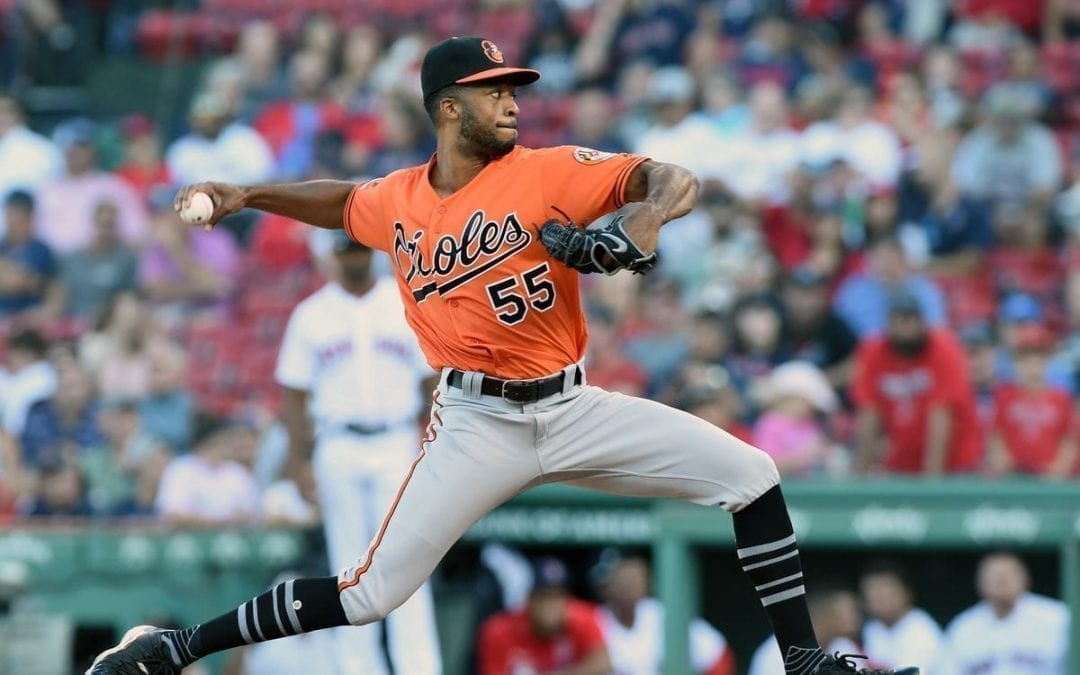
Year after year in recent memory, one thing remains consistent when it comes to the Baltimore Orioles and that’s terrible pitching. There have been a few bright spots and some surprises along the way, but overall, opponents have to feel good knowing the Orioles are coming up on their schedule, especially hitters finding themselves in the midst of slump.
(You can discuss this on the BSL Board here.)
In 2018, the Orioles pitching staff recorded the worst ERA in the majors at 5.19 and led the league in HR/9 IP (1.47) while having the third-worst combined fWAR in the majors (7.3), ahead of only the Kansas City Royals (6.4) and Miami Marlins (2.7). Their 19% strikeout rate and 9% walk rate both ranked near the bottom of the league.
The numbers were more horrendous in 2019 after Nate Karns and Dan Straily became the only two additions to the major league pitching staff in the offseason.
Not even an All-Star season from John Means and second-half uptick from Dylan Bundy could help the overall numbers. Baltimore ranked dead last in combined fWAR (5.5), ERA (5.67), HR/9 IP (1.90), and spent another year failing to produce very many strikeouts (19.5%, 2nd worst in MLB).
The 2020 season wasn’t going to be much better, and could have ended up being even worse, if that’s possible (of course it is, it’s Orioles pitching we are talking about). Key additions to the roster included Tommy Milone, Wade LeBlanc, Kohl Stewart, and a handful of relief castoffs brought in with the hopes of one or two catching fire.
Dylan Bundy was shipped off to Los Angeles for four pitching prospects, Mychal Givens has been in the center of trade discussions for over a year now, and John Means has been a constant target of possible regression in 2020. This year’s pitching staff would have been quite the sight over a full 162-game schedule.
Let’s take a different approach and look at the glass as half-full for a bit. A number of top pitching prospects will likely make their debut if the 2020 season gets off the ground, the Orioles have two legitimate top of the rotation prospects in Grayson Rodriguez and DL Hall (with a likely third in Asa Lacy on the way, maybe?), and minor league pitching staffs down on the farm dazzled in 2019.
As far as John Means is concerned, I’m not going to place any bets anytime soon on him taking a major step backwards. He may never make another All-Star team, but he’s a solid major league starting pitcher to slot into your rotation.
At the major league level, we saw a few specific effective pitches which may point to brighter futures for a handful of arms currently on the roster. There are many more pieces to the puzzle when we’re talking about pitching improvements, but here are a few pitches that may be keys to unlocking something as this staff looks to improve.
(I won’t be talking about John Means and his changeup here. It’s a well-known effective pitch and one of the top changeups in all of baseball.)
Dillon Tate’s Changeup
A quick glance of Tate’s baseline pitching numbers aren’t eye-opening, but a deeper dive into Tate’s numbers show promise for the starter turned reliever who made his MLB debut in 2019. There was his near 60% groundball rate, his xFIP of 4.82 which was significantly lower than his ERA of 6.43, and his .228 average against which helped to offset his near 10% walk rate to produce a 1.29 WHIP.
Tate’s sinker was a solid pitch, producing an average launch angle of -9 degrees and an average exit velocity of 87.8 mph, well below league-average for EV on sinkers. Despite a pedestrian 8.6% whiff rate, Tate was able to produce a large amount of weak ground balls with the pitch.
But the real gem was his changeup. His second-most used pitch at 19%, Tate’s changeup produced a 37.5% whiff rate and an average EV of 74.4 mph. Best of all, he didn’t allow a single base hit off his changeup. With a near 10 mph difference between his sinker and changeup, Tate was able to keep hitters off balance and guessing wrong.
Having a changeup with similar horizontal and vertical movements compared to his sinker greatly helps.
A heavy reliance on his sinker was expected in his first taste of the big leagues, but if Tate can utilize his changeup more moving forward, the Orioles may have something. I know, small sample size alert, but the changeup is a quality major league pitch and his sinker isn’t so bad either.
Miguel Castro’s Slider
There are two pitchers on this roster I can’t give up on just yet, Miguel Castro and Tanner Scott. Raw, over-powering, and electric are the first words that come to mind whenever I see these names and I’ve been holding out hope that a breakthrough finally occurs. Sure, “wild” is another commonly used phrase when discussing the duo, but the potential is too high to overlook.
The 25-year-old Castro, standing at 6’7”, spent his first two seasons with the Orioles posting enormous walk totals, low strikeout numbers, and negative fWAR values. We finally saw progression in 2019 as the Orioles moved away from archaic player development strategies and joined the world of modern baseball.
Overall, Castro owned a career-high strikeout rate of 22%, held opponents to a .227 average, and was worth 0.4fWAR. He continued to improve as the season rolled along, lowering his .262 pre-All-Star break BAA to .183 post-All-Star break, increasing his swing and misses, lowering his ERA from 5.28 to 3.72, and witnessing a big drop in home runs allowed.
There are still a lot of issues to fix when it comes to Castro, I’m not going to deny that, however, the slider is an unbelievable pitch.
His slider was the highest rated slider among Orioles relievers and had the 34th highest rating among all major league relief arms. Castro’s fastball usage dropped by 10% compared to 2018, which was a good idea seeing as opponents have feasted on his fastball, but that isn’t the case with his slider and changeup.
Coming in at 3,029 RPM, Castro’s slider has the third-highest spin rate in the majors and he added significant movement to the pitch last year. The results? Opponents hit just .154 (.140 xBA) against the slider and whiffed 37.5% of the time. His placement of the pitch was also much improved. Only five at-bats ended in a walk (38 strikeouts) and his chase rate numbers took a big step forward
Lefties weren’t immune to Castro’s secondaries. They felt the wrath of his changeup, whiffing 32% of the time and hitting just .125 against the pitch. Both the slider and changeup were improved and highly effective pitches last year. Now, let’s hope the fastball can start producing.
Branden Kline’s Changeup
A product of Frederick, Maryland, University of Virginia graduate, and a fantastic story of a young pitcher overcoming injury to achieve his dream of becoming a big league pitcher are just a few reasons why Orioles fans love Branden Kline, but can he put it all together on the mound?
Kline’s debut was rocky, but his strong finish leads to hope that maybe the 28-year-old can find some success in the majors. His high-velocity, low-spin fastball was rocked pretty hard all year, but Kline gave up no runs in 8.1 September innings to close out the year. That came after giving up 18 runs on 26 hits in 17 innings over the previous three months (with significant time on the Baltimore/Norfolk shuttle mixed in).
If Kline can move away from being a largely two-pitch pitcher (fastball, slider), there could be an opportunity to put up better numbers.
Opponents barreled Kline at a 9.4% rate in 2019, well above the league average of 6.3%, they patiently waited for Kline to either leave one over the plate (slugging percentage north of .500) or walk them (10.8% walk rate), and they made a lot of hard contact (49.2%, 34.5% was league average).
But one seldomly used pitch had a high rate of success in 2019, his changeup. Used just 8.5% of the time, Kline held opponents to an .063 average with his off-speed offering.
The pitch produced an average exit velocity of 79.1 mph and a -10 degree launch angle, extreme differences from his fastball and slider. It also produced a respectable 34.5% whiff rate. With about nine mph of separation between his changeup and fastball, as Kline’s confidence in the pitch increases, so should his success with it.
Again, there are many confounding variables that can change the trajectory of a major league pitcher and if these particular pitchers do begin finding more success with the pitches mentioned but see regression with their primary offerings, then we’re back at square one. However, it’s something to watch as these young arms work to cement a place in the Baltimore Orioles bullpen.
All stats from Baseball Savant and FanGraphs.

Orioles Analyst
A former high school teacher and coach in the mountains of Virginia, Nick Stevens has been writing about the Baltimore Orioles and their minor league system for five years. When he isn’t at a minor league stadium, he’s enjoying a Wizards game or supporting his alma mater, James Madison University. Co-Host of The Verge.