
Let me start this piece off by stating, unequivocally, that I love baseball.
I have covered the game for many years. I have lingered in many clubhouses, interviewed players, managers, coaches and team officials, befriended security guards and team staffers. I love the ins and outs of the game, the patient explanations on technique, the behind-the-scenes stories, the off-the-record conversations — all of it.
But as much as I love it, and as much as I yearn to see these highly-tuned and often underrated athletes take the field, I’m not sure they should.
I wrote about this recently on Baltimore Sports and Life and talked about it on The Warehouse and thought about it every day since the plan for a return came about. It’s complicated and my feelings are conflicted.
As it turns out so are those of the sport’s greatest player, Mike Trout.
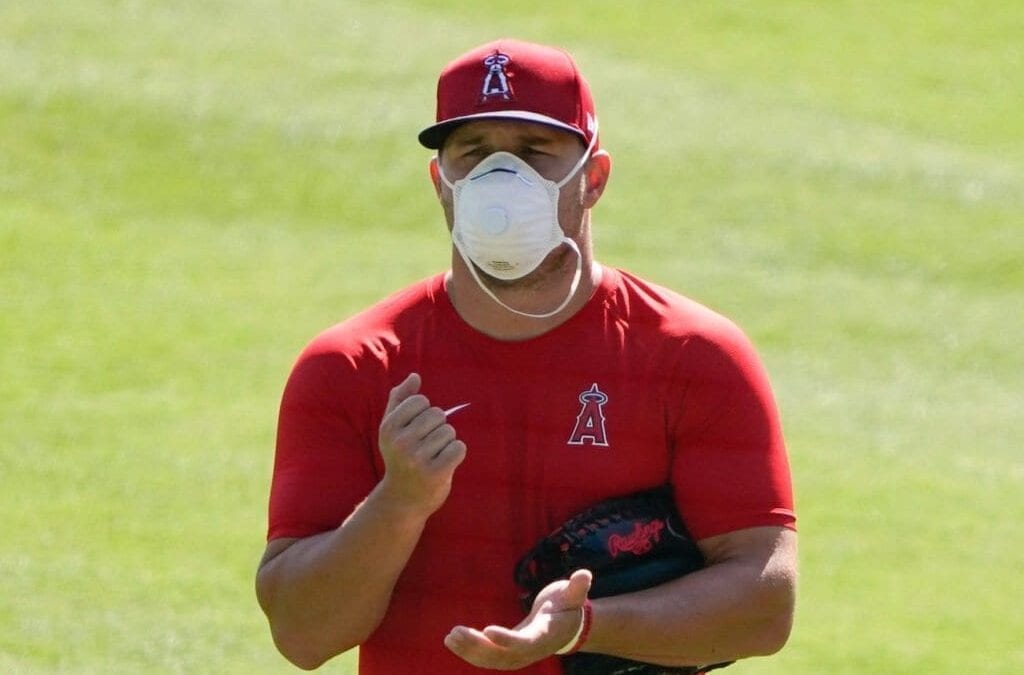
Trout, whose wife is pregnant, said last week that while he’s planning to play in an abbreviated 2020 season, he is not really comfortable about it, and he is reserving the right to change his mind. He also said that he’s hearing that a lot of players are feeling the same way.
(You can discuss this on the BSL Board here.)
“It’s a tough situation for everybody,” Trout said. “I talked to a lot of guys across the league and they’re texting me a lot. I’m not gonna name any names, but they’re all thinking the same thing: ‘Is this gonna work?'”
That is a question that nobody seems to know the answer to, and I’m not sure how they would. MLB has put a detailed safety plan in place, but you can only do so much when the virus continues to rage across the country, particularly in Florida, Texas, Arizona and California, homes to 10 of MLB’s 30 teams.
“Is this gonna work?”
Some players, including Dodgers stars Clayton Kershaw and Justin Turner, are confident that it will. But the list of those who aren’t so sure seems to be growing.
New Dodger David Price announced on Sunday that he would sit out the 2020 season for safety reasons. So has Atlanta’s Felix Hernandez and Cleveland bench coach Brad Mills. They join others who have already made that call, including Washington’s Ryan Zimmermann and Joe Ross, Colorado’s Ian Desmond and Arizona’s Mike Leake.
And there are others like Trout who are opting to play – for now – but clearly are worried. I mean, Astros shortstop Carlos Correa won’t even let his wife get her hair done during the season, and she’s a former Miss Texas! The horror!
“We know what it takes to make the season possible,” he said. “What we’re doing is we come to work out and we go back to our houses. I think that’s the key … I think if we can keep it simple. Simple as come get your work in and go back home, get some rest, I think we’ll be able to be fine and be able to carry on with the season.”
And Correa is right, with one big caveat – to truly be safe, you need to trust EVERYBODY to look at it the same way, and to take it just as seriously.
And frankly, guys like Trout and Price and Correa aren’t even the guys I worry about so much. They have plenty of money and will be fine if they sit out the season. And they won’t be in danger of losing their jobs after a long layoff.
I feel for the end-of-the-bench guys, the AAAA players who might feel pressured to play so that their team doesn’t forget about them, and so they can make ends meet. And before you scoff at the notion, let me tell you a brief story about Corky Miller.
Miller was a journeyman catcher who played 10 consecutive season in the big leagues from 2001-2010. Even though he earned MLB time in each of those seasons, he never spent a full season in MLB. In fact, the most games he ever played was 39 (129 plate appearances), in 2002. That meant he received a pro-rated MLB minimum salary for the time he was on an MLB roster, and a significantly lower minor league salary the rest of the year.
He explained to me what that was like years ago when he was with the Reds organization. He and his wife had a home (and mortgage) in California. He had an apartment in Louisville, where the Reds’ AAA team played. Then he needed an apartment in Cincinnati when he was called up. And an apartment back in Louisville when he was sent down. He worked in construction or in restaurants during the offseason to pay the bills.
Miller would’ve been the kind of guy who probably would’ve felt he had to play, regardless of how he felt about the virus. And there are many others in similar situations. Look at your favorite team’s roster – it won’t be hard to pick them out.
The thing to remember with all of this it that it only takes one. Not just one player or one coach or one team official, but one sick person who is in contact with that player or coach or official. A careless relative who swore he wore a mask but didn’t all the time. A friend who didn’t believe in the numbers. Or simply someone who is unlucky. That’s all it takes. Next thing you know, you’ve got a problem.
“It takes one guy to bring that in this clubhouse,” Trout said. “And given how contagious this virus is, it’s going to be hard to contain.”
That’s why I’m glad Trout spoke out, because that lends legitimacy to anyone else to express their own worries and potentially not play, even if he’s not a star.
If you’d like some good news amidst all of this, it’s that the percentage of MLB folks to test positive for COVID-19 has been low, standing at just 1.2 percent as of a couple days ago. That is a reason for optimism at least. The trick will be keeping it that way, and it’s going to have to take a concerted effort by everybody in the game – from the players to the team officials, from the umpires to the clubbies, from the journalists to the groundskeepers — to make that happen.
The problem is not MLB, the problem is that we’ve handled it so poorly as a society. It’s like having the only umbrella in a wind storm – you might be dry now, but it’s going to be hard to stay that way.
So while I am excited to see baseball. I’m nervous at the very idea. Is it worth it? I hope it is. I hope MLB people remain healthy and safe. I want to see Trout hit lasers. I want to watch knee-buckling curveballs and diving catches. I want to see bat flips and brush-back pitches. I want to see 1st-to-3rd dashes. I want to see baseballs clanking off those empty outfield bleachers.
But this isn’t about me and what I want. And it isn’t about what you want. Or about what any fans want. This is about public health, period. It’s about doing what’s best for everybody.
“Is this gonna work?”
I guess we’ll find out.

Orioles Analyst
Bob Harkins is a veteran journalist who has worked as a writer, editor and producer for numerous outlets, including 13 years at NBCSports.com. He is also the creator of the Razed Sports documentary podcast and the founder of Story Hangar, a network of documentary podcasters.