
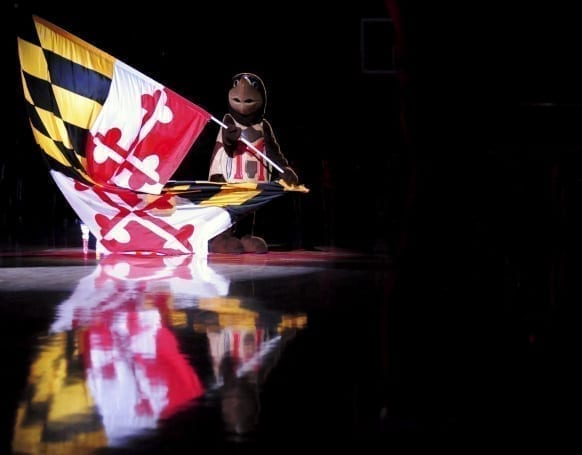
The last week was an interesting one for the Maryland Terrapins from a scheduling standpoint. With a Tuesday night matchup against Bowie State followed by Saturday’s key clash with Wisconsin, Mark Turgeon’s team had the opportunity to not only get some ancillary figures quality minutes against an overmatched foe but also strengthen their position in the Big Ten title race.
(Join the discussion on the BSL forums here.)
Maryland only completed one of those tasks, as they laid an egg during a critical stretch in Saturday’s 74-68 home loss to the Badgers. As a result, instead of sitting in a tie atop the Big Ten standings with an Iowa team they hold the head-to-head tiebreaker on the Terps find themselves a game out. And while Wisconsin certainly deserves credit for the way in which they played, taking control of the game with a 28-5 first-half run, Maryland really has no one to blame but themselves for the defeat. Why? Because the two issues that have been prevalent throughout conference play, turnovers and defensive rebounding, once again proved to be problematic.
Maryland finished Saturday’s game with 12 turnovers, which at first glance is a respectable figure. However, seven of those turnovers came during Wisconsin’s 28-5 run. Maryland missed shots and when that happened they looked to force the issue far too often, making errors that a team like Wisconsin is more than capable of capitalizing on.
The occasional “error of commission,” where a player is looking to make a play and simply misses the mark, is something many would be willing to deal with. But when it happens repeatedly, and players commit turnovers that would be best classified as “errors of omission,” that’s a major concern.
In conference games Maryland has turned the ball over on 18.4 percent of its possessions, a figure that ranks 13th in the Big Ten (only Indiana has a worse turnover percentage), and overall their turnover percentage is at 19.3 percent. Maryland doesn’t play particularly fast either when considering their tempo, which ranks 230th nationally per Ken Pomeroy’s numbers, so that isn’t a good excuse for their struggles to take care of the basketball. Following Saturday’s loss Turgeon cited the team’s attempts to get to the foul line that proved costly when it didn’t work, leading to two results.
One, Maryland took that frustration to the defensive end of the floor as they were unable to get the stops needed to slow down the Badgers. And two, their offense at times resembled a child trying to jam a square peg into a round hole; instead of looking for the best available shot guys forced the issue. That can’t happen as Maryland looks to not only win the Big Ten but play deep into March as well, and a key in that regard will be the play of Melo Trimble.
Against Wisconsin the sophomore struggled mightily, shooting 1-for-12 inside of the arc and finishing the game with ten points (8-for-10 FT). Add in five turnovers (with six assists), and Trimble had a rough afternoon at the office. Games of that caliber haven’t been the norm for Trimble, so that has to be noted, but his play serves as the barometer for a team that follows his lead. Maryland has other veterans, such as Rasheed Sulaimon, Robert Carter Jr. and Jake Layman, but two of those players are in their first season in the program.
The transition to being more of a vocal leader can be difficult for many. It’s not just about speaking more but understanding what each particular moment requires as well as how to communicate with your teammates. Trimble discussed this process in an article written by Hallie Grossman of ESPN the Magazine, and it’s a transition that bears watching down the stretch. Because as Trimble goes, so goes Maryland.
This season he is as likely to spy an open teammate beneath the basket as to launch a 3. And Maryland has infused enough talent around Trimble — from experienced transfers (Sulaimon, Carter) to blue-chip preps (Diamond Stone, the country’s sixth-ranked recruit in 2015) — that this squad can win games even with the reserved version of him. But the NCAA tournament awaits. And if Trimble’s first stab at self-reimagination was to determine how far he could go as a player, his next one may well dictate how far he and his teammates can go together. “They say they want me to act like it’s my team,” he says.
People want to follow Trimble. He just has to take the lead.
Also of note for Maryland has been the defensive rebounding, as Wisconsin grabbed more than 38 percent of its available misses Saturday with Vitto Brown and Ethan Happ combining for nine of the team’s 13 offensive rebounds. With Robert Carter Jr. and Diamond Stone leading the way, why is Maryland such a mediocre team when it comes to closing out defensive possessions with a rebound? One would think that given the raw physical gifts their front court players possess the Terrapins would be a better rebounding team. But as it’s been said many times over, rebounding is just as much about effort and fundamentals (boxing out) as it is skill level, if not more.
Maryland’s currently tenth in the Big Ten in defensive rebounding percentage, which makes it all the more amazing that they’re tops in defensive efficiency. Maryland’s been able to get away with that in most of their conference games thus far, but Wisconsin made them pay to the tune of 20 second chance points. This is something the Terps have to address, because of their last five games two will be played against teams that rate among the best in the Big Ten in offensive rebounding percentage (Indiana leads the league and Purdue is third).
As as it so happens, the Hoosiers and Boilermakers are two of the teams looking to emerge from the pack and win the Big Ten regular season title.
The good news for Maryland heading into this week is that they’re only a game behind Iowa. But if they’re to make a push at the Big Ten’s top spot, Maryland has to clean things up in the turnover and defensive rebounding areas. However those areas have been a cause for concern all season long, and with the season approaching its most important month time’s running out to get them addressed properly.

BSL Analyst
Raphielle’s been writing about college sports for more than a decade, making the move to college basketball alone in 2013. Beginning his work with the former website CollegeHoops.net in 2003, Raphielle spent 3 years writing for NBCSports.com beginning 2013, covering CBB and the Olympics. In 2016, Raphielle joined Heavy.com. If there’s a game on, there’s a strong likelihood that he’s watching it.