

I’ve given up trying to figure out what Maryland men’s basketball will do from game to game.
The Terps are owners of perhaps the most confusing 3-7 conference record in the entire country, dethroning a trio of ranked teams on the road while losing every other meeting with a Big Ten foe as they sit in 11th place. Of course, one of the teams below them is Michigan State, so the Terps can at least know that misery loves company.
(You can discuss this on the BSL Board here.)
Of the three wins in conference play, perhaps the most baffling one was their win over Minnesota at The Barn. The Terps were coming off a game where they had just allowed 87 points to Michigan and were facing a Golden Gophers team yet to lose at their arena. The Terps, after allowing Michigan to make 51.8 percent of its field goals and exactly half of its threes, put the clamps on the Gophers with a 30.4 field goal percentage and a horrendous 21.7 three point percentage, giving up 38 fewer points than their prior game.
What made the Minnesota game especially notable was that Maryland controlled for all 40 minutes. The Terps went into halftime leading by nine points and outscored the Gophers by five points in the second half, giving them a comfortable 14-point win. The Minnesota game was an outlier compared to Maryland’s performances from half-to-half the rest of the year.
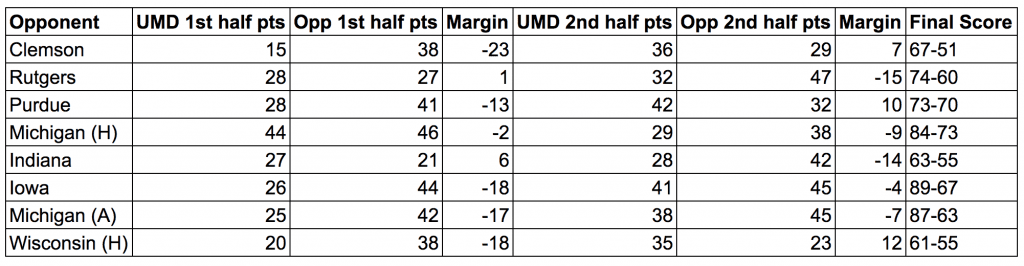
Maryland’s inconsistency between halves began in their first power conference game against Clemson, trailing 38-15 at halftime before fighting back in the second half to outscore the Tigers 36-29 in a losing effort. By increasing their scoring from 15 points to 36 points, the Terps more than doubled their first half production. The Purdue game on Christmas continued this trend. A 41-28 first half lead by the Boilermakers was almost erased by the Terps outscoring Purdue 42-32 second half, as the Terps fell just short in the 73-70 loss that was marred by poor free throw shooting.
More than a month removed from the trips to Clemson and Purdue, Maryland was still consistently inconsistent, as exhibited by their most recent loss to Wisconsin. A 38-20 deficit against the Badgers quickly eroded in the second half, with Maryland starting the half on a scorching 20-5 run to cut Wisconsin’s lead down to three points before the Badgers held on for a 61-55 win. While the 23-point hole against Clemson was simply too much to overcome in a half, it’s easy to wonder if Maryland could have two more conference wins if they didn’t give themselves such a difficult task in the second half of games. Of Maryland’s eight losses, five of them have seen them trailing by over ten points going into halftime, which isn’t quite a winning formula.
The Terps have also received inconsistent individual performances. Eric Ayala was the star of the Minnesota victory, dropping 21 points and making 57 percent of his field goals but he then followed it up with a rough 1-for-10 game, making none of his six three point attempts on the way to a four-point game against the Badgers. It was the fewest points he scored this season and one of just 13 times in his 80-game Maryland career he failed to get at least five points. This isn’t meant to pick on Eric Ayala or blame him solely for Maryland’s 3-7 record but instead to provide the most recent example that there’s been very little consistency from the Terps this season.
The most obvious thing that’s different from any other Maryland season is the lack of crowds. The Terps haven’t had to deal with difficult road atmospheres like at Purdue and Michigan State this year but at the same time, no Maryland opponent has found themselves shooting pivotal second half free throws with hundreds of students screaming at them from the wall at Xfinity Center while they hold up spinners or humorous cardboard cutouts. Last season, Big Ten teams went 96-44 at home, a winning percentage of 68.6, the fourth-highest in the country. This year, they’re 41-27, winning 60.3 percent of the games, a figure that has fallen to ninth in the country out of the 31 conferences playing this season. Five of the six power conferences have seen the home winning percentage drop by at least seven points, with the ACC standing alone as a bizarre outlier.
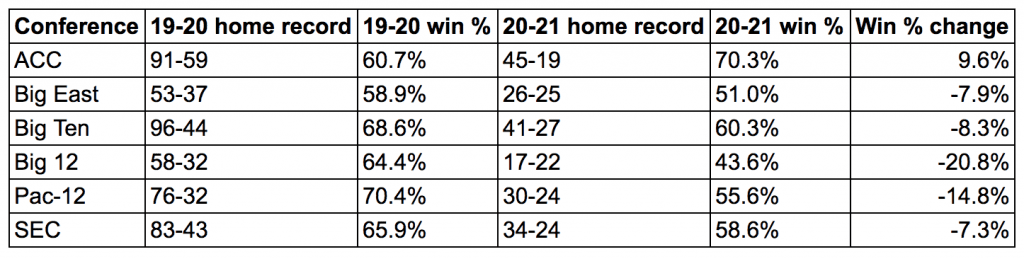
Maryland’s performance on the road compared to home definitely makes more sense this year, but it’s still abnormal with data from the rest of the schools in the power conferences. It could just be as simple as they still get the energy from traveling to another team’s arena trying to knock them off but lack that same energy at home when a supportive student section is replaced by cardboard cutouts.
Maryland’s struggles against big men without Jalen Smith also helps to explain this, but even there, things are still inconsistent. After Michigan’s Hunter Dickinson scored 26 points with a near perfect 10-for-11 effort on field goals, the Terps kept him quiet with just three points in their second meeting, but ended up losing by even more points. Meanwhile, Illinois seven-footer Kofi Cockburn scored 21 points, grabbed ten rebounds and made 80 percent of his field goals but the Terps still managed to defeat Illinois despite his efficient double-double.
You’d think teams would be taking tons of shots in the paint, but that hasn’t quite been the case. Last year, 64.4 percent of field goal attempts against the Terps in Big Ten play were two-pointers but this year, the figure has gone down to 61.8 percent. It’s not a huge change but still, teams have actually been choosing to shoot threes against Maryland at a greater rate than the prior year. Free throws have arguably been a bigger problem this year, with the Terps decreasing their success rate from 77.3 percent of their attempts in conference play last year to 64.5 percent this year.
Despite all of Maryland’s inconsistency, their best wins are currently enough to earn them tournament consideration. Joe Lunardi has the Terps in the tournament as a #12 seed and Maryland’s current ranking of #44 on Kenpom is good enough where it normally produces a tournament appearance.

Given the overall strength of the Big Ten, it’s hardly out of the question Maryland makes the tournament while finishing in the bottom half of the conference. However, their road to the tournament becomes a lot easier if there’s more consistency. Maryland needs to avoid huge halftime deficits, get more reliable production from players like Eric Ayala and most importantly, get a couple Big Ten wins in College Park.
If they can do all of those, they’ll find themselves in the bracket. If they don’t, it’ll continue to be a frustrating season of unpredictability for the Terps.

BSL Analyst
Rose Katz is a recent graduate of the University of Maryland’s journalism school, where she worked for The Diamondback as the online managing editor and a sports blogger. As a student, she spent almost all of her time on campus in The Diamondback’s newsroom or at Xfinity Center, Ludwig Field and Maryland Stadium. Rose gained intern experience with the Mid-Atlantic Sports Network (MASN).