
We’re now just about three weeks into the 2021 MLB regular season and after a thrilling sweep of the Boston Red Sox to begin the season, the Baltimore Orioles are playing about as well as a team built to win very few games can expect to play. The tough stretches have been brutal, but the Orioles are sitting at 7-8 overall and we’ve seen our fair share of positives that we can point to as we look forward to a brighter future in Birdland.
Preparing to enter a week with two off days, the Orioles sit near the top of the league with a 28.5 percent strikeout rate (only the Cubs have been worse) and they rank among the bottom-third of the league in home runs (20), walk rate (7.5 percent), on-base percentage (.286), and combined Wins Above Replacement (1.0). Clearly, we’re discussing a very small sample size within a normal 162-game schedule in 2021, but there’s no denying that the offense is sputtering in Baltimore.
(You can discuss this on the BSL Board here.)
During a time when players are hitting the ball harder than normal (although this appears to be stabilizing a bit now), the Orioles rank in the bottom-half of the league in barrel percentage (8.1 percent) and in average exit velocity on balls in play (89.1 mph) and hard-hit percentage (39.9 percent). The result? A high number of moderately-hit fly balls right at defenders and just 64 runs scored across 15 games, 31 percent of which came in two Sunday games against Boston.
It’s mid-April and reading nothing but downer articles is already mentally draining, so let’s look at the positives through the first few weeks of the season that could end up leading to bigger things in the future.
Stay hot, Cedric Mullins.
I can’t write this piece without discussing Cedric Mullins. When you pull up his Baseball Savant page, you instantly see a lot of red highlighting his Statcast rankings (even if he has cooled a bit) and you see an aesthetically pleasing spray chart with dots on all parts of the field, including only four infield hits. Yes, the same Cedric Mullins who made his money in 2020 collecting infield hits isn’t relying on one of his biggest strengths in 2021, yet he’s tied for the sixth-highest WAR value in baseball (0.9), sitting behind only Byron Buxton and Mike Trout among center fielders.
Mullins is currently hitting .379 but his .275 xBA and absurdly high .512 BABIP point to the obvious, a significant drop in his batting average. But Cedric Mullins is doing a lot of things right through his first 60+ plate appearances.
For instance, he’s not hitting the ball on the ground as much as we’re used to seeing. Normally around a 50 percent ground ball hitter, Mullins is putting approximately 38 percent of batted balls on the ground, versus 63 percent of batted balls being classified as a fly ball or linedrive, a well-above league mark. He’s also been a very patient hitter at the plate, drawing six walks in 64 plate appearances (9.4 percent), chasing just 23 percent of pitches out of the strike zone (league-average= 28 percent), and swinging at the first pitch just 17 percent of the time, just about half his career-rate and league-average.
I’m still not entirely sold on Mullins being a full-time starter in a major league starting lineup, but the question is creeping into my mind. Like Anthony Santander and Austin Hays, the potential is there but we’ve seen so very few games, it’s still very difficult to get an accurate read. However, if he can prove to be even a slightly-above league-average hitter, his sneaky pop, defensive abilities, and 90th percentile sprint speed add much-needed value to a roster.
His defense has been really good (a few questionable routes and a less than stellar arm have hurt him a bit) in center field and despite his hard-style of play on defense, he hasn’t been injury-prone during his career, unlike Hays who has quickly found his way onto the all too familiar Injured List. Let’s revisit this again in June or July and if a lot of the numbers discussed above are still impressive, perhaps the discussion surrounding the future of Cedric Mullins will change. For now, let’s just enjoy this spectacular run from a player many considered cooked.
Elsewhere around the diamond, Freddy Galvis now has seven hits in his last six games, upping his average to .265 and wRC+ to 121, Maikel Franco is proving to be a solid signing at third base, both offensively and defensively (for now), and DJ Stewart is back with just enough loud at-bats to keep you interested. I’m not even close to being worried about Trey Mancini as he now begins to heat up (and a .189 BABIP can’t possibly continue for much longer, can it?). I’m also going to hold off on diving into Anthony Santander for a bit longer. Oblique injuries may not seem too serious, but can wreak havoc on a player for a while.
Don’t be worried about Ryan Mountcastle, yet.
That leaves Ryan Mountcastle. Here’s why I’m not worried and why it may be just a matter of time before he settles in and begins making his case for 2021 American League Rookie of the Year honors.
Entering play on April 18, Mountcastle is hitting .193 with a .532 OPS and wRC+ of 45. I don’t have to tell you that those numbers are bad. A 21:2 K:BB ratio is also pretty horrendous. But Mountcastle is hitting the ball hard and he’s being slightly more selective at the plate. A big chunk of his issues may come down to timing. If that’s the case, be prepared for a fun stretch coming up.
Still just 24 years old, Mountcastle has excelled at every level of the minor leagues, despite being between 2-4 years younger than his competition at each level. This is his first major speed bump along the way. Pile on the fact that the rest of the league now has a small book on him and his defensive issues at a new position likely impacting all parts of his game , we’re watching a young player with a lot of potential battle through a learning curve. He did play in just 35 games last season, games in empty stadiums. The lights are figuratively brighter this year and fans are back, in some capacity (100% if we’re talking about Texas). Maybe this has even a small impact, maybe it doesn’t, but there’s no denying that the pressure is on Mountcastle to perform and you can see the weight of that on his shoulders in just about every at-bat.
Since notching seven hits in a six-game hitting streak, Mountcastle is hitless in his last three contests (0-11), but he’s crushed the baseball harder in two of those three games than he has in any other game in this young season. Take Saturday night’s 8th inning at-bat with two runners in scoring position for example. Mountcastle worked a 2-0 count before driving a 94 mph sinker 362 feet the other at 102 mph. It would have been a three-run bomb in a few other parks, but Texas hasn’t been as kind to hitters. Instead, it was a long, loud sacrifice fly to right field.
Mountcastle is averaging 89.7 mph EV on batted balls (2.3 mph harder than last season), with a max EV of 110.3, a career-high. Those two marks rank in the 52nd and 80th percentile in the majors, respectively. Unfortunately, making contact has been an issue, despite a slightly more selective approach at the plate.
He’s swinging at fewer pitches in the strike zone and making just about the same amount of contact on strikes as he did last season. That’s fine for now, even though both of these numbers are below league-average. Most, if not all, of his plate discipline numbers are worse than league-average, but slightly better than his personal numbers from last season. Baby steps for the #BabyBird. He’s also chasing fewer pitches out of the zone, but making contact on just 38 percent of those swings, and that’s where opposing pitchers continue to attack him.
Mountcastle is destroying pitches thrown inside on him, a prime reason why Bill Ripken recently said he’s confident that Mountcastle will be a middle-of-the-order hitter for the Orioles for a long time, and he’s started to hit breaking balls fairly well over his last few games after being attacked with nearly 50 percent breaking balls and failing to produce above the Mendoza-line. It’s the small victories and adjustments like that which should be highlighted when it comes to Mountcastle’s season. Remember, he’s 24 years old and this is his first full season in the major leagues. He won’t be in left field for the long-term and those hard-hit balls are going to begin consistently dropping in. With two off days this coming week and a trip home to Florida on the docket, this could be a good week for the now former-Top 100 prospect.
Can Bruce Zimmermann develop into a rotation piece for the Baltimore Orioles?
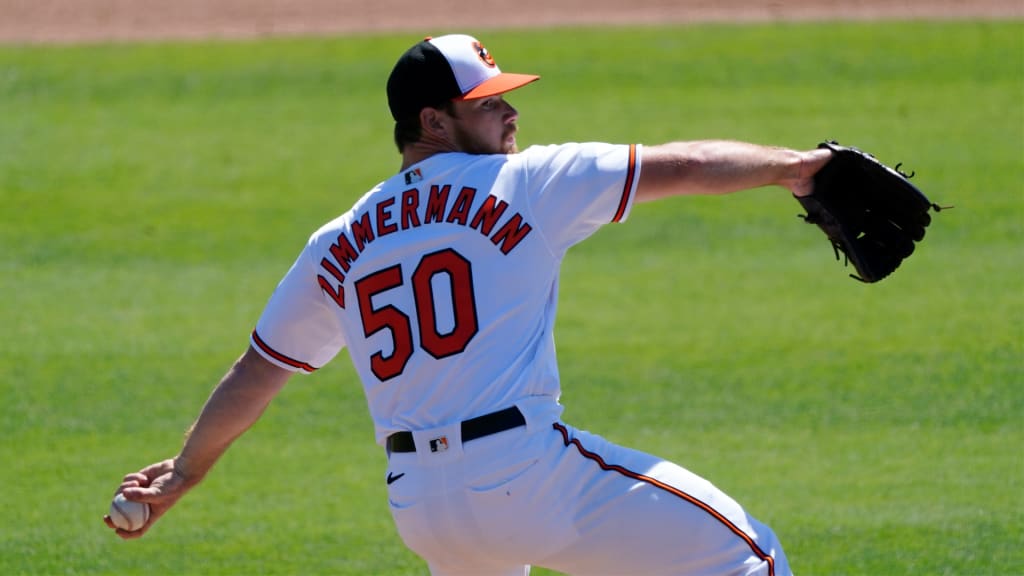
That would be really nice, wouldn’t it? Bruce Zimmermann has little room for error when he climbs the bump for each outing, but you could not ask for a better start for him out of the gates.
Through his first three starts, Zimmermann is 1-1 with a 4.24 ERA and 11 strikeouts to five walks across 17 innings (5.6 IP/GS). The baseball card stats are pretty good for a young pitcher with just 24 MLB innings under his belt so far.
Zimmermann put up back-to-back Quality Starts against the Boston Red Sox in his first two outings, putting up nearly identical lines in each start. He combined to go 12 IP (six in each start) with six earned runs allowed on 11 hits, nine strikeouts, and two walks. Zimmermann didn’t bring the same stuff against Seattle in his third outing, and he admitted as much in his post-game press conference, but he still managed to go five innings, allowing two earned runs on six hits with three walks and two strikeouts. He kept the Orioles in that game, but just three hits from his offense against Justin Dunn and the Mariners’ bullpen capped off another brutal night at the plate for the Birds.
If you look a little deeper, you see a few other positives from Zimmermann, one of those being his changeup. We have featured both Eric Longenhagen of Fangraphs and Alex Fast of MLB and PitcherList on the On The Verge podcast here on the BSL Radio Network, neither of whom gave high praise for Zimmermann’s changeup, but he’s thrown that particular pitch 22.4 percent of the time (second most-used pitch) and held hitters to a .143 average with a 23 percent whiff rate.
His slider, a 55 FV grade pitch per Fangraphs (his highest), has been used just 10 percent of the time. If he can be this effective without using his, arguably, best pitch, I’m much more intrigued about the future of Bruce Zimmermann than I was a few weeks ago. It’s been the changeup that has helped generate a 34 percent chase rate, a mark that ranks in the 87th percentile among MLB pitchers in 2021.
However, it’s not all Old Bay and crab legs for Zimmermann. He has allowed four home runs in his 17 innings as opponents have been hitting him fairly hard thus far. And while a 4.24 ERA is respectable for a number five starter type, Zimmermann owns a 5.79 FIP and a 7.03 xERA at this point. Yes, we’re talking small sample sizes but those numbers do raise some eyebrows.
If Zimmermann wants to keep producing, he’s going to have success with his fastball. Not a very highly regarded pitch, Zimmermann’s 91 mph “heater” has produced a 12 percent whiff rate and opponents are currently hitting .435 against the pitch with a .557 wOBA. Let’s put that into perspective. There are 168 MLB pitchers who have thrown at least 50 four-seam fastballs this season and Zimmermann’s .557 wOBA is the 8th-highest mark in the majors. His BAA is the 10th-highest.
If my math is right (I was a history major so it’s probably not), Zimmermann’s next start will come against Miami this week. Their lineup is a middle-of-the-pack lineup in terms of offensive production, but when it clicks, it’s a relentless lineup. Coming off an outing where he didn’t have high-quality stuff, it will be a big test for Zimmermann as he tries to prove that he remains in the starting rotation.
I’d love to dive into the bullpen as well, but I’ll just note that the Orioles’ bullpen currently ranks 7th in the majors in combined fWAR. Don’t let a few rough outings from a sleep-deprived Shawn Armstrong and two Rule 5 picks who haven’t been on a mound in a competitive game in two years distract you from the fact that this bullpen has been effective.
Choose to view this season how you wish, but when I look at the pieces who should be around for a while, I largely like what I see so far and I’m optimistic about the immediate future.

Orioles Analyst
A former high school teacher and coach in the mountains of Virginia, Nick Stevens has been writing about the Baltimore Orioles and their minor league system for five years. When he isn’t at a minor league stadium, he’s enjoying a Wizards game or supporting his alma mater, James Madison University. Co-Host of The Verge.