
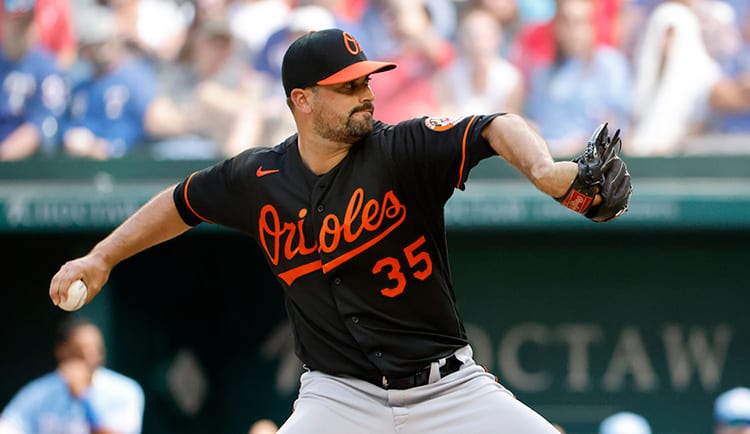
The Baltimore Orioles were not exactly busy this offseason.
While the New York Mets traded for Francisco Lindor, the Los Angeles Dodgers added Trevor Bauer and the Toronto Blue Jays added George Springer, Baltimore took a more subtle approach to their roster, reflective of a rebuild that isn’t ready to bring in big-name players yet.
With a quarter of the season now completed, four new veteran Orioles have seen meaningful playing time so far: Maikel Franco, Freddy Galvis, Matt Harvey and Adam Plutko. Let’s grade how each of these players has done so far and then figure out how likely it’ll be they spend the rest of the season in Baltimore.
(You can discuss this on the BSL Board here.)
Maikel Franco: C
Officially signed on March 16, Franco was a late addition to the roster compared to his former Phillies teammate Freddy Galvis, who was announced on January 26. Only getting 19 at-bats during spring training didn’t seem to be an issue to start the year for Franco, who began his Orioles tenure as an RBI machine.
In his first 17 games, he provided 15 RBIs and finished April with a .316 average with runners in scoring position, going 6-for-19 in clutch situations. While Franco was able to get big hits, he was much less useful with the bases empty in April, batting .179 with a .537 OPS. He finished April tied with Trey Mancini for the team lead in RBIs, so it was hard to complain about how he did with the bases empty after the first month.
Then the calendar turned to May and nothing good happened to the former Phillie. As of Wednesday morning, there are 168 hitters with 50 plate appearances this month and Franco ranks 167th for OPS and is dead last for batting average.

As for his defense, outs above average, a Statcast metric, says Franco ranks 33rd out of 35 third baseman qualified for the stat. While I do trust the data, it feels like Franco has been able to handle his fair share of hard-hit balls coming his way. For example, Giancarlo Stanton hit this ball almost 120 mph but Franco was still able to start a double play from it. Even if the metrics don’t like his defense, he still provides enough flashy plays to provide some entertainment.
Franco’s future with this team became improved with Rio Ruiz being designated for assignment. While Ruiz has primarily been a second baseman this year, he’s a natural third baseman and the fact he’s not in Baltimore anymore is a good indication that Franco won’t have any immediate competition for starting at third. As for the minors, Rylan Bannon’s .672 OPS with the Norfolk Tides doesn’t indicate there will be any rush to promote him.
Franco will probably see less playing time in September to give Bannon or someone else a cup of coffee, but it looks like he’s going to be your everyday third baseman for the next couple of months and will probably finish the season as an Oriole.
Freddy Galvis: B+
I feel like a lot of the fanbase has been comparing Galvis to Jose Iglesias, which is understandable but still unfair to Galvis.
In a 39-game sample during the weirdest baseball season of our lives, Iglesias set career highs for batting average, on-base percentage and slugging percentage in a pleasant surprise for someone signed for his defense. The Orioles sold high on Iglesias, giving the Angels a replacement for Andrelton Simmons in exchange for two prospects. Galvis was then brought in as the replacement for Iglesias.
Galvis starting the year with a .167/.255/.262 slash line after his first 13 games and 48 plate appearances certainly didn’t help his reputation of replacing the guy who spent last season flirting with a .400 batting average. However, once the Orioles arrived in Texas to play the Rangers, Galvis started hitting. He went 6-for-11 with four extra-base hits in Baltimore’s first visit to the new stadium and since April 16, he’s been slashing .307/.361/.533. Based on OPS+, he’s an above-average hitter for the first time in his career and his .759 OPS is his career-high.
Galvis hasn’t just been doing better than the prior seasons in his career, he’s been doing better than most of the shortstops in the league this year. He’s 10th in OPS out of every shortstop with at least 130 plate appearances this year, hitting slightly better than Carlos Correa and Trevor Story and doing much better at the plate than Gleyber Torres and Francisco Lindor. He’s also outhitting Iglesias, as the Angels shortstop has a .666 OPS.
Outs above average has Galvis at zero, meaning he’s been average at the position. While I once again am going to trust the fancy data from MLB, Galvis has still provided some razzle-dazzle with his fielding that I don’t think exit velocity and launch angle can properly measure.
There aren’t any impressive MLB-ready options at shortstop in the organization right now, so Galvis doesn’t look likely to see a reduction in playing time for the sake of the future. Of course, a veteran on a one-year deal who’s enjoying a career year could become a trade target if he continues to sustain these numbers. A cursory glance at production from shortstop says the Oakland A’s could be a team keeping an eye on Galvis. Elvis Andrus has done a dreadful job replacing Marcus Semien this year and Oakland might be open to an upgrade as they once again seem to be fighting with the Houston Astros for the division title.
Matt Harvey: C+
In spring training the Orioles decided to take fliers on two pitchers whose primes were about six years ago: Matt Harvey and Felix Hernandez. Hernandez didn’t make it out of spring training but Harvey managed to earn a spot in the rotation and at the start of the season, did a decent job with it.
In his first six starts, he had a 4.06 ERA and did an excellent job keeping the ball in the ballpark with only two homers allowed throughout 31 innings. No one was mistaking him with 2015 Matt Harvey but he was reliably able to provide four strong innings, with the fifth and sixth innings being more of a gamble. His April 26 start vs. the New York Yankees was especially promising, lasting six innings with one earned run, scattering three hits and three walks across the six innings.
The first six starts now feel like a distant memory after three straight bumpy appearances. Thanks to an error, Harvey didn’t allow an earned run against the Red Sox but still struggled through four innings and allowed his third homer of the season. His return to Citi Field went poorly as he allowed eight hits and ended the day with seven earned runs to his name. Things further went downhill on Tuesday, as he allowed multiple homers for the first time this year on his way to failing to finish the second inning.
Statcast data percentiles show that Harvey has hardly been a disaster in terms of opponents hitting him hard. He’s been above average for both hard-hit percentage and barrel percentage and he’s also doing a very good of avoiding walks. However, he simply hasn’t been doing anything to miss bats as shown by the low percentile in both K percentage and whiff percentage.

Regardless of whether the first six starts or the last three starts are closer to Harvey’s talent this season, he seems like a lock to not finish the year as an Oriole. If he rights the ship and returns to providing more starts with five innings and two earned runs, he’d attract the attention of a contender looking for depth in the rotation. I’d guess his trade value would be similar to the return for Andrew Cashner: teenage lottery tickets. If Harvey continues his downward spiral, the Orioles don’t have much incentive to let him continue to start over Keegan Akin, Bruce Zimmermann, Zac Lowther and anyone else currently in Norfolk. One way or another, Harvey still being in Baltimore when we reach August would be maybe the biggest surprise of the season.
Adam Plutko: A-
Plutko joined the Orioles just days before Opening Day, being acquired on March 27 from Cleveland. So far, the late move has been a major help to an Orioles pitching staff that has struggled to go deep into games.
Plutko has recorded at least four outs in half of his appearances this year, providing valuable longevity in relief. He’s also come into the game during the fifth inning or earlier six times, showing that manager Brandon Hyde trusts him to get multiple outs to bridge the gap between the starter and more high leverage arms like Paul Fry and Cesar Valdez. Before Sunday’s implosion as a starter against the Yankees, Plutko had allowed just four extra-base hits and one homer in 21.1 innings, good for an opposing slugging percentage of .268, further demonstrating his value to the bullpen.
Besides Sunday, Plutko only has one other outing where he had a bad day: when he tried to close. During a 7-inning doubleheader against the Seattle Mariners, Plutko was given the seventh inning and a two-run lead. He promptly allowed a single and a game-tying homer. So he struggles with the first inning and the save situations but other than that, you can’t complain about how he’s pitched.
In terms of his ability to provide both length and quality out of the bullpen, Plutko might be the most valuable pitcher on the Orioles who isn’t named John Means. However, there’s no part of the roster that seems like a more obvious trade chip in a rebuild than a 29-year-old reliever. If Mychal Givens and Miguel Castro both got moved last year, there’s zero reason to think Plutko will be spending August and September pitching at Camden Yards.

BSL Analyst
Rose Katz is a recent graduate of the University of Maryland’s journalism school, where she worked for The Diamondback as the online managing editor and a sports blogger. As a student, she spent almost all of her time on campus in The Diamondback’s newsroom or at Xfinity Center, Ludwig Field and Maryland Stadium. Rose gained intern experience with the Mid-Atlantic Sports Network (MASN).