
After looking at the Baltimore Colts’ Hall of Famers that are inducted into the Ravens’ Ring of Honor, making it a true Baltimore Football Ring of Honor, this week I’m touching on the 11 people connected with the Ravens who are also members of this elite group.
Some of the names are very familiar; the three Hall of Famer members; OT Jonathan Ogden (inducted to the Ring in 2008), LB Ray Lewis (2013), and S Ed Reed (2015), along with Owner Art Modell (2003), TE Todd Heap (2014), and Coach Brian Billick (2019). There has been so much said and written about these individuals that I could not possibly do them justice with brief mentions in this column.
For those of you who have become Ravens’ fans more recently, however, the other names in the Ring of Honor may be less familiar, so I’ll spend some time now sharing a bit about their stories, working in reverse order of their induction.
(You can discuss this on the BSL Board here.)
RB Jamal Lewis (2012) – Lewis was the 5th overall pick in the 2000 NFL Draft, and his 1,364 yards rushing during his rookie season was a primary reason the Ravens even made the playoffs with their otherwise anemic offense. He missed the 2001 season after tearing his ACL in training camp (as documented on Hard Knocks) but came back in 2002 duplicating his rookie success. He followed that in 2003 with one of the best seasons a running back ever had. He set an NFL record in the opener with 295 yards against Cleveland (still second all-time), and never slowed down, totaling 2,066 for the season (third all-time).
Lewis’s career stalled somewhat in 2004, when he spent four months in prison, resulting in a two-game suspension by the league, and injuries cost him two more games. As the pounding he received and administered with his powerful running style accumulated, his productivity dropped somewhat, leading the Ravens to release him in 2007. Lewis finished up his career with three seasons in Cleveland. He remains the leading rusher in Ravens’ history. This article from 2018 details some of the challenges of Lewis’ post-football life.
K Matt Stover (2011) – Unlike many kickers, Stover was not a vagabond, drifting from team to team until finding success. He was drafted in the 12th round by the NY Giants in 1990, cut after a season on IR, and signed by the Cleveland Browns. Stover played for the Browns/Ravens for 18 years, then finished up his career in 2009 with Indianapolis, where he became the oldest player to score in a Super Bowl.
He was not known for long-distance field goals (although he did make a 55-yarder in 1991) but rather for his consistency. Stover kicked 18 game-winning field goals in his career. His last one got the Ravens past Tennessee in the 2008 playoffs and was his last field goal for Baltimore. Stover was the other main cog in the Ravens 2000 champs’ offense, leading the NFL with 35 field goals. He was the last player from the Cleveland Browns’ 1995 roster to play in the NFL and has been very active in charitable activities in his retirement. He currently sits sixth on the NFL’s all-time scoring list.
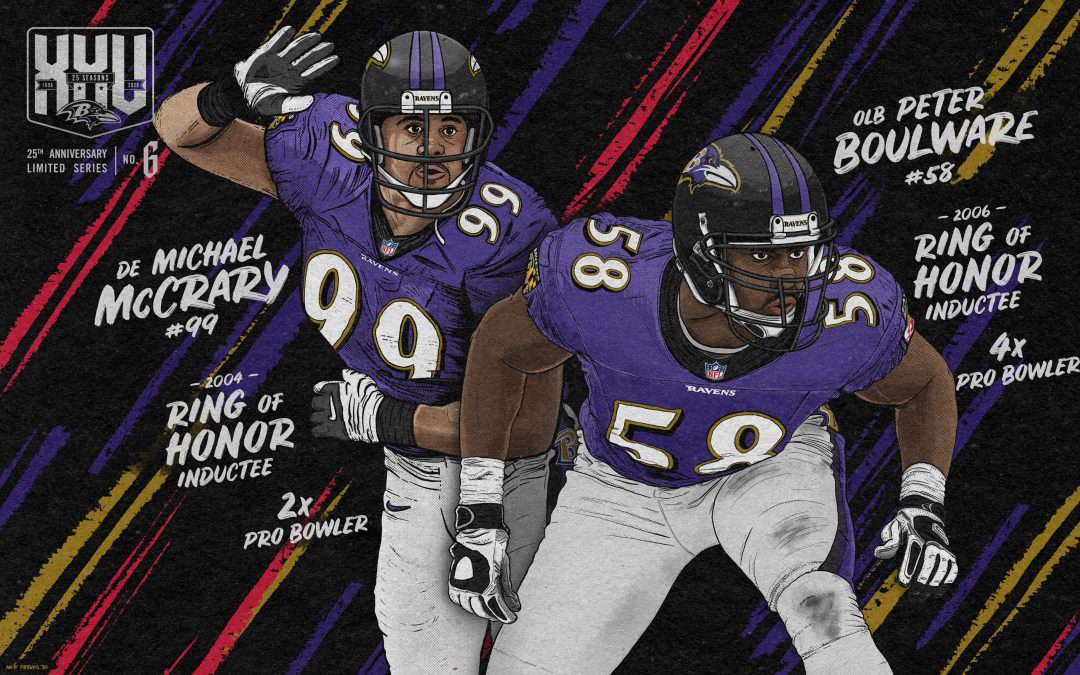
LB Peter Boulware (2006) – Boulware was the 4th overall pick in the 1997 NFL Draft. His selection paid immediate dividends for the Ravens when he tallied 11.5 sacks and was named the AP Defensive Rookie of the Year. Boulware became one of the best pass rushers in the league, leading the NFL with 15 sacks in 2001 and being named to four Pro Bowls. In 2004, knee surgery, then a toe injury, kept him out for the entire season. He returned in 2005, but in a diminished capacity and retired after the season.
Boulware is second on the Ravens’ career sack list behind Terrell Suggs, who will likely soon join him in the Ring of Honor. His brother Michael played linebacker and safety in the NFL from 2004-07. In retirement, Boulware has been a successful businessman, founded a private school in Tallahassee (he played there at Florida State), and came within 430 votes of being elected to the Florida State Legislature in 2008 before being appointed to the state’s Board of Education.
DE Michael McCrary (2004) – McCrary was drafted in the seventh round by the Seattle Seahawks in 1993. After leading the Seahawks with 13.5 sacks in 1996, he signed with the Ravens. McCrary settled into the right defensive end position and was one of the anchors of the 2000 Super Bowl championship defense regarded as one of the best of all time. He had a career-high 14.5 sacks in 1998 (third-most for a season in team history behind Boulware and Elvis Dumervill) and was named to the 1998 and 1999 Pro Bowls. Knee injuries eventually caught up to McCrary and led to his retirement in 2002. This Baltimore Sun article from 2007 details the pain he dealt with as a player and continued to in retirement.
Interestingly, in 1976 his mother sued a day care across the street from their home because it only accepted white kids. She won the case, which went all the way to the Supreme Court. One of the two dissenters in that decision was former NFL player Byron “Whizzer” White. In 2000, McCrary was selected the NFL Man of the Year, which at that time was named after…”Whizzer White.” Here is the Wikipedia link to the story of the court case with documenting links included.
RB Earnest Byner (2000) – Ernest Byner was a very good football player. He and fullback Kevin Mack were an effective duo for the Cleveland Browns in the late 1980’s, leading up to “The Fumble,” for which Byner will forever be known in football history (here is a retrospective where Byner talks about it). He bounced back from that to gain 3,264 yards rushing with the Washington football team from 1990-92.
So what did he do for the Ravens? Well, Byner did score the game winning touchdown in the Ravens’ first game ever, and he contributed 947 yards rushing from 1996-97 before retiring to become the team’s Director of Player Personnel from 1998-2003. As far as a Ring of Honor goes, that’s a thin resume. An assumption that he made was that it was a “tie between the two cities,” meaning Cleveland and Baltimore. That would be the only example I can find of the team bringing a part of Brown’s history into Ravens’ continuity.
When Byner was selected for the Ring in 2000, the team was only in it’s fifth season in Baltimore, so the candidate list was pretty short. I could make a good case that they should have made the Baltimore Colts I discussed last week the first inductees, but then again, Byner did win the Ed Block Courage Award and the NFL Extra Effort Award in 1996, and the NFPLA Unsung Hero and Ravens Man of the Year awards in 1997. Adding all of that up, I would say that Earnest Byner is a man worthy of honor.
Byner left the Ravens to coach on Joe Gibbs’ staff in Washington in 2004, then made coaching stops in Tennessee, Jacksonville, and Tampa. He is currently involved in charitable work in the Nashville area.
I hope you enjoyed reading about these former stars as much as I enjoyed researching them. Later this year, DT Haloti Ngata is schedule to be inducted, with G Marshal Yanda to follow in 2022. The Ravens, for a franchise still relatively young, has had some fantastic players and people associated with it
Coming up, did you know that over the last few years, the Ravens have been the dominant team in the NFL…in August? Yep, I take a look at that next week and try to figure out what, if anything, it means.
Until then, remember, you can make a difference! No, that’s John Walsh.
Bazinga! No, that was Sheldon Cooper.
Oh well, have a great week everyone.

Jim Johnson spent most of his life in Maryland, growing up with the Orioles, the Colts, Terps, and later Ravens. He started his sports writing career as “The Courtmaster,” covering the Terps and ACC hoops and was a frequent guest on Bob Haynie’s old WNST show and other sports talk across the region. He is currently in his second run at BSL. After previously covering Maryland and Big Ten Football, he now writes about the NFL, primarily the action in the AFC North. Jim covers both current and historic stories, seeking perspective and having fun in the process.