

Yesterday USMNT manager Gregg Berhalter announced the 26 players called in to start the final qualifying round for next years World Cup in Qatar. What’s being called as the Ocho will consist of 8 teams playing a home and home series against each team. So over the next 7 months we will play 14 qualifiers in 5 windows. If that sounds like a compressed schedule it is. They will play 3 matches in 4 of the 5 windows and 2 matches in the other. Three matches in a single window is tough, especially for the US where a majority of our players are playing in Europe. Look no further than next week for an example of how the travel is tough for our players. Several players have club matches this Sunday. They will then travel late night or early Monday to the training site (Nashville). Train on Monday and Tuesday then fly to El Salvador on Wednesday. Thursday play in El Salvador and travel back to Nashville Friday. Light training on Friday then training on Saturday. Play Canada on Sunday. Monday travel to Honduras. Light training on Monday then training on Tuesday. Play Honduras on Wednesday. This is why depth is going to be so critical. That is just too much for anyone except perhaps goalkeepers to be able to play at near peak levels.
(You can discuss this on the BSL Board here.)
Before we get into the matches over the next week plus there are a couple of other things to note. On August 12, FIFA release their latest rankings and the US has moved up to #10. Now we can debate at length how faulty the FIFA rankings are and you won’t get any argument from me. They are suspect at best.
- How is Mexico ranked #9, ahead of the US when the US just beat Mexico in the finals for both the CONCACF Nations League and the CONCACAF Gold Cup? Both official FIFA tournaments.
- Is the US really better than say Switzerland at #14? Switzerland beat the US right before the Nations League and the Euro 2020 tournament so hard to say yes to that one.
But whatever ranking you think the US really should be at the current ranking is what FIFA has put us at and that is important. Really important for two reasons.
First, the FIFA rankings are what are used to place teams into pots for drawing the groups for the WC. The top 7 teams that qualify plus the host team, Qatar, are place into Pot 1. Then the next highest 8 qualifying teams are placed into Pot 2 and so on. The bottom line here is the higher the pot you get slotted into the better chance you have of being able to advance out of your group. Each group gets one team from each pot. While not too likely at this point, depending on which countries end up qualifying there is an outside chance the US could sneak into Pot 1 and that would be huge. Here’s a look at how the pots could likely shake out:
Pot 1: Qatar, Belgium, Brazil, France, England, Italy, Argentina, Spain
Pot 2: Portugal, Mexico, Denmark, Netherlands, Uruguay, USA, Colombia, Germany
Pot 3: Croatia, Senegal, Japan, Ukraine, Iran, Algeria, Czech Republic, Serbia
Pot 4: Australia, Korea Republic, Nigeria, Ecuador, Cameroon, Ghana, Honduras, Canada
Whether you end up in Pot 1 or Pot 2 you are going to end up with one really tough team. BUT if we were to end up in Pot 3 then we would face a team from both Pots 1 and 2.
The second point is one that is not well known or understood but its really big for player development. For players wishing to play in England their soccer governing body, the Football Association (FA) have strict rules on players from outside the UK getting permits to play in the UK. Foreign players are required to obtain an GBE (Governing Body Endorsement) which basically means that the FA believes that player adds value to their competition. Its a fairly detailed process and if you are interested here is the actual FA can be looked at here.
Players are awarded points based on their domestic league, their continental competitions, and international competitions and how many minutes they played and how well their teams performed. A player must have earned 15 points to get a GBE. But there is a shortcut to this process and this is where the US FIFA ranking of 10 comes into play. The shortcut version is simple. If a player plays for a national team ranked in the top 10 then they get an auto GBE pass if they played in 30% or more of that national teams matches during the evaluation period. Of course, the lower a respective national team is ranked the higher % of matches a player must have played in. If a team is ranked 31-50th then an auto pass is granted for a player who played in at least 70% of their matches. If a national team is ranked below 50 there is no auto pass only points are earned.
Suffice it to say that this is a long winded way to say that there has never been a better time to get to England than right now.
So with that backdrop lets answer the opening question. Is the USMNT on the cusp of another golden era? I think so and in spades. After an absence of 40 years, since 1990 they have qualified for 6 straight WCs until they failed to make Russia 2018. In that run of 6 they advanced past the group stage three times and reached the quarter-finals in 2002. In that 2002 WC they won their Round of 16 match besting Mexico 2-0 then went on to a very controversial loss to Germany 1-0, who made the final. Like any sporting competition with a tournament or playoff things have to go right for you to make a deep run. But, on paper, this US team has the talent and depth to do just that. But first they need to qualify and get that distaste for that fateful night in Couva, Trinidad erased.
The roster selection features a strong reliance on our top players in Europe, with some experienced players from the MLS, as well as some young upcoming stars as follows:
26 Man Roster (Caps/Goals)
GOALKEEPERS (3): Ethan Horvath (Nottingham Forest/ENG; 7/0), Zack Steffen (Manchester City/ENG; 23/0), Matt Turner (New England Revolution; 7/0)
DEFENDERS (10): George Bello (Atlanta United; 3/0), John Brooks (Wolfsburg/GER; 43/3), Sergiño Dest (Barcelona/ESP; 11/1), Mark McKenzie (Genk/BEL; 6/0), Tim Ream (Fulham/ENG; 45/1), Antonee Robinson (Fulham/ENG; 12/0), Miles Robinson (Atlanta United; 9/3), James Sands (New York City FC; 6/0), DeAndre Yedlin (Galatasaray/TUR; 64/0), Walker Zimmerman (Nashville SC; 17/2)
MIDFIELDERS (5): Kellyn Acosta (Colorado Rapids; 37/2), Tyler Adams (RB Leipzig/GER; 14/1), Sebastian Lletget (LA Galaxy; 29/7), Weston McKennie (Juventus/ITA; 24/7), Cristian Roldan (Seattle Sounders; 25/0)
FORWARDS (8): Brenden Aaronson (RB Salzburg/AUT; 7/3), Konrad de la Fuente (Olympique Marseille/FRA; 1/0), Jordan Pefok (BSC Young Boys/SUI; 6/1), Ricardo Pepi (FC Dallas; 0/0), Christian Pulisic (Chelsea/ENG; 38/16), Gio Reyna (Borussia Dortmund/GER; 8/4), Josh Sargent (Norwich City/ENG; 16/5), Tim Weah (Lille/FRA; 13/1)
For the three matches in this coming window, Berhalter and staff are facing three overarching questions.
- Who to play in the net? This is a tough question but one that really has no wrong answer. All three keepers have a strong resume. Matt Turner had a terrific Gold Cup and just won the MVP award for the MLS All Star game. His weakness is that he isn’t with his feet on the ball and Berhalter likes his teams to play out of the back. Then there is Ethan Horvath who came into the Nations League final when Zack Steffen had to come off for injury. Horvath was insanely good to finish that match and is probably the best of the three with his feet. But Steffen has more international experience than the other two. If Berhalter wants to go with the hot hand and a keeper who is actually playing then expect to see Turner. I expect to see him use two keepers in this next window (Turner and Steffen).
- How to maximize the points earned while rotating players to keep them fresh and get some younger players more experience. I think this will be the critical decision. He must avoid the tired leg syndrome that led to our defeat in Couva on October 10, 2017. The good news is that we have much more quality and depth than we did then so keeping legs fresh while maintaining a strong and cohesive team should be easier.
- The tactics and formation to play for each of the three matches. This is linked closely with #2 above. Will we see a traditional 4-4-3, a 3-5-2, or a 4-3-2-1? Might see all three! We have the players to use any of these approaches and any will work. The key is to allow our wing players to do what they do best. Run, especially in the second halves when the other teams start to falter. Go back and watch the second half of the US win over Mexico in the Gold Cup. Berhalter’s use of subs in that match was terrific and with 5 subs still in play this really favors the US.
Now before we get into the actual matches one last thing to address, especially for those who have not watched many qualifying matches in Central America, and that is ‘concacafery.” Don’t look for this in your Webster’s you won’t find it but I assure you it is as real as the sun rising in the east. Well ok just what the hell is concacafery? A simple definition would be the nonsense that goes on when the US plays a soccer match in Central America. While not typically a fan of conspiracy type things this has been going on for so long that while our governing body, CONCACAF, doesn’t overtly do these things they sure don’t do anything to fix it! And there are several things that are typical in our matches down there.
First, field conditions suck. Now some of this isn’t intentional (probably). Certainly the fields and stadiums in some of these locations are not up to international standards. Poor drainage, potholes, sod laid to recently that tears up easily, and overly small fields.
Then there are the hooligans. Fans congregating outside team hotels and banging on drums and blowing horns while partying all night long. To the point where they even advertise where the US is staying. Try playing a competitive match after getting zero sleep and having flown across the ocean.
Then my personal pet peeve, and the worst of all is the officiating. El Salvador and Honduras are going to hack and hack and hack. They will designate the players they want to frustrate (Pulisic will be one for sure) and they will target him with late tackles. Player A will hack us. Then Player B will hack us and the referee will then talk to them. Then they will switch who to hack and Player C will hack the. Then Player D will hack them. And then maybe the referee with give a yellow card for Persistent Infringement. And they will do this all game just ensuring that they never get a player carded twice and sent off. And all while this is happening whenever their players are tackled they will lay on the ground for days on end. The tactic is simple and unfortunately effective. The more fouls, the more delays, the more time wasting shenanigans the better the chance that they can keep the game 0-0 and perhaps find a counter attacking goal to pull off the upset.
US at El Salvador (September 2, 10:05 pm EDT, CBSSports)
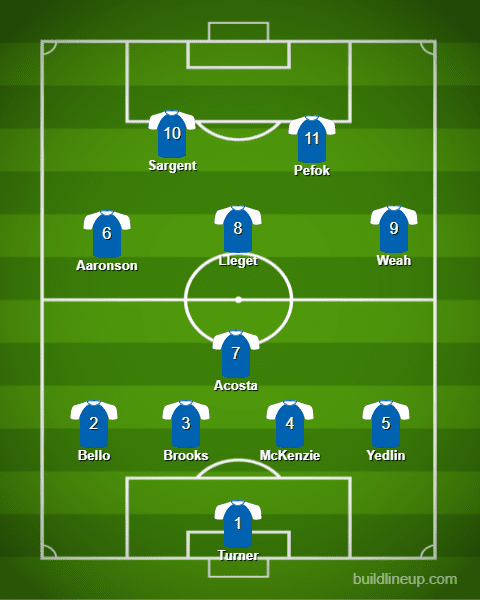
This should be the easiest match of the three and a prime opportunity for the US to start out the road to Qatar with 3 points. While El Salvador showed in the Gold Cup that they can play, only lost to Mexico 1-0, they just don’t have the overall talent to stick with the US. The one bid advantage that they do have is that most of their players play in their domestic league and won’t have any travel prior to this match. Still the US needs to step on the gas and put this team away. With a 4-4-3 formation look something like this on the way to a 2-0 victory.
Canada at US (September 5th, 8:00pm EDT, FS1)
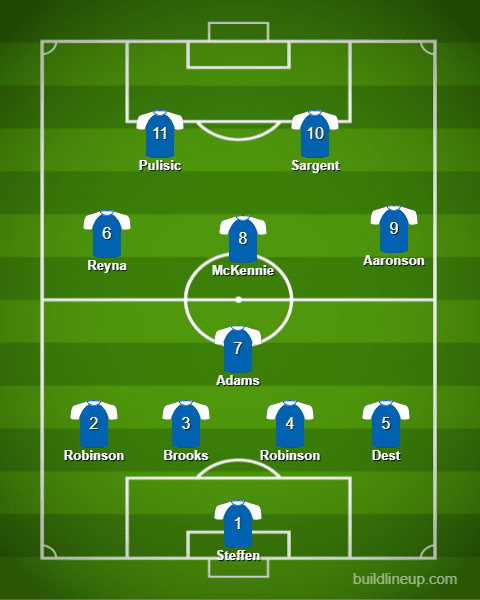
The toughest match tactically this go round. Canada gave the US a very tough match at the Gold Cup and could have won. Both teams were missing some key players but the US didn’t have any of its European based players so expect this one to go a bit more favorably. Still Canada will have Alphonso Davies and Jonathan David back. Coupled with Tajon Buchanon they will pose a threat from the outside. But I expect Berhalter to put out our best XI for this match leading to a 3-1 victory.
US at Honduras (September 8th, 10:05pm EDT, Paramount+)
This will be the physically toughest match of the three. It will have been a long week and this side is masters of concacafery physical play. This is where our depth will be needed and a draw here would be a fine result. While I still hope for the full 9 points this window 7 would be a great start and this might be the draw, say 1-1.
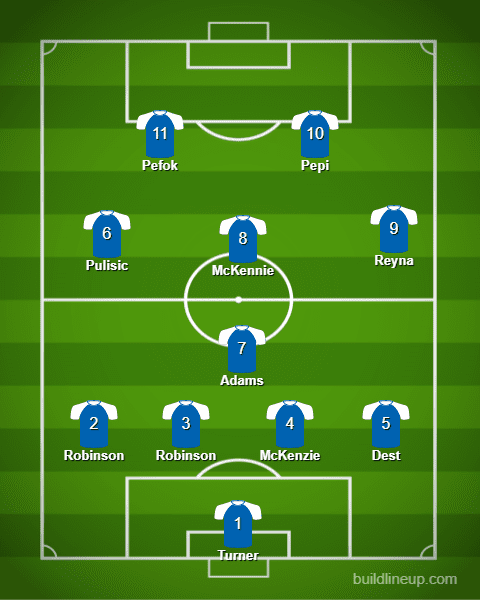
The key here is to not pay as much attention to the actual starting lineups each match. Watch to see who plays, well when they are subbed in, and how the team reacts to their presence. The lineups are going to be very fluid based on form, fitness, and the opponents tactics. Certainly we would love to see 9 points, but 7 would be very good, and 5 acceptable. They need to avoid digging themselves a hole like in 2017!
With the talent and depth this roster has right now and the development we could see over the next year plus this team is well positioned to make a statement in Qatar…..but we got to get there first.

Soccer Analyst
Steve is an avid fan of all things soccer and the O’s. Originally from the west, he grew up in the Baltimore area. He returned to the west for college where he earned a BS degree in Chemical Engineering from Montana State University and spent 36 years working at the Idaho National Laboratory prior to retiring in 2013. It was during his school years in Baltimore where he learned to play soccer and that developed into a life long passion. He played competitively for over 40 years and was a four year starting goalkeeper at MSU. He also coached and refereed in the Idaho premier soccer and High School programs for many years.