
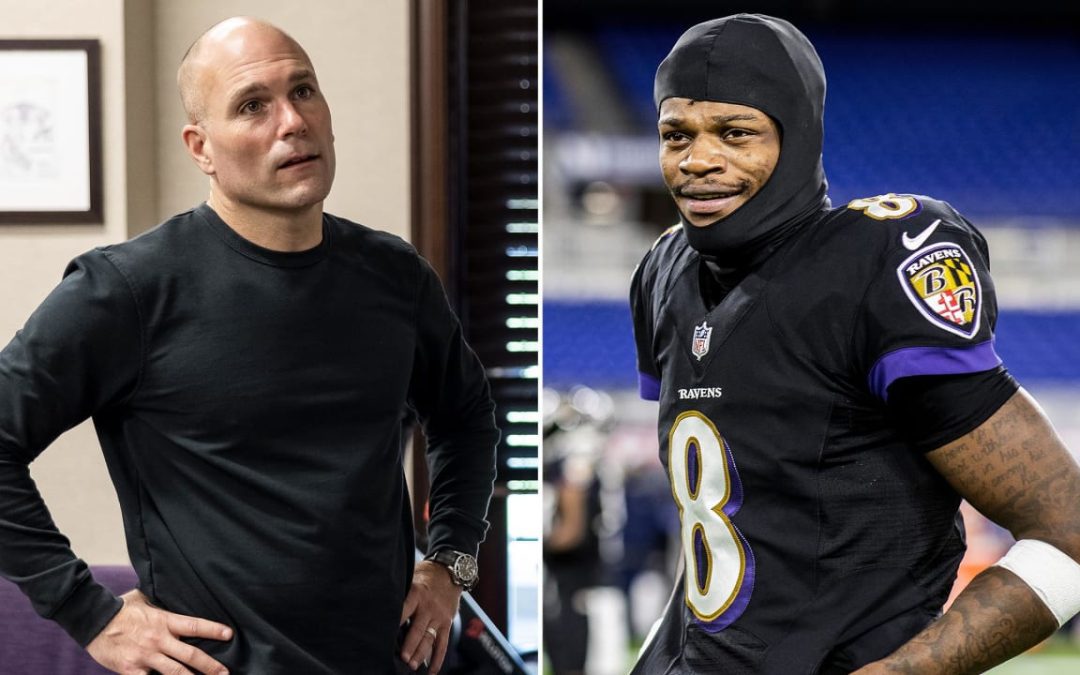
It’s been a while since Lamar Jackson’s contract has been a topic of conversation. While I’m not especially eager to get back into that discussion, I think now is an apt time to do so as it’s the calmest things will be during the NFL calendar year.
When thinking about a player’s contract, there are many factors to account for. First of all, do you want them to continue with your team? This is obvious but still important to verify. If they play a position you’re not very deep in but have become a distraction or hindrance for your club, you ought to look elsewhere instead of keeping them out of necessity. Thankfully, that’s not the case with Jackson. Both he and the team want him to be in Baltimore.
The second substantial bargaining question is one that no one can accurately answer—how good will the player be over the life of the ensuing deal? Being that it’s Jackson’s second contract, he’s in his prime, and knowing that the injury he suffered last year was essentially a fluke, both sides should think he will have close if not equal to the success he had during his MVP season.
Thirdly, what do others at their position earn? The market is a major negotiating point. Take edge rusher, for example. That position can describe both defensive ends and linebackers, but those specific labels carry two vastly different average salaries. According to Over the Cap, the top APY (average per year) salaries for edge rusher, interior defensive lineman, and linebacker are as follows:
- EDGE: $28,002,750 (T.J. Watt)
- IDL: $22,500,000 (Aaron Donald)
- LB: $19,700,000 (Darius Leonard)
A per-year difference of over $8 million based on your position designation is something contract negotiators (on both sides) are going to be well aware of. Again, the good news is Jackson doesn’t have to worry about a discrepancy like this, as he is, indeed, a quarterback. The trouble, though, comes when comparing your player to others of similar standing. You can probably find similarities to justify your respective stance, but as always there must be mutual agreements to complete any deal.
From an outsider’s perspective, it seems evident that a renewed contract between Jackson and the Ravens is a matter of when, not if. What he wants to be paid is something only he knows. What goals and visions Jackson has for the next few years of his playing career are likely to culminate with a Super Bowl championship. If he won this coming Super Bowl, we’ll likely see a contract offer comparable to Patrick Mahomes,’ whether it’s from the Ravens or not.
Assuming Jackson is healthy, plays very well, and wins a game or two in the playoffs, a 5-year contract worth $200 million, would be a fair resolution. The player would see long-term security while a mitigated amount of guaranteed money could be offset long term concerns from a team standpoint.
There are three deals currently on the books that I believe will directly influence Jackson’s next contract. Dak Prescott, Patrick Mahomes, and Josh Allen all have received big money deals within the last two years and possess similar dynamic traits to Jackson’s.
Although the market is widely influential in negotiations, you can’t just say because you play the quarterback position, you deserve to be paid amongst the highest at that position. There are certain select criteria one must meet to rightfully campaign for top dollar:
- Be a 1st round pick
- Be elected to the Pro Bowl
- Be named an MVP
- Win a Super Bowl
Not all of these four players have made each of those accomplishments, but this is the kind of company that, if you’re in it—and Jackson is—enables you to seek a massive contract.
The key elements to contracts are years, overall money, and guaranteed money. Percentage of APY according to that year’s salary cap is relevant too, because it’s a direct indication of how much that contract is going to enable or hinder your ability to compensate the rest of your players for a particular season.
Here’s a look at the contracts of Prescott, Mahomes, and Allen:
| Prescott | Mahomes | Allen | |
| Age at signing | 28 | 25 | 25 |
| Years | 4 | 10 | 6 |
| Overall money | $160 million | $450 million | $258 million |
| Guaranteed money (at signing) | $95 million | $63.1 million | $100 million |
| APY | $40 million | $45 million | $43 million |
| Salary cap for year in which contract was signed | $182.5 million (2021) | $198.2 million (2020) | $182.5 million (2021) |
| % of APY to cap | 21.9% | 22.7% | 23.6% |
| % of guaranteed money to overall money | 59.4% | 14.0% | 38.8% |
| % of guaranteed money to cap | 13.0% | 3.2% | 9.1% |
If you take the averages of those three deals, you come up with an approximate contract for 7 years worth $290 million, including $86 million guaranteed. However, the 2022 cap is set to be $208.2 million, so any forecasted deal would have to be proportional. Going by the above stated percentages of APY to cap, Jackson’s APY would be in the neighborhood of $47 million. However, he must put forth an excellent season after missing five games in 2021 due to injury.
If he does, I think he gets over $40 million per season. As far as years go, I’ve long thought that five years was the appropriate term, which is the exact average of Prescott and Allen (Mahomes’ deal is an outlier in that regard).
Five years at 20 percent of the cap in the year which the deal was signed, with 35 percent of the overall money being guaranteed at signing are figures I think are fair to Jackson and the team. So strangely enough, my projection is nearly identical to the amount of this year’s salary cap.
My predicted figures for Jackson’s next contract: 5 years, $210 million, including $70 million guaranteed at signing. That would put Jackson’s APY at $42 million. It would also put his percentage of APY to the cap at 20.2 and the percentage of guaranteed money to the cap at 6.7.
For reference, Jackson will turn 26 on January 7, 2023, so his age at the probable time of a new deal is right in line with the players listed above. He would be compensated similarly to those players in terms of overall money, breaking the $40 million per year threshold, while “only” receiving 6.7 percent of guaranteed APY, somewhat guarding the Ravens against future injury or poor performance.
There’s also a very real consideration Pat Moriarty and Eric DeCosta must make when offering anyone a new deal, as there are currently four contracts with cap figures north of $25 million on the books for 2023. That won’t make giving Jackson a new contract prohibitive, but it’ll certainly be something to account for. There is the option of the franchise tag, which is unlikely because it hammers the Ravens’ already fragile cap next year and leaves Jackson without long-term assurance.
At the end of the day, Jackson will get paid handsomely, likely by the Ravens. If he gets a deal for at least 4 years worth at least $40 million per, I have to think he’d be happy.
Whatever ends up happening, I think both sides have gone about matters just as fans could’ve hoped. I don’t expect the end result to be any different.

Born in Baltimore, Mike had long been drawn to sports of all kinds. Growing up watching Cal Ripken play ever day gave him a great example for which to attack every endeavor he undertakes.
When the Ravens came to town, though, that’s when Mike found his passion. Since that time, he’s tried to gain every bit of knowledge he could. Now as a high school coach, Mike is able to take his film study and appreciation of the game to a new level.
To engage with Mike on social media, follow him on Twitter @MikeFastNFL.