

Periodically I like to take a look at the Baseball Savant leaderboards for different stats during the season, especially the leaderboards for hard-hit rate, average exit velocity, barrel rate, things like that.
And that’s what I was doing a few days ago when I was surprised to find a member of the Baltimore Orioles in the top echelon of hitters in hard-hit rate—Ramón Urías.
First, in case you’re unfamiliar with what hard-hit rate is, as defined by Savant, hard-hit rate is the percentage of balls hit by a batter with an exit velocity of at least 95 MPH. As of this writing, the MLB leader in hard-hit rate is, unsurprisingly, Aaron Judge at 64.9% followed by Yordan Álvarez at 62%.
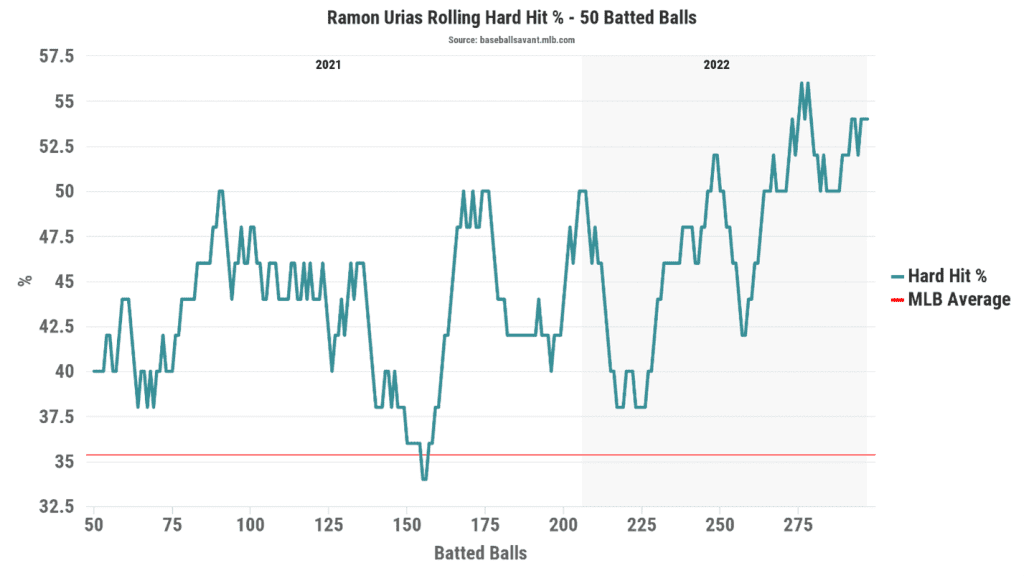
And if you scroll down the leaderboard a little bit, you’ll come to No. 30 on the list and you’ll see Urías with a hard-hit rate of 49%, ahead of names like Joey Gallo, Bo Bichette, Pete Alonso, and Kyle Schwarber.
A closer look reveals that, yes indeed, Urías’ hard-hit rate has been climbing:
Now, Urías has never been a big home run hitter, so to see his name in the same breath as other major home run hitters in the game is strange. So exactly what’s going on with him?
When it comes to players exceeding expectations, you can sometimes say “oh, well they’re getting lucky” for one reason or another. Maybe they’ve got a super high BABIP, maybe they’re way outperforming their FIP, maybe it’s a whole host of other potential reasons. But there isn’t really a way to luck yourself into a high hard-hit rate—it’s something Urías really is doing.
But as you may already know, Urías isn’t exactly setting the league on fire. Right now he’s slashing .220/.271/.341 on the season. So if he’s hitting all of these rockets, why aren’t they going for hits?
The answer to that question is two-pronged, and I’ll start with the easy part first—there’s been some bad luck at play here and a number of those outs typically would be hits. Per Savant, while Urías is hitting just .220, his expected batting average is .272, the 27th-largest gap between average and xBA in all of baseball.
Now for the more nuanced part—Urías is hitting a lot of balls directly into the ground.
MLB defines a groundball as a ball that’s hit at a launch angle of 10 degrees or lower. Of the 31 balls that Urías has hit with an exit velocity of at least 100 MPH, about 58% have had a launch angle of 10 degrees or lower and just under a quarter have had a launch angle of zero degrees or lower.
Here’s a graphic that illustrates the type of contact Urías is making:
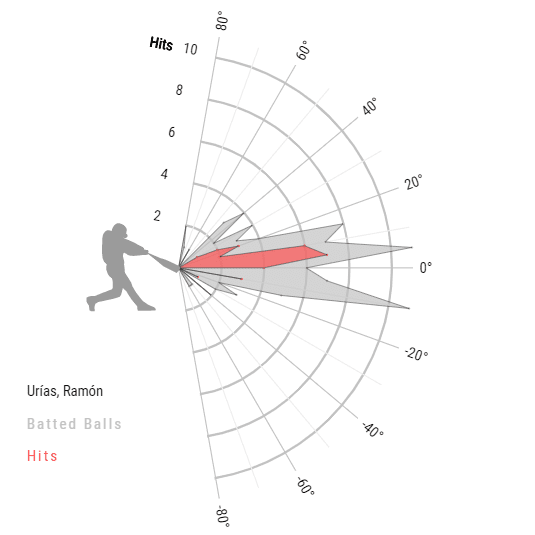
That is a whole lot of balls right on the ground, which explains how Urías can hit so many balls so hard and still get out all the time—hard-hit groundballs can definitely go for hits if they sneak through the infield, but that’s far from a given.
Now, this isn’t to say that Urías is only hitting balls on the ground. In fact, he’s seen his fly ball rate increase a slight bit this year. The problem is, he’s also hitting balls to straightaway center field more than ever before—at a 38.8% clip, a career high so far, and that’s the least ideal place to hit a ball.
There’s another aspect of Urías approach so far this year that I want to bring up that could also explain some of his struggles—he’s being a lot more aggressive at the plate than he has been in past years.

As you can see, Urías’ swing rate has risen a bunch this year. Now, that’s not necessarily a bad thing, in fact it can be good to see a hitter be a bit more aggressive, but in Urías’ case, he’s just kind of swinging at everything.
Take a look at how his chase rate (percentage of pitches swung at outside the strike zone) and swinging-strike rate (percentage of strikes from a swing and miss) have changed:
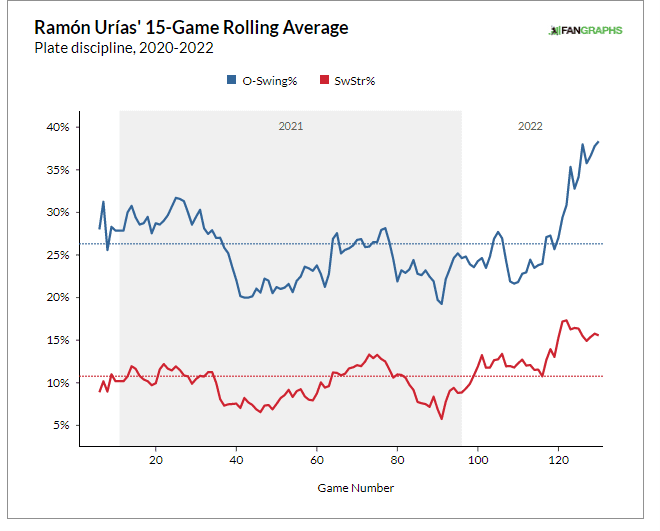
They’re both moving up to pretty high levels. In fact, as of this writing, Urías’ chase rate is sitting at nearly 30%, which is a career-high so far, and his swinging-strike rate is sitting at 13.4%, also a career high (in the majors at least).
And as you might expect with him swinging at everything, his strikeout rate and walk rate haven’t looked great:
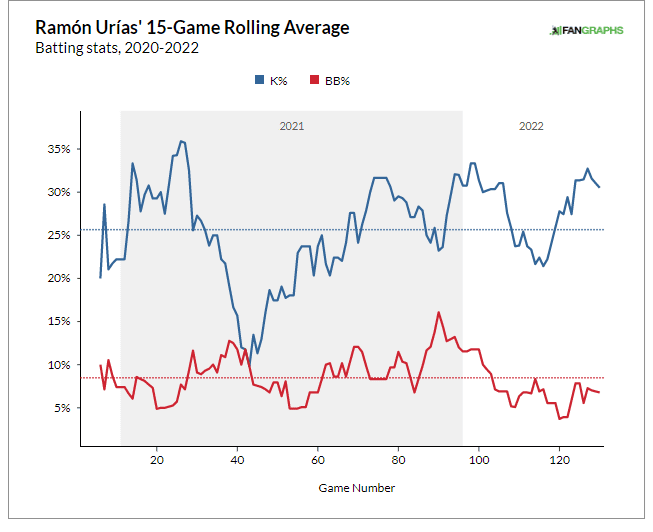
To sum up, so far this year, Urías is a lot more aggressive at the plate, he’s hitting balls harder than ever before, and unfortunately, a lot of those hard-hit balls are going right into the ground.
So what can Orioles fans expect from him? Urías is a really interesting case, because seeing an increase in hard-hit rate like this is generally a good thing—it’s good when hitters hit the ball hard (crazy, I know).
And clearly there’s been plenty of bad luck, given the gap between Urías’ batting average and his expected batting average. The lack of plate discipline worries me and I think limits his potential ceiling, but I do think better days are ahead for Ramón Urías. He’s not going to hit in the .220s all year, I could easily see some regression to the mean, some of that bad luck going away, and an ultimately solid year from Urías.

Ben Palmer has lived in Maryland his whole life and currently spends his days working as a health care journalist. He also previously wrote for and was a site expert for the FanSided blog The Baltimore Wire and currently works as managing editor at Pitcher List where he writes about fantasy baseball.