
Starting this year, Major League Baseball will be introducing an unprecedented change that will alter the very nature of the sport.
And no, I am not talking about the pitch clock.
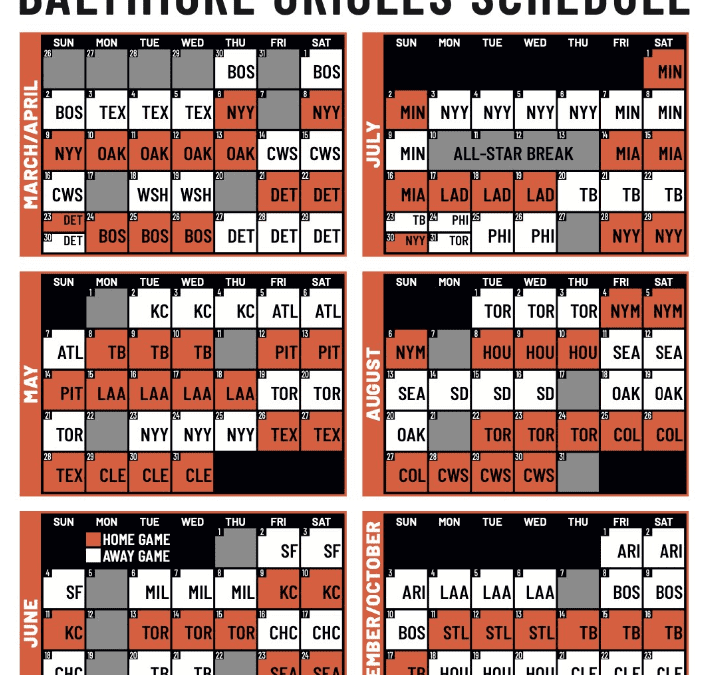
This season will be the first time that all 30 teams actually face each other in the regular season, thanks to a significantly expanded interleague schedule.
The easiest way to summarize how this expanded interleague will radically alter every team’s schedule is by comparing the 2022 and 2023 opponents for your Baltimore Orioles.
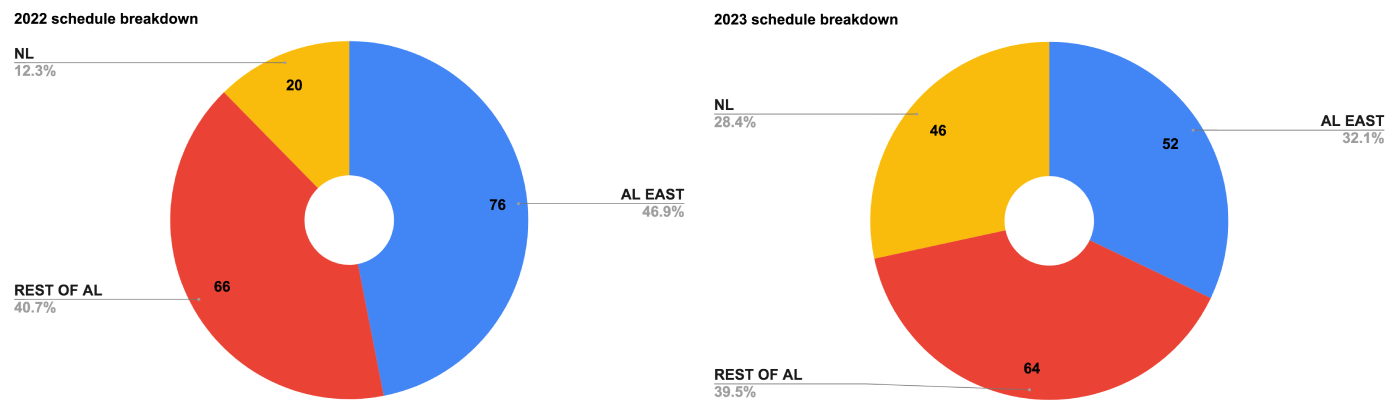
In 2022, the Orioles played 20 games against the National League Central and the Washington Nationals. Now in 2023, they’ll face all 15 NL teams across 46 games. In one year, interleague has gone from under 15 percent of their schedule to becoming over a quarter of their games.
Meanwhile, the Orioles will spend much less time playing their American League East rivals. 19 games against each AL East team has been reduced to 13 games, creating a new total of 52 games in the division.
While interleague games have spiked and divisional games have dropped, there will at least be no major tweaks to games against the rest of the AL. In 2022, the Orioles had a home-and-home series with the ten members of the AL Central and AL West and that will continue.
So, how will this new schedule impact the Orioles?
A closer look at the 2022 schedule reveals that fewer games in the AL East certainly seems like a good thing. While they ended the year 83-79, they were a rather underwhelming 34-42 in the division and didn’t win the season series against any of the four other teams in the division.
In comparison, the first-place Yankees were unsurprisingly much better in the division, putting together a 47-29 record that saw them win the season series against every AL East team by multiple games.

Baltimore arrived at a winning record while being eight games below .500 in the AL East thanks to a 49-37 record against everyone else. They were 37-29 against the other two AL divisions while going 12-8 against the NL Central and Nationals.
In the AL East, the Orioles won 44.7 percent of their games, a 162-game pace of 72 wins. Outside the AL East, they won 57 percent of the time, a noticeably higher pace of 92 wins.
The four other AL East teams also all had winning percentages above 50 percent playing outside the division, combining for a 57.8 winning percentage and a record of 199-145.
Based on this data, it seems entirely possible that the entire AL East will see its win total improve from last year just because they’ll spend less time beating up on each other.
However, I’d hardly consider that a guarantee. The massive increase in facing the NL teams is harder to project simply because it has never happened before.
The Orioles facing the Yankees six fewer times certainly can’t hurt, but what happens when those six games are replaced with facing the Los Angeles Dodgers and New York Mets? Is swapping out a trip to Toronto for a trip to San Diego going to be the kind of schedule change that makes it easier to reach 90 wins?
Last year saw the NL have six teams with more wins than the third-place Rays, but also saw seven teams lose more games than the last-place Boston Red Sox. Facing the Atlanta Braves every season could be harsh, but there’s still a chance it’s a net positive if it means an annual six games against small-market clubs with low payrolls like the Pittsburgh Pirates and Cincinnati Reds.

The AL was 152-148 in interleague last year, but now we’re going to be dealing with a much larger sample that should go a long way to helping us understand who this schedule change helps and hurts.
Another notable wrinkle to this schedule change is fewer games inside the division reduces the amount that every team is able to directly impact their chances at winning the division.
If everything breaks right and the Orioles find themselves battling for the division with the Yankees, they won’t get to face them after July 30. The final two months of the season with zero games against someone in the division feels bizarre to think about, but that’s the reality of this new schedule.
In 2022, the Orioles played the AL East 20 times in their final 30 games. In 2023, they’ll meet a division rival only 11 times in the same span of 30 games.
2023 will provide the Orioles with a schedule that could be their easiest in decades. However, we’ll just have to wait until October to see if that’s truly the case.

BSL Analyst
Rose Katz is a recent graduate of the University of Maryland’s journalism school, where she worked for The Diamondback as the online managing editor and a sports blogger. As a student, she spent almost all of her time on campus in The Diamondback’s newsroom or at Xfinity Center, Ludwig Field and Maryland Stadium. Rose gained intern experience with the Mid-Atlantic Sports Network (MASN).