
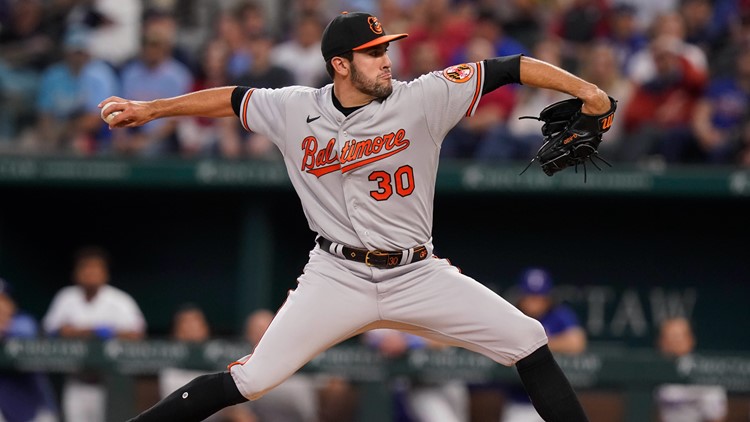
When Grayson Rodriguez was sent down to Norfolk to start the spring, Oriole fans were flabbergasted. Sure the young pitcher struggled throughout spring training, but his track record throughout the minor leagues suggested that there was nothing left for him to learn at that level. The fanbase was tired of waiting; it was time for Rodriguez to come to Baltimore.
That wait came to an end earlier than expected when Kyle Bradish suffered a right foot contusion in Texas and was forced to spend time on the injured list. With a spot open in the rotation, Rodriguez finally got his call to the big leagues, where he has stayed ever since.
Now, seven starts into the Rodriguez-era, the results have been mixed. He has struggled to keep command over the strike zone and has been prone to giving up too many home runs, but he has also illustrated an ability to work through difficult situations and limit damage thanks to his electric pitch arsenal. It’s been exciting to watch him develop on the biggest stage, and while the next few months may bring new challenges for the young right-hander, getting to work through them in the major leagues will only make him stronger in the long run. Here are some takeaways from Rodriguez’s first month in Baltimore.
Struggles
Leadoff hitters
One of the biggest issues Rodriguez has had over his first seven starts is an inability to get out leadoff hitters. Of the 35 batters he has faced to start an inning, four have walked, seven have hit singles, three have hit doubles, and two have hit home runs. That’s good for a ridiculous .387/.457/.677 slash line.
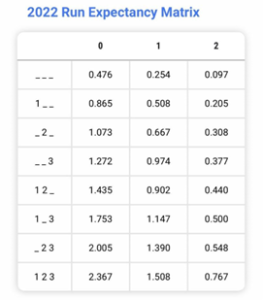
While Rodriguez has proved he is capable of working out of difficult situations, putting the leadoff man on base still drastically increases the likelihood of allowing a run in an inning. In 2022, innings in which the leadoff man reached first base had an expected run total of .865. Alternatively, innings in which the leadoff man was retired had an expected run total of just .254. These numbers suggest that Rodriguez’s inability to put away the first batter he faces each inning is the driving factor behind his inflated ERA (5.08). If he can come out of the gates stronger, he could drastically reduce the number of runs he is allowing and relieve some of the pressure that comes along with holding on baserunners.
Too many barrels
In addition to his struggles against leadoff hitters, Rodriguez has also been a victim of too many barreled up pitches through his first month in the major leagues. He is in the 14th percentile in average exit velocity allowed, the 6th percentile in hard hit percentage, the 25th percentile in expected batting average against, and the 28th percentile in barrel percentage. These numbers are indicative of a pitcher who is missing his spots and leaving too many pitches over the middle of the plate.
While many young pitchers face this same problem upon their arrival at baseball’s highest level, Rodriguez’s success this season will be contingent upon whether or not he can avoid barrels moving forward. Better usage of his cutter and curveball, which have yielded 80% and 85.7% hard hit rates respectively, could provide an avenue to do so. His changeup and slider have been excellent, so elevating the rest of his five-pitch arsenal would help him to keep opponents off balance and away from hard contact.
Inefficiency
The combination of lots of leadoff hitters on base and a high rate of barreled pitches has prevented Rodriguez from working deep into games. His 1.54 WHIP and 19.08 pitches per inning have allowed him to pitch into the sixth inning just once while averaging only 4.2 innings per appearance. Length has never been one of Rodriguez’s strengths, but his inefficiency since arriving in Baltimore has prevented him making as big of an impact as fans hoped he would have on the rotation.
The ineffectiveness of his fastball is a potential cause for his inability to put together quick innings. What was one of his best swing-and-miss pitches throughout his time in the minor leagues is responsible for 64% of his walks and almost 45% of the hits he has allowed despite being thrown just over 42% of the time. The velocity remains high (75th percentile) but he has struggled to command it, missing out of the zone and over the middle of the plate too often. Finding ways to consistently land that pitch on the inside half of the plate, as he did to strike out Randy Arozarena on Tuesday, could help him to work more efficiently moving forward.
Strengths
Changeups
While Rodriguez’s fastball has been inconsistent, his changeup has been a completely different story. Thanks to its 34.9 inches of vertical drop (1.5 inches above league average), opponents are hitting just .229 off the pitch with a 32% strikeout rate. Speed has also played a role in the success of Rodriguez’s changeup as he throws it at an average of 13 MPH slower than his fastball, a three MPH larger difference than the league average.
The changeup has long been considered Rodriguez’s best pitch so its smooth transition to the major league level is an excellent sign for his development. It’s incredibly rare to find a pitcher who can yield a 30.5% whiff rate while holding hitters to a 31.3% hard hit rate with a pitch that has minimal horizontal movement but Rodriguez has done exactly that, showing fans everything they need to know about the validity of his “stuff”.
In-game improvements
Another positive takeaway from Rodriguez’s first seven starts is the in-game improvements he has made from inning to inning. In innings 1-3, opponents are slashing .313/.380/.554 while scoring just over .6 runs per innings. However, in innings 4-6, those lines drop to .235/.304/.392 with an average of just .15 runners crossing the plate per inning.
A similar trend can be found when looking at Rodriguez’s splits against opposing lineups who are facing him for a first, second, and third time. Hitters are often thought to gain an advantage at the plate if they have already faced a pitcher, but Rodriguez has shown the opposite to be the case thus far. The adjustments he is making in the middle of games have led opposing batting averages to drop from .309 the first time through the order to .271 the second time and down to .211 the third time. Whether the credit belongs to the coaching staff, the catchers, or Rodriguez himself, someone is doing an excellent job of recognizing flaws in opposing lineups and applying it mid-game to help the right-hander effectively navigate the middle innings of his starts.
Limiting damage
Though leadoff hitters have been a problem for Rodriguez, keeping them put and preventing damage has not. Opponents are hitting just .167 off the right-hander with runners on base, a drop of over .200 from their totals with no one on base. Furthermore, five of the seven home runs Rodriguez has allowed have come with the bases empty. By limiting hard contact with runners on, Rodriguez has been able to avoid big innings and keep the team in ball games more often than not.
Rodriguez’s high strikeout rate is one of the driving forces behind his ability to navigate difficult situations. The rookie has struck out nine more hitters (41) than any other player on the roster, positing an impressive 11.11 K/9 over his 33.2 innings of work. 22 of those strikeouts have come with runners on base, suggesting that he has been able to find his best stuff when he has needed it most.
Given how little experience Rodriguez has at the major league level, he is sure to experience growing pains throughout the rest of the year. However, his first few appearances have brought promising results and there’s reason to believe his stats will improve as he becomes more comfortable in Baltimore. MLB Pipeline’s No. 4 overall prospect has already proved he belongs at the highest level, and it shouldn’t be long before the league starts to take notice.

Luke Rollfinke is a student at Vanderbilt where he is pursuing a career in sports journalism. A recent graduate from the Friends School of Baltimore, Luke has spent his entire childhood in Charm City and is a devoted Orioles fan. In the past, he has written for SB Nation and has worked closely with Ravens columnist John Eisenberg. From nights at Camden Yards to Sunday afternoons watching NFL Redzone, Luke eats, sleeps, and breathes sports. He is excited to bring his perspective to BSL.