
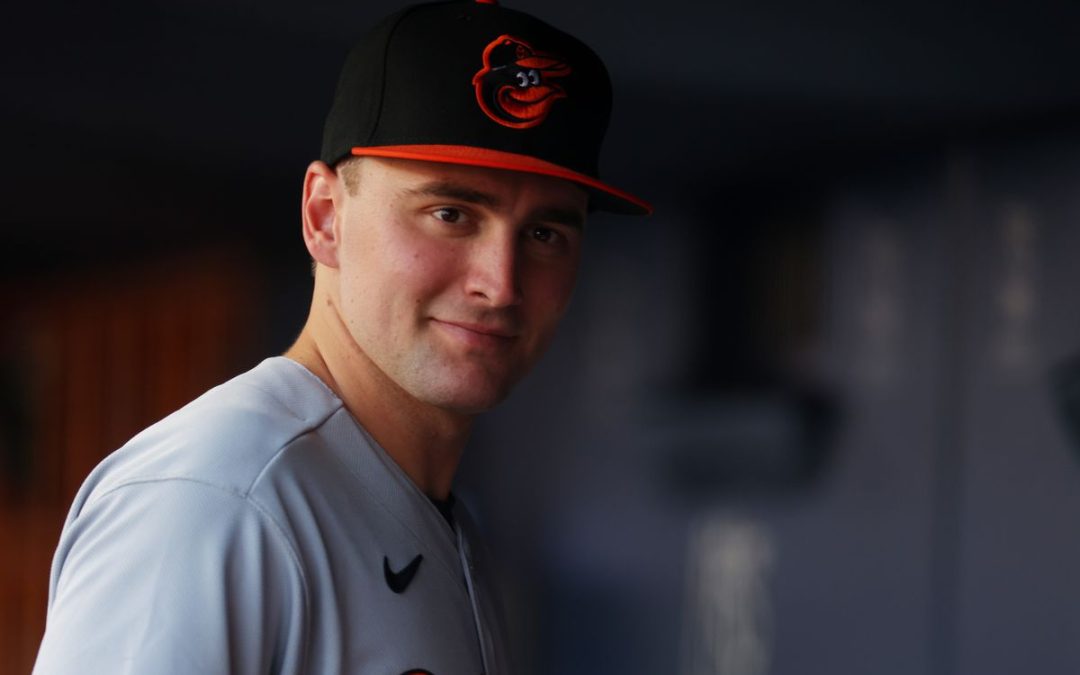
For much of May and June, Orioles fans clamored for Colton Cowser to be called up to the major leagues. Now, just 20 games into his major league career, many of those same fans are begging for him to be returned to Norfolk.
It’s true that Cowser has not impressed during his short stint in Baltimore. His .098/.254/.118 slash line leaves much to be desired and his 28.6% strikeout rate is significantly higher than the 23.3% rate he posted in the minor leagues. So, other than the natural growing pains associated with being promoted to the big leagues, what is behind Cowser’s slow start?
First off, Cowser has been falling behind in the count far too frequently. Over a quarter of his plate appearances have began 0-2 and almost half of his plate appearances have began 1-2, indicating an inability for him to put himself in advantageous situations. For reference, Jordan Westburg, who was called up around the same but time has had more success so far, has fallen behind 0-2 in just 10% of his plate appearances and 1-2 in just 14% of his plate appearances.
(EDIT FROM BSL: All Numbers here prior to Cowser going 1 for 1 yesterday in Toronto with his 2nd double.)
Similar to most batters, Cowser hits far better when ahead in the count than he does when behind. Of the plate appearances referenced above, just two have resulted in him reaching base (one on a walk and one on a hit). Similar trends could be seen during his time at Norfolk where he batted .386 with 11 extra base hits when ahead in the count and just .273 with 5 extra base hits when behind in the count. While those trends aren’t exactly surprising, they are relevant as it pertains to Cowser’s inability to reach base.
Cowser is currently facing the same problem that Gunnar Henderson faced earlier this year: he is taking too many pitches. Of his 63 plate appearances, just 13 have seen him swing at the first pitch and just one has seen him put the first pitch in play. He hasn’t been much more aggressive on second pitches either, having put the ball in play just six times with an 0-1 or 1-0 count.
When pitchers know that a batter is unlikely to swing at the first pitch, much less put it in play, they enter each at bat ready to attack. This leads to more first and second pitch strikes and more pitchers’ counts, leaving the batter at a significant disadvantage and unsure of what to expect.
Henderson’s season turned around when he started entering the batter’s box in attack mode, ready to ambush the first pitch he saw. It forced pitchers to approach him more carefully, creating more hitters’ counts and more opportunities to drive the baseball. Walks are great but hits are better, and until Cowser starts to jump on pitches early on in the count, he will continue to put himself in difficult situations.
Moving on to when he has put the ball in play, one of the biggest problems for Cowser has been the number of ground balls. His ground ball rate of 55.9% is 11.2% above league average and his topped hit rate of 47.1% is 16.2% above league average, illustrating an inability to create productive launch angles.
With the abolishment of the shift, high ground ball rates are less of a concern than they would have been in recent years. However, major league infielders can cover significantly more ground than most of the infielders Cowser played against in the minors, so picking up hits at a rate close to what posted with Norfolk will require him to either raise his exit velocity or raise his launch angle.
Exit velocity hasn’t been a significant problem so far given that his average mark of 86 MPH is just a tick below the league average of 88.4 MPH. Consequently, an improvement in launch angle could yield significantly better results for Cowser.
His current average launch angle sits at just 1.6 degrees, a massive departure from the league average of 12.2 degrees. Cowser is getting on top of everything, whether it’s off-speed pitches at the bottom of the zone or fastball up at the letters. If he can level out his swing and avoid driving so many pitches into the ground, he should see a steady improvement across his stat line, especially as it pertains to “barrels”, of which he currently has zero.
In addition to his inability to get the ball in the air, Cowser has also struggled mightily against pitches on the outside half of the plate. Of his 28 whiffs, 16 have come on outside pitches and of his 13 “hard hit” balls of 95+ MPH, just one has come on an outside pitch. Overall, his average exit velocity on outside pitches is 10-15 MPH lower than his average exit velocity on pitches inside or down the middle.
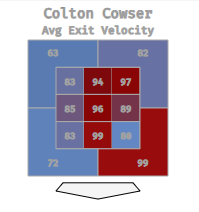
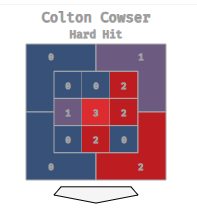
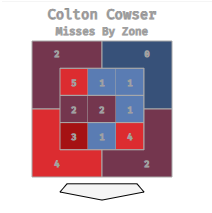
(Credit to Baseball Savant for Graphics)
Remarkably, four of his five hits have also come on outside pitches, suggesting that there is plenty of potential for Cowser to be able to hit pitches in all parts of the zone. Unlocking that potential will be no easy task, however, as pitch location is one of the biggest differences between minor league baseball and major league baseball.
In the minors, very few pitchers can hit their spots consistently to exploit the outside half of the plate. The majors are a different story, however, and succeeding at the highest level requires you to be able to make solid contact regardless of pitch location. If Cowser can begin to drive the ball to the opposite field with some consistency, it will not only improve his stats against outside pitches, but also earn him more opportunities to see inside pitches that he can turn on and drive into right.
Fortunately, there are a couple of trends in his data that suggest some better results could be coming for Cowser. His line drive rate of 29.4% and hard-hit rate of 38.2% are both above league average, and his weak contact rate of 2.9% is below league average. His walk rate is also above league average at 14.3%, though I think that bringing that number down by being more aggressive may actually be better for his long-term development (much like it was for Henderson).
It should also be noted that, while his expected stats are still not great, Cowser has been the victim of some bad luck. His expected batting average of .203 and expected slugging percentage of .250 are both more than twice his actual stats, indicating that a number of balls he has put in play should have fallen and simply didn’t. If Cowser is batting above .200, as the analytics suggest he should be, we are likely having a very different conversation about his performance up to this point.
Finally, it’s important to remember that Cowser isn’t the only Orioles prospect who failed to produce upon his arrival in the major leagues. Adley Rutschman had just seven hits, two walks, and one hit-by-pitch through his first 54 plate appearances and Henderson was batting .170 with just seven extra base hits on May 13th of this year.Hend
Cowser, like many others, has been prone to slow starts throughout his career. He batted just .214 through his first 14 games with Aberdeen in 2022 and went just three for his first 30 to kick off 2023 at Norfolk. If he’s still hitting below .150 at the end of August, then I’d say there’s some cause for concern. Until then, however, Cowser deserves to be given the time and opportunities necessary to adjust to the highest level of competition in the world.

Luke Rollfinke is a student at Vanderbilt where he is pursuing a career in sports journalism. A recent graduate from the Friends School of Baltimore, Luke has spent his entire childhood in Charm City and is a devoted Orioles fan. In the past, he has written for SB Nation and has worked closely with Ravens columnist John Eisenberg. From nights at Camden Yards to Sunday afternoons watching NFL Redzone, Luke eats, sleeps, and breathes sports. He is excited to bring his perspective to BSL.