
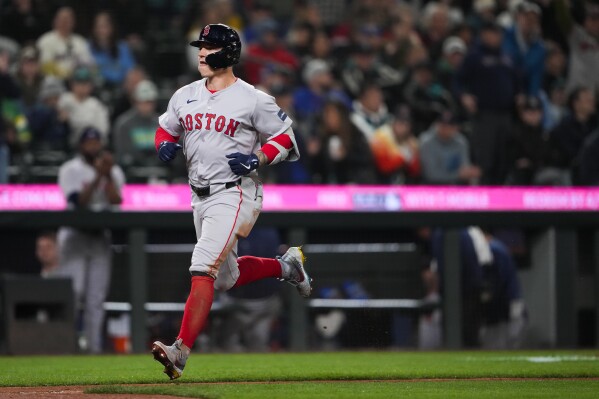
On January 20, the Baltimore Orioles officially said farewell to Anthony Santander after he signed a contract with the rival Toronto Blue Jays. Of course, Santander’s departure wasn’t exactly a surprise after the Orioles signed Tyler O’Neill earlier in the offseason.
While O’Neill and Santander are certainly both power-hitting corner outfielders, they’re hardly clones. The pair differ in several key factors including their strikeout rate, platoon splits, health and of course, their contracts.
In choosing O’Neill over Santander, the Orioles are picking up someone who strongly embodied baseball’s three true outcomes last season.
O’Neill’s strikeout rate sat in the second percentile last year, while his whiff rate was in the fifth percentile. However, his frequent strikeouts came paired with a hard-hit percentage in the 90th percentile and a walk rate in the 87th percentile. O’Neill might swing-and-miss a lot, but his combination of power and discipline still makes him a productive hitter.
Meanwhile, Santander ended 2024 with above-average numbers for both his strikeout and walk rate, but did worse than O’Neill in batted-ball metrics like hard-hit percentage and barrel rate.

The Orioles, like every other organization in today’s game, are more than happy to start someone who strikes out a third of the time if the other two-thirds of his plate appearances include plenty of walks and loud contact.
The right-handed hitting O’Neill also massively differs from the switch-hitting Santander for their platoon splits.
When O’Neill faced left-handed pitching in 2024, he was one of the best hitters in the sport. In 156 PAs against lefties, O’Neill produced an outstanding 1.179 OPS, the second-best OPS facing lefties among all hitters with at least 150 PAs against them. Meanwhile, O’Neill without the platoon advantage was a rather pedestrian hitter, providing a .693 OPS right-on-right. For those wondering, that’s a difference of 486 points in his OPS.
Unsurprisingly, Santander enjoyed a much more stable level of production between lefties and righties. His OPS was .793 against lefties and .822 against righties, a gap of just 29 points.

Focusing on a righty who crushes lefties certainly makes sense for a team expecting to give 500+ PAs to several left-handed hitters like Gunnar Henderson and Cedric Mullins, but interestingly enough, the 2024 Orioles had virtually identical production against lefties and righties.

Santander also offers a much cleaner bill of health than O’Neill. In the past three years Santander averaged 153 games per season, while O’Neill averaged 94.
Last year in Boston, O’Neill had three separate stints on the injured list due to a concussion in April, right knee inflammation in May and a leg infection in August. Additionally, 2022 and 2023 saw him deal with a right shoulder impingement, a left hamstring strain, a lower back strain and a right foot sprain. If he manages to appear in over 100 games like he did last year then I’d imagine the Orioles will be happy with the signing, but not if he misses over half the season like he did in 2023.
As for the contracts, Santander earned himself both a longer contract and a higher average annual value. Ken Rosenthal reported that Santander’s deal is for five years and 92.5 million dollars with the chance for it to become a six-year deal. Meanwhile, O’Neill signed a three-year deal for 49.5 million dollars with a player opt-out after the first year.
Santander will be looking at an AAV of 18.5 million dollars, while O’Neill’s AAV will be slightly smaller at 16.5 million dollars. Of course, the key difference between these deals is their length. The Orioles are only committing to O’Neill for a maximum of three years, while Toronto could be looking at keeping Santander on the books until 2029 or 2030.
The Orioles looking to make a shorter-term commitment when it comes to a corner outfield slugger makes sense given that there are several other pretty major contract decisions looming. Adley Rutschman is currently set to become a free agent after the 2027 season, while Gunnar Henderson’s last year in Baltimore could be in 2028. If the Orioles believe they have a legitimate chance at keeping at least one of these players then it would make sense to avoid having 18.5 million dollars per year already tied up with another player.
Ultimately, it’s easy to see both a best-case and worst-case scenario for these decisions when looking at the short term and the long term.
The best case scenario is O’Neill’s excellence against left-handed pitching combined with his great Statcast metrics mean the Orioles don’t miss a beat in 2025 while having the long-term budget space to keep at least one of their two biggest homegrown stars.
However, there’s also the chance that O’Neill’s underwhelming health and uninspiring numbers against right-handed pitching makes him a disappointing addition while the money saved doesn’t matter when Rutschman and Henderson take massive deals from someone like the New York Mets and/or the Los Angeles Dodgers.
Choosing O’Neill over Santander might not be the most important decision Mike Elias will make with the Orioles, but it is one that will have ramifications for both next season and far beyond that.

BSL Analyst
Rose Katz is a recent graduate of the University of Maryland’s journalism school, where she worked for The Diamondback as the online managing editor and a sports blogger. As a student, she spent almost all of her time on campus in The Diamondback’s newsroom or at Xfinity Center, Ludwig Field and Maryland Stadium. Rose gained intern experience with the Mid-Atlantic Sports Network (MASN).