
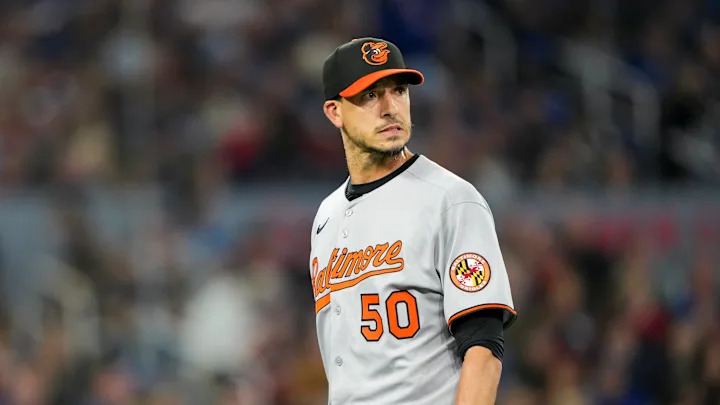
When the Orioles signed Charlie Morton to a one-year, $15 million deal in the offseason, I think the most generous Orioles fan was saying “well, he’s not who he used to be, but he started 30 games last year and the year before, turned in fairly respectable numbers, let’s see what happens.”
It was a bit of a head-scratching move in retrospect now, given the Orioles lost Corbin Burnes and never really replaced him with anyone of a similar caliber but instead opted for Charlie Morton’s ghost and Tomoyuki Sugano (who, admittedly, has looked pretty decent so far this year).
But I don’t believe that even the most pessimistic Orioles fan could’ve predicted just how bad Charlie Morton would be this year.
Granted, he’s only 33.2 innings and six starts into the year, but an 8.82 ERA and a 1.96 WHIP is certainly a sight to behold in any Major League starting rotation, let alone a rotation of a team that, at least supposedly, has World Series aspirations (or did before the season started).
So what’s gone wrong with Charlie Morton? He hasn’t been this bad at basically any point in his career. Sure, he didn’t turn in the best season last year, but 165.1 innings with a 4.19 ERA is at least mediocre and not horrible. And even a year earlier, Morton posted a 3.64 ERA over 30 starts, so while he wasn’t his past, dominant self, he’s still shown he had life even as he hit 40.
But as we dig into Morton’s repertoire, there are some clear indicators of what’s going wrong. So let’s take a look.
Digging into Charlie Morton’s repertoire
Right off the bat I want to say, Morton isn’t this bad. Some of this has been bad luck. He’s not an almost-9.00 ERA pitcher. But he’s also not the pitcher he used to be, not even the pitcher he was last year.
Morton’s repertoire for a long time now has basically been “throw my curveball and pray everything else works out okay.” He’s generally gone with the “pitching backwards” approach of having his breaking ball as his most-thrown pitch rather than his fastball, and it’s often worked because his curveball has historically been one of the nastiest around.
But that’s not happening this year. Morton’s been throwing his curveball 34% of the time which is the same usage percentage as his fastball. That’s the lowest usage percentage Morton has seen with his curveball in six years, typically he’s throwing it over 40% of the time.
That wouldn’t necessarily be an issue if his fastball was any good, but it’s not. The pitch comes in around 94 MPH on average with extremely average extension and induced vertical break at a very average attack angle. Basically it could not be a more average, mediocre fastball from a pure stuff perspective. The velocity, the movement, the spin, the attack angle, none of it is especially effective or special.
And what’s worse is, he has no command of the pitch at all. Typically you want to see a fastball located in the zone at least roughly 60% of the time, bare minimum at least 50% of the time. So far this year, Morton’s located his fastball within the strike zone 39.1% of the time compared to 51.4% last year.
He’s also throwing the pitch high in the zone a bunch, 68.7% of the time this year compared to 47.6% last year. Now imagine with me if you will a fastball coming in with average velocity, a fairly standard attack angle, not a lot of extension, and not a lot of induced vertical break on it that’s located high in the zone nearly three-quarters of the time. That sounds like a pitch hitters would love to tee-off on assuming it even gets in the zone (which as we’ve established, more often than not it doesn’t).
Unsurprisingly, given where the pitch is located, when hitters make contact with it, they’re hitting it for fly balls a lot—56% of the time to be exact (with a 28.6% HR/FB rate, so a lot of those are going out of the park), and they’re barreling it 16% of the time (which is bad).
And no matter how good your curveball is, one pitch does not a pitcher make. It needs to play off of your other pitches.
In the past, Morton hasn’t really had to locate his curveball in the zone a bunch, lots of pitchers do that because their breaking ball will get chased outside the strike zone a lot. That’s also been the case for Morton—until now.
Last year, Morton’s curveball sported a 37.9% chase rate. It was 39.2% the year before that and 38.5% the year before that. So far this year, it’s sporting a 28.1% chase rate which doesn’t go great with a career-low 34.3% zone rate. As a pitcher, you can get away with a zone rate that low on a breaking pitch if it’s getting chased a lot, but Morton’s curveball isn’t. Why would it? He can’t even locate fastballs in the zone—hitters know they can sit up there and either wait for a cookie over the heart of the plate or take a walk.
So let’s review—so far this year, Charlie Morton’s problems have stemmed from the fact that he’s throwing an extremely mediocre fastball that he has no control over alongside a curveball that has lost its effectiveness in part because he also can’t control it but also because his fastball isn’t as effective as it used to be.
And before you ask, yes, he has other pitches in his repertoire, though given his fastball and curveball comprise 68% of the pitches he throws, their effect is negligible.
He has a changeup and cutter that he generally reserves as pitches to throw against lefties. The changeup is fairly effective against lefties though the cutter gets rocked more often than not.
He also has a sinker that he throws almost exclusively to righties, but this is a situation where he doesn’t lack control, he lacks command. The sinker gets plenty of the strike zone, in fact it gets too much of the strike zone. Morton throws his sinker in the zone almost 60% of the time against righties and instead of locating it low and arm-side (which is ideal), he often locates it over the middle of the plate. And even worse, roughly 10% of the time he locates it literally middle-middle.
Unsurprisingly, righties are sporting a .417 average and .481 wOBA against the pitch as a result with a ridiculous 50% HR/FB rate.
Charlie Morton’s problems are mostly related to his lack of control on his main two pitches. His repertoire has basically fallen apart—the curveball isn’t as effective as it used to be, the fastball is bad, the sinker is terrible, the cutter is terrible, none of it is good news.
Can he fix it? Honestly, I’m not sure that he can. He’d suddenly need to start locating his pitches better and that’s not exactly a thing you can just switch on overnight. Morton looks like a 41-year-old pitcher whose skills are rapidly declining and who probably should’ve retired last year.
In short—it’s uhh…not looking good.

Ben Palmer has lived in Maryland his whole life and currently spends his days working as a health care journalist. He also previously wrote for and was a site expert for the FanSided blog The Baltimore Wire and currently works as managing editor at Pitcher List where he writes about fantasy baseball.