
The MLB Trade Deadline has come and gone and just like it seems to be every single year, it’s been an absolutely wild one with some crazy trades.
Some of those trades are likely to especially hit home for Orioles fans. While expected, losing guys like Cedric Mullins, Ryan O’Hearn, and Ramon Urias is tough as many have really grown to love these players (I know I have).
But now that the deadline is over, let’s take a look at the prospects the Orioles acquired through their various trades. In total, we’re looking at 16 new additions to the Orioles’ farm system, so here I’m going to provide you with a few quick sentences on each player so you can get to know them.
Let’s dive in.
Wellington Aracena, RHP
Aracena came over from the Mets in the trade that sent Gregory Soto to New York. Aracena is 20 years old and has looked pretty darn good so far at Single-A, pitching to a 2.38 ERA over 64.1 innings with 84 strikeouts and a 1.13 WHIP.
And even better, he started for the Delmarva Shorebirds just yesterday and pitched 4.2 shutout innings with six strikeouts and one walk. Not a bad way to kick off his Orioles career.
Aracena has a strong fastball that sits around 96 to 99 MPH but has gotten as high as 101 that he pairs with a sharp cutter that floats around 92 to 94 MPH and has more than six inches of gloveside movement. He’s also got an upper-80s slider and mid-80s curveball in his repertoire.
Aracena’s problem has been walks—he posted an awful 20.2% walk rate last year but has fortunately brought that down to 12.8% so far this year.
Cameron Foster, RHP
Foster also came over in the Gregory Soto deal and while he isn’t the highlight of the deal (that’d be Aracena), he’s still an interesting guy.
Drafted in the 14th round of the 2022 MLB Draft, Foster is 26 years old and has mostly spent time in Double-A this year, coming up to Triple-A somewhat recently. So far this year, Foster owns a 2.84 ERA with a 31% strikeout rate and a 7.1% walk rate through 31.2 innings, mostly out of the bullpen (he’s got one start on the year).
Foster’s repertoire includes a slightly above-average fastball that sits around 96 MPH on average with a cutter that sits around 89 MPH, an 83 MPH slider, and an 81 MPH curveball.
Foster mainly goes with a fastball/cutter combo (almost 75% of his pitches are fastballs or cutters) but the slider and curve do work in occasionally, despite being fairly average pitches.
Juaron Watts-Brown, RHP
Watts-Brown came over in the trade that sent Seranthony Dominguez to the Blue Jays in between a doubleheader and looks to be a pretty interesting pitcher.
The 23-year-old was drafted by the Blue Jays in the third round of the 2023 MLB Draft and so far has posted a 3.54 ERA with a 30.5% strikeout rate and 10.1% walk rate through 89 innings and 19 starts.
Watts-Brown has an okay fastball that sits in the low 90s, but that’s not his main pitch. That’d be his slider, which sits in the low 80s and serves as a solid above-average pitch paired with a decent upper-70s curveball.
In case you didn’t notice with his walk rate, walks have been an issue, but hopefully that’ll come down, especially if he’s going to stay a starter.
Twine Palmer, RHP
Another pitcher who could end up a starter or reliever, Twine Palmer came over from the Astros in the Ramon Urias trade and has looked decent so far a Single-A.
So far this year, the 20-year-old has pitched to a 2.13 ERA with a 25.1% strikeout rate and a 12.6% walk rate over 42.1 innings and eight starts.
Palmer’s a fairly big guy at 6’5″ and comes with a solid repertoire, including a low-90s fastball that plays up a bit thanks to its movement and extension. Palmer’s primary breaking pitch is a slider with solid movement and he mixes in a cutter, curveball, and changeup as well.
Palmer’s strikeout rate isn’t the greatest but his groundball rate is pretty impressive at almost 55% so far this year. Also worth noting, the guy hasn’t allowed a home run yet. Most likely, Palmer ends up a reliever.
Wilfri De La Cruz, SS
De La Cruz came over in the trade that sent Andrew Kittredge to the Cubs and comes to the Orioles as all potential given he’s 17 years old and just signed with the Cubs during the international signing period in January.
De La Cruz is a switch hitter with a solid approach mainly focused on line-drives than home runs. So far this year in Rookie ball, he’s posted a .262/.442/.417 line without a home run yet, but the fact he’s posted a 23% walk rate (in just 27 games obviously) is encouraging.
De La Cruz is athletic, he’s a decent runner, and he’s projectable. It’s hard to say what a 17-year-old prospect will turn into, but the potential is there.
Raimon Gomez, RHP
Gomez was one of the players that came over from the Mets in the Cedric Mullins trade and if there’s one thing that’s Gomez’s calling card, it’s his incredible fastball.
Back in April, Gomez recorded the fastest pitch that’s been tracked in the minor leagues since ABS tracking came around in 2021 with a 104.5 MPH fastball. Not only that, Gomez’s fastball sits 100 MPH on average. That’s…insane. He’s also got an above-average slider that sits around 90 MPH.
Problem is (tell me you saw this coming), Gomez has no idea where his pitches are going, and that’s been an issue.
So far this year, mostly out of the bullpen, Gomez has posted a 4.63 ERA with a 30.4% strikeout rate and a 15.8% walk rate over 35 innings.
We’ll see if he can rein in his control, but clearly the fastball is a marvel to behold.
Anthony Nunez, RHP
Another piece of the Mullins trade, Nunez was initially drafted as a high school shortstop before being released and going to college at the University of Tampa. The Mets signed him as a free agent last year and Nunez has looked good as a pitcher so far.
Nunez owns a fastball that can touch 96 MPH alongside a low-90s cutter, a sweeper that sits around 86 MPH, and a mid-80s changeup. The slider/changeup/cutter combo is really where Nunez shines and has so far posted a 1.58 ERA with 60 strikeouts and 17 walks over 40 innings, all out of the bullpen.
Nunez looks to be a bullpen arm, but the 24-year-old looks like he has some potential to be a pretty solid bullpen arm.
Chandler Marsh, RHP
It’s another pitcher and more specifically, another bullpen arm that the Orioles acquired in the Cedric Mullins trade.
Marsh is 22 years old and has to this point exclusively worked out of the bullpen to pretty good results, posting a 2.57 ERA with a 31.3% strikeout rate and a 10.2% walk rate over 42 innings.
Marsh owns a solid fastball/slider combo, with the former sitting 94 to 96 and the latter coming in with some solid, sharp break to it. He’s also got a changeup and curveball he uses occasionally, but those aren’t his main pitches.
Given the two-pitch approach, it’s likely Marsh stays as a bullpen arm, and hopefully the success continues.
Boston Bateman, LHP
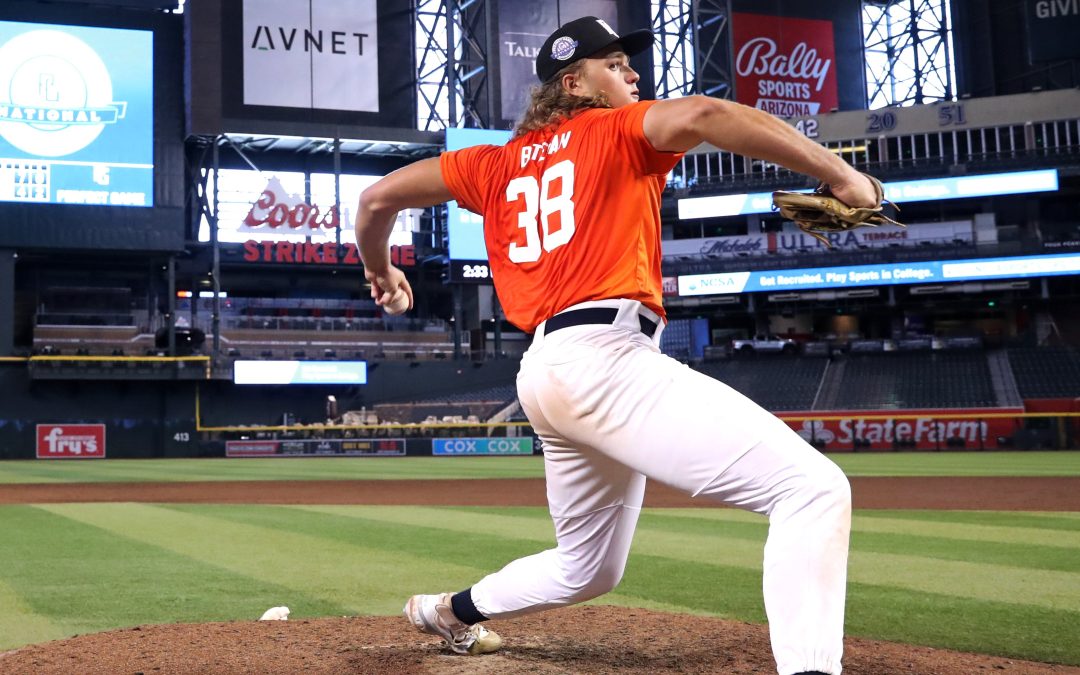
Bateman is the highlight of the deal that sent Ryan O’Hearn and Ramon Laureano to the Padres and looks like a pretty interesting prospect.
Coming in at 6’8″ and 240 pounds at just 19 years old, Bateman looks like he’s got plenty of potential. He owns a fastball that can hit 97 MPH but typically sits around 91 to 93, which he pairs with a slider and a curveball (though he throws the former more than the latter).
Bateman was drafted in the second round by the Padres in 2024 and has turned in mixed results so far in Single-A, posting a 4.08 ERA with a 25.8% strikeout rate and an 8.6% walk rate over 68.1 innings.
Again, he’s only 19 so this is all about future potential, and certainly there’s plenty there for Bateman.
Brandon Butterworth, 2B/SS
One of the few position players the Orioles acquired this trade deadline, Butterworth is a 22-year-old middle infielder who’s got good speed and has looked pretty solid at High-A so far.
In 89 games, Butterworth has posted a .267/.327/.455 line with 11 home runs and 13 stolen bases.
Coming to the Padres via the 12th round of the draft last year, Butterworth has generally been known more for his speed and fielding than his bat, but hopefully the success at High-A so far is a sign of things to come.
Cobb Hightower, SS/2B
Another middle infielder acquired from the Padres, Hightower was drafted in the third round last year and has looked better lately at Single-A.
Hightower is just 20 years old and looks to be a guy who could be a solid bat in the future. So far this year, he’s only posted a .239/.363/.314 line with one home run and seven stolen bases, but has looked better in July.
Again, it’s hard to sit there and project a player so young, but Hightower has some raw talent, and the fact he’s posted a 14.7% walk rate with just a 16.3% strikeout rate so far in Single-A is encouraging. The guy also ran a 6.6 in the 60-yard dash, so the speed is there too.
Victor Figueroa, 1B
Figueroa was drafted in the 18th round of the 2024 draft and has been lighting up the lower-levels of the minors so far to the rune of a .318/.420/.588 line with 12 home runs and five stolen bases over 64 games.
Figueroa came out of Mississippi Valley State and later Florida Southwestern State where he won the FCSAA Triple Crown posting a .421 average with 17 home runs and 79 RBI. He’s got solid bat speed and plate discipline, though he’s had some trouble with off-speed pitches.
Still, the guy’s posted great numbers so far, so we’ll see what happens as he climbs the minors.
Tyson Neighbors, RHP
A fourth-round pick in the 2024 draft, Neighbors struck out 86 batters in 48.2 innings as a sophomore at Kansas State and became a name to know.
Neighbors has pitched out of the bullpen so far this year with great success, posting a 1.85 ERA with a 37.6% strikeout rate and a 10.6% walk rate over 43.2 innings between High- and Double-A.
Neighbors has a fastball that floats around 95 MPH on average and can hit 98 with great induced vertical break. He pairs that with a solid mid-80s slider with lots of potential and a low-80s curveball alongside the occasional 90 MPH cutter.
Neighbors looks to be a bullpen arm but he looks like a bullpen arm with serious potential.
Tanner Smith, RHP
A 15th-round pick out of Harvard in 2024, Tanner Smith is another (mostly) bullpen arm who’s looked solid so far.
To this point in the minors, Smith has posted a 3.46 ERA with a 28.1% strikeout rate and 11.6% walk rate thought 26 innings. He’s the least-heralded of the prospects coming in the O’Hearn/Laureano deal and had some struggles in college, but we’ll see what eventually happens with a 22-year-old.
Micah Ashman, LHP
Ashman came over in the trade that sent Charlie Morton to the Tigers and is another big dude, coming in at 6’7″, though just 195 pounds.
Ashman came out of the University of Utah in the 11th round of last year’s draft and has so far looked great out of the bullpen between High-A and Double-A, posting a 1.49 ERA with a 31.1% strikeout rate and 5.6% walk rate through 42.1 innings.
Ashman has a fastball that sits around 90 to 92 MPH but is helped by his height alongside a solid slider with sharp, late break that has plenty of swing-and-miss potential. He’s also got a changeup that he tosses in there occasionally, but that’s not his bread and butter (that’s the slider).
Ashman projects as a control-first reliever who could be a solid left-handed bullpen piece for the Orioles in the future.
Dietrich Enns, LHP
You’ll notice something different about Dietric Enns compared to the rest of the guys listed here—he’s uh…old. Specifically he’s 34 (I’m also 34 I’m not old so shut up).
Enns came over to the Orioles from the Tigers last minute at the deadline in exchange for cash considerations. Enns played in the KBO last year and the NPB the two years prior to mostly middling success.
He’s pitched 17.2 innings in the majors so far this year for the Tigers to a 5.60 ERA, but his minor league numbers in Triple-A have looked much better, to a 2.89 ERA with a 26.7% strikeout rate and 5.6% walk rate over 62.1 innings.
The Orioles got Enns for literally cash, so there isn’t much here compared to the others. He’s basically a warm body they can put in what is now a depleted bullpen.

Ben Palmer has lived in Maryland his whole life and currently spends his days working as a health care journalist. He also previously wrote for and was a site expert for the FanSided blog The Baltimore Wire and currently works as managing editor at Pitcher List where he writes about fantasy baseball.