
The general mantra is that the road to a World Cup begins the day after the current one ends. While that is not wrong its also a bit out of context, especially for the USMNT and WC 2026. That statement is true in most cases because these are the steps to get to the next WC.
- Evaluate performance at the recently completed WC and look across the pool of players to build a deep pool of players that might have a role in the next WC.
- Play some friendlies and your Federation’s (in our case its CONCACAF) tournament to look at those players in depth.
- Use that pool and depth to navigate the qualification process.
Four years seems like a long time to navigate that process, and while its adequate its certainly not any too long. But for WC 2026 the USMNT didn’t have to go through step 3 as they automatically qualified as a co-host along with Mexico and Canada. So to many fans that seemed like a good thing. The reality is a bit different. Without having to go through the qualification process it really limited the number of quality/competitive matches the team had in order to really evaluate their player pool. Friendlies are all well and good but there are two downsides to this.
- Friendlies are just that, friendlies. And teams do not, generally, take those as seriously as competitive matches. The result being that most clubs are less inclined to release their key players for a non-competitive match.
- its difficult to schedule good teams since most other countries are involved in their qualification process and simply not available.
What this all means is that the quality of play that the USMNT could schedule was not as good as you’d like outside of their invite to COPA America 2024 and the CONCACAF Gold Cups. But the good news is that now that we are close to next summer more quality teams are available to schedule as they have already qualified or are still in that process and want to stay sharp. This started with window last month when we hosted South Korea and Japan. Both quality teams.
Here’s a look at the games currently on the schedule leading to next summer.
October – Ecuador and Australia
November – Paraguay and Uruguay
March – Portugal and Belgium
That is a very good preparatory schedule and its likely that 2 or 3 more games will be added next May/June right before WC2026.
So just what does this mean in terms of what the US needs to accomplish over these next two windows? According to Manager, Mauricio Pochettino, the “time for experimenting is over.” Pochettino made that statement concerning the window last month with the expectation being that future windows would be more aligned with the best roster of available players. Time to build a cohesive unit ready for our home WC. And the roster selection announced last week surely signaled that its time to get serious. Now that doesn’t mean there won’t be roster tweaks the rest of the way but by and large most decision from here on out will be based on fitness and form. Now one name I hope to see in November is Noahkai Banks. Although only 18 he could well be a key CB next summer.
Here’s the October roster with the players club affiliation listed.
Goalkeepers (4): Chris Brady (Chicago Fire), Matt Freese (New York City FC), Patrick Schulte (Columbus Crew), Matt Turner (New England Revolution)
Defenders (8): Max Arfsten (Columbus Crew), Cameron Carter-Vickers (Celtic), Alex Freeman (Orlando City), Mark McKenzie (Toulouse), Tim Ream (Charlotte FC), Chris Richards (Crystal Palace), Antonee Robinson (Fulham), Miles Robinson (FC Cincinnati)
Midfielders (8): Brenden Aaronson (Leeds United), Diego Luna (Real Salt Lake), Weston McKennie (Juventus), Aidan Morris (Middlesbrough), Cristian Roldan (Seattle Sounders), James Sands (St. Pauli), Tanner Tessmann (Olympique Lyonnais), Malik Tillman (Bayer Leverkusen)
Forwards (6): Patrick Agyemang (Derby County), Folarin Balogun (Monaco), Christian Pulisic (AC Milan), Tim Weah (Olympique Marseille), Haji Wright (Coventry City), Alex Zendejas (Club América)
And like EVERY roster selection announced the fans raised the age old question….”why wasn’t (insert favorite player here) selected….what’s wrong with this coach.” My first thought is to usually just laugh them off. In most cases there are good reasons the selections were made and equally why some were left off. Here’s a quick look at those missing from this camp and why that is.
Tyler Adams – Initially even I had the WTH Poch thought. Adams is our best DM and its not even a question. And he hasn’t been hurt so what gives. Turns out there’s no behind the scenes issue here. Adam’s wife is do to have a baby any day now and he stayed home to be with her.
Sergino Dest – Just recovering from injury and its not up to full time playing.
Ricardo Pepi – Injured
Gio Reyna – Injured. Two matches in for his new club and hurt again. Reyna’s chances of making the final roster are rapidly dropping. He really needs to recover quickly and get in a couple of matches to be able to get called in for the November camp.
Johnny Cardoso – Injured
Jack McGlynn – Injured
Josh Sargent – Just not called in but not surprising that again last September he failed to produce for the Nats.
Now the two names you can find all kinds of back door stories about.
Yunas Musah – I believe its a issue of form but his declining a callup to last summer’s Gold Cup likely didn’t earn him any extra credit.
Joe Scally – This is the really odd one for me. We need more defensive depth and he’s starting every week in the Bundesliga.
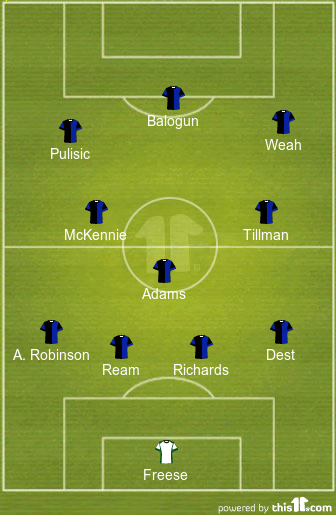
But at the end of the day this is a pretty solid roster and includes just about everybody you’d want to see that’s available. Now that we are approaching crunch time just what major decisions do Pochettino and his staff have to make before they submit the final WC 2026 roster? I think it mostly boils down to one major decision. Are they going to play a 4-3-3 or stay with a 3-5-2 which they mostly used last window. This is the critical decision because the players that need to be evaluated and tested the rest of the way really fall out from this one choice. As, an example, lets look at a “Best Starting XI” depending on your base formation. Here’s what a 4-3-3 might look like.
Now lets take a look at a 3-5-2 formation.
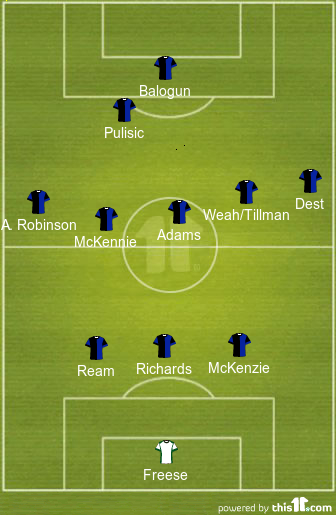
So mostly the same personnel except that you have Mark Mckenzie as a RB in the back three. This means you now have to decide to do want to keep Malik Tillman in your midfield 5 as the better ball handler or do you want to keep Tim Weah in there for his speed down the wings. Both are adequate defenders. Weah is a better outside attacker while Tillman is a better inside attacker and line between the back line and the attack.
And while most of the “Best XI” are the same, as you would expect, the biggest difference becomes who you then call in as the rest of your roster. If you stick with a 4-3-3 then your outside backs need to be very fit and have good 1 v 1 defending ability. And your defensive midfield needs to have very good overall defensive abilities and some speed to cover a counter attack when your outside backs are caught upfield. This would favor players such as Aiden Morris and Joe Scally. If you go to a 3-5-2 then you need to ensure you have backline substitutes that are very good defensively. Such as Joe Scally. But your wingback substitutes would be more offensively focused. Not that they don’t have to have adequate defending skills but there primary use is more in creating chances. This favors players like Alex Freeman and Max Arfsten. Thankfully, with a 26 man roster you can have the best of both worlds and have the ability to change formations based on the opponent and any player fitness issues. However the desire to be able to switch base formations and tactics is also not with its downside. Even though the rosters are expected to be 26 players it becomes more difficult to take a player such as Sebastian Berhalter. While Sebi is a fine midfielder there are others who are overall better players. BUT none of them have the free kick taking ability of Sebi. And in a match where you need a late goal there are two player types that can be crucial. A free kick taker and a big forward who is excellent in the air. I guess this is why Pochettino and staff get paid the big bucks. Not easy decisions they will have to make.
But this begins in earnest this Friday as we take on Ecuador. The game is set for this Friday, October 10 at 8:30 pm EDT in Austin, Texas. Then they will follow that up with a game against Australia on Tuesday, October 14 at 9:00 pm EDT at Commerce City, Colorado. Both matches will be broadcast on TNT and streaming will be available on Peacock.
The next 8 months is going to be a fun ride. Get your game face on. Time for the Nats to show us the good!
This article is courtesy of Eastern Shore Window and Door – “Protect your home and get the most out of your view with stylish, affordable, energy-efficient home improvements from Eastern Shore Window and Door.”

Soccer Analyst
Steve is an avid fan of all things soccer and the O’s. Originally from the west, he grew up in the Baltimore area. He returned to the west for college where he earned a BS degree in Chemical Engineering from Montana State University and spent 36 years working at the Idaho National Laboratory prior to retiring in 2013. It was during his school years in Baltimore where he learned to play soccer and that developed into a life long passion. He played competitively for over 40 years and was a four year starting goalkeeper at MSU. He also coached and refereed in the Idaho premier soccer and High School programs for many years.