
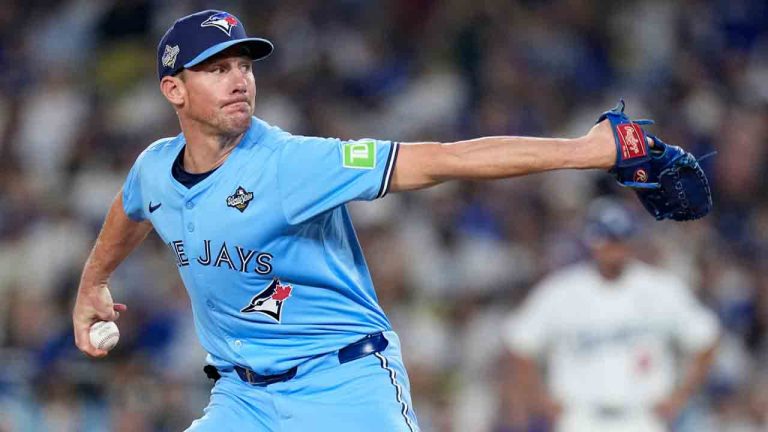
The Orioles didn’t land Framber Valdez. They didn’t land Ranger Suárez. Instead, they signed Chris Bassitt, and maybe that’s okay.
After last season’s failed Charlie Morton experiment, the signing of 36, almost 37-year-old Chris Bassitt may not be the most inspiring of signings for O’s fans, but Bassitt should slot in as a stabilizing piece in a rotation that still very much needed depth.
Bassitt has never had an ‘eye-popping’ season, but he’s the model of consistency. The worst season of Bassitt’s career (min. 30 IP) was his 2024 season with the Blue Jays, where he pitched to a 4.16 ERA over 171 IP; numbers the Orioles would generally be happy with getting out of a mid to back of their rotation pitcher. Obviously, the Orioles are hoping he can pitch roughly in line with his career season average of a 3.64 ERA, 193 IP and 8.4 K/9. There’s no denying those exact numbers would have been massively beneficial last year.
Bassitt’s contract itself is on the higher side from an AAV perspective, coming in at $18.5M for the 2026 season, but his value comes from stability. Four straight seasons of 30+ starts and nearly 200 innings per year. In a rotation that was decimated by injuries last season, availability and consistency may very well be worth the slightly higher price tag for one season.
Let’s take a closer look at Bassitt:
One of the more impressive parts of Bassitt’s game is his extensive pitch arsenal. He throws 8 different pitches, with ~75% of his usage coming from the top 3 (Sinker (~42%), Cutter (~17%), Curveball (~16%)) and the remaining 5 making up the last 25% of pitches thrown (based on 2025 season).
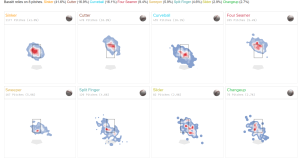
Source: Baseball Savant
Interestingly, Bassitt’s closest pitcher comparison may be none other than the Orioles’ recently re-signed Zach Eflin. Both pitchers sit in the low 90s and rely on the cutter, sinker and curveball. While Eflin relies more heavily on the cutter, Bassitt relies more heavily on the sinker. If we take a deeper look into some of their Statcast metrics, both pitchers also allow similar average exit velocities (87-89 MPH), hard hit rates (35-38%), and barrel % (7-9%).
Realistically, Bassitt slots in as a solid third or fourth starter in the rotation, which we now are expecting to look something like this:
1. Trevor Rogers
2. Kyle Bradish
3. Chris Bassitt
4. Shane Baz
5. Zach Eflin / Dean Kremer
It remains to be seen how the Orioles choose to approach this rotation in 2026, especially with Tyler Wells and Cade Povich also being potential starting options. Wells has struggled with injury and Povich has struggled with consistency, but it certainly seems likely that one or both of them will start at some point in the season despite beginning in the bullpen or even in AAA.
Rogers and Bradish are certainly locked in at 1 and 2 in some order, and it feels like Bassitt is somewhat locked in at the third spot, but it becomes tricky to discern between Baz, Eflin and Kremer after that. Could the Orioles go for a 6 man rotation? With a handful of off days in the first few weeks of the season, I wouldn’t expect it right away, but it definitely shouldn’t be ruled out later on in the season, particularly given the injury histories of Bradish and Eflin.
While this projected rotation would certainly have looked more imposing with Ranger Suarez or Framber Valdez at the top, it’s undeniably much stronger than what the Orioles had going into the 2025 season:
2025 Starting Rotation:
1. Zach Eflin
2. Charlie Morton
3. Dean Kremer
4. Tomoyuki Sugano
5. Cade Povich
In what has been a busy offseason for the Orioles, with the signings of Pete Alonso, Taylor Ward, and Ryan Helsley to name a few, Bassitt is just the kind of under the radar move that could pay large dividends. The Orioles don’t need Bassitt to be an ace – they need him to prevent overuse in April, protect young arms in the second half of the season, and give them a chance to win every fifth day as they look to get back on track toward a playoff run in 2026.
As a Baltimore native, Zach is an avid Orioles and Ravens fan. After interning for the Baltimore Orioles, he currently works as a Senior Quantitative Risk Analyst for OneMain Financial and is a part-time graduate student studying Data Science at the University of Michigan.