
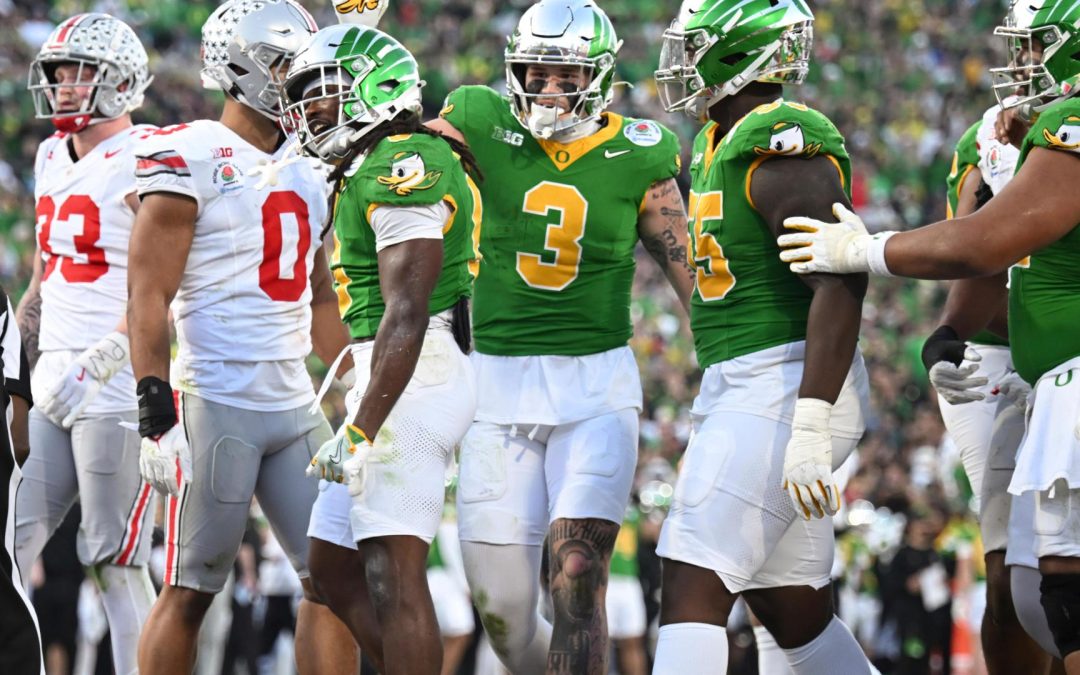
Lane Kiffin called Kirby Smart last spring to tell him his team stunk. Smart told him the same thing back. Both teams made the College Football Playoff.
That story, from David Hale’s tiered ranking of all 138 FBS teams, is the best shorthand for what this sport has become. The floor has risen. The ceiling has dropped. Mike Elko said it plainly: the best teams today are meaningfully worse than the best teams of five years ago, and the gap between the top and the middle has collapsed.
Phil Steele’s preseason magazine is the cleanest evidence. In his final projected standings he has a two-way tie atop the SEC (Georgia, Texas), a three-way tie atop the Big Ten (Ohio State, Oregon, Indiana), and a three-way tie for second in the ACC (SMU, Clemson, Louisville). Steele has been doing this for thirty years and does not hand out ties for fun. That’s what expanded rosters and unlimited portal movement have done to the top of the sport.
One clarification before we go further, because two things in this preview sit uneasily next to each other. We’re arguing that the sport has compressed nationally — and then, forty paragraphs from now, we’re going to tell you the Big Ten had three teams better than anyone in the SEC and seven teams worse than anyone in the SEC. Both are true, and they’re not in conflict. What’s compressed is the distance between programs, not the distance within conferences. Any well-funded school with the right coach can now reach the top ten in two years, which is national parity. But the leagues themselves have gotten enormous and unbalanced, so a single conference can house both the best team in America and the 90th-best one. Indiana’s rise and the Big Ten’s stratification are the same phenomenon viewed from different angles: money and mobility made it possible to climb fast, and the schools that climbed fastest didn’t wait for their neighbors.
The headline number is still three — three straight national titles for the Big Ten, by three different schools, ending with Indiana going 16-0 and sweeping all 66 first-place votes after beating Miami on January 19. The SEC put five teams in last year’s field, got one into a semifinal, and none into the final. It’s on its longest title drought since the turn of the century.
The playoff stays at twelve for a third straight year, after the Big Ten (which wants 24) and the SEC (which wants 16) failed to agree before ESPN’s deadline. Two tweaks passed: all four Power Four champs are guaranteed in, as is the top-ranked Group of Six champion, and Notre Dame is guaranteed if it finishes top twelve. Both exist because Duke won the ACC last year and watched James Madison and Tulane take the spots.
The AP poll drops Monday. Here’s ours.
Top 20 Power Rankings Entering 2026
Power ranking is a neutral-field question. CFP percentage is a different one — it folds in schedule, conference path, and the auto-bid structure. That’s why Notre Dame carries the highest playoff probability in the sport while sitting third here, and why Texas is sixth with the toughest schedule in America and a playoff number below Texas Tech’s.
A note on schedule numbers throughout this piece: every strength-of-schedule rank comes from ESPN’s final preseason SP+ projections, and every one is a rank out of 138 where No. 1 is the hardest slate in the country.
| # | Team | CFP % | The case |
|---|---|---|---|
| 1 | Ohio State | 76% | Sayin (PFF’s No. 1 passing grade), Jeremiah Smith (PFF’s No. 1 player), and a defense that hasn’t allowed 25 points in 24 straight games. Six opponents in the CBS top 25 — arguably the toughest schedule in program history. |
| 2 | Oregon | 74% | SP+ No. 1 offense, No. 2 defense. Three of PFF’s top 33 players on one defensive line. |
| 3 | Notre Dame | 78% | Returns 72% of its offensive and defensive snaps, best rate in the country, plus a guaranteed berth at top-12 and the softest résumé path of any contender. |
| 4 | Indiana | 72% | 27-2 under Cignetti. The 2025 drive-scoring differential (+34.4%) is the best of the playoff era. |
| 5 | Georgia | 69% | Best back seven in the country, led by KJ Bolden. The schedule is the argument: Steele has it 9th-toughest nationally, while SP+ calls it the softest draw in the SEC at 26th. Either way, it’s a demanding slate by any standard but Georgia’s own recent ones. |
| 6 | Texas | 62% | Best defensive front in America. Also the No. 1 strength of schedule in the country — eight games against projected top-20 teams. |
| 7 | Miami | 71% | National runner-up, upgraded at quarterback, and it avoids both teams that beat it last year. |
| 8 | Texas Tech | 64% | Best yards-per-play defense of the playoff era, and a league schedule that misses BYU, Utah, and Kansas State. |
| 9 | Texas A&M | 46% | SP+ ninth. Best success-rate differential in the SEC by 50%. Lost ten players to the draft. |
| 10 | Ole Miss | 40% | Chambliss and Lacy are a top-12 PFF player apiece. The schedule is the hardest Oxford has seen in years. |
| 11 | LSU | 42% | Kiffin and Leavitt, walking into a genuinely difficult first year — 19th-toughest schedule per SP+, 11th per FPI, with nine SEC games plus Clemson. |
| 12 | Oklahoma | 40% | Fourteen starters back, a healthy Mateer, and the fourth-hardest schedule in America. |
| 13 | BYU | 40% | Third nationally in returning snap percentage. Bachmeier and LJ Martin both back. |
| 14 | Alabama | 40% | Good, not great — but PFF’s Nos. 15 and 38 players are both Alabama defensive backs. |
| 15 | USC | 33% | Maiava averaged 9.1 yards per attempt. They’re also 15-15 in their last 30 against P4/P5. |
| 16 | Michigan | 29% | Whittingham, a real offensive line, John Henry Daley, and 23 interceptions over two years to fix. |
| 17 | Penn State | 26% | Misses Ohio State, Oregon, and Indiana. Also returns five starters. |
| 18 | Tennessee | 22% | Knowles fixes the defense. FPI has the slate 14th-toughest nationally and only 13th-hardest inside the SEC, which tells you everything about this league. Quarterback is unsettled. |
| 19 | Washington | 22% | 45 points per game in nine wins, 9.3 in four losses. Demond Williams is a problem for anyone not elite defensively. |
| 20 | Iowa | 20% | Reigning Joe Moore winners with two of PFF’s four best returning linemen. Four losses by fifteen points, total. |
These sum to roughly 9.7 of twelve. The rest goes to the Group of Six auto-bid (~1.0) and the field — Utah, Louisville, SMU, Clemson, Missouri, Arizona, Auburn, Virginia Tech, Florida.
A note on schedule numbers: this preview cites three systems — ESPN’s SP+, ESPN’s FPI, and Phil Steele’s rankings — and they don’t always agree. Every figure below names its source, and every one is a national rank where No. 1 is the hardest slate in the country.
Consensus check (top ten)
| Team | BSL | Coaches | SP+ | Kalshi CFP % |
|---|---|---|---|---|
| Ohio State | 1 | 1 | 1 | 76 |
| Oregon | 2 | 2 | 2 | 75 |
| Notre Dame | 3 | 5 | 3 | 82 |
| Indiana | 4 | 6 | 5 | 74 |
| Georgia | 5 | 3 | 4 | 69 |
| Texas | 6 | 4 | 6 | 65 |
| Miami | 7 | 7 | 7 | 74 |
| Texas Tech | 8 | 12 | 8 | 64 |
| Texas A&M | 9 | 8 | 9 | — |
| Ole Miss | 10 | 10 | — | — |
Our biggest gap from the coaches: Texas Tech four spots higher, and Georgia and Texas each a spot lower than voters have them.
Five Teams We Like Better Than The Projections
1. Auburn. 0-6 in one-possession games. That’s a coin landing on its edge six straight times. Alex Golesh arrives running the Cignetti playbook, bringing quarterback Byrum Brown (3,158 passing, 1,008 rushing at USF) with him, and inherits a defense returning most of its production under DJ Durkin with first-team All-American linebacker Xavier Atkins. Auburn is priced like a program in transition. It has more pieces than that.
2. Iowa. Four losses, fifteen total points, and one of five teams that didn’t lose a game by more than a touchdown. The reigning Joe Moore line returns Kade Pieper (PFF’s No. 25 player, moving to center) and Trevor Lauck, who allowed six pressures all season. The catch is real — 8,843 career offensive snaps, fewest of any P4 team, which means the skill positions are learning on the job. But Iowa has more playoff-era wins than any P4 program that’s never made the field, and the thing that usually keeps them out is close-game variance that just cut against them four times in one year.
3. Louisville. Eight losses over two years, seven by one score. Isaac Brown led the nation at 8.75 yards per carry, more than a full yard clear of second — his own backup was third. And Clev Lubin is the highest-graded returning edge defender in FBS since 2024, with 110 pressures and a 24% pass-rush win rate that led the Power Four. Jeff Brohm’s fourth team has a top-five ACC defense and a genuine star at each line of scrimmage, and it’s being priced third in a three-team race.
4. Virginia Tech. James Franklin walks into a roster that isn’t bare and a schedule that gives him runway — no projected top-30 opponent until the Oct. 24 trip to Clemson. The defense has to be dramatically better; last year’s unit gave up 2.8 points per drive on possessions starting in its own territory, worst in the ACC and 128th nationally. But a 6.5-win number prices a program’s past, not this staff’s floor.
5. Oklahoma State. A genuinely contrarian one. Eric Morris rebuilt the roster wholesale out of North Texas and brought the two pieces that matter: Drew Mestemaker, who led FBS with 4,379 passing yards and 34 touchdowns against nine picks as a first-year starter, and Caleb Hawkins, who led the entire country with a 94.1 PFF rushing grade and 25 touchdowns as a true freshman. Yes, thirty-nine teams have won a game against Big 12 competition more recently than Oklahoma State has. That’s exactly why the number is where it is.
Also considered: Arizona (Fifita is undersold everywhere but Tucson), Missouri (Hardy and Cayden Green are both top-20 players nationally, health permitting), Florida (biggest year-over-year climb in the CBS 138 at +49 spots).
Five Teams We Like Less Than The Projections
1. Houston. Steele has the Cougars fourth in the Big 12. We have them outside the top six. Last year: 6-1 in one-possession games, 4-1 in games decided by a field goal or less, five wins after trailing or being tied in the fourth quarter, the easiest schedule in the league, and the largest positive penalty margin in the country at 38 fewer than opponents. Individually, any one of those could be a skill. Collectively, they’re the standard profile of a team whose record outran its play, and nearly every one of them points toward regression. Houston has ten wins by a field goal or less over four seasons, most in the nation. Runs like that end.
2. Utah. Utah’s offensive success rate jumped from 38.2% to 50.8% in one year — the largest such leap of any Power Four team, and leaps that size historically give back a meaningful share of the gain. Add a first-time head coach, a slate ranked 64th-toughest nationally and among the softest in the Big 12 (so the record will likely look better than the team), and twelve straight losses to ranked opponents by an average of thirteen points. Steele has them third in the Big 12. We have them outside our national top 20 entirely.
3. Virginia. Ten wins on one of the easiest P4 schedules in the country, propped up by a four-game stretch with three overtime wins and a survival on a late safety. Per ESPN’s metrics this year’s slate again ranks around 65th overall and 16th of 17 in the ACC, so the schedule advantage is intact. The experience is genuine — nobody in FBS has more. But a season built that heavily on one-score outcomes is the hardest kind to repeat.
4. Minnesota. A plus-one point margin for an eight-win team, driven almost entirely by a plus-24 points-off-turnovers margin. Set that aside and the underlying scoring profile looks closer to a four-to-five-win team than an eight-win one. Drake Lindsey’s 5.46 yards per dropback ranked 118th of 134; of the sixteen quarterbacks below him, four were Power Four starters and all four were benched and transferred by season’s end.
5. Penn State. The consensus has decided that Matt Campbell plus the easiest contender schedule in the Big Ten equals an immediate playoff push — Athlon projects 10-2, the market says 8.5. Penn State returns five starters. Campbell is an excellent coach who just watched the program he left get projected at 4.5 wins the moment he walked out the door. Year one in Happy Valley is a rebuild wearing a contender’s schedule.
Fades the market has already made, so we won’t take credit: Vanderbilt (5.5), Georgia Tech (6.5), Iowa State (4.5), Wake Forest (5.5).
Conference Deep Dives
THE SEC
Overview. Sixteen teams, nine conference games for everyone for the first time. SP+ has eleven SEC teams in its top 25 and everyone except Arkansas, Kentucky, and Mississippi State inside the top 30 — depth no other league approaches. What it doesn’t have is a No. 1, and it doesn’t have proven quarterbacks. Five SEC teams made the playoff last year; one reached a semifinal, none reached the final.
Schedule is doing enormous work in this league, and the honest summary is that nobody gets a break. Texas drew the toughest slate in America per SP+. Oklahoma’s is fourth. Tennessee has the 13th-hardest schedule in its own conference and still the 14th-hardest in the country by FPI. Georgia’s draw is the softest in the SEC by SP+ at 26th nationally — and Phil Steele has that same schedule 9th-toughest in America. For comparison, the easiest schedule in the Big 12 ranks 72nd by SP+. The gentlest path in the SEC is harder than what forty-plus teams elsewhere will walk. That’s the depth argument, and it doesn’t require picking a favorite among the metrics.
Coaching churn was seismic: Kiffin to LSU, Golding to Ole Miss, Golesh to Auburn, Sumrall to Florida, Silverfield to Arkansas, Stein to Kentucky.
1. Georgia — SEC title odds: 25%
- Strength: The back seven, led by KJ Bolden — PFF’s No. 11 player and the most valuable returning safety in the country. Drew Bobo anchors up front. The league’s most forgiving schedule helps too.
- Weakness: Explosiveness, in both directions. Only 39% of Georgia’s passing yards came on throws traveling 10+ yards downfield, 126th of 134. The pass rush has quietly collapsed: nine sacks on 337 non-blitz dropbacks, down from 21 the year before and 36 during the 2021 title run.
- The question: Dominant, or just very good? Georgia was 52-3 against Power Five teams from 2021-23 by an average of 27 points. Since then: 18-5 by under 13. Eleven programs have a more recent playoff win.
- Circle: at Ole Miss, Nov. 7.
2. Texas — 17%
- Strength: The front. Simmons and Rasheem Biles — PFF’s most valuable returning linebacker, with 31 tackles for loss or no gain over two years — are the best edge/backer pairing in the sport.
- Weakness: The run game and the calendar. Texas backs scored six rushing touchdowns all season, and the Longhorns drew the No. 1 schedule in the country.
- The question: Is Arch Manning great, or very good on a great roster? CBS’s insider survey named him the sport’s most overrated player. PFF has him ninth overall and notes he was sixth nationally in passing grade from Week 9 on. Both can be true at once.
- Circle: vs. Ohio State, Week 2. The final three games are all on the road.
3. Texas A&M — 12%
- Strength: Efficiency. A plus-12.32-point success-rate differential, 50% better than any other SEC team. Mario Craver’s 3.25 yards per route run led all qualified SEC receivers.
- Weakness: Ten players drafted, a program-record-tying haul, plus a rebuilt offensive line.
- The question: Was eleven wins the new baseline or the outlier? A&M has averaged 7.5 regular-season wins since joining the league in 2012.
- Circle: vs. Texas, Nov. 27.
4. LSU — 11%
- Strength: Kiffin, and it may need to be enough. He’s 12-2 in his last fourteen SEC games with 21-plus points in thirteen of them, against an LSU program that managed 21 points five times in its last thirteen. Trey’Dez Green and Jordan Seaton give the offense a real floor.
- Weakness: Everything is new at once. Sam Leavitt is coming off a down year, though he’s top-ten nationally in big-time throw rate with 39 explosive runs over two seasons.
- The question: Can a first-year staff install a culture in the hottest job in America? Trey’Dez Green and Jordan Seaton give the offense a real floor.
- Circle: vs. Clemson, Week 1. Best opening night in the sport.
5. Ole Miss — 10%
- Strength: Chambliss (PFF No. 12, second in FBS in passing grade under pressure) and Kewan Lacy (No. 10, 307 carries, 24 touchdowns, 1,010 yards after contact). The best quarterback-running back tandem in college football.
- Weakness: Everything is new at once, and the schedule isn’t waiting — 19th-toughest by SP+, 11th by FPI, nine SEC games plus Clemson in Week 1. Sam Leavitt is coming off a down year, though he’s top-ten nationally in big-time throw rate with 39 explosive runs over two seasons.
- The question: How much of last year was scheme? Ole Miss led in the second half of every game it played, one of only three teams to do so.
- Circle: vs. Georgia, Nov. 7. Golding is undefeated all-time against Smart.
6. Oklahoma — 8%
- Strength: The defensive front. 63 tackles for loss led the nation, David Stone was second among FBS tackles in run-stop rate, and Tate Sandell is the reigning Groza winner.
- Weakness: The schedule, brutally — fourth-toughest in the country. Road trips to Michigan and Georgia before Red River in Week 6, then four more top-25 opponents in November.
- The question: Venables has alternated six-win and ten-win regular seasons for four straight years. Which one is this?
- Circle: at Georgia, Sept. 26.
On Alabama at seven. This is where we split from Phil Steele, who has the Tide T-3 in the SEC and his No. 1 surprise playoff contender, largely on a schedule that misses both Texas and Ole Miss. His case is real, and the secondary backs it up: Bray Hubbard (PFF No. 15, most valuable returning safety over two years, seven interceptions) and Dijon Lee Jr. (No. 38, 6-foot-4, an 80.2 coverage grade as a true freshman) are as good a duo as exists in the country.
Ours is the running game and the profile. Twelve of Alabama’s thirteen FBS games came against FPI top-40 teams — most in the country — and the Tide went 8-4 while outscoring that group by two total points across twelve games. Over Saban’s final five years, Alabama was 34-8 against that tier by 13.2 a game. Last season the Tide averaged 3.85 yards per designed run, 129th of 136, and were one of four teams in the bottom 30 in yards both before and after contact. The other three were Kent State, UMass, and Charlotte. Alabama SEC title odds: 9%. If Keelon Russell hits, Steele is right and we look silly by October.
THE BIG TEN
Overview. Three titles in three years by three different schools, and a 9-3 record against other conferences in playoff games since realignment — three times the CFP wins of the next-best league.
It is also the clearest illustration of the point we made up top. Last year the Big Ten had three teams better than anyone in the SEC and seven teams worse than anyone in the SEC. Ohio State and Oregon went a combined 25-1 against everyone not named Indiana. That’s not evidence against national parity; it’s what national parity looks like inside an eighteen-team conference where four schools are spending like NFL franchises and four others aren’t.
Steele projects a three-way tie at the top, and we think that’s close to exactly right. New head coaches at Michigan (Whittingham), Penn State (Campbell), Michigan State (Fitzgerald), and UCLA (Chesney).
1. Ohio State — Big Ten title odds: 29%
- Strength: Julian Sayin completed 77.0% of his passes, the third-highest single-season mark in the history of the sport, set the PFF single-season accuracy record, and led all FBS quarterbacks in passing grade. He throws to Jeremiah Smith, PFF’s No. 1 player for a second straight year, and now Chris Henry Jr. Eight offensive starters return.
- Weakness: Seven defenders to the draft, and a slate with six CBS top-25 opponents that pushed the win total down to 9.5.
- The question: Can the defense be merely very good and still win it all? Probably. Ohio State has lost more than two regular-season games once since 2005.
- Circle: at Indiana, Oct. 17. Road trips to Texas, Indiana, USC, and Nebraska, plus home dates with Oregon and Michigan.
- For Buckeye fans: since 2011, Ohio State has closed a season on back-to-back losses four times. The next years produced 12-0, a national title, and another national title. They lost their last two in 2025.
2. Oregon — 26%
- Strength: SP+ No. 1 offense and No. 2 defense. Dante Moore (PFF No. 7) led the nation in deep-passing grade with 30 big-time throws, tied for most in FBS, and turned down a projected top-three pick to return. Brandon Finney Jr. allowed the lowest passer rating of any qualified Big Ten outside corner.
- Weakness: The big-game ledger, and coordinator turnover. Lanning is 5-7 against top-15 opponents; four of the five wins came by a touchdown or less, four of the seven losses by ten or more.
- The question: Does the offense hold its level with new voices calling it?
- Circle: at Ohio State. With a trip to USC and a home date with Michigan, the No. 1 seed is entirely self-determined.
3. Indiana — 23%
- Strength: The defense and the left tackle. Carter Smith is PFF’s No. 8 player overall; Amare Ferrell is tied for the Power Four lead with eight interceptions over two years across 1,500-plus snaps.
- Weakness: Fernando Mendoza is gone. Josh Hoover arrives with nearly 10,000 career yards and 24 interceptions over two seasons — Indiana’s quarterbacks threw 13 in that same span.
- The question: Repeatable, or lightning? Cignetti answered it by signing seventeen transfers, including Nick Marsh (100 catches at Michigan State) and Tobi Osunsanmi up front.
- Circle: vs. Ohio State, Oct. 17. Indiana misses Oregon entirely and hosts both Ohio State and USC.
4. USC — 7%
- Strength: Coverage. Opposing quarterbacks averaged 6.25 air yards per attempt against USC, lowest in FBS, and only 65.5% of throws even crossed the line of scrimmage. Now add Jontez Williams, who has allowed a 25.6 passer rating since 2023, lowest among FBS corners with 300+ coverage snaps. Maiava averaged 9.1 yards per attempt with 27 big-time throws.
- Weakness: 15-15 in the last 30 against P4/P5 competition, and Maiava’s 21 turnover-worthy plays tied for ninth nationally.
- The question: Riley has said publicly this roster can win a national championship. In Los Angeles, saying it out loud usually means the clock has already started.
- Circle: vs. Oregon. USC hosts Oregon and Washington back-to-back.
5. Michigan — 5%
- Strength: The trenches. Sprague in protection, Daley off the edge with a 93.4 pass-rush grade that ranked second in FBS, and a rushing attack that was 19th nationally in EPA.
- Weakness: Throwing it. 23 passing touchdowns against 23 interceptions over two years, after 78 and 24 in the four before that. 81st nationally in passing EPA. Steele flags one of the hardest schedules in the country.
- The question: Does Underwood become the player the recruiting rankings promised in year two with Beck?
- Circle: vs. Oklahoma. Michigan hosts Oklahoma, Iowa, Penn State, and Indiana.
6. Penn State — 4%
- Strength: The schedule. Misses Ohio State, Oregon, and Indiana; hosts USC and Minnesota. Campbell brought Iowa State players with him to plug the biggest holes.
- Weakness: Five returning starters.
- The question: How long does a full rebuild take, even on an easy path? Penn State lost nine games over two years and eight came by a touchdown or less — the accumulated near-misses that cost Franklin his job.
- Circle: vs. USC.
THE BIG 12
Overview. Sixteen teams and, for one year, a real hierarchy — until Brendan Sorsby left Texas Tech following a controversial, gambling-related eligibility fight, turning the league’s clearest picture into its murkiest. Tech still has the most talented and experienced roster by a wide margin, plus the easiest schedule in the conference — 72nd-toughest nationally — and a draw that misses BYU, Utah, and Kansas State.
The structural problem hasn’t changed: 1-8 in playoff games since 2014, with TCU’s 2022 run the only win. It stays ahead of the ACC on head-to-head, 10-6 over two seasons.
1. Texas Tech — Big 12 title odds: 40%
- Strength: A defense that allowed 3.94 yards per play, the best mark of the playoff era, and became one of three teams in that span to hold opponents under three yards per designed run for a full season. A.J. Holmes Jr. was the nation’s most valuable interior defender; Austin Romaine arrives with the most run stops of any Power Four linebacker over two years. The Dickey/J’Koby Williams/Joyner backfield is the deepest in America.
- Weakness: Quarterback, and it isn’t close.
- The question: Can you win a conference without knowing who’s taking snaps in September? One caution flag: Dickey’s per-carry numbers are propped up by a single game against Kansas (21 carries, 263 yards). Against everyone else he averaged 4.4.
- Circle: vs. Houston, Week 3. The only way Tech sees BYU is in Arlington.
2. BYU — 22%
- Strength: Continuity. Third nationally in returning snap percentage at 62.5%, with Bachmeier back and LJ Martin — preseason Big 12 Player of the Year, 1,299 yards, 56 forced missed tackles, 36 explosive runs, all league bests — returning from shoulder surgery.
- Weakness: The résumé gap. Of the eleven FBS teams above a .700 win rate since 2020, only BYU has never made a playoff, at 57-20.
- The question: Three toss-ups decide it — home against Arizona, road at TCU and Utah.
- Circle: vs. Notre Dame, Oct. 17, in Provo. Win that and the résumé builds itself.
3. Utah — 9%
- Strength: Defense, always. Scalley built those units alongside Whittingham for two decades.
- Weakness: Sustaining an offensive leap of that size, with a schedule ranked 64th-toughest nationally — among the league’s softest — likely to make the record flatter the team.
- The question: Can Utah beat somebody good? Twelve straight losses to ranked opponents since 2022.
- Circle: vs. BYU.
4. Arizona — 8%
- Strength: Fifita, with 9,183 career yards and 73 touchdowns, plus Tre Smith back from injury alongside Chase Kennedy and Taye Brown.
- Weakness: No middle ground — seven straight years finishing either inside the SP+ top 30 or outside the top 75. And a plus-88 points-off-turnovers margin after a minus-50 the year before, the largest positive swing in FBS. Swings like that rarely hold.
- Circle: at BYU. They lost in Provo in overtime last season.
5. Kansas State — 7%
- Strength: Scheduling fortune. K-State misses Texas Tech, BYU, and Utah, has the 69th-toughest slate nationally, and SP+ makes them an underdog in exactly one game.
- Weakness: Four new offensive line starters, two returning defensive starters under new coordinator Jordan Peterson, and a first-year head coach.
- The question: Avery Johnson is the only Big 12 quarterback in the playoff era with 300+ dropbacks to complete under 60% in consecutive seasons. Does that change?
- Circle: at TCU.
6. TCU — 4%
- Strength: Jeremy Payne, who over his last five games — all against winning teams, three against ranked opponents — put up 602 total yards at 6.43 a carry.
- Weakness: Jaden Craig arrives from Harvard, where he threw for 2,869 yards and 25 touchdowns in eleven games, to replace Josh Hoover.
- Circle: vs. BYU, Oct. 3.
Houston sits seventh for us and fourth for Steele. That’s the sharpest single disagreement in this preview.
THE ACC
Overview. Seventeen teams, nine conference games for most, and a league that got mocked all last season while producing the national runner-up. Duke won the ACC and lost the playoff spot anyway — a wrong the new access rules have since corrected.
The scheduling ambition is real: 25 non-conference games against Power Four opponents plus Notre Dame, more than any conference, including nine against the SEC and six against the Irish. All seventeen members play at least ten games against P4-or-Notre Dame competition. Boston College drew the league’s toughest slate at 27th nationally. The problem has never been willingness. It’s the top end.
This year the top end is Miami — 165 of 188 first-place votes, and SP+ has the Hurricanes seventh nationally with the next ACC team, Clemson, at 23rd. The league has six teams bunched between 23rd and 37th. That gap, and that bunching, is the whole race.
Part of why it’s bunched: four of the seventeen programs are in year one or year two under a new head coach. James Franklin at Virginia Tech and Tavita Pritchard at Stanford are first-year hires, Jake Dickert is entering year two at Wake Forest, and Cal now has Tosh Lupoi after he left Oregon’s defensive coordinator job — the second Ducks coordinator to leave for a head-coaching seat this offseason. Lupoi inherits Jaron-Keawe Sagapolutele coming off a strong freshman year, which is a better starting point than most first-year hires get.
1. Miami — ACC title odds: 46%
- Strength: Skill talent. Malachi Toney is PFF’s No. 5 player — he led FBS in yards after the catch (841), missed tackles forced after the catch (33), and receptions producing a first down or touchdown (58), as a true freshman. Mark Fletcher ran for 1,192. Darian Mensah led the Power Four in passing yards and brought Cooper Barkate with him. Bryce Fitzgerald had six interceptions as a freshman.
- Weakness: The trenches. 14,601 career snaps and two first-round edge rushers gone off the two lines.
- The question: Does Mensah win a big one? He’s 1-6 against ranked opponents at Duke and Tulane. Worth remembering how brutal Miami’s 2025 was: eleven games against FPI top-40 teams, while ACC title participants Duke and Virginia played eight combined.
- Circle: at Notre Dame, Nov. 7. Miami misses both SMU and Louisville in the regular season.
2. SMU — 13%
- Strength: Kevin Jennings enters year three with nearly 7,000 career yards, and SP+ gives the Mustangs the most navigable schedule of the ACC’s second tier.
- Weakness: Closing, and a front-loaded slate. SMU has played seventeen ACC games and had a chance to win on the final play of all seventeen. They travel to Florida State and Louisville in the first month.
- The question: Does one of those putts finally drop?
- Circle: at Louisville, Sept. 19.
3. Louisville — 13%
- Strength: A star at each line of scrimmage. Isaac Brown’s 8.75 yards per carry led the country by over a full yard, and Lubin’s edge production is the best of any returner in FBS.
- Weakness: Seven of eight losses over two years came by one score. Two straight years of that stops being purely variance.
- Circle: vs. SMU, Sept. 19. Louisville plays Ole Miss on a Sunday in Week 1 and Villanova on a Friday in Week 2; this is their first real Saturday.
4. Clemson — 11%
- Strength: Sammy Brown — 106 tackles, 13.5 for loss, five sacks, 18 run stops, tied for tenth among FBS linebackers — and a front seven that should be top-fifteen nationally. SP+ is meaningfully higher on Clemson than the human consensus.
- Weakness: Quarterback, and close games. 32-7 in one-possession games from 2011-21; 9-8 since 2022.
- The question: Christopher Vizzina or true freshman Tait Reynolds? Swinney has never wanted an “I told you so” season more.
- Circle: vs. Miami, Oct. 3, one month after a Week 1 trip to LSU. Clemson’s season will be legible by the first Saturday in October.
5. Virginia Tech — 6%
- Strength: Franklin, a Penn State reunion project at quarterback, and tight end Luke Reynolds.
- Weakness: The defense that surrendered 2.8 points per drive on its own side of the field, last in the ACC.
- Circle: at Clemson, Oct. 24 — the first projected top-30 opponent on the schedule.
6. Pitt — 4%
- Strength: The pass rush. Only Clemson has averaged more sacks per game than Pitt (3.1) since Narduzzi took over in 2015.
- Weakness: Rasheem Biles, the most valuable returning linebacker in college football, now plays for Texas.
- Circle: at Miami.
Georgia Tech falls out of our top six. Only 24% of last year’s offensive snaps return, both coordinators were replaced, and presumptive starter Alberto Mendoza — Fernando’s younger brother — has never made a college start. Steele has the Yellow Jackets fifth. The market has them at 6.5. The team we’d watch instead is Cal: a defensive-minded first-year head coach in Lupoi, a returning quarterback in Sagapolutele, and a schedule with real swing games at UNLV, SMU, NC State, and Virginia. In a league where six teams are separated by fourteen SP+ spots, that’s a live ticket.
NOTRE DAME (Independent)
Playoff odds: 78% — the highest in the sport, because the Irish are guaranteed a berth at top twelve and face nothing resembling a conference gauntlet.
- Strength: Continuity and defensive backs. The 72% snap-return rate leads the country, and no team had a better explosive-play differential (+7.5%). Leonard Moore is PFF’s No. 2 player overall, with the best first two college seasons of any cornerback in the PFF era — seven career interceptions and nineteen career completions allowed for a first down, none of them while Notre Dame trailed. Brauntae Johnson (No. 44) had four picks and missed two tackles all season.
- Weakness: Two first-round running backs gone in Jeremiyah Love and Jadarian Price, and a health picture that’s improving but not resolved. Kyngstonn Viliamu-Asa — the top returning linebacker in college football, with the second-best run-defense grade in FBS — is one of six players on modified activity coming off his November ACL tear. Marcus Freeman has said he’s hopeful the group will be full-go before the opener, which is a meaningfully better outlook than “availability unknown,” but it isn’t a clearance either. A defense this good has one genuine soft spot, and it’s what happens at linebacker if he isn’t right.
- The question: Does CJ Carr — PFF No. 14, sixth in the Power Four in big-time throw rate — become the No. 1 overall pick the league thinks he might be, now that he has to carry the offense rather than complement it?
- Circle: vs. Miami, Nov. 7, with at BYU on Oct. 17 right behind it. Those are the two games on the schedule. The opener is worth noting for a different reason — Wisconsin at Lambeau Field, in prime time, is the kind of neutral-site swing the Irish schedule specifically to build a résumé that doesn’t come with a conference title attached.
THE PAC-12 (2.0)
Overview. Eight football members: Oregon State and Washington State, joined by Boise State, Colorado State, Fresno State, San Diego State, and Utah State from the Mountain West and Texas State from the Sun Belt. Those newcomers won thirteen of the last fourteen MWC titles. ESPN projects the new Pac-12 with the best average SP+ rating of any Group of Six league. The format is a seven-game round robin plus an adjustable flex week in Week 13 — a genuinely clever piece of design forced by an eight-team membership.
Order and title odds: Boise State (34%), Fresno State (18%), San Diego State (15%), Texas State (13%), Washington State (10%), Utah State (6%), Oregon State (3%), Colorado State (1%).
Boise State is the favorite but missed or broke a tackle on 76.5% of attempts last year, second-worst in the country, and has lost three straight to Fresno State. Fresno returns twelve starters in Matt Entz’s second year, six from a defense allowing 18.8 a game, and hosts Boise on Oct. 10 in the game that decides the league. San Diego State’s secondary is absurd: opponents attempted 52 throws of 20-plus yards and completed eight, averaging 4.96 per attempt, by far the best rate in FBS. Texas State has the conference’s best offense — nineteen plays of 50-plus yards, four more than any other FBS team.
The grim number underneath all of it: of 76 all-conference players from the five non-power leagues with eligibility remaining, only 23 stayed at the same school.
National Unit Rankings
Top 8 Offensive Lines
- Notre Dame — Four starters back off a line that allowed twelve sacks and paved 5.7 yards per carry. Anthonie Knapp kicks inside to guard as a first-team All-American; Guerby Lambert didn’t allow a sack across 670 snaps.
- Iowa — Reigning Joe Moore winners, with Pieper (83.5 run-block grade, fifth among FBS guards) and Lauck (87.8 pass-block grade, fourth among tackles). Two of the four highest-rated returning linemen in the country on the same unit.
- Georgia — Drew Bobo is the nation’s best center with nearly 1,000 career snaps at the position. Dontrell Glover logged 750-plus as a true freshman.
- Ohio State — Eight offensive starters protecting the most accurate passer in college football history not named Bo Nix or Mac Jones.
- Indiana — Carter Smith is the only returning FBS tackle inside the top ten in both pass- and run-blocking grade. Wisconsin’s Joe Brunner plugs in at guard.
- Texas — Goosby is a top-ten 2027 prospect and, with Carter Smith, one of only two returning tackles with 80-plus grades in both phases. This has to be the most improved line in America.
- Missouri — Cayden Green’s 89.6 pass-blocking grade was second in all of FBS and the best of any returning tackle, after he moved out from guard.
- Michigan — Andrew Sprague is elite in protection, and Whittingham builds identity here first.
Just missed: Oklahoma, LSU (Jordan Seaton may be the best pure pass protector in the sport), Cincinnati (Evan Tengesdahl is the top-graded returning guard in the country), Tennessee, Minnesota.
Top 8 Defensive Lines
- Oregon — A’Mauri Washington (led all FBS tackles in batted passes), Teitum Tuioti (11 sacks, most run stops of any FBS defensive lineman over two years), and Matayo Uiagalelei (52 pressures). Three PFF top-33 players on one front. PFF thinks it might be the best line in America and it’s hard to argue.
- Texas — Colin Simmons is PFF’s No. 3 player and the most valuable returning edge in FBS. Nobody generated more sacks per game without blitzing.
- Texas Tech — Holmes was the most valuable interior defender in the country, in front of a unit that just posted the best yards-per-play mark of the playoff era, with portal adds Trey White, Adam Trick, and Mateen Ibirogba.
- Oklahoma — The 63 TFLs and Stone’s second-ranked run-stop rate. Venables’ fronts have finished top-twelve in tackles for loss eleven times since 2013.
- Ohio State — Seven defenders drafted and Patricia still has Alabama transfer James Smith and the deepest two-deep in the league.
- Ole Miss — Will Echoles led the Power Four in both pressures (39) and defensive stops (35), with six batted passes.
- Miami — Ahmad Moten Sr. and Justin Scott are a genuine top-five interior pairing, carrying a unit that lost more experience than anyone.
- Louisville — Lubin alone gets them here.
Just missed: South Carolina (Dylan Stewart’s 88 pressures since 2024 trail only Simmons), Michigan (Daley), Indiana, Clemson, Pitt.
Top 10 Coaching Staffs
Head coach plus everything under him — coordinators, position development, and the increasingly decisive skill of roster construction under a salary cap nobody calls a salary cap. A great head coach is the single biggest input here. He just isn’t the only one, and in 2026 he may not even be the tiebreaker.
1. Ohio State. Ryan Day has a national title, a .900-plus career winning percentage, and the two things that follow from those: he can hire anyone, and nobody leaves unless they’re leaving to run their own program. Matt Patricia’s defense has now been elite for two straight years — 24 consecutive games without allowing 25 points is the second-longest streak of the playoff era — and that came after the unit was supposed to fall off. The receiver development is the best in the sport, full stop, and it’s the reason a five-star like Chris Henry Jr. picks Columbus knowing Jeremiah Smith is already there. Eight offensive starters returning is a staff achievement as much as a roster one.
2. Indiana. Curt Cignetti is 27-2 with a national championship at a program that was irrelevant thirty months ago, which is the single most impressive body of head-coaching work in college football right now. But the staff underneath him is the actual story. They identified a Heisman winner, a title-winning defense, and a full offensive line in the transfer portal inside three years — and when all of it graduated at once, they went out and signed seventeen more transfers rather than flinching. Portal evaluation is now a coaching discipline, and this is the best department in the country at it.
3. Georgia. Kirby Smart is the best defensive head coach of his generation and has two national titles to prove it, and the staff’s development record in the back seven is unmatched — KJ Bolden arrived as the No. 1 safety recruit in his class and is now the most valuable returning safety in America, which is what’s supposed to happen and almost never does. The reason they’re third rather than first is philosophical, not tactical: Smart has taken and lost the fewest transfers in the SEC over three years (30 in, 43 out) while publicly pushing back on the sport’s new economics. That worked brilliantly for a decade. It’s working slightly less well now, and the pass-rush numbers — nine sacks on 337 non-blitz dropbacks, down from 36 in 2021 — are the first place it shows.
4. Notre Dame. Marcus Freeman runs the most stable operation in college football, which in this era is a competitive advantage rather than a compliment. The 72% snap-return rate leading the country is a retention number, and retention is coaching. Joe Rudolph’s offensive line work is the best in the sport — twelve sacks allowed, 5.7 yards per carry, and a returning first-team All-American who’s being moved to a new position because the staff thinks it makes the whole unit better. The defensive back pipeline (Moore, Brauntae Johnson, Christian Gray, Adon Shuler) is a factory that hasn’t slowed down.
5. Oregon. Dan Lanning has built the most talent-rich roster outside of Columbus and Austin, recruits and retains at an elite level, and just convinced a projected top-three NFL pick to come back to school — which is a coaching win before it’s a roster win. The question is continuity. Lanning lost both coordinators to head-coaching jobs this offseason: Will Stein to Kentucky and Tosh Lupoi to California. That’s the clearest possible endorsement of the staff he assembled and a real risk to the one he has now.
The replacements are internal-feeling hires rather than outside gambles. Drew Mehringer takes over the offense that just graded as SP+’s No. 1 unit in the country — a scheme that threw for more yards to tight ends and running backs (1,581) than any team in America, and which now has to keep Dante Moore’s deep-ball production intact after he led the nation in that grade with 30 big-time throws. Chris Hampton inherits the SP+ No. 2 defense and, in the front, arguably the best position group in the sport: A’Mauri Washington, Teitum Tuioti, and Matayo Uiagalelei are all inside PFF’s top 33 players. Hampton’s secondary background is the encouraging part given Brandon Finney Jr. is coming off a season in which he allowed the lowest passer rating of any qualified Big Ten outside corner.
Two elite units, two first-year play-callers. It’s the single most interesting continuity test of 2026, and it’s the reason Oregon sits fifth rather than second.
6. LSU. Lane Kiffin is the best offensive play-caller in college football and it isn’t especially close — 12-2 in his last fourteen SEC games with 21-plus points in thirteen of them, against an LSU program that managed 21 points five times in its last thirteen. Pair that with Blake Baker, a legitimately excellent defensive coordinator, and you have the most interesting staff bet of 2026. The unknown is whether Kiffin the CEO is as good as Kiffin the coordinator in a job where the temperature never drops.
7. Michigan. Kyle Whittingham won 21 years’ worth of games at Utah by out-coaching more talented rosters in the trenches, and he’s walking into Ann Arbor with more talent than he’s ever had. He brought John Henry Daley with him — the No. 2 pass-rush grade in FBS last season — which tells you players will follow him. And the Jason Beck hire is the most encouraging thing Michigan has done in two years: an offense actually designed around Bryce Underwood’s skill set rather than one he was asked to survive. Twenty-three passing touchdowns against 23 interceptions over two seasons is a coaching failure, and it’s the specific failure this staff was hired to fix.
8. Texas Tech. Joey McGuire has done the hardest thing in the sport — win a conference at a place that had never done it in the Big 12 era — and he did it by building a defense, which nobody in Lubbock has ever managed. Cody Campbell’s money gets all the coverage, and it should get some. But money doesn’t produce the best yards-per-play defense of the playoff era; coaching does. This staff also just replaced its best linebacker with the best available linebacker in the portal (Austin Romaine) and reloaded a defensive front with three targeted transfers. They will need every bit of it with the quarterback room in the state it’s in.
9. Miami. Mario Cristobal has completely inverted the program’s identity — Miami had the best sack differential in FBS last year at plus-30, which is not a sentence anyone wrote about the Hurricanes for two decades. The offseason was the flex: they lost Carson Beck to the NFL and simply took the ACC champion’s quarterback and his No. 1 receiver in one stroke. The counterweight, and it’s a fair one, is that this staff has been better at acquisition than at closing — Cristobal’s late-game management remains the most-litigated thing about him in South Florida.
10. Clemson. This is a bet on the assistants more than the principal. Dabo Swinney has two national championships and an unmatched program-building résumé, but the last four years have been a slide — 9-8 in one-possession games since 2022 after going 32-7 in them before — and his resistance to the portal has cost him. Tom Allen and Chad Morris is the best coordinator pairing he’s had in years, arriving at exactly the moment he needs it. Sammy Brown is a first-team All-American under Allen’s system and SP+ likes this roster substantially more than the human consensus does. If Swinney gets his “I told you so” season, this staff is the reason.
Just missed: Auburn (Alex Golesh plus DJ Durkin is the most likely staff on this list to be in the top ten next August), Tennessee (Josh Heupel hiring Jim Knowles is the single best coordinator addition of the offseason), Texas (Sarkisian assembles talent as well as anyone; the 0-fer against Smart and last year’s Florida loss are why he’s here and not in the ten), BYU (Kalani Sitake is 23-4 over two years on a fraction of the budget), Iowa, Virginia Tech (James Franklin), Florida (Jon Sumrall and Buster Faulkner).
The Individual Awards
Top 5 Heisman Candidates
1. Julian Sayin, QB, Ohio State. We’re going off the board relative to a market that has Carr and Manning as co-favorites. Sayin led all FBS quarterbacks in passing grade, set the PFF single-season accuracy record, posted the third-highest completion percentage in the history of the sport, and earned a sub-70 grade exactly once. He is the only returning 2025 Heisman finalist, he plays for the preseason No. 1, and he now adds Chris Henry Jr. to a room that already has the best receiver alive. The only real risk is vote-splitting with his own target.
2. Arch Manning, QB, Texas. The most talent, the biggest platform, the clearest arc. He was sixth nationally in passing grade from Week 9 onward and tied for fifth among Power Four quarterbacks in rushing touchdowns. He is also, per CBS’s insider survey, the most overrated player in college football. Both things can be true, and Week 2 against Ohio State starts settling it.
3. CJ Carr, QB, Notre Dame. Co-favorite, the softest schedule of any contender, and an evaluation community that already believes he’s a future top pick. The knock is real: Notre Dame’s offense doesn’t generate huge counting stats, and no preseason favorite has won this since Mariota in 2014.
4. Dante Moore, QB, Oregon. Led the nation in deep-ball grade with 30 big-time throws. Turned down a top-three pick. If Oregon wins the Big Ten and he’s the reason, he wins this.
5. Trinidad Chambliss, QB, Ole Miss. Won his eligibility case in court, came back, and is PFF’s No. 12 player after ranking second in FBS in passing grade under pressure. The 91.8-grade revenge performance against Georgia in the quarterfinals is the tape. The harder schedule cuts both ways.
Best non-quarterback: Jeremiah Smith, and it isn’t close on merit — he leads all returning receivers in grade, yards, and touchdowns over two seasons. Best longshots: Ahmad Hardy, Malachi Toney, Byrum Brown, Caleb Hawkins.
Top 8 Quarterbacks
- Julian Sayin, Ohio State — Historically accurate. PFF’s No. 4 player overall.
- Dante Moore, Oregon — Highest ceiling, best deep ball, best supporting cast.
- Trinidad Chambliss, Ole Miss — Second in FBS under pressure, with 585 rushing yards on top of it.
- CJ Carr, Notre Dame — Six interceptions in a full first season behind the best line in America.
- Arch Manning, Texas — 26 passing touchdowns and ten rushing. The second-half surge was real.
- Darian Mensah, Miami — Led the Power Four in passing yards, sixth nationally in big-time throws.
- Jayden Maiava, USC — 9.1 yards per attempt and 27 big-time throws. Also 21 turnover-worthy plays.
- Bear Bachmeier, BYU — Best freshman season in the Big 12 and the reason BYU is 23-4.
Next eight: Sam Leavitt (LSU), Noah Fifita (Arizona), Drew Mestemaker (Oklahoma State), Demond Williams (Washington), Kevin Jennings (SMU), Marcel Reed (Texas A&M), Bryce Underwood (Michigan), LaNorris Sellers (South Carolina).
Top 8 Skill Position Units (RB / WR / TE)
- Ohio State — Jeremiah Smith, a five-star freshman in Chris Henry Jr. who’d start anywhere in America, and Bo Jackson in the backfield.
- Miami — Toney, Fletcher, Barkate, and Elija Lofton. Four NFL bodies.
- Oregon — Jamari Johnson replaces a first-round tight end and may be better; nobody in the country threw for more yards to tight ends and running backs.
- Texas — Cam Coleman led all SEC players with thirteen contested catches on a broken offense, and Ryan Niblett is the best return man in America.
- Indiana — Charlie Becker back, Nick Marsh in with 100 career catches.
- Texas Tech — Terrance Carter Jr. is the first-team All-American tight end, J’Koby Williams put up 1,592 total yards and eleven touchdowns, and the backfield runs three deep.
- Missouri — Ahmad Hardy led the nation in yards after contact, the Power Four in rushing yards and forced missed tackles, and has 399 more rushing yards since 2024 than any returning FBS back. This ranking depends entirely on his health.
- LSU — Trey’Dez Green was second among all tight ends in both receiving touchdowns and contested catches, now in a Kiffin offense.
Just missed: Florida (Jadan Baugh, one fumble on 354 career carries), Ole Miss, Louisville, Oklahoma State, Rutgers (KJ Duff tied for the FBS lead in contested catches).
Quick Hits
- Most experienced roster: Virginia, at 48,313 career snaps. Only five other schools clear 40,000. Least: Northern Illinois, at 11,935.
- Most newcomers: Iowa State, with 82, under first-year coach Jimmy Rogers.
- Best oddity of 2025: Baylor fumbled fourteen times and lost twelve; its opponents fumbled eight and recovered six. An 18.2% recovery rate is the worst in FBS and, functionally, impossible.
- Sleeper nobody’s discussing: South Carolina, with the most career offensive snaps in the country, 76% of last year’s offensive production back, and Sellers, Nyck Harbor, and Dylan Stewart all returning off a 4-8 season.
- Biggest climb in the CBS 138: Florida, up 49 spots.
- Hottest seats: Luke Fickell (Wisconsin), Dave Aranda (Baylor), Mike Norvell (Florida State), Mike Locksley (Maryland).
- Best Week 0 game: North Carolina vs. TCU in Dublin, Aug. 29 — with Virginia vs. NC State in São Paulo the same weekend, which tells you as much about the sport’s direction as anything else in this preview.
Five Biggest Storylines Entering Week 1
1. The playoff format war is unresolved, and it’s about to get uglier. Twelve teams for a third year, because the Big Ten wants 24, the SEC wants 16, and the 2024 agreement gave those two leagues the only votes that matter. A 20-team model with four play-in games got floated this month and shot down quickly. The committee met Aug. 10 on TV windows and scheduling, and a decision for 2027 is due before Dec. 1. Watch what happens the first time a two-loss ACC champion knocks out a three-loss SEC team.
2. Can anyone break the Big Ten’s grip? Three titles, three schools, and a 9-3 playoff record against other leagues. The SEC’s counter is depth — eleven teams in the SP+ top 25, everyone but three inside the top 30 — against a Big Ten that owns the top two and also has four teams outside the top 60. Depth wins regular seasons. The Big Ten keeps winning Januarys.
3. Indiana’s encore. Cignetti is 27-2, with both losses coming to the No. 1 and No. 2 teams in the country. Mendoza is gone; Hoover and seventeen transfers arrive. If Indiana stays in the top four, the stockpiled-talent model is officially dead and any well-run program with money and the right coach can win a national title inside three years. If they go 8-4, everyone files last season away as a fluke. It’s the most consequential single-team story of 2026 and it isn’t close.
4. Courtrooms, eligibility, and gambling. Chambliss won his case and starts for Ole Miss. Oklahoma’s Owen Heinecke followed the same path. Tennessee’s Joey Aguilar was denied. There is no coherent eligibility standard anymore — there’s litigation, and whoever files it best. Meanwhile Sorsby, who’d have been the best quarterback in the Big 12, left Texas Tech over a gambling-related eligibility fight. He will not be the last.
5. The Pac-12 is back, and the Group of Six is hollowing out. The new league launched July 1 with the best projected rating of any non-power conference — and it cost the Mountain West the winners of thirteen of its last fourteen titles. Only 23 of 76 returning all-conference players from the five non-power leagues stayed put. Four Group of Five teams have made the playoff; they’ve lost by an average of three touchdowns. If the field ever reaches 24 and teams thirteen through 24 actually matter, the honest question is whether these programs get ranked there at all.
The Floor and the Ceiling
Everything above is downstream of one idea, so we’ll end where we started.
The floor has risen and the ceiling has dropped, and the consequences run through every section of this preview. It’s why our top eight are separated by fractions rather than tiers, and why the coaches, SP+, and the prediction markets can look at the same eight teams and order them four different ways. It’s why Steele projected ties atop three of the four power conferences and nobody in the industry blinked. It’s why Alabama can be the seventh-best team in its own league in August, and why Auburn can go 0-6 in one-score games and still be a reasonable bet to win nine.
It’s also why schedule now does work that talent used to do. Texas drew the hardest slate in America. Tennessee has the 13th-hardest schedule in its own conference and the 14th-hardest in the country. Georgia’s draw is either the softest in the SEC or the 9th-toughest nationally depending on which model you trust, which is its own kind of answer. Notre Dame carries the highest playoff probability in the sport without being the best team in it. Texas Tech is a conference favorite partly because of who it doesn’t play. Twenty years ago those were footnotes. Now they’re the argument.
And it’s why the preseason favorite matters less than it ever has. Only two teams this century — 2004 USC and 2017 Alabama — have started No. 1 in the AP poll and finished as champions. Last year the voters got the entire top four wrong, then watched a program that was irrelevant in 2023 win sixteen straight games.
So when the AP poll lands Monday and somebody tells you it’s meaningless, they’re only half right. It isn’t a prediction anymore. It’s a snapshot of a sport where reloading is faster and staying on top is harder than at any point in living memory. Entering Week 1 genuinely not knowing who the best team in the country is used to be a failure of analysis.
Now it’s just the truth about the sport.
Sources: ESPN’s final preseason SP+ and 138-team tiered rankings (Bill Connelly, David Hale); ESPN’s preseason All-America team (Lederman/Olson); the PFF College 50 (Wasserman/Chadwick); Phil Steele’s 2026 preview magazine; the AFCA Coaches Poll; ACC/SEC/Big Ten/Big 12 preseason media polls; CBS Sports 138 and regression analysis; Sports Illustrated, Athlon, On3; and FanDuel/DraftKings/BetMGM/Kalshi markets as of Aug. 14, 2026. All rankings, percentages, and opinions are our own.
Strength-of-schedule figures are drawn from ESPN’s SP+, ESPN’s FPI, and Phil Steele’s 2026 rankings, each named where cited; all are national ranks where No. 1 is hardest. Conference title odds sum to 100 per league; national CFP percentages sum to twelve and are calibrated against the live Kalshi qualification market. Estimates, not forecasts.

Owner
Chris Stoner founded Baltimore Sports and Life in 2009. He has appeared as a radio guest with 1090 WBAL, 105.7 The Fan, CBS 1300, Q1370, WOYK 1350, WKAV 1400, and WNST 1570. He has also been interviewed by The Baltimore Sun, Baltimore Business Journal, and PressBox (TV). As Owner, his responsibilities include serving as the Managing Editor, Publicist, & Sales Director.