
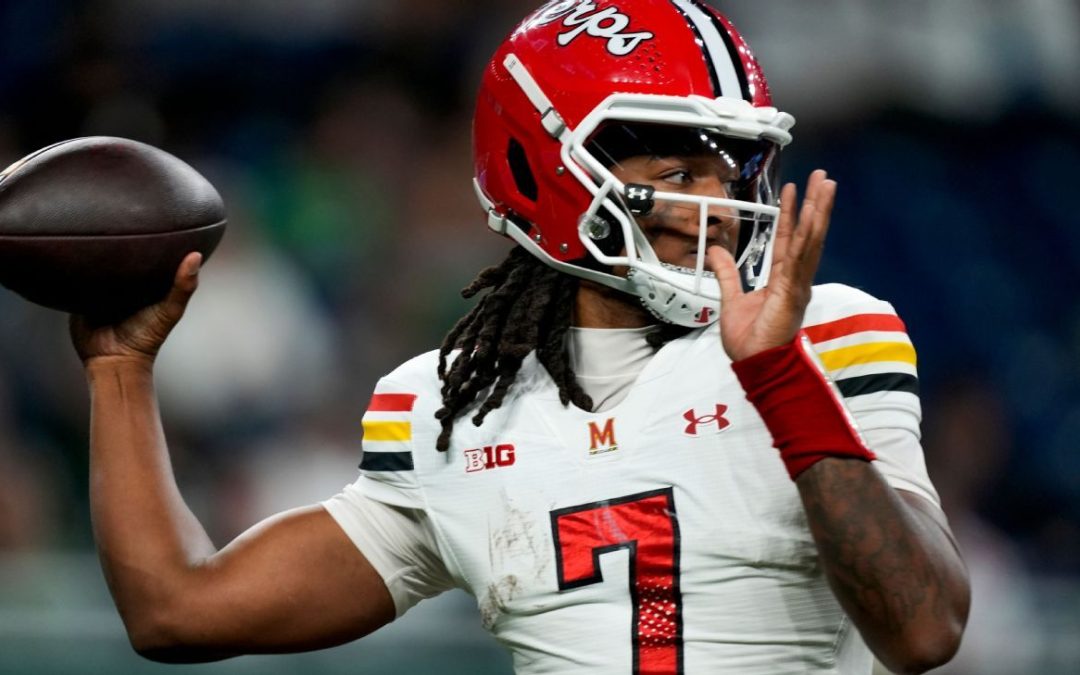
Maryland enters year eight under Mike Locksley coming off consecutive 4-8 seasons, and it enters with more continuity than almost anyone in the sport. The Terps return 71 percent of their production, second nationally, along with 14 starters and a sophomore quarterback who started every game as a true freshman. Two new coordinators arrive on offense and special teams. A second-year coordinator returns on defense.
There is a real case that this team is better than 4-8. There is also a real case that the players most responsible for last season’s few strengths are the ones who left. Both cases are built from the same roster, which is what makes this an interesting season rather than an obvious one.
This is a long look at the whole roster: what we like, what we are still asking, and what the first month should answer.
The short version
What we like:
- Linebacker is the surest group on the roster, and Daniel Wingate may be the best player on the team.
- Sidney Stewart and Zion Elee give Maryland a real edge tandem even without Zahir Mathis.
- Michael Hershey is settled and genuinely good at center, and he is a developmental success story.
- The tight end room is deep, talented and about to be used more.
- Sean O’Haire and Bryce McFerson are plausibly the best kicker-punter tandem in the Big Ten.
- Jamare Glasker and Messiah Delhomme are two secondary pieces worth building around.
What we are asking:
- Can this offense score inside the twenty after finishing last in FBS in red zone touchdown rate?
- Does the run game move at all, and how much of Clint Trickett’s rushing résumé was scheme?
- Who catches the ball in a room that returns 37.8 percent of its production?
- Can the interior defensive line hold up after losing two starters from a unit that was already 99th against the run?
- Does the secondary survive losing an NFL third-round pick and an all-conference corner in the same year?
- Can Maryland finally win a close game, and hold up in the fourth quarter?
Setting the table
The 2025 season had two halves and no middle. Maryland started 4-0, beating Florida Atlantic, Towson, Northern Illinois and then Wisconsin on the road, 27-10. It then lost eight straight to finish 4-8 and 1-8 in the Big Ten. The first three of those losses came by a combined ten points: four to Washington, three to Nebraska, three to UCLA. The Terps went 0-3 in one-score games on the year.
Two numbers explain most of it. Maryland finished last in FBS in red zone touchdown rate at 37.8 percent, and it was outscored 102-34 in fourth quarters. That is an offense that could move the ball and not finish, attached to a defense and a roster that could not hold up late. The Terps also forced 21 interceptions and were still outscored on the season, which puts them in a group of three FBS teams that managed that particular trick.
Locksley responded with two significant hires. Clint Trickett arrives as offensive coordinator from Jacksonville State, replacing Pep Hamilton after one difficult year. Trickett comes out of the Dana Holgorsen tree, having played for him at West Virginia, and his Jacksonville State offense led Conference USA in total yards. Matt Barnes takes over special teams, hired in March on short notice after Chili Davis was promoted and then poached by the Minnesota Vikings. Barnes is a Frederick native and Urbana High graduate returning for a second Maryland stint, having previously run the Terps’ special teams from 2016 to 2018 before three seasons at Ohio State and coordinator jobs at Memphis and Mississippi State. Ted Monachino returns for year two as defensive coordinator, with Aazaar Abdul-Rahim as co-coordinator.
The roster churn cut both ways. Maryland kept Malik Washington, Stewart and most of its young core, which in the current era is its own kind of win. It lost Aliou Bah to LSU and Alan Herron to the NFL on the offensive line, Kevyn Humes to Rutgers and Dontay Joyner off the roster in the secondary, and Dillon Fontus to Syracuse up front. Safety Jalen Huskey went to Jacksonville in the third round of the draft. Zahir Mathis, a Freshman All-American, was lost for the season to an August injury.
The Offense
Quarterback
Malik Washington is the reason for most of the optimism around this team, and the reason is legitimate. He became Maryland’s first freshman to start a season opener since 2012, started all twelve games, and completed 273 of 473 passes for 2,963 yards with 17 touchdowns and nine interceptions. He also announced early that he was staying, which mattered.
The efficiency numbers are the other side. Washington completed 57.7 percent of his throws and posted a 118.4 passer rating that ranked 108th out of 117 qualifying FBS quarterbacks. ESPN put him in its eighth tier of quarterback situations. On The Solid Verbal, Ty Rubenstein’s critique was about touch: that Washington throws nearly everything at maximum velocity and needs to modulate on the five-yard out and the fifty-yard ball alike.
That critique deserves a large asterisk. Maryland’s receivers dropped 39 passes last season, more than any unit in the country. Some meaningful share of the completion percentage belonged to the room rather than the arm. The complication is that Maryland removed the drops and the production in the same transaction, so we will not know how much of the accuracy problem was his until he is throwing to people who catch it.
One underrated asset: Washington was Maryland’s second-leading rusher with 303 yards at 5.4 a carry. In a spread system that is a cheap way to add numbers to the run game, and Trickett’s offenses have historically used the quarterback.
Behind him the depth is unproven but interesting. Cardell Williams arrives from Sacramento State having thrown for 1,651 yards and ten touchdowns while also, per our earlier reporting, running for 382 yards and twelve scores. If that rushing line holds, he is an obvious short-yardage package waiting to be built, and Maryland was last in the country inside the twenty. Jack Capaldi, Max Lawrence and freshman Nathan Bernhard round out the room.
Running Back
This is the group most people have ranked last on the roster, and the production supports that. Maryland attempted 305 runs last season, fewer than any offense in Division I, and averaged 104.3 rushing yards a game, its lowest figure since joining the Big Ten in 2014. The per-carry average did climb from 3.6 to 4.1.
DeJuan Williams is better than his rushing line suggests. He led the team with 927 all-purpose yards, set a Maryland single-season record for receiving yards by a running back with 426 (breaking Bruce Perry’s 359 from 2001), and led all Big Ten backs with 45 receptions. He was named the team’s Freshman Offensive Player of the Year. He also ran for 501 yards on 128 carries at 3.9 a pop with two runs longer than 20 yards all season, which is the part that has to change.
Worth remembering who he is. Williams was a four-star out of Saint Frances who chose Maryland over Michigan, Ohio State and Penn State. A back with that profile averaging 3.9 is at least partly a blocking and play-calling story rather than a talent story.
The depth is where the questions live. Harry Dalton arrived from USC with real high school recognition in Virginia and has eight career carries for 44 yards. Terrez Worthy is the most explosive name on paper, having led all juco rushers with 1,492 yards and ten touchdowns at Lackawanna in 2023 and averaged 5.4 a carry at Temple in 2024 with a 75-yard touchdown against Tulane, but he left Temple four games into 2025 for personal reasons and finished with 71 yards on 23 carries. He also returns kicks. Iverson Howard, a three-star per 247 and an ESPN 300 four-star per ESPN, averaged 3.2 on 39 carries and handled kickoff returns.
Locksley said in camp that Williams, Howard and Dalton have all come along and given him hope the run game shows up. Inside MD Sports reports that nobody behind Williams has separated. When the coach and the people at practice every day see it differently, September settles it.
Wide Receiver
The honest answer here is that nobody knows, and anyone claiming otherwise is guessing.
Only 37.8 percent of Maryland’s receiving production returns. Shaleak Knotts, Jalil Farooq and Octavian Smith Jr. are all gone, and the nation-leading 39 drops went with them. The addition-by-subtraction argument has genuine merit. It is also true that the top returning receiver is Kaleb Webb with 22 catches for 318 yards, and that Maryland threw for 98 yards against Rutgers, its lowest total since 2022.
The reasons for optimism are real even if unproven. Chris Durr, in from Wyoming with 45 catches for 469 yards, won the Torrey Smith Wide Receiver Award in the spring and has reportedly built strong chemistry with Washington. One source described him as potentially the best after-catch runner Maryland has had in a while, which is the most useful trait a receiver can have in a spacing offense trying to manufacture easy yards. Jeff Ermann independently reported the same buzz in August. Na’eem Abdul-Rahim Gladding caught 51 passes for 667 yards and six touchdowns at Old Dominion with 100-yard games against Coastal Carolina and Appalachian State, earned All-Sun Belt honorable mention. Webb has reportedly moved to the top of the depth chart, and he was a top-200 four-star who was targeted oddly infrequently last season despite being more reliable than the players around him.
There is more talent in this room than the production suggests. Ryan Manning, who has three career catches, was a top-100 national receiver coming out of Saint Frances. Zymear Smith was a four-star ESPN 300 signee who picked Maryland over Alabama, Penn State and South Carolina, redshirted, spent a stretch at defensive back and is now back at receiver. Sean Williams was a top-five player in D.C. Ejani Shakir caught 43 passes for 724 yards at Independence C.C. Jordan Scott was the No. 2 juco receiver in his cycle and spent a season at Florida State, though he did not crack the rotation here last year.
One structural note that matters for the red zone. This is among the tallest receiver rooms in the Big Ten. Scott is 6-foot-7. Webb and freshman Josiah Teasley are 6-5. Jayden Kitchens is 6-3. Spacing does not solve the goal line, where the field shrinks, but catch radius might. If Maryland finds red zone touchdowns this fall, jump balls are a plausible mechanism that has nothing to do with the run game. The counter-question is the right one: whether these receivers separate at the top of a route against Big Ten corners, which is a different job than winning contested balls in the Sun Belt or Conference USA.
Tight End
This may be the most improved situation on the roster, and it is the clearest place to check whether the new scheme is real.
Dorian Fleming tied for second among Big Ten tight ends with 40 receptions for 351 yards and three touchdowns, earned honorable mention All-Big Ten, and is on the John Mackey Award watch list for a second straight year. His nine catches against Washington were the second-most by any FBS tight end in a game last season and the second-most by a Maryland tight end in thirty years. He shared the team’s spring leadership award with Mathis.
Preston Howard is back after three seasons at Maryland and a year at Auburn, where he started seven games. He has been candid that Auburn was not his best year or his best headspace, and he is reportedly in the best shape of his career. AJ Szymanski is a legitimate in-line blocker at 6-6 who played all twelve games with three starts. JT Taggart, Willie Taggart’s son, gives the room another body, and the freshman class adds three more.
Trickett developed Harrison Bryant into a Mackey Award winner at Florida Atlantic, and Maryland is expected to play a significant amount of two-tight-end personnel as a way to manufacture throws around a thin receiver room. Maryland’s tight ends caught 49 passes last season, under 18 percent of Washington’s completions. If that share does not climb, the scheme change is smaller than advertised.
The caveat comes from Fleming himself. Drops were a problem for him and his blocking was inconsistent, and he has said his own next step is being seen as a physical blocker rather than only a pass catcher. Two-tight-end sets only work if the second tight end can block. Otherwise it is an announcement to the defense.
Offensive Line
Start with the good number, because it is a very good number. Maryland allowed nine sacks last season, the fewest by any Big Ten team since 2020 and tied for third-fewest in the nation.
Now the complications. The same unit graded in the high 40s and low 50s as run blockers across most of its starters, and Inside MD Sports reports the sack total was aided by an inordinate number of screens under Hamilton. So the line’s best trait was partly a play-calling artifact, and Trickett is being asked to improve its weakest trait while running a scheme that may put its strongest at risk. Two starters are gone in Bah and Herron.
Michael Hershey anchors it and deserves more attention than he gets nationally. He came out of high school a three-star ranked the 213th defensive lineman in the country, choosing Maryland over Charlotte, Yale and Delaware. He started all twelve games at center, allowed zero sacks and ten pressures, posted an 83.5 PFF pass-blocking grade, and now sits on the Rimington Trophy watch list with Phil Steele rating him the eighth-best draft-eligible center in the country. The Athletic included him among the top interior linemen in a re-rank of the 2024 recruiting class.
Rahtrel Perry returns at left tackle after starting all twelve games, a Central Connecticut State transfer who was a first-team All-NEC pick and a top-ten portal tackle when he arrived, with two years of eligibility left. Isaiah Wright started all twelve at left guard and has 24 career Power Four starts across Rutgers, Buffalo and Maryland, and he is moving to tackle this fall. Tellek Lockette is the headline addition, a Texas State transfer with 28 career starts and 2,011 snaps whom Pro Football Network rated the top offensive lineman among small-school transfers to the Power Four. He allowed no sacks and no pressures in 131 snaps last season before a lower leg injury ended his year, which is excellent and a small sample at the same time.
The upside piece is Jaylen Gilchrist, an ESPN 300 signee who was the 80th overall recruit in his class and lost 2025 to an injury in the opener. He is the highest-rated lineman on the roster and is competing for a starting guard job as a redshirt freshman. Ryan Howerton, a 6-6, 332-pounder who moved in from tackle, and Amory Hills are in that competition too. The belief inside the building is that this group is nastier and more physical than a year ago. The running game will be the evidence either way.
The Defense
The returning production, read closely
Maryland brings back 74 percent of its defensive production and eight starters. It does not bring back the players who earned recognition.
Jalen Huskey was the team’s Defensive Player of the Year, a captain and a second-team All-Big Ten safety with 72 tackles and four interceptions, and he ranked sixth among Big Ten safeties in PFF total defense grade before Jacksonville took him 100th overall. Cam Rice was honorable mention All-Big Ten on the defensive line and graduated. Dontay Joyner was honorable mention All-Big Ten at corner with eight pass breakups and left the program in August. Dillon Fontus started inside and transferred to Syracuse. Zahir Mathis was a Freshman All-American with 8.5 tackles for loss and six sacks and is out for the year.
Stewart and Wingate are the returning honorees. That is not a prediction of collapse. It is a reason to hold the 74 percent lightly, because volume and quality are not the same thing.
One note on how the units get counted. Maryland lists Stewart and Elee at linebacker, our depth chart puts SAM with the defensive line, and Inside MD Sports grouped edges with the line for its rankings. Count the edges as line and the front looks good, because they are the two best young players on this defense. Count them as linebackers and the line looks thin while the linebacker room looks excellent. We are treating the edges as part of the front here.
Edge
Sidney Stewart’s freshman season was outstanding: 32 tackles, 10.5 for loss, seven sacks, seven quarterback hits, two pass breakups, a forced fumble and a forced safety. He arrived a three-star and a top-40 player in Maryland who chose the Terps over West Virginia, Boston College and Indiana. Keeping him was a real offseason win.
Zion Elee is the highest-rated prospect the program has ever signed, a five-star already named to the Shaun Alexander Freshman of the Year watch list. He is listed at SAM in an OR with Stewart, which means Monachino has a decision about how to get both on the field.
Mathis’s injury is the complication. He and Stewart combined for 13 sacks and 19 tackles for loss last season, and half of that is gone. The listed replacement at JACK, Nahsir Taylor, had 19 tackles, three tackles for loss and two sacks in eleven games. The underlying question is whether Stewart can be a primary rusher rather than a complementary one. At 6-2 and 255 he is built more like a base end than a prototypical edge, and being the player every Big Ten tackle game-plans for is a different job. Maryland On SI’s Jaden Golding is betting yes and projects double-digit sacks. That is the optimistic case and it is a fair one.
Interior DL
This is the group we are watching hardest.
Maryland allowed 175.6 rushing yards a game last season, 99th in FBS, with Rice and Fontus playing. Both are gone. Add up the 2025 tackles for every projected interior contributor, across four different programs, and the total is 82. Wingate had 102 by himself. Their combined tackles for loss come to nine. Stewart had 10.5 alone.
The counterweight is pedigree, and it is not nothing. Bryce Jenkins was a four-star ESPN 300 signee and the No. 2 recruit in D.C. in his class. DD Holmes was also a four-star ESPN 300 and the No. 2 player in D.C. in his. Derrick LeBlanc, in from UCF, was the 51st overall recruit in the country out of high school. JaMarcus Whyce is a four-star freshman who ranked 17th in Ohio. EJ Moore was a Phil Steele FCS Freshman All-American before he arrived. Eyan Thomas, a second-team All-NEC pick at Saint Francis, is the returning piece at 6-3 and 328. Lavon Johnson comes back from Texas, and Armon and Jayvon Parker arrive from Washington with size and 32 combined games.
Counting stats are a poor way to judge young rotational linemen, so we would not write this room off. Jenkins and Holmes are entering the years when interior linemen typically arrive. But this is the group Big Ten offenses will test first, and we will have to wait and see if there is improvement here or not. I like some of the depth that was added, but we have to see them perform.
Linebacker
It’s been argued by some that Wingate, not Washington, is currently the best player on the team. It is defensible.
Wingate had 102 tackles, sixth in the Big Ten and 35th nationally, with 6.5 tackles for loss, 1.5 sacks and a pick six against Florida Atlantic. He is the first Terp to reach 100 tackles since Tre Watson in 2018, and he did it playing through a high ankle sprain for most of the season without missing a snap. His teammates voted him the Louis L. Goldstein Gold Helmet Award as the program’s most outstanding player. He is on the Butkus, Bronko Nagurski and Chuck Bednarik watch lists. Monachino called him the player who holds the whole thing together and said there can never be enough of him. Lavain Scruggs said a fully healthy Wingate is a complete monster.
Trey Reddick started ten of eleven games with 53 tackles, 5.5 tackles for loss and two sacks, and he is a 6-4 athlete who was a three-time state champion at Phoebus and chose Maryland over Wake Forest, North Carolina and Penn State. The knock is that his length and his habit of launching at ball carriers produce some missed tackles. Carlton Smith finished fourth on the team with 64 tackles despite one start as a true freshman, tied for second in quarterback hurries, and picked Maryland over Alabama, Miami, Penn State and Notre Dame. He looks like the next one.
Stephen Dean III arrives from VMI, where he led the Southern Conference with 117 tackles as a captain and added 9.5 for loss. Locksley has pointed to his physicality and special teams value. Jordan Williams is the roster’s most unusual story, a grad transfer who spent four seasons playing college basketball at Texas A&M, Vanderbilt and Rice before returning to a sport he last played as a high school sophomore, when he was a Texas state MVP. His father played five NFL seasons at running back and his brother is on Tampa Bay’s roster.
The returners here combined for 23 starts, against one start for the group that came back a year ago. The depth thins after the top four, though Kaden Carter is a four-star freshman rated the seventh-best inside linebacker in his class and Travares Daniels II was a top-100 player in Florida. Unproven is not the same as untalented. How many snaps Wingate and Reddick hold up for will decide whether this is a strength or a thin strength.
Secondary
Maryland finished third-to-last in the Big Ten in passing yards allowed and last in the conference in passing touchdowns allowed. It gave up 43 percent on third down, and only Illinois and Northern Illinois were held under 215 yards through the air. Then it lost Huskey and Joyner. That is the case for worry, and it is a strong one.
The case for optimism starts with Jamare Glasker. The redshirt senior tied for the team lead and ranked fourth in the Big Ten with four interceptions, including three straight games with a pick, the longest such streak by a Terp since William Likely III in 2014, and he returned one for a touchdown against UCLA. He added six breakups and 32 tackles. The staff believes he is a quality No. 1 corner and that belief looks earned.
Amari Jackson gives Maryland experience opposite him, with 28 starts across four years at Boston College, two career interceptions including a pick six, and an ESPN ranking of 82nd overall and fourth among corners changing schools. Abdul-Rahim coached him at BC, so the install is not starting from zero. The caveat is durability: injuries have cost him significant time each of the last two seasons, including a torn ACL that ended 2024.
Jordan Scruggs was added in mid-August after a court granted him a sixth year of eligibility, and he raises the floor. He has 35 career games and 20 starts across Washburn, Central Missouri, Hutchinson C.C., South Alabama and West Virginia, and his best season came at South Alabama in 2024 with 69 tackles and a 96-yard interception return. He was rotational at West Virginia rather than a full-time starter, he is 5-11 and 166 pounds, and he arrived roughly two weeks before the opener. Floor-raiser, not a Joyner replacement.
The young corners are interesting. Sean Johnson comes from the Archbishop Spalding pipeline. Lloyd Irvin III and true freshman Hakim Satterwhite add depth. Judah Jenkins started as a true freshman in 2024, missed all of 2025, and moved back from safety for camp. Ricardo Cooper Jr., a converted receiver and former walk-on who was voted Maryland’s special teams player of the year, could see real defensive snaps.
At safety, Messiah Delhomme is the player we would bet on to take a leap. A four-star ESPN 300 signee who chose Maryland over Ohio State, Alabama and Florida State, he played all twelve games as a true freshman with 39 tackles, four pass breakups, an interception, a fumble recovery and a tackle for loss. He led the team with 12 tackles against Indiana, picked off his first pass against Nebraska, and was one of only eleven players nationally to block two kicks. He said in camp that the game has slowed down for him and credited extra film work with the assistants. That is standard camp fare, except the room just lost a third-round pick, so his development is load-bearing.
The spot next to him is a three-way question. Lavain Scruggs, a 6-3, 215-pound redshirt senior from Baltimore, started all twelve games and ranked third on the team with 64 tackles, adding two interceptions and three breakups, with a career-high eleven at Illinois. Across sixteen career starts the production has been steady and the coverage moments have not always been. Jayden Shipps, a sophomore from Spalding, played all twelve games as a freshman with eleven tackles and a sack, and coaches like what they have seen. Darrell Carey is the wild card, a DeMatha product and the class’s top-rated signee who flipped from Penn State after James Franklin’s firing and turned down Indiana and Oregon. He will play. Gavin Edwards adds depth, though the jump from Division II North Greenville and a spring at Austin Peay to the Big Ten is enormous.
One quieter thing to keep in mind across the whole defense. Maryland forced 21 interceptions and recovered two fumbles, a national low. The fumble number should improve. The interception rate is the least stable component of turnover margin and probably will not hold. The Terps were outscored even with that margin.
Special Teams
The specialists are excellent and the operation around them was not, and both halves need saying.
Sean O’Haire went 21-of-24 on field goals and 29-of-29 on extra points, earned first-team All-Big Ten as a redshirt freshman and led the conference with 1.75 made field goals per game, ninth nationally. His 87.5 percent conversion rate is the second-best single season in program history, and his 21 makes and 92 points set Maryland freshman records. He has never missed an extra point in college. He came from Richmond after going 12-for-12 in his first season ever playing football.
Bryce McFerson averaged 44.2 yards a punt, second in the Big Ten and the sixth-best single season in Maryland history, with 14 punts of 50-plus and 19 inside the 20. He was second-team All-Big Ten and earned a third career Ray Guy Award list selection. His 366 yards on eight punts at UCLA set a school record. He was the top-ranked punter in the country out of high school and averaged 45.1 at Notre Dame before transferring.
Everything else was bottom-third. Maryland ranked 92nd nationally in punt return average at seven yards, 14th of 18 in the Big Ten. It allowed 8.5 yards per punt return, fifth-worst in the conference. It averaged 18.4 yards per kickoff return, 15th. Net punting was 38.5, 13th, despite an elite leg. And a recurring short-kickoff problem handed opponents field position repeatedly.
That is why the Barnes hire matters as much as the returning talent. His Ohio State résumé includes three Big Ten titles and two College Football Playoff trips. The return jobs were still unsettled through camp, with Cooper, Howard, Durr, Gladding, Zymear Smith and Justin DeVaughn among the names. DeVaughn is worth watching for a specific reason: the redshirt freshman from Mervo recently ran the second-fastest 110-meter hurdles time in Maryland history and finished fourth at the Big Ten championships. Whether track speed becomes football speed is an open question, but Maryland needs somebody to be dangerous with the ball.
The bigger question underneath all of it
Read this roster by recruiting profile rather than last season’s box scores and a different team appears.
Locksley has recruited the DMV well. That is not in dispute, and it is why outsiders keep calling this roster underrated. Biff Poggi’s version was that Maryland has always had good skill players and now has a quarterback too. The talent has been arriving for several years, and the record over the last two seasons is 8-16.
So the question this fall is less about whether the talent is here and more about whether this staff converts it. That is a development and scheme question rather than a roster question, which makes Trickett, Barnes and Monachino’s second year the things to judge in September. Not the star ratings.
Worth saying in the other direction too, because recruiting rankings are a starting point rather than evidence. Hershey chose Maryland over Charlotte, Yale and Delaware and is now a Rimington candidate. Gladding was a zero-star recruit who led his team in catches and touchdowns. Development runs both ways, and this staff has a track record of finding players other people missed.
There is also a resource dimension worth naming. Poggi has described rosters at the top of the Big Ten running $40 to $50 million, and said a team spending $25 million is still shorthanded. Maryland is not in that business. Retention is the lever this program can actually pull, and it pulled it with Washington and Stewart; but when you are starting from an overall talent deficit to begin with – and you lose Mathis and Joyner before the first snap of the season – that obviously hurts.
The Schedule
Twelve games, with ESPN’s Match-Up Predictor win probability for each.
| Date | Opponent | MD Win % | Note |
| Sept. 5 | Hampton (FCS) | 99.0% | Home, under the lights. |
| Sept. 12 | at UConn | 77.7% | New staff, new roster in East Hartford. |
| Sept. 19 | Virginia Tech | 36.9% | 7:30 p.m., national TV. The one. |
| Sept. 26 | UCLA | 64.6% | Best home conference number on the board. |
| Oct. 3 | at Nebraska | 20.9% | Lost by three in College Park last year. |
| Oct. 10 | at Ohio State | 2.4% | Buckeyes open No. 1. 9-0 all-time in the series. |
| Oct. 17 | Rutgers | 56.7% | The measuring stick. Bye follows. |
| Oct. 31 | Illinois | 44.8% | Home coin flip. |
| Nov. 7 | at Purdue | 48.7% | The road game to steal. |
| Nov. 14 | Wisconsin | 46.2% | Maryland won 27-10 in Madison last year. |
| Nov. 21 | at USC | 11.0% | Cross-country trip, Jayden Maiava returns. |
| Nov. 28 | Penn State | 20.9% | Matt Campbell era, QB Rocco Becht. |
Three non-conference games, and each carries a different kind of test. Hampton is about installation and health. UConn is the one Maryland fans are most nervous about and, we would argue, the one where the fear is most out of date. This is not the 9-4 team people remember. Jim Mora left for Colorado State, Jason Candle arrived from Toledo with an almost entirely new staff, the offensive coordinator behind a 36.9-point offense left for TCU, and a wave of players hit the portal. That said, Candle went 81-44 at Toledo with two MAC titles and no losing season in ten years, and a brand-new staff in Week 2 is a variance game. The failure mode is treating a road opener like a walkover.
Virginia Tech at home in primetime is the game most likely to define how this season gets remembered. ESPN has Maryland at 36.9 percent, which says the model believes James Franklin’s first-year reload took. Maryland On SI’s staff mostly disagreed and picked this as the signature win. That is a wide gap between local sentiment and the numbers. Watch Penn State transfer Ethan Grunkemeyer at quarterback and Brent Pry running the Hokie defense. This is also the last meeting for a while, with Virginia Tech having bought out the 2027 and 2028 games and Maryland replacing them with Baylor. Franklin now recruits the same DMV players Locksley does, and Darrell Carey is on Maryland’s roster because Franklin got fired at Penn State.
What the math actually says about a bowl
The popular route to six wins goes like this: bank Hampton and UConn, take care of Rutgers at home and Purdue on the road, then find two among Virginia Tech, UCLA, Illinois and Wisconsin.
Maryland’s overall bowl probability is 44 percent.
ESPN has Maryland at 56.7 percent against Rutgers and 48.7 percent at Purdue, so those are coin flips rather than banked wins, and sweeping all four so-called must-wins is a one-in-five proposition. Maryland is projected at 20.9 percent at Nebraska and 20.9 percent against Penn State at home, and those add up. Most realistic six-win seasons include a game nobody has penciled in, which is a more forgiving picture than a checklist implies.
The schedule’s shape still matters. ESPN’s numbers give Maryland 2.78 expected wins across the first four games and 2.52 across the last eight. The Terps have gone 1-14 after September across two seasons, so the front-loading is not a small detail. A 3-1 start keeps everything open. A 4-0 start, which is an 18 percent proposition, would change the season entirely. A 2-0 start is a 77 percent proposition, which is to say it should happen and would not tell us much on its own.
What we will be watching in September
- Rushing attempts against Hampton. Maryland ran the ball more than 30 times in exactly two games all of last season. A number comfortably north of 35 against an FCS opponent would signal a real philosophical change. The box score will not tell us much. The play-calling will.
- Tight end target share. The cleanest early read on whether the two-tight-end plan is real, and whether Fleming’s blocking has come along enough to run it.
- Whether a goal-line package exists, and who is in it. Maryland was last in FBS inside the twenty. If Cardell Williams is part of the answer, we should see it in Week 1.
- Snap counts up front. Specifically Elee, Nahsir Taylor, and how the interior rotation sorts out among Jenkins, Holmes, LeBlanc and Thomas.
- Where Jordan Scruggs lines up. He has had roughly two weeks in the system, and Hampton is his only live audition before Virginia Tech.
- The safety next to Delhomme. Lavain Scruggs, Shipps or Carey. This is the most open competition on the roster.
- The return game and the short kickoffs. The least glamorous item here and the one that quietly cost field position all last year.
- Fourth quarters. Opponents outscored Maryland 102-34 in the fourth last season. Nothing in the offseason obviously addressed depth or conditioning. If that flips, a lot of coin-flip games flip with it.
Projection
Our projection is 5-7, with 6-6 well within reach and 4-8 in play if September goes badly. We would take the over on a 4.5-win total and we would not be surprised by a bowl. ESPN’s per-game numbers produce 5.30 expected wins and make five the single most likely outcome, which is close to where the roster review landed independently.
That is a notch below most published previews. College Football News says 6-6. Both Solid Verbal hosts said 6-6, with Rubenstein saying he sees a step forward here. Maryland On SI’s staff went 6-6, 6-6 and 7-5. Poggi predicted eight or more. CBS called the Terps the most underrated team in the Big Ten, though that label came from the one panelist who ranked them sixth while three others had them 16th, and the unofficial Big Ten media poll had Maryland 15th.
We may well be too low. The gap between our number and theirs is mostly about how much credit to give returning production that does not include last year’s best defenders. Reasonable people are weighing that differently.
What would move us is specific and it arrives quickly. If Maryland converts in short yardage, if the tight ends get used the way the scheme suggests they will, and if two of those young interior linemen show up, this is a bowl team. All three are answerable by the end of September. Beat Virginia Tech and the conversation changes on the spot.
I feel teams are built from the lines out, and it seems like MD has more size and strength on both sides of the ball this year.
That’s encouraging, but like everything with MD; you want to see talent and projection translate to production.
MD Football can be a frustrating watch year-to-year, because the roster often has a number of talented pieces, but their depth will get pressed and limitations get exploited over the course of a season.
This roster again has some legitimate talent and but also questions everywhere.
It’s hard not to bring everything back to Locksley and Washington though.
The fanbase in-general feels burned. Lots of seasons of irrelevance do that.
Locksley is appreciated as a recruiter, but people want results.
He’s especially under-the-gun due to the magical turn-around experienced at Indiana.
The Hoosiers story aside, I think we can universally agree that this is a difficult job.
You aren’t spending at the levels of the Conference Powers, nor do you have their history.
If you bring in quality talent, you aren’t always in a position to then keep those players from being poached by programs with more spending power.
You can have recruiting and portal success overall, but still not have the same roster depth that an additional $25M buys.
Those are all valid thoughts, but no MD fan wants to hear that in Year 8 of Locksley’s tenure.
Especially with Washington back under center for Year2.
There is a genuine feeling amongst MD fans, “If we can’t make a leap now, when can we?”
There is also the wonder of, “If Washington is really strong this year, will MD be able to keep him?”
The possibility of retaining Washington for 2027 is a question for another day.
Right now, you are hoping that Washington takes all of the Freshman year experience, and is ready to pull everyone up a notch.
If he’s excellent week-to-week, the questions at RB and WR decrease.
If he’s regularly putting points on the board, then the Defensive Front 7 can be in position to pin their ears back and get after QB’s – which would of course make life easier for the Secondary.
Maryland finishing 4-8, 5-7, or 6-6 with a bowl shouldn’t be good enough for Locksley to keep his job.
At 7-5, there is at-least an argument to be made.
Really, the schedule is about as kind as MD is going to get.
A real breakthrough season would be beating Hampton, UConn, Rutgers, and Purdue – and then winning 4 of 6 vs. Virginia Tech, UCLA, Nebraska, Illinois, Wisconsin, and Penn State.
That’s really the year MD needs to get more fans to buy in, and for the program to be better positioned going forward.
It’s also a very tall order when it feels like MD could lose any of the non Hampton games.
What will hold my interest this Fall is that with Washington on-board, MD should have a viable chance to win every game that isn’t in Columbus, Ohio.
We will see how it shakes out.
Lot of pressure on the 20 year old Washington to lead this group But it’s fun entering the year knowing he has the potential to be great.

Owner
Chris Stoner founded Baltimore Sports and Life in 2009. He has appeared as a radio guest with 1090 WBAL, 105.7 The Fan, CBS 1300, Q1370, WOYK 1350, WKAV 1400, and WNST 1570. He has also been interviewed by The Baltimore Sun, Baltimore Business Journal, and PressBox (TV). As Owner, his responsibilities include serving as the Managing Editor, Publicist, & Sales Director.