
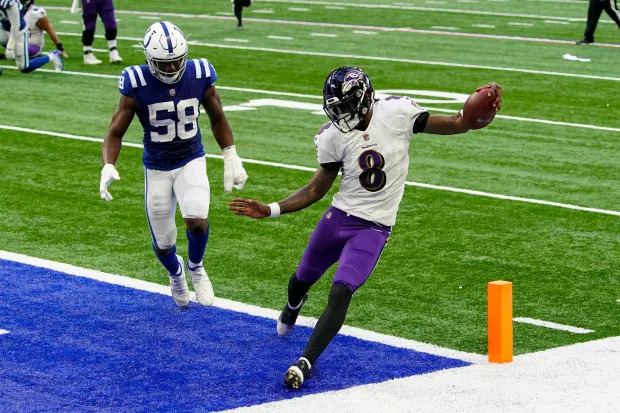
The 2025 Ravens season ended with Tyler Loop’s 44-yard field goal attempt missing on the final play in Pittsburgh, in a game that decided the AFC North. Baltimore had started 1-5, clawed most of the way back, and finished 8-9 anyway. Eighteen years of John Harbaugh ended a few weeks later.
What replaces it is a 43-year-old first-time head coach who calls his own defense, a 30-year-old coordinator who will call his first NFL offense from the booth, and a two-time MVP entering Year 9 off the least productive full season of his prime.
Clay’s model grades this the second-best roster in football. The market set the win total at 11.5, tied with the Rams for the highest on the board. The staff has never coached a game together. That combination is why this is the hardest team in the league to project, and why the honest version of this preview contains more open questions than a team with these expectations ought to have.
Minter & Co.
Jesse Minter inherits more pressure than any first-year coach in the league, because the mandate isn’t “make the playoffs.” Baltimore does that. The mandate is to win once they get there.
Minter finished third among all defensive play callers in CBS’s poll of twelve writers — behind only Mike Macdonald and Steve Spagnuolo, ahead of Vic Fangio and Brian Flores. He’ll call it himself, which matters for a reason beyond scheme: the buck stops with him now. One of the more tiring recurring features of the Harbaugh era was how often he absolved himself of his coordinators’ decisions. That option no longer exists. Anthony Weaver handles the front seven, Mike Mickens the secondary.
Declan Doyle drew zero votes in that same poll. He is 30, was Ben Johnson’s coordinator in Chicago last season, coached tight ends in Denver, and came up in New Orleans from 2019 to 2022. His influences are Sean Payton and Johnson, which on paper means pairing Payton’s downhill duo runs with Johnson’s outside zone — a fit for Derrick Henry as clean as anything you could draw. He’ll call plays from the booth, with Weaver and Minter splitting sideline duties.
We left this staff off our top-ten coaching staffs, and we want to restate why, because that’s the sort of omission a Baltimore site gets accused of underthinking. Half a staff isn’t a staff. Minter has never been a head coach. Doyle has never called an NFL offense. They’ve never worked a game together. And being great at X’s and O’s — which Minter unambiguously is — is not the same skill as keeping a room rowing in the same direction after a bad October. A coordinator’s job is scheme. A head coach’s job is everyone pulling the same way when things go sideways. This group could be top-five by December. It hasn’t earned the ranking in August.
What Minter’s Defense Actually Looks Like
This is the part of the preview that got underwritten everywhere, including by us. “Fast, violent, aggressive” is what every new staff says. Here’s what the tape and the tracking data actually say, and it’s more specific and more interesting than the slogan.
Start with the résumé, because it’s stark. The year before Minter arrived in Los Angeles, the Chargers ranked 30th in passing yards allowed at 249.8 per game, 24th in points allowed at 23.4, and 27th in yards per play at 5.5. Derwin James had the worst season of his career. Over Minter’s two years running it, that unit finished fifth in passing yards allowed at 193.4, third in points at 19.9, and seventh in yards per play at 5.2 — back-to-back top-ten defenses by EPA, with James returning to consecutive Pro Bowls.
He runs a 3-4 built on versatility, and the governing idea is to muddy the picture for the offense while keeping it simple for his own players. The tracking data describes something close to the opposite of what “aggressive” usually implies. Per Next Gen Stats, the 2025 Chargers played zone on 80.7 percent of snaps (fifth-highest), used split-safety looks on 49.6 percent (fourth-most, a hair ahead of Macdonald’s Seahawks), rushed four on 72.6 percent, and blitzed on just 21.4 percent — third-fewest in football. The personnel is the tell: nickel only 55.2 percent of the time, eighth-lowest in the league, because they were in dime at the third-highest rate. While most of the NFL pivoted toward heavier personnel, Minter went the other way and dared offenses to run into it.
So the identity is this: Minter isn’t trying to trick you with exotic pressure. He gives you a clean look, rushes four, plays zone with two safeties deep, and bets his defensive backs win. As Russell Street Report put it, that only works if the defensive backs are elite.
The hinge is the hybrid safety. Minter used James near the box on roughly 85 percent of snaps, and when the Chargers blitzed, James was often the one coming — 12.9 percent of his own snaps, and fifth on the team in pressures. Minter’s explanation, from when he arrived in Los Angeles, is the sentence to memorize: the closer he is to the action, the better he is. The flexibility was the point — maybe it’s three corners and he’s the safety, maybe two safeties and he’s the nickel, maybe he’s the dime.
Now consider that Minter, a former Ravens defensive backs coach for four seasons, studied Kyle Hamilton extensively before taking the Chargers job and is now inheriting him. Hamilton graded 86.3 at PFF in 2025, third among all safeties, and has a credible claim to being a more versatile version of what James was asked to do. Baltimore has spent three years arguing about how to use him; the answer just walked in with two years of film on exactly that question.
Two more notes. Minter does keep a change-up: over the Chargers’ final six weeks he called 13 Cover 0 blitzes, and quarterbacks went 3-for-10 for 23 yards with an interception, two sacks and seven pressures — low usage, high leverage, a tendency breaker rather than an identity. And the front he ran was a four-down look with two large interior bodies and stout edges, a near-exact description of what Baltimore is handing him.
The catch, and it’s a real one. A scheme that rushes four, plays two-high zone, and dares you to complete underneath throws requires corners who can cover without help. Clay grades Baltimore’s corner room a 5. The safeties are the best-graded unit at any position on any roster in football; the corners are the position where this defense is most likely to break. Minter’s system will amplify whichever of those two facts turns out to matter more.
There is one happy accident in the fit, though: a defense that plays dime at the third-highest rate in the league doesn’t need four good linebackers. Baltimore’s linebacker room also grades a 5. Minter’s preferred personnel quietly hides that.
Why Did The Defense Fall Off? Is It Fixed?
Baltimore’s defense went from sixth in DVOA in 2024 to 16th in 2025. Zach Orr absorbed most of the criticism and the Ravens moved on, which we supported — not only because we think the new staff is better, but because it lets the fanbase turn the page.
But the diagnosis matters, because it determines whether Minter is fixing a scheme or inheriting an already-solved personnel problem. The 2025 defense played without Madubuike for fifteen games, had no legitimate edge rusher, and got a compromised Wiggins and Humphrey in the secondary. Madubuike is back, Hendrickson is here, Wiggins is healthy. If that was the disease, most of the cure arrived in March, before Minter called a play. That’s the optimistic read and the one we lean toward — with the caveat that bad personnel and bad scheme aren’t mutually exclusive, and we won’t know the split until October.
Mandatory Lamar Talk
Obviously nothing matters more.
The 2025 line: 21 touchdowns, 7 interceptions, 2,549 yards, 8.4 yards per attempt, a 103.8 rating, 15th in EPA per dropback, 19th in success rate, 14th in completion percentage over expectation. Perfectly good. Nowhere near what he’d been.
Jackson opened completing better than 70 percent at 9.1 yards per attempt with a 14-to-1 touchdown-to-interception ratio. Then he hurt his hamstring. After he returned he was visibly slower, scrambled less, held the ball longer and stopped pushing it downfield. Steven Ruiz’s read at The Ringer was that the decision-making itself looked like a function of the health. He went 6-7 in his 13 starts, averaged 196.1 passing yards a game, and averaged 26.8 rushing yards a game — roughly half his 2024 figure.
That’s an argument for a rebound — which is why the same outlet ranked Jackson the third-best quarterback in football. PFF lands in the same place from the other direction, and suggests the recovery was underway before the season ended: Jackson graded 91.4 over his final four games, a year removed from a 94.0 grade and a 41-to-4 touchdown-to-interception ratio.
So the film read and the grades agree. The disagreement is with the third group. What Sando’s voters and the players’ Top 100 are describing isn’t a hamstring — it’s a choice. The opposing coach who said he wasn’t sure how much Jackson still wants to run and take hits is making a claim about a 29-year-old’s willingness to absorb punishment, which no amount of healing fixes and which wouldn’t show up as a bad grade. Sando’s stated reason for the demotion was the halved rushing production, not the missed games. The players’ Top 100 dropped him 67 spots, to 69th, which is peer evaluation rather than a model and stings accordingly.
If the dip was the hamstring, Jackson is a top-three quarterback again the moment he’s healthy and this is a genuine Super Bowl roster. If it was the start of a deliberate recalibration — fewer designed runs, fewer scrambles, more time in a pocket fronted by an interior line that’s still a projection — then he’s good but no longer the player who breaks games open, and Doyle’s work becomes a necessity rather than an enhancement. Both view points look defendable in August. We will see which plays out.
Underneath it is the plainest question, the one we asked three weeks ago and still can’t answer: does he play 16 or 17 games, or 12 or 13? He’s been limited to 13 or fewer in three of five seasons. Clay projects 671 rushing yards on 122 carries. Doyle’s first job is making him a run threat without making him a target.
Here’s the case nobody makes loudly enough. The knock is a rookie head coach and a first-time play caller. But Jackson has won MVP in the first season under each of his last two new coordinators — unanimously under Greg Roman in 2019, only the second unanimous winner in league history, and again under Todd Monken in 2023. Twenty-two teams open 2026 with a new offensive coordinator. No quarterback in football has a better track record with one.
Doyle’s Offense?
Jackson has taken five percent of his career snaps there. His 226 under-center snaps since 2018 are the second-fewest of any quarterback with 50 starts, behind only Kyler Murray. Over those same eight seasons he has posted the highest QBR in the NFL from under center — 81.2, with 20 touchdowns and one interception. It is simultaneously the least-used and most productive part of his game, and Doyle has him there more than any previous camp.
PFF expects Doyle to lean on three-receiver sets with plenty of motion, which is what you’d predict from a Payton and Ben Johnson product. Clay’s model, meanwhile, has Baltimore first in rushing attempts and dead last in pass attempts. Those can coexist — you can run heavily out of 11 personnel, and Johnson did exactly that in Detroit — but they point in different directions, and which one Doyle actually is determines whether the receiver room is a problem or a non-issue. If Baltimore is in 11 personnel on 65 percent of snaps, the fourth receiver matters enormously. If they’re a two-tight-end battering ram, it barely matters at all.
Neither transition has been clean. The offense false-started eight times in one August practice varying cadences, and Jackson spiked his helmet after a two-minute drill ran out of clock. But he attended voluntary spring work to get ahead of the installation, has called Doyle a wizard, and says he’s absolutely ready.
The Roster: What’s Real? What’s Still A Projection?
Clay grades this the second-best roster in football — No. 5 offense, No. 4 defense, 430 points scored and 340 allowed, first in rushing attempts and rushing yards, dead last in pass attempts.
RB
Derrick Henry is projected for 317 carries, 1,482 yards and 13 touchdowns at 32, and the people expecting a cliff should note his 5.2 yards per carry last year was still above his 4.9 career average and tied James Cook for the best mark among backs with 250-plus carries — behind worse blocking and a diminished quarterback. The seven fumbles across two seasons, a third of his career total, reads fluky to us rather than alarming.
The real question is workload philosophy. Justice Hill was limited to ten games and his catches fell from 42 to 21; Adam Randall went to IR during cuts, leaving Henry, Hill and Rasheen Ali. Should holding Henry under 300 carries even be a goal? There’s a version where you protect him for January and a version where the physicality is the plan. Doyle’s answer says a lot about how he sees the offense.
And a loss getting too little attention: Patrick Ricard, a three-time All-Pro, followed Harbaugh to the Giants. Fullbacks are devalued league-wide and Baltimore has long profited from the contrarian position — it’s helped the run game, the quarterback, and the physicality this team is built on.
Receiver and Tight End
Both grade a 5. Flowers got $35 million a year. Everyone likes Flowers. Everyone would like him considerably more as a No. 2.
Here is the number that frames everything else: Flowers was the only Baltimore wide receiver last season to record more than 22 receptions or 330 receiving yards. Not the leading one. The only one.
Flowers was the only Baltimore wide receiver last season to record more than 22 receptions or 330 receiving yards.
Rashod Bateman gave the Ravens nothing in 2025 after ankle injuries, and that can’t repeat in ’26. In 2024 he played all 17 games and averaged 16.8 yards on 45 catches with nine scores. He needs to be available and move the chains. And there’s a complication beyond football: Bateman was arrested in Georgia in June and faces charges of family violence battery, reckless conduct and first-degree criminal damage to property stemming from an alleged incident involving the mother of his child. His attorney has said the situation was taken out of context and that the facts will come out through the court process, and the case is pending. The Ravens have notified the league and say they’re cooperating. Separately from the courts, the NFL’s baseline discipline for a first offense in this category is six games, though circumstances vary. Nobody should be forecasting an outcome. Everybody should understand that Baltimore’s WR2 has a real chance of missing time for reasons that have nothing to do with his hamstrings.
Mark Andrews is 31 and coming off a year where his yards per catch fell from a 12.3 career average to 8.8. We’re glad to have him, though we’d have kept Isaiah Likely if forced to choose, and losing Charlie Kolar stung. Fifty catches and 600 yards wouldn’t surprise us. Neither would a bounce toward his career ypc norms, since a good chunk of last year’s decline tracks with the quarterback throwing him the ball.
Which brings us to the group that has to fill the gap.
Ja’Kobi Lane has been the story of camp, not just in Baltimore but leaguewide. The third-rounder at No. 80 out of USC is 6-foot-4 and 200 pounds, wins 50-50 balls, and provides the size-skill combination this offense has spent Jackson’s entire career looking for on the outside. Crucially, he isn’t doing it against backups — a team source told CBS’s Matt Zenitz that within the first week of camp Lane was already a starter in 11 personnel and the club’s No. 3 receiver. The caveat came from the same source, and it’s the right one: it’s camp, and we’ll see what he does when the season starts. August produces a breakout star every year whose September never arrives. The pre-draft knock was his ability to play through contact, and he caught 49 percent of his contested targets at USC — a fine number that isn’t the elite one his highlight tape implies.
Elijah Sarratt, the fourth-rounder at No. 115 out of Indiana, is the one we liked most on tape and the one furthest from contributing. He averaged at least 2.00 yards per route run in all four of his college seasons, which is a genuinely difficult thing to do, and he graded 86.1 at PFF last year – the best mark in Baltimore’s draft class. He also spent camp, by the team’s own description, starting from ground zero. That’s normal for a Day 3 receiver, and why you can only expect so much from him this year.
Devontez Walker is the wild card, in that he’s now in Year 3 and has been targeted ten times in his NFL career. He caught four touchdowns on those ten targets, which is a fun rate and a meaningless sample. The big-play ability has flashed in each of his first two seasons. How many snaps does he get this year? Can he become a reliable target?
The tight ends are deeper than the grade suggests, and this is where Doyle’s Ben Johnson lineage may show up. Durham Smythe was signed to be the traditional in-line blocker opposite Andrews, which matters more than his 44.7 PFF grade or his 13 total receptions across the last two seasons – though he did average 27.5 catches a year from 2020 through 2023, so a modest bump wouldn’t shock. Matthew Hibner is the interesting one: Baltimore traded up in the fourth round for him and believes he’s ready for an immediate role as a pass catcher. Josh Cuevas, the fifth-rounder, graded 69.6 and is the developmental piece. Johnson built his Detroit offenses around tight end usage; Doyle spent last season with him and coached the position in Denver.
The cleanest statement of the problem remains: exactly three players on this roster have ever caught more than ten passes from Lamar Jackson. Flowers, Bateman, Andrews. And one of those three is 31 and coming off his worst year, while another has a pending court case.
Getting Out Ahead Of The Argument
Here’s how this goes wrong, and we’d rather say it in August than in November.
Jackson is going to wear the cape. That’s what he does – he elevates the people around him, and he’ll make three or four throws a month that no other quarterback in football makes to receivers no other team would start. Some of these guys are going to look better than they are because of him. That’s not a criticism; it’s the single best argument for optimism on this roster.
But run the pessimistic branch. Bateman doesn’t rebound, or isn’t available. Andrews stays a 600-yard tight end. Lane is a rookie who has rookie weeks. And Jackson, protecting a 29-year-old body, doesn’t get back to running the way he did in 2024. None of that requires anything to go catastrophically wrong. Every one of those is a reasonable outcome on its own, and together they describe an offense that grinds. A team that wins 20-17 behind Henry and a good defense, converts third-and-4 instead of hitting the 40-yard shot, and looks nothing like the unit that put up 28 to 30 a game in 2023 and 2024.
That offense can still be plenty good enough to win eleven games, but may often feel not good enough. And here’s the thing worth noticing now: even the bull case agrees. Clay’s model – which again grades this the second-best roster in football – projects Baltimore for 430 points. That’s 25.3 a game. Four to five points a game below the 2023 and 2024 versions, from the projection system that likes this team most.
So when the offense looks pedestrian in October, the finger is going to point at Jackson. It always does. The MVP is the most expensive and most visible player on the field, and “he’s not the same” is the easiest column in sports to write. Our question, when it happens, will be a simple one: given the weapons around him, should we have expected more?
Flowers is a very good No. 2 being paid as a No. 1. Behind him is a receiver with a pending court case, a 31-year-old tight end coming off his worst season, a rookie who has been great in shorts, and a third-year player with ten career targets. Set against that, an offense that scores 25 a game and wins the division is not a quarterback failing. Also, if we’re going to say that Jackson has to again be Superman, than it’s fair to say that this offense fully needs Henry to again be Batman.
Offensive Line
This is where the projection is thinnest, and it got shakier in the last two weeks.
The center job is still open. Danny Pinter suffered a season-ending knee injury in joint practices with Minnesota, and Minter said this week he hasn’t decided between Ethan Pocic and Jovaughn Gwyn. Gwyn started the final two preseason games; Pocic played 31 snaps to Gwyn’s 15. Pocic turned 31, is coming off a Week 14 Achilles tear, has never played a full 17-game season, and didn’t practice Monday. He’s also graded above 60.0 at PFF in each of the last five seasons, so the floor is real. The ceiling isn’t Tyler Linderbaum, who ranked fifth among all centers last year and is now a Raider.
John Simpson is back at left guard, where league-average would be a win if he can cut the penalties — he graded 56.9 last season but ranked 11th among all guards at 77.3 in 2024. Year 11 of Ronnie Stanley is still something to feel fine about, though his drop-off from 2024 to 2025 came specifically in pass protection, which loops back to whether Doyle can get the ball out faster. Baltimore also hired Dwayne Ledford as offensive line coach and run game coordinator, which given how much of this group is new may matter as much as any individual signing.
Ronnie Stanley is the piece everything else leans on, and the two-year trend is worth being precise about rather than waving through. In 2024 he was excellent: an 80.9 PFF pass-blocking grade, the sixth time he’d cleared 80 in his career, and just two sacks allowed across 535 pass-blocking snaps, which ranked 11th among full-time starting tackles. That season is also why the Ravens’ left-side run game was the best in football – Baltimore led the NFL in yards on outside and off-tackle runs to the left and averaged nearly seven a carry there. Stanley isn’t just protecting Jackson’s blind side; he’s the reason a chunk of Henry’s production exists.
In 2025 that slipped. He graded 70.9 overall, 35th among 89 qualified tackles, with a 72.8 pass-blocking grade and 68.0 in the run game, allowing 28 pressures including four sacks and four hits, with seven penalties. Not bad. Just ordinary, from a player who has been considerably better than ordinary. The encouraging part is buried in the same numbers: he played 857 snaps. For a tackle whose career was nearly derailed by ankle injuries and who missed enormous stretches from 2020 through 2022, availability is the harder problem, and he solved it. He is 32, entering Year 11, on a three-year, $60 million deal with $44 million guaranteed and a manageable $9.9 million cap hit this season.
So: does the pass protection come back? Part of the answer isn’t his. Stanley’s game is built on giving ground while maintaining his mirror, which works beautifully with a quarterback who gets the ball out and less well with one holding it and hunting a play. Jackson held the ball longer after the hamstring injury, and Stanley’s numbers moved in exactly the direction you’d expect. If Doyle’s offense speeds up the release — under center, on schedule, off play-action — Stanley’s grade probably recovers without him doing anything differently. That’s the push-and-pull of it, because Jackson extending plays is also part of what makes him great.
The right side is the interesting part. Olaivavega “Vega” Ioane at No. 14 was the most popular mock-draft pairing of the spring for good reason, and the bar he has to clear is embarrassingly low — both of Baltimore’s 2025 starting guards graded below 60.0 at PFF. He’s 6-foot-4 and 326 pounds, calls himself a mauler, and DeCosta described him as straight from central casting. The scouting consensus had him as the best interior lineman in the class and, for some evaluators, the best offensive lineman in it full stop. He allowed zero sacks in 2025 playing mostly left guard at Penn State, was penalized three times in 2024, and the traits that travel are the ones this offense specifically needs: a stout anchor that stalls bull rushes on the spot, powerful jump sets, and enough short-area quickness to climb to the second level. That last part is the fit with Doyle’s duo-and-outside-zone marriage. Lamar Jackson was sacked 36 times last season; the pick was a statement about that.
Which brings us to Roger Rosengarten, who might be the quietest important player on the roster. A 2024 second-round pick out of Washington who started every game of the Huskies’ national title run, he has spent his first two NFL seasons lining up next to a failed guard experiment in Daniel Faalele, a converted tackle who never took to the position. Rosengarten has never had a real right guard. Now he has a first-rounder there, and the early returns on the pairing have been effusive — he’s called Ioane a stud and said it feels like they’ve played together three or four years, crediting the rookie’s movement skills and balance with making combination blocks and pass protection easier. With Linderbaum gone and so much of the room turned over, Rosengarten and Stanley have also become the leadership of this unit, which is a lot to ask of a third-year player. If he takes a Year 3 step in the run game and the right side becomes a strength rather than a patch, a group we’ve called “not upper-echelon” gets a good deal more interesting.
The Front Seven
Trey Hendrickson grades an 8, had back-to-back 17.5-sack seasons in 2023 and 2024, and the PFF numbers on him are striking: a pass-rush win rate of 20 percent or better in each of the last three seasons, which no Ravens edge defender has managed since PFF began collecting the data in 2006, and a pass-rush grade above 90.0 in each of those years, which no Raven has done since Dumervil in 2013. He is the pass rusher this franchise has lacked for a decade.
He is also 31, missed ten games last season, had core muscle surgery in December, and Clay projects only 9.9 sacks. The March criticism — that he doesn’t set an edge the way Maxx Crosby does, after Baltimore’s failed pursuit of Crosby — is fair, and it’s the reason second-rounder Zion Young matters more than a typical Day 2 pick: Young posted an 86.6 PFF run-defense grade in college and could take real early-down snaps precisely to cover that weakness.
Edge still grades a 5, which should worry people more than it does. Behind Hendrickson it’s Mike Green, our breakout pick, coming off 3.5 rookie sacks with a 4.7 projection; double digits from him is the swing outcome for this defense. Inside, Madubuike and Travis Jones grade 8 and Calais Campbell a 7, entering Year 19 and turning 40 this week after an awful personal summer. Keeping him available for January is the whole point of the signing.
Tavius Robinson is the third rusher. The 2023 fourth-rounder out of Ole Miss broke his foot in the Week 6 loss to the Rams, went on injured reserve, missed seven games, and returned in Week 15 against Cincinnati – where he immediately produced a sack that pushed the Bengals out of field-goal range and the pressure that forced Burrow into a game-sealing pick-six. He finished with 4.5 sacks in ten games across 447 snaps, the second-most sacks on the roster.
Travis Jones is the one certainty here, and that’s new. For three years he was a run-stuffing nose who flashed. In 2025, with Madubuike gone, he became the best defensive lineman on the roster and one of the best in football at the position. He graded 79.2 at PFF, second on the entire defense behind only Hamilton, and led every Ravens defender in pressures (47), sacks (five) and run-defense grade (81.1). He set career highs in tackles (47), tackles for loss (nine) and quarterback hits (nine) while playing 16 games. PFF called him a secret superstar. Baltimore signed him to a three-year, $40.5 million extension in December, and he’s 26. He is also coming back from a pectoral injury that put him on PUP in July, which is worth monitoring but isn’t the concern of this group.
Madubuike is. And nobody is sure what the Ravens are getting here. That leads to a wide range of possible outcomes.
From the start of 2023 until he went on injured reserve in September 2025, Madubuike’s 21.5 sacks were the most of any defensive tackle in the NFL. He had 13 in 2023, which led all interior linemen and earned him a four-year, $98 million extension. He followed it with 6.5 sacks and 56 pressures in 2024 – third among all defensive tackles — and a second straight Pro Bowl. He has a team-high 69 quarterback hits since entering the league in 2020. He had played 55 consecutive games. Paired with Hendrickson, that’s an interior-plus-edge combination Baltimore hasn’t had in a decade, and it’s most of the reason Clay grades this the top interior line in football.
The uncertainty is genuine and it is not the usual injury boilerplate. Madubuike hurt his neck in Week 2 of 2025, against Cleveland on September 14th. The injury was described as potentially career-threatening, and there were real retirement rumors attached to it. He played 102 snaps last season. He did not have surgery until mid-April more than seven months after the injury which is an unusual timeline and one nobody has fully explained. He was cleared to return to football activity by independent spine and cervical specialists, which is a meaningful hurdle cleared rather than a formality. He opened camp on PUP for conditioning. And per Minter, he did not take a single 11-on-11 rep during training camp.
So the range runs from “an All-Pro interior rusher walks back into a front that already has Hendrickson, Jones and Campbell, and this defense is top-five” to “a 28-year-old works his way back on a snap count, is a rotational contributor into October, and is never quite the same explosive player.” Both are plausible right now. The Ravens’ one real signal is that they kept him off injured reserve at cuts, which would have cost him four games — Minter said he doesn’t see Madubuike missing anything like that. That’s a vote of confidence with money behind it.
What makes this the season’s quietest swing factor is the scheme fit. Minter doesn’t blitz; he rushes four on nearly three-quarters of snaps and asks his front to win one-on-one so the coverage can stay intact behind it. Unlike a traditional 3-4 where the ends funnel the quarterback outward, Minter wants active hands and feet inside, getting free and into the backfield — which is precisely what a healthy Madubuike does better than almost anyone. A four-man rush that generates pressure without help is the load-bearing assumption of the entire defense. Madubuike at his 2023 level makes that assumption safe. Madubuike at 60 percent makes it a question, and pushes more of the burden onto a corner room that grades a 5.
The rest of the interior is deeper than people realize, which is the hedge. Campbell grades a 7 entering Year 19, turning 40 this week after an awful personal summer; keeping him available for January is the whole point of the signing. And John Jenkins, 37, quietly had a fine 2025 — he didn’t miss a game and logged 523 defensive snaps, more than any Baltimore lineman except Jones. Broderick Washington adds beef. Baltimore can survive a slow Madubuike ramp. It just can’t reach its ceiling without him.
Roquan Smith was voted the second-best off-ball linebacker in football by NFL executives, coaches and scouts. The position group grades a 5. Both can be true if the depth behind him is thin, and it is. It’s Year 4 for Trenton Simpson, who has an opening and hasn’t yet taken it. Teddye Buchanan was kept off injured reserve as he works back from a December ACL tear — worth watching, because after taking over as a starter in Week 2 as a rookie he graded above 60.0 in five of his final six games and ranked 31st among linebackers in run-defense grade. As noted above, Minter’s dime-heavy tendencies reduce how much this matters. It doesn’t eliminate it.
Secondary
Hamilton, Malaki Starks, Jaylinn Hawkins. The best-graded unit at any position on any roster in the league, and the exact profile – long, versatile, zone-friendly, football-smart – that Minter has built defenses around his entire career. Hawkins arrived in free agency off a 74.9 PFF grade.
Nate Wiggins is in Year 3 after playing most of last season’s second half through a groin injury, and has reportedly had a strong camp with added strength. He doesn’t have to lock down half the field; he does have to take the opponent’s best receiver each week. Marlon Humphrey, in Year 10, got targeted relentlessly in 2025. He’s a two-time All-Pro who no longer has to lead the group, but a rebound would raise the ceiling of this group. Chidobe Awuzie starts outside, T.J. Tampa is depth a lot of people are excited about, and Keyon Martin and rookie Chandler Rivers are competing for the slot.
The Specialists
Jordan Stout made a Pro Bowl and followed Harbaugh to New York. Sixth-round rookie Ryan Eckley replaces him.
And then Loop. Context first: before 2025, kicking balls were kept under lock and key by officials and were stiff. A rule change now lets teams break in 60 balls before the season, and league-wide distance and accuracy jumped accordingly. Loop arrived as a rookie in that new environment, replacing the greatest kicker who ever lived.
He went 30-for-34, 8-for-9 from 40 to 49, and 1-for-3 from 50-plus with two missed extra points, and often looked uncomfortable. The one that got away was the 44-yarder in Pittsburgh on the last play of the season. He then went 5-for-8 across the preseason with two misses in the finale, and the Ravens signed Jake Moody to the practice squad Monday – the first time all offseason they’ve carried a second kicker. Minter reiterated Loop is his kicker in Indianapolis and that he just wants every scenario covered.
Part of us extends the benefit of the doubt; replacing Justin Tucker was impossible and Year 2 should be better. The other part notes that a league converting from distances nobody used to attempt will ask more of him, not less. The fanbase being incredibly skeptical, doesn’t make his job any easier.
The Division
We have Baltimore winning the AFC North at 11-6. That deserves more scrutiny than it usually gets, because the defending champion is still there and the division was decided on the final play last year.
Pittsburgh won it at 10-7 and returns Clay’s No. 3 defense, headlined by the best edge group in football. Their problem is an offense Clay ranks 26th, run by a 42-year-old Aaron Rodgers who posted the league’s lowest average depth of target while finishing 23rd in EPA per dropback. If Rodgers is merely league-average, that’s a division threat, and our 8-9 projection for them is the AFC North call we’d most expect to be wrong.
Cincinnati we have at 10-7 with the second-easiest schedule, Clay’s No. 3 offense and a defense rebuilt around Dexter Lawrence. They don’t need a good defense, just an average one – which they haven’t had since 2022.
Cleveland has drafted well the last two years and might be beginning to put something together, but they’re starting the season with Deshaun Watson at QB. Every indication 2026 will be another long-year for the Browns.
Eleven wins should take this division.
The Schedule
Fifth-easiest in the league by Sharp’s model, behind only Detroit, Cincinnati, New Orleans and the Jets. The front half is genuinely soft: at Indianapolis, New Orleans, Dallas in Rio de Janeiro, Tennessee, at Atlanta, at Cleveland, then Cincinnati in Week 7 and at Buffalo in Week 8.
Two notes. An international game in Week 3 is a strange wrinkle for a staff installing two new systems before it has established any routine. And a soft opening means a slow start would be genuinely alarming. If Baltimore is 3-3 through six against this slate, the pressure mounts.
Our Number
We published 11-6, AFC North champions, the No. 2 seed in the AFC — and an under on 11.5.
The over is priced at +115 and the under at -140, an implied 46.5 percent chance of twelve wins or more. Baltimore has the highest total in the AFC and the second-highest in football. SI’s projection lands on the under as well.
We’re also not alone at eleven. Nate Tice and Robert Mays both landed there, with Tice making the point we’d endorse: twelve wins is a lot of wins in any season, new offenses take four or five weeks to settle, and eleven is technically the under and still a very good year for a team built to peak in January.
Buffalo is our AFC favorite, with Baltimore close behind.
Week 1: Ravens at Colts
Sunday, September 13, 1:00 PM, CBS. Baltimore is a 3.5-point favorite with a total of 48.5, and given a 61.4% chance of winning by ESPN’s Match-Up Predictor. Clay’s model lands almost identically at 61%, projecting 24.5–21.4.
Two debuts at once: Minter’s first game as a head coach, Doyle’s first calling an NFL offense — from the booth, on the road, against Lou Anarumo.
Doyle vs. Anarumo
Anarumo earned the nickname “mad scientist” in Cincinnati for schemes that changed week to week, and the reputation is built on two specific things: disguise in the secondary, and manipulating an offense’s protection plan to create favorable matchups for his rushers. There’s an irony there — one of the rushers he did that for was Trey Hendrickson, who is now Baltimore’s.
The numbers are less extreme than the reputation. Anarumo blitzed on 28.6 percent of opponent dropbacks from 2019 through 2024, 18th in the NFL. He is not Flores or Bowles or Wink Martindale. What he does instead is vary what the pressure looks like — simulated pressures where four rush but you can’t tell which four, linemen dropping into coverage, and a signature “Tango” concept he began leaning on in 2023.
The wrinkle that should concern Baltimore most is what sits behind the pressure. Anarumo’s Bengals finished fourth in the league in Quarters usage behind a blitz and third in two-high coverage rate when blitzing at 36.1 percent — meaning he sends five and still keeps a two-deep structure behind it. That is the exact call designed to punish a quarterback who assumes pressure means single coverage and takes the shot. It’s also the call that punishes a young play caller whose hot routes are built on a pre-snap read that turns out to be a lie.
Anarumo’s Colts finished 2025 with 41 sacks, five more than the year before. And this is his second year in the building, which matters: the shape-shifting works better once the personnel knows the system.
How Doyle should attack it. Play-action from under center with Henry as the threat forces a two-high defense to commit a safety. Doyle’s best counter to simulated pressure is the thing Baltimore is built to do anyway: run it.
Indianapolis
The Colts are trying to answer whether they’re the team that looked like a contender for two months or the one that lost its final seven games. Daniel Jones was excellent early — top ten in passing yards, yards per attempt, completion percentage and touchdowns — before tearing his Achilles in December. He was a full participant in camp. Whether the injury takes anything off his movement is the question they can’t answer until Sunday, and it’s a live one, because Jones has always been an underrated runner who throws well outside the pocket. Anthony Richardson is behind him.
The infrastructure is good. Jonathan Taylor grades a 9 and got paid at two years, $44 million; Quenton Nelson and Bernhard Raimann anchor a line some outlets have inside their top five. That’s the matchup Baltimore’s interior has to win, and it’s the reason Shane Steichen’s play-action game works.
The receiver room got rebuilt in a hurry after Michael Pittman Jr. was traded to Pittsburgh. Keenan Allen signed a one-year deal last month, was arrested early Sunday morning on misdemeanor OVWI charges, and Chris Ballard said flatly on Tuesday that he will play — internal discipline won’t cost him snaps, and the NFL will likely wait for the legal process, though its alcohol policy allows for a suspension of up to three games. Allen at 34 is still a precise route runner who wins underneath and over the middle. That’s exactly the throw Indianapolis wants for a quarterback in his first game back, and exactly the area a two-high zone defense concedes by design.
The Colts are banged up around him. Alec Pierce, Josh Downs and tight end Tyler Warren are all questionable, and Indianapolis already lost Coleman Owen, D.J. Montgomery and Will Mallory to injured reserve.
On defense, Sauce Gardner and Charvarius Ward are both questionable — and it’s worth knowing how thin that room has been. Last season Indianapolis lost rookie Justin Walley to a torn ACL in the preseason, Jaylon Jones to a hamstring in Week 1, Ward to three concussions, and Gardner played just two full games. The clearest path to a better Colts defense starts with availability they still don’t have. Up front, Laiatu Latu doubled his sack total to 8.5 last year and is the reason Indianapolis felt comfortable letting Kwity Paye and Samson Ebukam walk; DeForest Buckner and Grover Stewart hold the interior.
Ravens Defense Will Focus On Taylor
Steichen’s offense is built outward from the run. Taylor is the engine, the play-action game is the payoff, and the reason Indianapolis was productive for two months last year is that Jones was excellent throwing off it Play-action from under center depends on a quarterback who can carry out a fake, reset his feet and throw on the move. If Jones is even slightly compromised there, the whole structure loses its teeth and Indianapolis becomes a dropback offense with a rebuilt receiver room and a quarterback in his first game back.
Baltimore’s plan will be to stop Taylor with the front. Clay’s top-graded interior line in the NFL against Nelson and Raimann is the matchup that decides whether Indianapolis gets to play the game it wants. If Madubuike, Travis Jones and Campbell hold up on early downs, the Colts are throwing on second-and-8 into a two-high zone, and Hendrickson gets to rush against a line that has to slide toward help.
Minter’s defense will concede the underneath throw by design. Maybe Keenan Allen and Jones have some success with that? If the Ravens aren’t afraid of being beat over the top, there will be a lot Hamilton near the line.
Ravens Availability
Madubuike stayed off injured reserve. We will see if he’s ready to go. Either way, snap count figures to be limited.
Buchanan was also kept off IR. Same thing there. Ready to go? Limited snap count if so.
Randall went to IR, leaving Henry, Hill and Ali as the backs.
What happens at Center? Will Pocic be available?
Matchups To Watch
Whoever wins the Center job against DeForest Buckner. Need the Center to help with the scheming, and also to avoid consistently getting pushed back into Jackson. Don’t want a game where the Ravens are consistently facing 3rd and long.
Kyle Hamilton, wherever Minter puts him. First real look at the James blueprint applied to a better player. What percentage of snaps is he up on the line? How often is he blitizing?
Keenan Allen over the middle. Who is covering him in the slot?
Our call: Ravens get the road W to start the year, but maybe less comfortably than some think. Would like to avoid this game coming down to kicking.

Owner
Chris Stoner founded Baltimore Sports and Life in 2009. He has appeared as a radio guest with 1090 WBAL, 105.7 The Fan, CBS 1300, Q1370, WOYK 1350, WKAV 1400, and WNST 1570. He has also been interviewed by The Baltimore Sun, Baltimore Business Journal, and PressBox (TV). As Owner, his responsibilities include serving as the Managing Editor, Publicist, & Sales Director.