
How These Numbers Move
A word on method before anything else, because this is the week the sport overreacts.
Our August work is the starting point and it stays put until something argues it down. The burden sits with the change, not with the position. We are not reshuffling on wins and losses. We are looking for two things.
Significant injuries. And performance that diverged meaningfully from what the game was priced at.
A team that was supposed to win by four touchdowns and won by one has told us something. A team that beat an FCS opponent by fifty has not. Every change below carries a reason. Where there is no reason, there is no change.
Quick Hits
Michigan was our worst read, and the Hail Mary is the least of it. We had the Wolverines 16th on three things: the trenches, Kyle Whittingham, and Jason Beck repairing 23 interceptions in two years. All three were tested against Western Michigan and all three failed. The offensive line, which lost only two starters from a solid unit, badly lost its battle against a rebuilt Broncos front. The defensive front, supposedly a strength on paper, generated one tackle for loss and surrendered a 20-play drive that consumed 13:40. Underwood started 5-of-5 for 61 yards. Between that and the winning play he was 6-of-16 for 62 yards with an interception, locking onto receivers and forcing throws into impossible windows. Jordan Marshall and Savion Hiter combined for 59 yards on 16 carries. Western Michigan was, by preseason SP+, the second-worst team Michigan will play all year, and Michigan was outplayed for essentially the full sixty minutes.
Cal was our ACC dark horse and did not close. They lost 45-24 at home to UCLA. Total yardage was comparable and the game turned on three Cal turnovers. What does not overstate it is the fourth quarter. Cal was outscored 21-0 at home in the final quarter. Sagapolutele threw two interceptions to Ta’Shawn James in that quarter. Wayne Knight scored on a 31-yard run one play after the first and a 4-yard run after the second. Anthony Woods finished it from 53. We should also admit the pick was more aggressive than we let on: FTN’s model had Cal 68th in the country entering the season. That was not a mild contrarian position and we did not frame it as the reach it was.
Oklahoma State lost at Tulsa. The Cowboys were our fifth and most contrarian “like better” call. The two programs have met 43 times since 1953, and Oklahoma State had never lost to Tulsa in consecutive meetings until Saturday. The last time Tulsa won back-to-back was 1951-52, when the opponent was still called Oklahoma A&M. The failure was specific: Eric Morris brought two starting linemen with him from North Texas and evidently needed more. Drew Mestemaker’s 29 completions gained 241 yards with two interceptions and a lost fumble, and Caleb Hawkins, a 1,400-yard rusher in Denton, managed 79 yards on 18 carries. FTN had Oklahoma State 63rd preseason. We were the outlier.
Georgia Tech was the first live test and we passed it for the wrong reason. We put the Yellow Jackets outside the ACC’s top six and named Thursday as the first check. Colorado won 14-13 on a Julian Lewis touchdown pass with 42 seconds left, then blocked a 45-yard field goal as time expired. The ranking looks right. The reasoning does not. Our case was 24% of offensive snaps returning and a quarterback who had never started. Alberto Mendoza went 17-of-23 for 237 in his debut. Georgia Tech lost because it ran for 51 yards on 30 carries and fumbled three times in the first half.
There is a second problem with claiming this one. We treated Colorado as a middling Big 12 opponent. Deion Sanders’ transfer class looked interesting. Gideon Lampron, Liona Lefau and Randon Fontenette combined for 22 tackles, and a rebuilt front held Justice Haynes and Malachi Hosley to 3.1 yards per carry. Georgia Tech expected that game. Losing it reframes the night from “we were right” to “we do not yet know what that loss was worth,” and Colorado hosts Weber State on Saturday, so will be awhile before we learn more about the Buffaloes.
Georgia Tech still has Tennessee in Atlanta this week, and Georgia to end the year in their remaining out-of-conference slate.
Might have had Virginia wrong. We conceded after Week 0 that our lower-than-consensus call looks off. Nothing has improved it. Bill Connelly at ESPN described the Cavaliers as playing like grown men against NC State and establishing a physicality much of the ACC will struggle to match.
The model-versus-market flags finished 1-3. We named four games where ESPN’s Match-Up Predictor disagreed with the market. Georgia Tech was the largest gap on any favorite, ESPN at 58.5% against a spread implying roughly 69%, and Georgia Tech lost. The model was right to shave. LSU was the reverse: ESPN had the Tigers at 75.3% against a number implying about 80%, and LSU won by 41. Washington was the same story, ESPN at 87.9% against a line that moved from 21.5 to 23.5 during the week, and the Huskies won by 14 without covering. SMU, the widest gap on the board at 51.5% against a market implying the high 50s, won by exactly three as a three-point favorite. Straight up, the model finished 1-3. Against the number it finished 2-1 with a push.
What went right: Boise State. The task, as we defined it, was not to win at Autzen but to avoid handing the committee a data point. The Broncos were tied 27-27 in the fourth quarter, won the fourth-down battle 2-of-3 against Oregon’s 0-for-3, and lost 34-27 as three-and-a-half-touchdown underdogs. This was Boise’s second trip to Eugene in three seasons and the second one-score result; the 2024 visit ended 37-34 on a field goal as time expired, and that competitive loss was a meaningful part of why the Broncos made the playoff as the No. 3 seed. ESPN’s own playoff projection now notes the same precedent and slots Boise State into the bracket as the Group of Six representative.
And Louisville. We liked Louisville more than most in our preview. We expected a quality game vs. Ole Miss. Ole Miss won 41-38 on a 48-yard field goal at the buzzer. Lincoln Kienholz, making his first career start after three seasons on Ohio State’s bench, threw for 307 with two touchdowns and no interceptions and ran for a team-best 69 yards. Louisville turned it over zero times, erased a 14-point fourth-quarter deficit and lost to a walk-off. One thing to note is that Isaac Brown was held to 36 yards on 16 carries after leading the nation at 8.8 per carry last season. Louisville scored 38 on a top-ten SEC defense without him doing anything.
And Auburn. Auburn was another team we had above consensus, and they got a win in a 1 score game after going 0-6 in them last year. Byrum Brown threw three interceptions and no touchdowns and Auburn won anyway, surviving DJ Lagway’s fourth-and-10 conversion and fourth-and-goal touchdown before a failed two-point pass ended it.
Three Corrections
We got three venues wrong in our Season and Week 1 Previews.
NC State and Virginia played at Scott Stadium in Charlottesville. The season preview said São Paulo, but the game was moved.
Louisville and Ole Miss did not play in Oxford. The Week 1 preview called it a road game and asked what a Louisville win in Oxford would mean. It was a neutral-site game at Nissan Stadium in Nashville, the inaugural Liberty Mutual Music City Kickoff, with Ole Miss as designated home team.
Wisconsin and Notre Dame did not play in South Bend. Our board listed it as a road game for Wisconsin. It was played at Lambeau Field in Green Bay, part of a two-game neutral-site series.
Power Rankings
Five teams moved. Fourteen shifted only because someone above or below them moved, which is displacement. Miami cleared our threshold and we held them anyway, for reasons below.
| # | Team | Prev | Change |
| 1 | Ohio State | 1 | — |
| 2 | Notre Dame | 3 | displaced |
| 3 | Indiana | 4 | displaced |
| 4 | Oregon | 2 | down 2 |
| 5 | Georgia | 5 | — |
| 6 | Texas | 6 | — |
| 7 | Miami | 7 | held |
| 8 | LSU | 11 | up 3 |
| 9 | Texas Tech | 8 | displaced |
| 10 | Texas A&M | 9 | displaced |
| 11 | Ole Miss | 10 | displaced |
| 12 | Oklahoma | 12 | — |
| 13 | USC | 15 | up 2 |
| 14 | BYU | 13 | displaced |
| 15 | Alabama | 14 | displaced |
| 16 | Penn State | 17 | displaced |
| 17 | Tennessee | 18 | displaced |
| 18 | Washington | 19 | displaced |
| 19 | Iowa | 20 | displaced |
| 20 | Michigan | 16 | down 4 |
Michigan, down four, and twenty may be generous. The largest deviation on the board: a 27.5-point favorite winning by one. The replay is worth explaining. NBC’s officiating analyst Terry McAulay said on air that his network’s clock was synced to the stadium clock, that the ball was nowhere near a player at zero, and that he could not see how the Big Ten arrived at one second. No additional angles aired during the review and the referee announced the change without explanation. The Big Ten released video and audio of its replay crew just before midnight, and that footage justified the decision. Either the stadium clock or the replay clock was out of sync, which is an inexcusable production failure either way.
None of which is the reason Michigan drops. Michigan drops because the specific things we ranked them on all failed in the same game. Oklahoma’s front led the nation with 63 tackles for loss and visits Saturday. If it exposes the same problems, Michigan leaves this list.
Oregon, down two. A 17.5-point deviation, and unlike Michigan’s it lands directly on something we published. We put Oregon second while calling the loss of both coordinators the single most interesting continuity test of 2026. Oregon outgained Boise State 497-274, got a career-high 378 from Dante Moore, and won by seven. Ten penalties for 90 yards, 4-of-12 on third down, 0-for-3 on fourth, no turnovers forced, and beaten on special teams. That is a finishing problem, and finishing is what coordinators do. Lanning said afterward there was a lot to fix.
LSU, up three. Plus 30.5 against the spread, the largest positive figure on the board, and against a Power Four opponent rather than an overmatched one. LSU rushed for 309 yards, gained 644 in total, and led 336-54 in yardage at halftime. Sam Leavitt completed a 20-yard pass to four different receivers. Jordan Ross and Princewill Umanmielen combined for four tackles for loss and 2.5 sacks, and Ross returned an interception for a score. Kiffin retained Blake Baker, which now looks like the shrewdest decision of his hire. Our August reservation about LSU was never the talent, it was the schedule split. One night does not bend a schedule that ranks 19th-toughest by SP+ and 11th by FPI. We feel considerably better about LSU than we did on Saturday morning, but the number doesn’t change significantly with that remaining schedule.
USC, up two. Plus 15.5 and a shutout. Maiava completed 92% for 349 and three scores, the best completion percentage at USC since 1995, and has five touchdowns against six incompletions in two games. Five of the top six pass-catchers were freshmen or sophomores. Kayden Dixon-Wyatt and Trent Mosley both cleared 100 yards, which no two USC freshmen had done since the school began keeping records in 1973. USC has not gone scoreless-against in back-to-back first halves since 2009 and scored two safeties, believed to be a program first. Gary Patterson’s unit is the story.
Miami, held at 7. Plus 14.5, which clears our threshold, and we are not moving them. Our published question about Miami was never the skill talent. It was whether a plus-30 sack differential travels after losing 14,601 career snaps off both lines. Mensah went 27-of-30 for 401 and five scores and Toney caught 12 for a school-record 234 and three touchdowns. Miami recorded two tackles for loss. And Stanford was missing three injured projected starting offensive linemen, plus receiver Nico Brown and edge rusher Gabe Kaminski. Miami’s backs also gained 76 yards on 22 carries through three quarters, which is its own small flag.
Injuries. Oklahoma played without two projected offensive line starters and still shut out UTEP while scoring on every possession through three quarters. That is a hold, not a drop, and it may matter in Ann Arbor. Notre Dame’s status on Kyngstonn Viliamu-Asa remains unconfirmed; his recovery from a November ACL tear has run ahead of expectations, but clearance is not certain. USC’s three Week 0 absences remain unconfirmed. Ole Miss lost Kewan Lacy to a thigh injury that Pete Golding did not think was serious.
A note on method. FTN’s simulation model also moves teams on performance against expectation, and moves faster than we do. Readers who think we are slow have a visible benchmark. We think being slower in September is the point.
And a useful check. CBS published its projection of Tuesday’s AP poll after we had finished the table above, and framed the entire week’s movement as “the shifting nature of performance against expectations.” Our same thought process. The results line up more than they diverge: both have Ohio State first and Notre Dame second, both move LSU from 11th to exactly 8th, both drop Michigan from 16th to exactly 20th, and both land USC at 13th. Four of our five moves match a poll projection built from voter behavior rather than from a stated rule.
Three places we disagree. CBS drops Oregon five spots to 7th; we drop them two, because the coordinator question was already priced into our second-place ranking and a 223-yard yardage advantage is not the profile of a team in trouble. CBS raises Miami from 7th to 5th; we hold, because Stanford was missing three projected starting offensive linemen and Miami still managed two tackles for loss, so our published question went unasked rather than unanswered. And CBS drops Texas Tech two spots for the field goals against Abilene Christian; we hold at 9th, because our preseason work already named the quarterback as the weakness. That said, would have liked more vs. an FCS opponent, so maybe CBS has it right there.
One more line from that projection matters to us: Louisville is projected to fall out of the AP poll entirely after losing by three to No. 9 on a walk-off. We are keeping the Cardinals at 13% in the ACC.
The Playoff Field
These are our estimated probabilities of reaching the twelve-team field. Not rankings and not seeds. It is why Notre Dame carries the highest percentage (78%) chance of making the CFP, while sitting second in the power rankings.
| Team | Preseason | Now | Change |
| Notre Dame | 78% | 78% | — |
| Ohio State | 76% | 76% | — |
| Oregon | 74% | 71% | ▼ 3 |
| Miami | 71% | 73% | ▲ 2 |
| Indiana | 72% | 72% | — |
| Georgia | 69% | 69% | — |
| Texas Tech | 64% | 64% | — |
| Texas | 62% | 62% | — |
| Texas A&M | 46% | 46% | — |
| LSU | 42% | 42% | restored |
| Ole Miss | 40% | 40% | — |
| Oklahoma | 40% | 40% | — |
| BYU | 40% | 40% | — |
| Alabama | 40% | 40% | — |
| USC | 33% | 37% | ▲ 4 |
| Michigan | 29% | 24% | ▼ 5 |
| Penn State | 26% | 26% | — |
| Tennessee | 22% | 22% | — |
| Washington | 22% | 22% | — |
| Iowa | 20% | 20% | — |
| Group of Six auto-bid | ~1.0 | ~1.0 | — |
| The field | 1.34 | 1.36 | ▲ |
The Group of Six line does not move. It is roughly one full berth and it stays roughly one full berth no matter who claims it. What changed is who. Boise State went from 34% to 38% inside the Pac-12 and now appears in ESPN’s projected bracket as the Group of Six representative. The size of the slice is fixed; the name on it got clearer.
The Florida State Promise
We wrote in the Week 1 preview that Florida State appears nowhere in our published ACC title odds, and that if the Seminoles won at home on Labor Day night, the field number gets revisited in Week 2. Competitive game, but SMU got the win in Tallahassee.
The game came with a power outage of more than ninety minutes pushed kickoff to 9:15 p.m. Eastern, and Doak Campbell ran on partial power throughout. No replay review. No headset communication between coaches and players. No PA announcer, no sideline tablets, no working scoreboard. The clock came off the field.
Under those conditions Florida State was the better story and the worse team. Ashton Daniels threw for 125 yards on 12-of-23 and closed the night with a ball in the dirt and a throw into triple coverage. Samuel Singleton Jr. tied it at 24 on a 39-yard catch and run with 8:17 left. SMU’s Kevin Jennings was the best player on the field and still turned it over three times, including an interception in the end zone. Add Florida State’s 34-17 win over New Mexico State as a 30-point favorite, in which it led 17-10 late in the third, and the early September read is that the Seminoles are what most people thought they were. Not good enough. Norvell’s seat has to be getting warm.
SMU goes from 13% to 14% to win the ACC, after the road conference win.
Conference Projections
ACC: Miami 49%, SMU 14%, Louisville 13%, Clemson 7%, Virginia Tech 6%, Pitt 4%, field 7%. Preseason was Miami 46%, SMU 13%, Louisville 13%, Clemson 11%, Virginia Tech 6%, Pitt 4%, field 7%.
Clemson comes down four points. Not because of the margin itself, but because the margin discredited the specific thing the 11% was built on. We put Clemson third in the ACC on the arrival of Tom Allen and Chad Morris. Clemson produced its first first down at 10:19 of the first quarter and waited nearly thirty minutes for a second. It finished with 145 yards, its fewest since 2009, and allowed 644, its most since 2012. Vizzina’s 17 dropbacks gained 82 yards. Tait Reynolds’ nine attempts, including three sacks, netted four. Connelly called the Morris hire lazy and reductive, which is the direct rebuttal to the bet we published.
Miami takes three of those four points. This is a move about the field, not about Miami. We just declined to move them in the power rankings because they did not answer our question about the trenches. Winning the ACC is a different question, and it got easier when the most credible challenger collapsed. The last point goes to the field, where the Florida State promise gets settled Monday night.
The counterweight Miami should not enjoy. The ACC went 1-5 against the Big 12, Big Ten and SEC in Week 1, with a minus-80 point margin, the worst in league history, and recorded its most season-opening losses to current Power Four opponents ever. Miami’s path got easier and Miami’s résumé got worse in the same weekend. If the league does not improve, the November trip to Notre Dame becomes the only thing on the schedule the committee will weigh.
Two ACC numbers now look light. Pitt at 4% beat a decent Miami of Ohio team 59-14 with Mason Heintschel throwing for 453 yards and seven touchdowns, and could plausibly be 6-1 when it visits Miami in Week 8. Virginia Tech at 6% beat VMI 73-3 with genuine physicality in James Franklin’s debut, Jeffrey Overton Jr. and Marcellous Hawkins Jr. combining for 173 yards and five scores. Neither result proves much on its own. Both are worth watching before we defend those figures again.
Where the systems disagree, and why. Miami rises in the conference table and holds in the power rankings. These are not inconsistencies. The power ranking asks how good a team is. The conference number asks who wins a league. The playoff number asks who qualifies for a bracket. The same week can answer one and not the others.
SEC. Georgia 25%, Texas 17%, LSU 14% (from 11), Texas A&M 12%, Alabama 9%, Oklahoma 8%, Ole Miss 8% (from 10), field 7% (from 8). LSU is the biggest single move in the article, and it’s larger than the two-point playoff bump because the conference question and the schedule question are different. Ole Miss loses two for winning by three against a team we rank outside the top 20. The field loses one, mostly Missouri losing Hardy and Green.
Big Ten. Ohio State 31% (from 29), Oregon 24% (from 26), Indiana 23%, USC 9% (from 7), Penn State 4%, Michigan 3% (from 5), field 6%. Ohio State rises because two teams both gave ground in the same week, not because of Ball State. Penn State holds — we published a fade, and a shutout of Marshall doesn’t retire it.
Big 12. Texas Tech 42% (from 40), BYU 22%, Utah 9%, Arizona 8%, Kansas State 7%, TCU 4%, field 8% (from 10). Identical logic to Miami and Clemson in the ACC. Tech didn’t improve, Oklahoma State collapsed out of the field.
Pac-12. Boise State 38% (from 34), San Diego State 15%, Fresno State 14% (from 18), Texas State 13%, Washington State 10%, Utah State 6%, Oregon State 3%, Colorado State 1%. Our published preview had Fresno second at 18%, returning twelve starters, hosting Boise on October 10th in the game that decides the league. They then lost 39-0 to USC. Boise took the No. 2 team to the fourth quarter. The four point swing here might not be enough.
Conference Overviews
The ACC. The league we called bunched is bunching in the wrong direction, but the race may be better for it. Clemson lost by 41 and is effectively out of the conversation. Cal lost at home by 21. Georgia Tech lost to Colorado. Miami looked like a national title team on offense. Below that, Virginia, Louisville, Pitt and Virginia Tech all made real first impressions, and Duke, the defending champion, beat Tulane 17-3. SMU got the road win vs. FSU.
The SEC. LSU was the most impressive team in the country and it is not close. Kiffin’s return to Oxford on September 19th is one of the marquee events of the early season, and Ole Miss did its part by surviving Louisville. Alabama beat East Carolina 48-10 and ran for 227 yards, the specific number our lower-than-consensus call was built against. Keelon Russell went 18-of-30 for 256 with no interceptions and one sack, rushed for 23 on the game’s first third down, and moved the chains on seven of his twelve carries. Daniel Hill and freshman EJ Crowell combined for 84 on 16. We wrote that if Russell hits, Phil Steele is right and we look silly by October. FTN has Alabama eighth to our fifteenth. That two outlets on the other side of our call, and Kentucky is Saturday. Every SEC team won in Week 1.
The Big Ten. Ohio State beat Ball State 56-3 and held them under three yards per play, with Jeremiah Smith catching eight for 151 and 237 yards rushing as a team. Indiana beat North Texas 52-16 but was outgained on the ground 152-134 and currently sits 115th in non-garbage-time rushing success rate. Josh Hoover went 13-of-16 for 231 and four scores with no turnovers, which matters for a quarterback who lost the ball 42 times in 31 TCU starts. Penn State opened the Matt Campbell era 45-0 over Marshall with exactly one rush longer than ten yards. Rutgers lost at home to UMass, a program that was 0-32 against power-conference opponents before Thursday, and travels to Boston College on Friday.
The Big 12. Houston beat Oregon State 33-20 but did not cover. Texas Tech did not find a gear. Oklahoma State lost at Tulsa. BYU beat Utah Tech 63-7, and FTN has them 21st to our fourteenth. Arizona visits Provo on Saturday. Baylor lost by one and lost DJ Lagway to another injury, which is the live question in Waco.
The Pac-12. Boise State was the best thing that happened to the new league. ESPN now has the Broncos in its projected bracket and describes them as front-runners for the Group of Six berth if they keep playing like that. Memphis, which beat UNLV 27-21 in Week 0, visits Boise on Saturday. Washington State lost the Apple Cup 24-10 but held Washington’s backs to 3.3 yards per carry and missed two field goals in a one-score fourth quarter. Oregon State was competitive vs. Houston.
The Week 2 Board
Spreads and totals are DraftKings. Win probabilities are ESPN’s Match-Up Predictor. All eight games are Saturday, September 12.
| Game | Kickoff / TV | Spread | ESPN % | Total |
| No. 10 Oklahoma at No. 16 Michigan | 12:00 FOX | OKLA -5.5 | 64.3% | 45.5 |
| Arizona State at No. 8 Texas A&M | 12:00 ABC | A&M -14.5 | 88.6% | 50.5 |
| No. 2 Oregon at Oklahoma State | 12:00 ESPN | ORE -22.5 | 93.0% | 59.5 |
| Arizona at No. 14 BYU | 3:30 FOX | BYU -7 | 76.8% | 51.5 |
| Mississippi State at Minnesota | 3:30 | MSST -1.5 | 60.1% | 55.5 |
| No. 13 Alabama at Kentucky | 3:30 ABC | BAMA -10.5 | 84.6% | 48.5 |
| No. 20 Tennessee at Georgia Tech | 7:00 ESPN | TENN -13.5 | 76.5% | 55.5 |
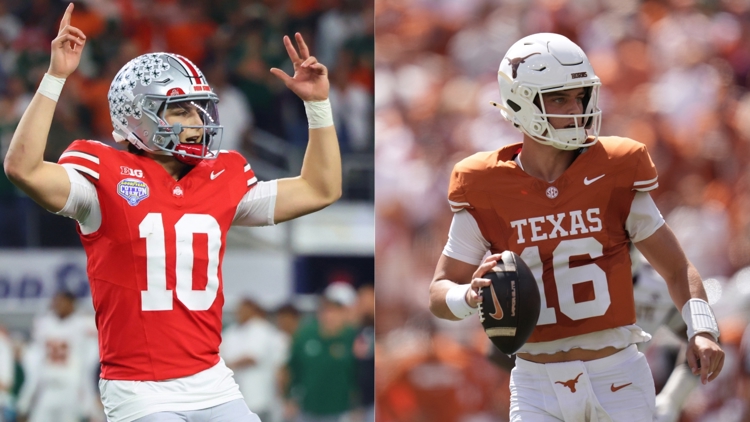
| No. 1 Ohio State at No. 5 Texas | 7:30 ABC | TEX -1.5 | 59.8% | 47.5 |
The two marquee games carry the two lowest totals on the board. Everything else sits between 48.5 and 59.5. The market expects the best games this week to be grind it out games, and the Ohio State–Texas history supports it: three straight meetings, none of them shootouts, including 14-7 in Columbus last season.
Predictions
Oklahoma 24, Michigan 17. Oklahoma covers. Michigan’s problem is the one Western Michigan already exposed: protecting Bryce Underwood behind a line that lost its battle to a MAC front. Oklahoma led the nation with 63 tackles for loss and is missing two projected offensive line starters of its own, which is why this is seven and not fourteen. Under.
Texas A&M 38, Arizona State 17. Cover. The Aggies held Missouri State to 67 yards and four first downs, the fewest by an A&M opponent since 1978, and Marcel Reed completed nine of his final ten passes. Arizona State sits 40th in FTN’s model. Over.
Oregon 38, Oklahoma State 13. Cover. The harshest available view of our own miss. Oklahoma State scored 10 at Tulsa behind an offensive line that gave up ten hurries, sits 63rd in FTN, and now hosts a team that outgained Boise State by 223 yards. The market implies 18.5 Cowboy points. We do not believe them. Under.
BYU 31, Arizona 20. Cover. Our preview called this one of three toss-ups deciding BYU’s season, and we have the Cougars a bit higher than FTN does. Taking BYU here is putting money where the preview already was. If we are wrong, the fourteenth ranking is the thing that was wrong. Over.
Minnesota 27, Mississippi State 24. The upset, and our least confident pick. We faded Minnesota on a plus-24 turnover margin, so picking them is uncomfortable. But a road SEC favorite that FTN ranks 51st, against a home team at 55th, at minus 1.5, is a price built on conference letters rather than teams. This is a hunch, not a finding. Under.
Alabama 34, Kentucky 20. Cover, and it is the pick that hurts. We have Alabama fifteenth, Steele has them seventh, FTN has them eighth, and Week 1 looked we had it wrong. Kentucky sits 44th in FTN. Taking Alabama to cover 10.5 on the road is honest about where the evidence points. Over.
Tennessee 31, Georgia Tech 24. Tennessee wins, Georgia Tech covers. Over.
Texas 23, Ohio State 20. Texas covers, it’s close as you would expect. The Buckeye defense that lost three of the top eleven picks in the draft. There is always more talent in Columbus, but still a lot to ask of the young Buckeyes in Week 2. One note that could point to Ohio State. Ohio State rushed for 237 and held Ball State to 45, while Texas was outgained on the ground 161-156 by Texas State, and Sarkisian conceded the line had growing pains and the run game has to be better. If we lose this one, that is the reason. Under.

Owner
Chris Stoner founded Baltimore Sports and Life in 2009. He has appeared as a radio guest with 1090 WBAL, 105.7 The Fan, CBS 1300, Q1370, WOYK 1350, WKAV 1400, and WNST 1570. He has also been interviewed by The Baltimore Sun, Baltimore Business Journal, and PressBox (TV). As Owner, his responsibilities include serving as the Managing Editor, Publicist, & Sales Director.