
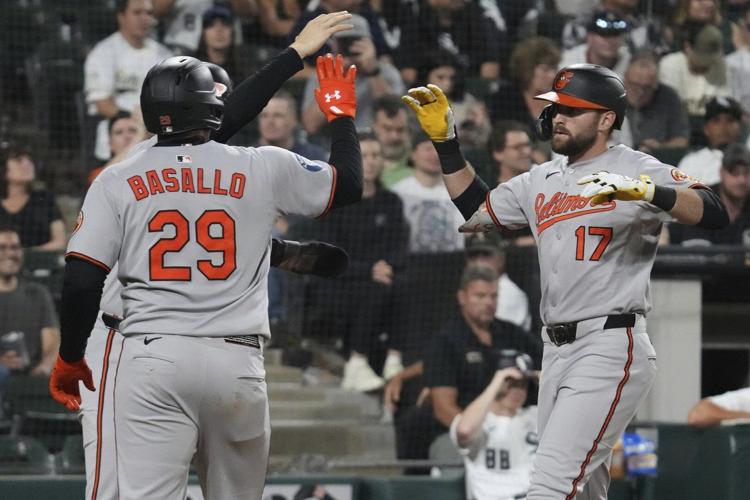
What’s the Best Case, Worst Case, and Likely 2027 (and Career) outcomes for Jackson Holliday, Coby Mayo, Samuel Basallo, Dylan Beavers, Colton Cowser, and Jordan Westburg?
Jackson Holliday — 2B, bats L, turns 23 in December
Where he is: 92 games, 328 plate appearances, .232/.309/.349, seven homers, eight steals. An 87 wRC+ and an 89 OPS+. 0.6 fWAR, 0.4 bWAR.
The case file: First overall pick in 2022. Baseball America Minor League Player of the Year. Struck out 33.2% of the time as a 20-year-old in 2024, then cut it to 21.6% in 2025, the second-largest year-over-year improvement in baseball. Played 149 games in ’25 and hit .242/.314/.375 with 17 homers and 17 steals.
He fixed the strikeouts. He didn’t fix the impact, and this year the impact got worse. His average exit velocity is 87.0 mph against a league mark of 88.8. His hard-hit rate is 34.3% against a league mark of 38.6%. His barrel rate is 6.9%. He is hitting the ball on the ground 44% of the time with a .118 ISO. The hamate injury is part of that and hamates historically cost a hitter power for the better part of a year, but there was no power surplus to lose.
The encouraging piece: a 26.2% chase rate, a 10.4% walk rate, and 28.8 ft/s sprint speed, 87th percentile. The approach and the athleticism are both real. And his .301 xwOBA against a .292 wOBA says he’s earned roughly what he’s gotten. There’s no hidden season here.
Career: .232, 29 homers, three seasons. Under control through 2030.
2027 Best Case — Fully past the hamate, age-23 season, and the exit velocity climbs into league-average territory, which is all he needs given the approach and the speed. .265/.345/.430, 18-20 homers, 15-20 steals, plus defense at second. 3.5-4.0 WAR and a first All-Star nod.
2027 Worst Case — A third straight season around .230/.310/.350. The contact quality stays 30th percentile, meaning there’s no production waiting to be unlocked. He loses time to Blaze Alexander and finishes under 1.0 WAR, and the Orioles spend the following winter taking calls.
2027 Likely — .250/.330/.390, 12-15 homers, 15 steals, roughly a 100 wRC+, 2.0-2.5 WAR as the everyday second baseman. Real improvement, no leap.
Career Best Case — Four or five All-Star-adjacent seasons in his late twenties, peaking around .285/.370/.450 with 20 homers and 25 steals. Something like Ozzie Albies with better strike-zone judgment. 30-35 career WAR.
Career Worst Case — He never slugs .400. A defensively adequate second baseman with a .330 OBP and no thump becomes a utility man at 29. 8-12 career WAR, three or four organizations, and a permanent spot on lists of draft busts he doesn’t entirely deserve.
Career Likely — A good, long career that isn’t a star’s career. Ten-plus years as a regular, 2-3 WAR annually, around .255/.335/.395, maybe one All-Star selection, 20-25 career WAR.
Coby Mayo — 3B/1B/DH, bats R, 24
Where he is: 116 games, 385 plate appearances, .224/.288/.460, 21 homers, a 109 wRC+ and a 105 OPS+. 1.5 fWAR, 0.6 bWAR. He homered twice against Cleveland on September 7th.
The case file: A fourth-round pick in 2020 who became an elite power prospect, and the power is now unambiguously playing. 91.5 mph average exit velocity, a 48.5% hard-hit rate, a 13.0% barrel rate, a .236 ISO. He pulls the ball 49.8% of the time and puts 35.5% of it in the air. That is a home-run hitter’s profile, in the majors, right now.
Two things to be honest about. First, there’s no luck story left: his .322 xwOBA sits essentially on top of his .323 wOBA. What you see is what he’s earned. Second, the strikeouts remain the whole question — 31.7% on the season with a 31.0% whiff rate. And the platoon split is severe, with the large majority of his damage coming against left-handers.
Through his first 646 big league plate appearances he hit .207/.282/.390 with an 89 wRC+. Since the All-Star break he’s been one of the two or three best hitters on the team.
One option year left. Cheap through roughly 2031.
2027 Best Case — The second half was the real player. 550 plate appearances, .255/.325/.510, 32-35 homers, a 130 wRC+, strikeouts down near 28%. 3.5 WAR and Silver Slugger votes at DH or first base.
2027 Worst Case — The splits calcify, he’s unplayable against right-handers, the whiff rate climbs back over 33%, and he’s a strong-side platoon bat with 350 plate appearances and under 1.0 WAR. Or he’s the centerpiece going out for pitching and hits 30 somewhere else.
2027 Likely — 450-500 plate appearances leaning on matchups. .240/.305/.475, 26-30 homers, a 110-115 wRC+, 1.5-2.0 WAR. Genuinely productive and genuinely flawed at once.
Career Best Case — Six to eight years as a 35-homer middle-of-the-order bat, two or three All-Star appearances, a 4-WAR peak. 20-25 career WAR, 250-plus homers.
Career Worst Case — The strikeouts against right-handed pitching never come down, and he’s a platoon slugger who bounces between four organizations. 500-600 games, 5-8 WAR, 90 homers.
Career Likely — A ten-year big leaguer with a defined role. 180-220 career homers, a career line near .240/.310/.460, 15-20 WAR. A real power bat, not a franchise cornerstone.
Samuel Basallo — C/1B/DH, bats L, 22
Where he is: 102 games, 367 plate appearances, .230/.300/.420, 17 homers, a 102 wRC+ and a 101 OPS+. 1.8 bWAR but only 1.0 fWAR, one of the widest splits on the roster,
The case file: Still the most valuable long-term asset of these five, and it isn’t close.
Signed out of Santo Domingo in January 2021. Reached Triple-A at 20 and hit .270/.377/.590 with 23 homers in 76 games. Debuted August 17, 2025, and five days later signed an eight-year, $67 million extension running through 2033, with a 2034 club option at $18 million and a $7 million buyout. It maxes at $88.5 million and was the largest pre-arbitration deal ever given to a catcher. He makes $1 million a year through 2028, then $4M, $7M, $11M, $15M, $15M. With the option, he isn’t a free agent until he’s 30.
The contact quality supports him: 90.5 mph exit velocity, a 43.0% hard-hit rate, a 12.7% barrel rate, and a .323 xwOBA against a .313 wOBA. He has been slightly unlucky, not lucky.
Two flags. His 39.4% chase rate is the highest among Orioles regulars by a wide margin and is the thing standing between a .300 OBP and a .350 one. And his sprint speed is 24.8 ft/s, fifth percentile in baseball, which matters for the question of where a 6-foot-4 catcher ends up if he has to move off the position.
All of that, at 22, with a 102 wRC+ and 17 homers. Catchers who do this at 21 and 22 become stars at a high rate.
2027 Best Case — The chase rate drops five points and everything follows. .270/.340/.500, 28-30 homers, a 135 wRC+, receiving grades to average, 110 games caught. 4.5-5.0 WAR and an All-Star selection.
2027 Worst Case — The chase rate holds, the OBP stays under .300, and the defense pushes him to first base and DH. .235/.295/.440 with 22 homers and 1.0 WAR. A fine age-23 season, but if the O’s are committed to him playing only 80 or so games behind the plate, that causes other roster construction discussions.
2027 Likely — .250/.315/.460, 24-27 homers, a 115 wRC+, 3.0-3.5 WAR splitting catcher and DH.
Career Best Case — A perennial All-Star catcher with multiple 5-6 WAR seasons, a 35-homer peak, and down-ballot MVP finishes. 40-50 career WAR and one of the five best contracts in the sport by 2030.
Career Worst Case — The bat plays and the position doesn’t, and the fifth-percentile speed means there’s nowhere to hide him but DH. A designated hitter with a .310 OBP by 25. Still a big leaguer for a long time; the surplus value evaporates. 15-20 career WAR.
Career Likely — A very good catcher for a decade. 3-4 WAR most years, two or three All-Star teams, 250-plus homers, 30-35 WAR, and by 2029 the extension is one of the reasons the Orioles are competitive again.
Dylan Beavers — LF/RF, bats L, 25
Where he is: 89 games, 295 plate appearances, .244/.323/.382, six homers, 18 doubles, a 101 wRC+ and a 100 OPS+. 0.1 fWAR, 0.0 bWAR.
The case file: The 33rd pick in 2022 out of Cal, signed for $2.2 million. Baseball America’s grades: hit 40, power 60, run 60, field 55, arm 60. He hit .304/.420/.515 with 15 homers and 31 steals at Norfolk in 2025.
The approach might be the best of this group. A 24.1% chase rate and a 24.5% whiff rate, both comfortably better than league average, with a 9.8% walk rate. That skill is major-league quality today.
Everything else is a problem. The 60-grade power has produced six homers and a .137 ISO, on an 88.2 mph exit velocity and a 7.0% barrel rate. The 60-grade speed has produced five steals in ten attempts despite 28.9 ft/s sprint speed, 88th percentile. And the defense, which I gave him credit for last time based on the scouting reports, has graded out at -4 in LF, -3 in RF, and -1 in CF per OAA. He does run and throw at high levels. He also graded perfectly adequate defensively in 2025, which would make you think ’26 has largely been a defensive slump for some reason, and not definitively who he is with the glove.
He’s also 25, with a .301 xwOBA against a .313 wOBA, meaning he’s been slightly fortunate, not unlucky. Under team control through 2031.
2027 Best Case — The power arrives at 26, which happens for tall left-handed hitters more often than people think, and the outfield defense regresses toward the scouting grade rather than the 2026 measurement. .265/.355/.450, 20 homers, 15 steals, a 120 wRC+. 3.0 WAR.
2027 Worst Case — .235/.320/.370 with eight homers and negative defensive value. A corner outfielder whose only carrying skill is not swinging at bad pitches doesn’t hold a job when Azocar, Booth, and Irish arrive. Under 0.5 WAR.
2027 Likely — .250/.335/.410, 12-15 homers, a 105 wRC+, roughly neutral defense. 1.0-1.5 WAR as a strong-side platoon corner outfielder.
Career Best Case — Five or six years as a .265/.360/.450 everyday corner outfielder with one 25-homer season. 18-22 career WAR.
Career Worst Case — The classic good-approach, no-impact corner bat, and the glove doesn’t save him. .240/.320/.380 across six to eight years as a fourth outfielder. 3-6 career WAR.
Career Likely — Useful for a long time without ever being important. 9-13 career WAR, 80 ish career homers. Ideally more of a platoon player vs. a regular starter.
Colton Cowser — CF/LF, bats L, 26
Where he is: 128 games, 347 plate appearances, .215/.306/.368, 13 homers, a 93 wRC+ and a 92 OPS+. 1.5 fWAR, 2.1 bWAR, with +4.9 Def.
The case file: The fifth overall pick in 2021 and the hardest of these five to read.
In 2024 he hit .242/.321/.447 with 24 homers, a 119 wRC+, and 3.9 fWAR, and lost the AL Rookie of the Year award to Luis Gil by two first-place votes. Then 2025: thumb, rib, and concussion injuries limited him to 92 games and he hit .196/.269/.385 with a 35.6% strikeout rate, bottom one percent of baseball. This year the strikeout rate is 30.3% with a 32.4% whiff rate. Better. Still bad.
His .319 xwOBA sits 18 points above his .301 actual wOBA, the biggest such gap among Orioles regulars. His hard-hit rate is 40.8% and his barrel rate is 10.4%, both above league average. He has been the unluckiest hitter on this team, and there is a better season sitting underneath these numbers than the batting average suggests.
Add the defense and you have a player whose floor is higher than a .215 hitter’s floor normally is.
Arbitration-eligible this winter. Free agent after 2029.
2027 Best Case — The batted-ball luck normalizes and the contact gains from this August hold. .245/.335/.450, 24 homers, 15 steals, a 118 wRC+, plus center field defense. 4.5-5.0 WAR and he’s in the running for being one of the best all-around players on the roster.
2027 Worst Case — The strikeout rate goes back over 33% and even good defense can’t rescue an 85 wRC+. 1.0 WAR, then a non-tender or a salary-dump trade in his second arbitration year.
2027 Likely — .230/.320/.415, 18-20 homers, a 105 wRC+, carried by the glove to 2.5-3.0 WAR. A good everyday center fielder whose value comes more from defense than offense, and who will frustrate everyone watching him hit.
Career Best Case — 2024 was real and his age 27-30 seasons deliver. Three or four 4-WAR seasons, a Gold Glove, 150-plus career homers, 25-30 career WAR.
Career Worst Case — The swing-and-miss wins. A defensive-replacement fourth outfielder by 29, finishing around 10-12 career WAR with 2024 as the one good season people bring up as a what if?
Career Likely — Five more years as an above-average defensive OF with a streaky, low-average, real-power bat. 2-3 WAR annually, 18-22 career WAR. Consistently more valuable to his employer than he looks to the people in the stands.
Jordan Westburg — 3B/2B, bats R, 27 (28 in February)
Where he is: Nowhere. He has not played a game in 2026 and won’t.
The case file: The 30th pick in 2020 out of Mississippi State, debuted in June 2023, and the only player on this list who has already been an All-Star.
The production, when he’s on the field, has been very encouraging. The inability to stay available has been disheartening.
- 2024: 107 games, .264/.312/.480, 18 homers, 63 RBI, All-Star. A season ended by a fractured hand.
- 2025: 85 games, .265 with 17 homers and 41 RBI. Hamstring, left index finger, right ankle.
- 2026: Zero games.
Career: .264 with 38 homers in 260 games across three seasons. Eighteen homers in 107 games is a 27-homer pace. Seventeen in 85 games is a 32-homer pace. The power has been trending up the whole time, and he’s a legitimately good defender at third base who can also handle second.
Here’s the whole projection in one sentence: he has never played 110 games in a season, and now he’s had Tommy John.
He was diagnosed with a partial UCL tear in his right elbow in February, took a PRP injection to try to avoid the knife, was shut down from throwing in early May when the discomfort came back, and had the surgery on May 13th with Dr. Neal ElAttrache. Elias said afterward that the delay cost nothing on the 2027 timeline and that Westburg being “back as a full player in the early part of 2027 is very much in play.” Westburg said in June that if he gets a normal spring, he thinks he’ll be ready.
Position players come back from UCL surgery much faster than pitchers, and the bat generally comes back intact. This is not the same risk profile as a pitcher’s Tommy John. But the surgery date puts him roughly nine months out at the start of spring training, which is cutting it close, and the arm strength question is real for a third baseman specifically.
Under club control through 2029.
2027 Best Case — Normal spring, opens on time, and finally gets the season he’s been chasing. 140 games, .270/.330/.470, 25 homers, plus defense at third. 4.0-4.5 WAR and a second All-Star nod.
2027 Worst Case — The elbow isn’t right in February, he opens on the IL, the arm strength doesn’t come all the way back, and he’s a 100-game DH-and-second-base guy. Or another unrelated injury, because that’s now four straight years. Under 1.0 WAR and the Orioles have to decide what he is with two years of control left.
2027 Likely — He’s back by April or May and plays 110-120 games at .265/.325/.450 with 20 homers and good defense. 2.5-3.0 WAR. The production when available is good; the availability is the question.
Career Best Case — He finally strings together health at 28-31 and puts up three or four seasons of 4-plus WAR with 25-30 homers and good third base defense. Two more All-Star teams, a big free agent contract after 2029. 25-30 career WAR.
Career Worst Case — The elbow lingers, the arm forces him off third, and he becomes a second baseman and DH who plays 90 games a year. He’s a useful player nobody can count on, changes teams twice, and finishes around 12-15 career WAR with everyone remembering the 2024 first half.
Career Likely — A very good hitter who plays 115 games a year. 2.5-3.5 WAR annually in the seasons he’s mostly available, 20-25 homers, a strong free agent case after 2029 that some team pays for. 20-25 career WAR.

Owner
Chris Stoner founded Baltimore Sports and Life in 2009. He has appeared as a radio guest with 1090 WBAL, 105.7 The Fan, CBS 1300, Q1370, WOYK 1350, WKAV 1400, and WNST 1570. He has also been interviewed by The Baltimore Sun, Baltimore Business Journal, and PressBox (TV). As Owner, his responsibilities include serving as the Managing Editor, Publicist, & Sales Director.