
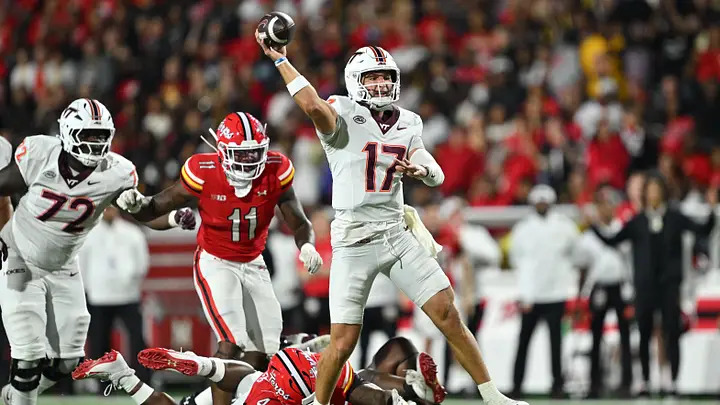
Maryland is 2-1 after Terps lost 35-26 to Virginia Tech at SECU Stadium last night. The loss ended Maryland’s 20-game non-conference winning streak, the longest in FBS. UCLA comes to College Park this coming Saturday sporting a 3-0 record under first-year coach Bob Chesney, after beating Purdue 52-38 yesterday.
We start with what we got wrong.
Where Our Virginia Tech Preview Missed
We called Maryland’s interior rush against the Hokie line “the single best matchup the Terps have on the field.” It was the worst. Maryland had ten sacks in its first two games and one against Virginia Tech. It had four tackles for loss. The Hokies converted eight of nine third downs in the first half, scored touchdowns on five of their first six possessions, and won time of possession by more than thirteen minutes. Daniel Wingate’s own explanation was bad angles and missed tackles.
We also built the preview around Maryland’s offensive line against Virginia Tech’s edge rushers. That matchup did not decide the game. Malik Washington threw for 359 yards. Protection mostly held.
We got two things right. We wrote that Luke Reynolds against Maryland’s second level was the likeliest way Virginia Tech would score efficiently, and that Maryland had not faced a tight end like him. Reynolds caught 12 passes on 12 targets for 107 yards and a touchdown. His fourth-and-1 catch, which stood after review with Maryland out of timeouts, ended the game. We also said the missing piece was the run game against a real defense. It was missing.
The pick was Virginia Tech by three. The margin was nine, and it was never that close.
What Happened
The first half decided it. Virginia Tech led 27-14 at the break with 302 yards and went up 35-14 early in the third quarter. Ethan Grunkemeyer finished 31 of 39 for 314 yards and three touchdowns. He added an 18-yard touchdown run on third-and-goal, two plays after Nahsir Taylor sacked him in the red zone. Maryland made the play and then could not finish the series.
Maryland’s offense was fine when it had the ball. The Terps averaged 6.6 yards per play to Virginia Tech’s 5.9 and scored touchdowns on all four red zone trips. It did not have the ball much. Three Hokie touchdown drives ate 6:45, 5:49 and 6:12 of clock, and Maryland’s first two possessions of the second half ended in a three-and-out and a turnover on downs.
The run game was the other half of it. Without DeJuan Williams, Maryland ran 21 times for 64 yards. Running backs accounted for 48 of those at 2.8 a carry. Three first-quarter runs lost yardage. Mike Locksley said afterward that Maryland did neither of the two things it had emphasized since January: run the ball and stop the run.
Penalties came back. Maryland had five in the first half for 39 yards. The yardage was small and the timing was bad. Amari Jackson was flagged for pass interference on third-and-eight to extend the drive that made it 27-14. Eyan Thomas jumped offsides inside the five on that same drive, and Virginia Tech scored on the next snap.
Then the two-point tries. Maryland went for two after its first fourth-quarter touchdown and again after its second. Both failed. Kick both extra points and the score is 35-28 with the same clock. Locksley said Maryland was playing to win and declined to hide behind analytics. There is some math backing the decisions; I hated the call on first try. Get the deficit to 14, and not put yourself in a position where you would need to convert a 2 point attempt. The second attempt, their chasing the previous miss, and when you fail to convert you need multiple scores without enough clock left. The 21 points Maryland allowed before halftime mattered more, but this was still annoying.
Some of the night was good. Washington completed 30 of 43 passes for 359 yards and three touchdowns with no turnovers. Through three games he is 83 of 115 for 892 yards, six touchdowns and no interceptions. Chris Durr Jr. caught 12 passes for 109 yards and two touchdowns, his second straight game with double-digit catches. Kaleb Webb caught five for 98. Dorian Fleming caught six passes, more than he had in the first two games combined, including his first touchdown of the season from two yards out. Maryland outscored Virginia Tech 12-0 in the fourth quarter, the reverse of last season’s pattern, though the Hokies were protecting a three-score lead.
One more detail. Jeffrey Overton Jr. had a 49-yard receiving touchdown and a rushing score. He is a Northern Virginia product Maryland recruited.
Locksley Watch
In our season preview we wrote that 4-8, 5-7, or 6-6 with a bowl should not be enough for Locksley to keep his job, and that 7-5 would at least make an argument. After the Virginia Tech loss, 6-6 is Maryland’s single most likely finish.
Who UCLA Is
UCLA went 3-9 in 2025. Chesney came from James Madison, which made the College Football Playoff last season, and brought eleven former Dukes with him. UCLA used 37 new players in the opener. Chesney has won 13 straight regular-season games dating back to Harrisonburg. He is the third UCLA coach in fifty years to start 3-0, after Terry Donahue in 1976 and Jim Mora in 2012.
The results are 45-24 at Cal, 28-10 over San Diego State and 52-38 over Purdue. The comparison everyone is reaching for is Curt Cignetti at Indiana. Purdue’s Barry Odom made it first, saying Chesney’s team has a style and identity that shows up in all three phases.
Two notes keep this in proportion. UCLA needed 21-point fourth quarters to put away both Cal and San Diego State, and it was shut out in the first half against the Aztecs. And Purdue has now lost 19 straight Big Ten games.
These teams met last October. UCLA won 20-17. Maryland pressured Nico Iamaleava throughout. He went 21 of 35 for 221 yards with a touchdown, threw two interceptions including one returned for a score, and fumbled away a sack. Almost everything around Iamaleava is different now.
The Matchup Is The Run Game
UCLA ran for 369 yards against Purdue and finished with 645, its most in a conference game since 2019. Chesney’s summary was that Purdue knew the run was coming and could not stop it. Wayne Knight, the James Madison transfer, ran for 177 yards and two touchdowns. He had 168 yards and six touchdowns through the first two games, which puts him at about 345 and eight. Anthony Woods is the complement. He ran for 118 yards and two scores at Cal.
Maryland’s run defense numbers still look good on paper. Opponents have run 98 times for 208 yards, 2.1 a carry. Virginia Tech ran 36 times for 131, a manageable number. The Hokie damage came on third down, after the catch, and on missed tackles. Against UCLA those problems will look like run defense. Through two games, before Purdue, Knight was averaging 8.0 yards a carry and Woods 9.3. If Knight gets four yards on first down, the Bruins are always in third-and-short, and Maryland could not get off the field on third-and-long against Virginia Tech.
The other side is just as plain. Maryland’s run game went from 9.1 yards a carry against Hampton to 3.5 at UConn to 3.0 against Virginia Tech. DeJuan Williams misses UCLA, Nebraska and Ohio State, likely Rutgers too, with a realistic return against Illinois on Oct. 31st. Iverson Howard and Harry Dalton have to carry it. Howard has 37 carries for 143 yards and Dalton 30 for 113, both under four a carry, and that includes Hampton. If they can’t do more, this becomes Washington throwing 40 times against a team that wants to shorten the game.
UCLA linebacker Sammy Omosigho has forced four fumbles in three games, two against Purdue. Knight turned both into touchdowns. Maryland has not lost a fumble this season.
Where Maryland Can Attack
Through Cal and San Diego State, UCLA’s defense allowed opponents to complete 32 of 65 passes for 336 yards combined, and held them to 3.4 yards a carry. Then Purdue put up 488 yards and 38 points. Ryan Browne threw for 378 yards and three touchdowns. Xavier Townsend had 162 receiving yards, 152 of them after the catch, including a 75-yard touchdown on the first play of the game.
Browne is the best quarterback UCLA has faced, and Washington is at least his equal on paper: 83 of 115 for 892 yards, six touchdowns, no interceptions. Maryland has three receivers who can win. Durr has 28 catches for 256 yards and three scores. Na’eem Abdul-Rahim Gladding has 17 for 239 and two. Webb has 11 for 167. If the run game gives Maryland anything at all, play-action is the most direct path to points.
Iamaleava is worth watching this week. He left the Purdue game twice, once after cutting a finger on his throwing hand and once after a third-quarter hit, and returned both times. He went 19 of 31 for 276 yards and three touchdowns, his first touchdown passes of the season, two of them to Semaj Morgan.
Keys To The Game
- Win first down. UCLA ran for 369 yards against Purdue. Through the first two games, Knight averaged 8.0 yards a carry and Woods 9.3. Maryland allows 2.1 a carry on paper, but missed tackles on third down cost it against Virginia Tech. Wingate, Carlton Smith and the front have to stop Knight and Woods on first down and force third-and-long. If UCLA stays in third-and-short, it controls the clock the way Virginia Tech did.
- Make UCLA tackle in space. Ryan Browne threw for 378 yards against this defense, and Xavier Townsend gained 152 of his 162 receiving yards after the catch. Durr, Gladding and Webb have to do the same. Cal and San Diego State found almost nothing against this secondary, so Maryland’s receivers decide which version shows up. Early points are also the fastest way to pull UCLA off its running script.
- Omosigho against Maryland’s clean record. He has forced four fumbles in three games. Two came against Purdue, and Knight scored after both. Maryland has not lost a fumble this season. A strip that hands Iamaleava a short field swings the game to UCLA.
- The fourth quarter. UCLA put away both Cal and San Diego State with 21-point fourth quarters. Maryland won the fourth 12-0 against Virginia Tech. Whichever team holds its identity over the last 15 minutes wins a game the market sees as close.
- Also watch the tight ends. Fleming caught six passes against Virginia Tech and his first touchdown of the season. The room now has 14 of Maryland’s 90 receptions, about 15.6 percent. Last season the tight ends drew roughly 18 percent of targets.
The Rosters
These teams were built in opposite ways. UCLA rebuilt nearly the whole roster in one winter. Maryland kept its own.
Chesney signed 40 transfers during the January portal window. On3 ranked the class No. 11 nationally and No. 2 in the Big Ten. ESPN’s Bill Connelly called it the seventh-best portal haul of the offseason. Many of the additions followed Chesney from James Madison, including Wayne Knight and defensive lineman Sahir West. Omosigho arrived as a four-star transfer. UCLA also signed 18 high school freshmen.
The portal class went heaviest at the lines: nine defensive linemen and eight offensive linemen. An offensive line assembled in January just ran for 369 yards against Purdue.
UCLA ranks No. 25 in the 247Sports Team Talent Composite. Maryland ranked 46th when we checked before the Virginia Tech game. That metric counts only how players graded as high school recruits and ignores what they did after, so it undersells rosters built on transfers who outplayed their ratings.
UCLA has more talent across the two-deep. Maryland has more players who have played together. Through three games, UCLA’s roster has looked more comfortable in its own system than Maryland’s has against a real opponent.
What’s At Stake
ESPN’s Match-Up Predictor gives Maryland a 57.4 percent chance against UCLA. DraftKings has UCLA favored by 2.5 on the road, with a total of 56.5. The model and the market disagree on who the favorite is. A 2.5-point spread works out to roughly a 43 percent chance for Maryland. We side with ESPN. UCLA’s 645 yards came against a Purdue team that has lost 19 straight Big Ten games, and the Bruins are crossing the country to play.
The table below uses ESPN’s game-by-game numbers. At the market’s price instead of ESPN’s, Maryland’s bowl odds fall from 60.0 percent to about 55.
| Maryland finishes | Now (2-1) | Beat UCLA | Lose to UCLA |
|---|---|---|---|
| 6-6 or better (bowl) | 60.0% | 74.2% | 41.0% |
| 7-5 or better | 29.2% | 41.0% | 13.3% |
| 8-4 or better | 8.6% | 13.3% | 2.3% |
Maryland projects to 5.82 wins. The most likely finish is 6-6 at 30.8 percent. Preseason, the projection was 5.30 wins and a 44.0 percent chance at a bowl. Before the Virginia Tech game it was 6.33 wins and 73.5 percent.
ESPN’s Football Power Index, updated today, ranks UCLA 40th nationally, 7.4 points better than an average team on a neutral field. Maryland is 48th at 5.5. That gap is under two points, which is why home field makes Maryland the model’s favorite. FPI’s own season simulations project Maryland at 5.8-6.2 with a 58.1 percent chance of six wins, close to our numbers. They project UCLA at 7.6-4.4 with a 90.5 percent chance.
The index also shows how the rest of the schedule splits. Ohio State is No. 1, Penn State 11th, USC 18th and Nebraska 21st. Illinois (44th), Wisconsin (53rd), Purdue (75th) and Rutgers (90th) all rank below Maryland.
Most of the schedule moved against Maryland after last night’s loss. Rutgers fell from 84.6 to 81.6, Wisconsin from 66.4 to 59.9, and Illinois from 63.9 to 59.6. Purdue rose from 60.9 to 64.1 after its 0-3 start. Maryland is still favored in five of its nine remaining games. The most winnable are Rutgers at home, Purdue on the road, and Wisconsin at home.
A win over UCLA does not change the most likely finish. At 3-1, 6-6 is still the likeliest result, at 33.2 percent. A loss does change it. At 2-2, the most likely finish becomes 5-7, also at 33.2 percent.
The order of the schedule makes this game matter more. After UCLA, Maryland goes to Nebraska (19.2 percent) and Ohio State (4.4 percent). Lose to UCLA and there is a 77 percent chance Maryland is 2-4 when Rutgers comes to College Park on Oct. 17th. From 2-4, the Terps would need four of their last six, and ESPN’s numbers give that about a one-in-three chance.
Beat UCLA and Maryland is 3-1 with a 74 percent bowl probability. Lose and the season becomes about whether the Terps can win nearly every game they are supposed to win.
Prediction
Last night, I found myself wishing Zahir Mathis was healthy, and giving MD another pass rusher.
I also found myself missing Dontay Joyner in the Secondary.
Also lamented not having DeJuan Williams available at RB.
But you play with who you have available. That’s part of the game.
Maryland couldn’t run effectively last night, nor could they make the plays to get off the field defensively.
If that story continues vs. UCLA, Maryland will lose another swing game.
UCLA’s run game against looks like the biggest threat.
I expect UCLA to look like a team crossing the country, and hoping MD will respond to their loss last night.
Washington and his receivers should find some of the same room Purdue did, especially off play-action. Maryland pressured Iamaleava into three turnovers last October, and his health is a question this week. If the Terps win first down on defense and hold onto the ball, they win.
We picked Virginia Tech by a field goal last week and were short by six. The market has UCLA by 2.5.
Last night was a swing game for MD’s season, and they loss.
Saturday vs. UCLA is another opportunity, and we will see if they can take advantage.
Picking MD here feels homer ish, and more hopeful vs. logical. Admitting that, I’ll go with Washington to find a way.
Maryland 31, UCLA 27.

Owner
Chris Stoner founded Baltimore Sports and Life in 2009. He has appeared as a radio guest with 1090 WBAL, 105.7 The Fan, CBS 1300, Q1370, WOYK 1350, WKAV 1400, and WNST 1570. He has also been interviewed by The Baltimore Sun, Baltimore Business Journal, and PressBox (TV). As Owner, his responsibilities include serving as the Managing Editor, Publicist, & Sales Director.