
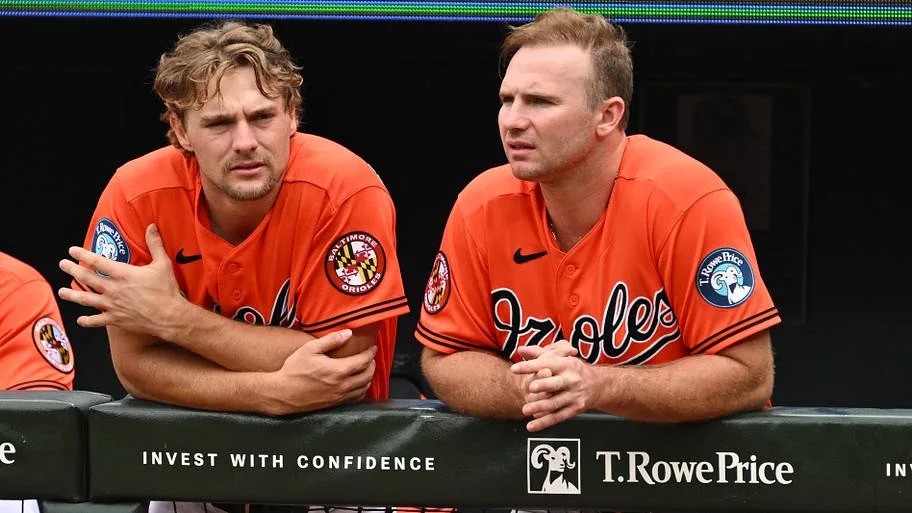
The MLB Playoffs are beginning this afternoon, and the Orioles will be home watching like the rest of us.
Some early thoughts on the off-season for the O’s.
The Diagnosis
The Orioles were average, literally average: 4.46 runs scored per game against a league mark of 4.48, a 101 OPS+, a 100 ERA+.
They finished five wins behind the 84-win White Sox for the last American League playoff spot.
Here’s where those five wins went.
They gave away outs. Baltimore converted .688 of balls in play into outs against a .699 league average. The Rays were at .724, the Dodgers .720, the Brewers .712. Spread an .011 gap across a full season’s worth of balls in play and you’re looking at something like 45 to 50 extra hits allowed. At roughly three-quarters of a run per hit-instead-of-out, that’s on the order of 30-plus runs, or about three wins.
Some of that is gloves. A lot of it is a staff that allowed too much hard contact, because defensive efficiency credits a defense for a lazy fly ball exactly the same as it does a diving stop. That distinction matters for where the money goes, and I’ll come back to it in Phase Four.
They had no one who could win a game by himself. Every team with a first-round bye has a Game 1 starter you’d pick against anybody: Misiorowski at 1.80, Messick at 2.56, Rasmussen at 2.67, Yamamoto at 2.53 with Skubal behind him. Even the Wild Card teams have Schlittler and Sale.
Baltimore had Brandon Young at 3.56, Rogers at 4.03, Baz at 4.11, Bradish at 4.12. That’s a functional rotation. It is not an edge. In a five-game series the better team wins about two-thirds of the time, and a true No. 1 is the closest thing to cheating those odds, because he pitches twice.
Bradish is undergoing surgery to repair a sports hernia, but should be fine for Spring Training. After pitching just 71.1 combined innings over 2024 and 2025, it shouldn’t be surprising to anyone that he looked tired down the stretch here in 2026. The important thing is that he logged 29 starts and 155 innings, and it’s completely reasonable to believe he takes a step back toward being the ace he was pre-injuries in 2027.
And the money wasn’t the problem. Baltimore opened at $170 million, 16th in baseball, ahead of Milwaukee ($125M), Tampa Bay ($90M), the White Sox ($84M) and Cleveland ($70M). Three of those four earned byes.
Meanwhile the bar didn’t move. The AL East went .558 against everyone outside the division, the best mark of any division, and sent three teams to October. Its two Wild Cards won 93 and 87. The AL West went .424 against the other divisions and its champion finished 81-81.
Average is not the goal.
The priority for O’s General Manager Mike Elias should be building a team that looks like it should win 90-95 games come Spring Training.
What The Core Actually Projects To
Our estimate on what’s likely for this group in 2027:
| Player | 2027 Likely | WAR |
|---|---|---|
| Samuel Basallo | .250/.315/.460, 24-27 HR, split C/DH | 3.0-3.5 |
| Colton Cowser | .230/.320/.415, 18-20 HR, plus CF defense | 2.5-3.0 |
| Jordan Westburg | 110-120 games, .265/.325/.450, 20 HR | 2.5-3.0 |
| Jackson Holliday | .250/.330/.390, 12-15 HR, 15 SB | 2.0-2.5 |
| Coby Mayo | 450-500 PA, 26-30 HR, matchup-driven | 1.5-2.0 |
| Dylan Beavers | .250/.335/.410, platoon corner | 1.0-1.5 |
Call it 13 to 15 wins from those six. Add Alonso at something near four, Henderson at three or three and a half in a bounce-back, Blaze Alexander at a win and a half, and the position-player group projects somewhere in the low twenties.
That is a playoff-caliber offense. Not a great one. A sufficient one.
Basallo’s best case is a 5-WAR All-Star catcher and Cowser’s is a 4.5-WAR center fielder, but more likely is a group of two-to-three win regulars.
Every Available Dollar Goes To Run Prevention, Not The Offense
The bats are already here, they’re cheap, and they’re controlled. What isn’t here is the pitching and the defense that turned Cleveland’s $70 million and Tampa Bay’s $90 million into byes.
There’s a warning in Baltimore’s own history on this. Through the 2023 preseason the Orioles had the No. 1 farm system four years running, with eight Top 100 prospects. Six were position players: Henderson, Holliday, Cowser, Westburg, Kjerstad, Ortiz. Two were pitchers: Grayson Rodriguez and DL Hall. Both pitchers have since been traded, and Hall just posted a 1.91 ERA in Milwaukee’s bullpen in October.
The system is back to No. 7 with four Top 100 prospects, and this time three of them are arms: Anthony Eyanson, Joseph Dzierwa and Caden Hunter.
Do not trade those three.
The playoff field makes the case better than I can. The four teams with byes had the four best average farm rankings in the entire field, and three of them did it on bottom-four payrolls: Cleveland at $70 million, Tampa Bay at $90 million, Milwaukee at $125 million. The Dodgers are the only club doing both at once, and they’re back at No. 1 in the system rankings even after trading two Top 100 prospects for Skubal.
The teams that spent big and let the system thin out are the ones who had to survive a best-of-three. Houston has ranked 29th on five straight lists and spent $246 million to go 81-81. San Diego is 30th. The Cubs have traded away 15 players who now appear on other clubs’ Top 30 lists and fell from eighth to 28th in eighteen months. The Yankees went 13th to 27th.
Two things are true about that at once, and the second one matters for Baltimore. Those trades are also what built the bullpens and lineups those teams brought to October. They got in. What they don’t have is cushion. So “trade prospects” isn’t wrong – it’s a bill that comes due later, and a team that has finished fourth two years running while sitting on a top-ten system is exactly the team that should be willing to pay it.
Pay it from the surplus. Position players, depth arms, blocked bats. Not the three pitchers.
One more line from the ledger, since it settles an argument I was having with myself in August: Boston fell ten spots, from 14th to 24th, after sending three of its six best prospects to Baltimore for Adley Rutschman. That same deal moved the Orioles from 13th to seventh. Whatever else is true about that trade, Elias got paid.
The Blueprint
Phase One: Housekeeping, before December 1st
The CBA expires at 11:59 p.m. on December 1st and a lockout is widely expected. Everything in this section is free and has to happen regardless, so do it early.
- Decline Luis Robert Jr.’s $20 million option and take the $2 million buyout — then try to bring him back cheaper. See Phase Four.
- Decline Ryan Mountcastle’s $7.5 million option.
- Decline the Eflin mutual option, $2 million buyout, and leave the door open on an incentive deal.
- Non-tender Leody Taveras in his third arbitration year.
- Tender Henderson, Bautista, Westburg and Cowser.
- Assume Helsley opts in at $14 million. He will.
That leaves roughly $126 million committed once the roster is filled out.
Phase Two: Buy the top of the rotation
This is the whole offseason. Everything else is a supporting move.
The swing: Tarik Skubal is not qualifying-offer eligible, because he was traded in-season. No draft pick, just money. If there is one winter to find out whether this front office will actually convert payroll flexibility into a player, it’s the one where the best pitcher alive comes without a compensation tax.
Be clear-eyed about the odds. The Dodgers sent two Top 100 prospects to Detroit for him, he put up a 2.36 FIP in ten starts for them, and they are back to the No. 1 farm system in baseball anyway. A two-time defending champion that just paid that price and still has the game’s deepest rotation is not letting him walk quietly. Baltimore would be bidding against the sport’s biggest checkbook* for a player that checkbook already traded prospects to acquire.
*(Maybe that is no longer the case?)
Bid anyway. Make him turn you down.
More realistically: Casey Mize, whom CBS has already identified Baltimore as a landing spot for. The projected contract is in Phase Six.
And either way, re-sign Trevor Rogers. He’s 28, he’s had success here, he’s said he wants to stay, and the Orioles are not obtaining two pitchers better than him. A rotation of Mize, Rogers, Bradish, Baz and Young is a real one. Add Skubal instead of Mize and it’s outstanding.
Phase Three: Don’t spend another dollar on the bullpen
This is the phase where I’ve already changed my mind.
If Orioles owner David Rubenstein gives Elias an unlimited checkbook, sure, go get an Adrian Morejon or a David Bednar.
Assuming there are limits to what Rubenstein will spend, I think you’ve got to look to allocate these would-be dollars elsewhere.
The money is already spent. Ryan Helsley will opt in at $14 million. Félix Bautista is in his final arbitration year at something like $4 million. That is roughly $18 million allocated to two high-leverage arms before anyone signs anything.
Neither is a comfortable bet. Helsley’s season was wrecked twice – the injured list in May, a brief return in June, a reaggravation, and then a shutdown on September 19th when the throwing program stalled. Bautista got back to the majors in September, which is genuinely encouraging after two shoulder surgeries, but it’s a September cameo, not a body of work.
The one real piece of good news is that Helsley’s MRI showed an intact UCL. No Tommy John. He spends the winter rehabbing with a target of being cleared by February.
Nobody should love relying on that. Here’s the argument for doing it anyway, and it’s stronger than “the money’s committed.”
Relief pitching is the one need with a reliable in-season solution.
High-leverage bullpen arms are the single most available commodity at every trade deadline, every year, in quantity. Half the sport sells them.
So the December problems and the July problems are different problems. Solve the ones that only December can solve.
Add to that what’s already in the building: Yennier Cano is signed for two more years at $7.5 million total and posted a 3.22 ERA with a 2.71 FIP. Grant Wolfram ran a 2.85 FIP behind an ugly ERA. Cam Sanders had a 2.28 FIP. Alex Hoppe hasn’t given up an earned run. Rico Garcia made 68 appearances.
That’s not a finished bullpen. It’s enough to open the season with, and it’s enough to see whether Bautista and Helsley are real before committing another $12 million to the most volatile asset class in the sport.
Milwaukee had ten different pitchers record a save this year. Depth, not names.
Everyone is going to want Morejon and Bednar, and both will have spent October pitching in high leverage for contenders – Morejon in what may be the deepest bullpen in the field in San Diego, Bednar closing for the Yankees. Both clubs will bid to keep them. Baltimore would be paying a premium, plus a draft pick in Morejon’s case, for the privilege of stacking a third expensive arm behind two it’s already committed to.
The money you potentially save here might be the difference between settling at the top of the rotation and not. Those are the same dollars. More on that in Phase Six.
Phase Four: The outfield, and the Mayo question
The current expectation inside the organization is that they’ll try to find regular at-bats for Coby Mayo in right field. He has the arm, he moves adequately, and 21 homers have to go somewhere.
Installing a converted third baseman in a corner runs against everything else in this plan. But do the at-bat accounting and the objection mostly collapses.
Where else does Mayo play?
- First base. Alonso is there for 150 games. That’s maybe a dozen starts.
- Third base. Westburg, if healthy. His likely case is 110-120 games, which leaves 45 or so — and Encarnacion-Strand and Blaze Alexander both want those, and both are better defenders there than Mayo is.
- Designated hitter. This is where it really breaks down. Basallo needs 60 to 70 DH days if he’s catching 80-90. O’Neill needs DH days. Encarnacion-Strand needs DH days.
Add it up and Mayo gets somewhere around 65 to 80 starts without an outfield glove. Call it 300 plate appearances for a 24 year old with a 91.5 mph exit velocity, a 48.5% hard-hit rate, four years of control, and real second-half progression.
That’s not a roster decision. That’s waste.
His position is “bat.” Right field is the only door wide enough to get him 450-500 plate appearances, and getting him those plate appearances is worth something real.
So I’ll concede the move and hold onto the consequence: he is likely below average out there, which means the outfield defense probably does not improve in 2027 and may get worse. That has to be paid for somewhere, and I’ll come back to where.
The mitigation you’d want is exactly the obvious one – pull him for a defender in close-and-late situations. It isn’t a full fix. You’re recovering maybe a quarter of his defensive innings. But those innings are the highest-leverage ones on the schedule, so the value is worth more than the raw count suggests, and it costs nothing but a roster spot.
Beavers gets left field, and the Orioles hope the glove comes back. That’s the likely plan. Is it defensible? Here’s what the Statcast record actually says:
| OAA | Attempts | Catch % | Expected | Diff | |
|---|---|---|---|---|---|
| 2025, all OF | 0 | 69 | 86% | 86% | 0% |
| 2026, LF | -5 | 108 | 82% | 87% | -5% |
| 2026, RF | -3 | 64 | 81% | 86% | -5% |
| 2026, all OF | -9 | 182 | 82% | 87% | -5% |
| Career | -9 | 251 | 83% | 87% | -4% |
Two things jump out, and they point in opposite directions.
The discouraging one: 2025 was the smaller sample. Sixty-nine attempts is about a third of a season’s workload, and OAA is noisy at that size. The -9 this year came in 182 attempts. And the gap is identical in both corners, -5% in left and -5% in right, which undercuts the “he was out of position” explanation.
The encouraging one: He ran 28.9 ft/s this year, 88th percentile, with a plus arm. OAA for a corner outfielder is mostly jumps and routes, not raw speed. A player whose athleticism is intact while his outs aren’t is failing at the coachable part. That’s a very different problem from a slow outfielder who simply can’t get there.
So: Beavers in left, with a real contingency rather than as an article of faith.
The bigger issue is what this outfield looks like against left-handed pitching. Cowser bats left-handed and has struggled against lefties. Beavers bats left-handed. Basallo bats left-handed. Mayo demolished lefties beautifully. Encarnacion-Strand crushed LHP, and I expect him back in part for that. O’Neill was hitting LHP this year before his most recent injury.
So you want a platoon right-handed outfielder who hits left-handed pitching and can cover center or left. Someone who can give both Cowser and Beavers a day against tough lefties without the defense collapsing, or replace Mayo in right field in close-and-late situations.
A right-handed hitter who can genuinely play center field, handles lefties, and doesn’t need to face righties.
Which describes Luis Robert Jr., who was on this roster for four days in September.
You can’t have him back at $20 million. At $5-8 million there’s real value. His career line against left-handed pitching is .285/.360/.498, he won a Gold Glove in center field in 2020, and he ran 28.9 ft/s this season. That’s the right-handed bat against lefties and the late-inning glove for Mayo in one roster spot.
The risk is availability – he’s averaged roughly 113 games a year over four seasons, and a herniated disc and a hamstring are exactly the injuries that eat a center fielder’s range. Sign him at the bottom of that band with playing-time incentives, and keep a glove-first depth outfielder at Norfolk who can actually cover center.
Going back to Mayo and team defense overall. If the 2027 outfield is Beavers coming off -9 OAA in left, Mayo converting from third base in right, and one proven glove in center, the defensive gains are not coming from out there.
Which means they have to come from somewhere else, and there are only two places left: the infield and the rotation.
The infield can get better on its own. Westburg at third for a full season is an upgrade over the Mayo/Encarnacion-Strand/Alexander rotation.
The rotation is the one you pay for. It can be reasonably argued that a team that concedes outfield defense by design needs its pitching to be better than “Mize and Rogers.” Every ball that isn’t put in play is a ball Mayo doesn’t have to catch. Which is the strongest case for going after Skubal.
Phase Five: A catcher who actually plays
A conventional backup doesn’t solve this.
The Orioles are not likely to give Basallo 110-plus starts behind the plate, and shouldn’t — he’s 23, he’s 6-foot-4, and his bat is too valuable to grind down. But if he’s catching 80 to 90 games, the other 70-plus can’t go to an automatic out. Carlos Narváez hit .083 over 69 plate appearances and finished under a .500 OPS in 237 at-bats. To be fair, he did have 42 extra-base hits in 2025.
What’s needed is closer to a 1A/1B than a platoon: a catcher who can start 70 games, catch well, and hit enough to bat seventh without the lineup collapsing.
Ryan Jeffers is that player. Tenth-best free agent in this class per CBS Sports, 29 years old, an .856 OPS this year, and productive against both left-handed and right-handed pitching. Quality catchers essentially never reach the open market. What he’ll cost is in Phase Six.
Phase Six: Make the money fit
At $190 million against roughly $126 million committed, there’s about $64 million to spend. Five line items, because Phase Three removed the sixth.
The realistic version, with actual contract projections rather than round numbers:
| Player | Projected deal | 2027 AAV |
|---|---|---|
| Casey Mize | 3 yrs / $54M, opt-out after 2027 | $18M |
| Trevor Rogers | 4 yrs / $84M | $21M |
| Ryan Jeffers | 4 yrs / $76M | $19M |
| Luis Robert Jr. | 1 yr / $6M plus incentives | $6M |
| Depth outfielder, glove-first | 1 yr / $2M | $2M |
$66 million — the Robert buyout is a separate $2 million already inside the committed figure — which lands the payroll at roughly $192 million.
That’s a rotation of Mize, Rogers, Bradish, Baz and Young, a catching tandem that doesn’t donate a lineup spot, and a fourth outfielder who gives you a right-handed answer against lefties. It’s a good winter. It probably wins 87.
The version that’s actually worth having
- Tarik Skubal — roughly $35M
- Trevor Rogers — $21M
- Ryan Jeffers — $19M
- Robert Jr. and a depth outfielder — $8M
$83 million, which puts payroll near $209 million.
And the trade lever is still there, unspent. You’d have the internal depth to address in-season needs that arise. Not looking to trade Eyanson, Dzierwa or Hunter. But others could certainly be available.
Where those numbers come from:
Mize, 3 years / $54 million with an opt-out. He’s a former No. 1 overall pick who turns 30 in May and opened 2026 looking like an ace — a 2.51 ERA through five starts, a 2.27 ERA with a 2.64 xERA early, a 26.5% strikeout rate. Then San Diego traded for him and he posted a 6.64 ERA over 40⅔ innings, gave up 14 runs in 17⅔ innings in September, and finished on the injured list with a sprained ankle. Full season: a 3.96 ERA over 127⅓ innings. He also has Tommy John in his past, missed all of 2023, and had a groin stint this year. The going comps are Luis Severino at 3 years and $67 million and Sean Manaea at 3 and $75 million, and Mize’s second half says he doesn’t reach either. The opt-out is the bridge: it’s how a pitcher who believes in his first half signs with a team that watched his second.
Rogers, 4 years / $84 million. He finished with a 4.03 ERA over 169⅔ innings and 30 starts with a 3.64 FIP and about 3.3 fWAR. Over 43 starts as an Oriole he’s at a 3.35 ERA and a 3.31 FIP. There were more hits allowed and a much higher home run rate in ’26, but he’s a left-hander entering his age 29 season with 170 innings in the thinnest starting pitching market in years. Yusei Kikuchi got 3 and $63 million at 34. Rogers is five years younger. If two clubs engage, this goes to five years and past $100 million.
Jeffers, 4 years / $76 million. He posted a 128 wRC+ in 2026, which is remarkable for a catcher, and he’s the best one available in a class Minnesota’s own beat writers describe as underwhelming. Bidding is expected to be aggressive, with the Yankees an obvious suitor after Austin Wells’s season. J.T. Realmuto’s 3 years and $45 million last winter is the floor comp, and Realmuto was five years older. The caution: a mid-May hamate fracture cost Jeffers two months and held him to 92 games, which is a durability question at the one position where it matters most.
And the draft pick math, which I’d left out entirely.
Rogers is qualifying-offer eligible – MLBTR projects the QO at $23.1 million. Jeffers is expected to get one from Minnesota too, and Morejon is eligible as well.
Extend Rogers the qualifying offer no matter what. He’s said he’s excited to test the market and is unlikely to accept, but if he does, the Orioles get a 3-WAR starter for one year at $23 million with no long-term risk. If (when) he declines and signs elsewhere, Baltimore collects a pick just after the first round. That’s the same mechanism that produced Wehiwa Aloy when Anthony Santander left.
So: signing Jeffers costs a pick, Rogers departing returns one. Roughly a wash. The version where Baltimore keeps Rogers and signs Jeffers is the one that costs a pick outright, and it’s still the right move.
One scheduling note that matters more than usual. The Orioles get five days of exclusive negotiating rights after the World Series, and the lockout arrives December 1st. If they want Rogers, you would like to make it happen in that window. Maybe not realistic, with Rogers surely wanting to test the market at this point.
What You Don’t Do
Don’t trade Gunnar Henderson. Two years of control, coming off the worst season of his career, is selling at the bottom. Run it back. If he rebounds and the team doesn’t, you move him next summer exactly the way you moved Rutschman.
Don’t trade Holliday or Mayo for prospects. Holliday’s value has never been lower and he’s 23 in December with control through 2030. Mayo hit 21 homers with a 91.5 mph exit velocity and has four arbitration years left. Neither of those is a sell-high. Some people are willing to just give Holliday away at this point and install Alexander – or Westburg, if his arm can’t handle third – at second. I don’t like Holliday’s baseball instincts, but I just can’t see giving him away when his value is at a low. I’d rather run it back and hope the light bulb goes fully on. Would expect more power next spring, a full year removed from his surgery.
Don’t buy offense. Not a bat, not a DH, not a corner outfielder signed for his OPS. The lineup projects to be sufficient. Runs allowed is the problem.
Don’t sign a closer. You’re already paying two of them. Use the money you’d hypothetically spend there on a starter.
The 2027 Roster This Produces
Rotation: Mize (or Skubal), Rogers, Bradish, Baz, Young
Bullpen: Cano, Rico Garcia, Wolfram, Sanders, Hoppe, Walker, plus Bautista and Helsley
Against right-handed pitching: Basallo C, Alonso 1B, Holliday 2B, Westburg 3B, Henderson SS, Beavers LF, Cowser CF, Mayo RF, Jeffers DH
Against left-handed pitching: Jeffers C, Alonso 1B, Alexander 2B, Westburg 3B, Henderson SS, O’Neill LF, Robert Jr. CF, Mayo RF, Encarnacion-Strand DH
Bench: whichever of Basallo/Jeffers isn’t starting, Alexander, Cowser or Beavers against lefties, Encarnacion-Strand, O’Neill, Robert Jr.
That’s 13 position players and it’s tight: Basallo, Jeffers, Alonso, Holliday, Alexander, Westburg, Henderson, Mayo, Cowser, Beavers, Robert, O’Neill, Encarnacion-Strand. The glove-first depth outfielder is Norfolk insurance rather than an Opening Day lock, which is fine – you’d want him the week O’Neill’s shoulder or Robert’s back acts up, and one of them probably will.
I said above the priority for Elias should be building a team that looks like it should win 90-95 games come Spring Training.
Is that this team? Maybe not.
It does look like a team you can argue into the high 80s with normal health, primarily with Henderson rebounding, and into the low 90s if two of Basallo, Cowser and Westburg reach their best case rather than their likely one.
There are multiple ways to build a team. This path is one option.
Next time we’ll look at scenarios where there is more wholesale change, and what that could look like.

Owner
Chris Stoner founded Baltimore Sports and Life in 2009. He has appeared as a radio guest with 1090 WBAL, 105.7 The Fan, CBS 1300, Q1370, WOYK 1350, WKAV 1400, and WNST 1570. He has also been interviewed by The Baltimore Sun, Baltimore Business Journal, and PressBox (TV). As Owner, his responsibilities include serving as the Managing Editor, Publicist, & Sales Director.