
September has come and gone and we now enter the meat of conference schedules. So how do things stand?
First, Some Business…
We’ve had two off-field developments within the past several days that could impact the future of college football.
First, the Protect College Sports Act passed a Senate vote by a wide majority. The bill would enshrine several things intended to bring stability that college sports leadership have been unable or unwilling to implement on their own within existing laws. I’ll go into more details and likely impact if/when it becomes law, but in short it will cap compensation for players via both school revenue sharing and NIL, limit individual player transfers to one throughout their eligibility, limit eligibility to five years within the age range the NCAA recently attempted to institute, limit conference expansion, and require schools to maintain a minimum number of non-revenue sports (both women’s and men’s). It will also give the NCAA an antitrust exemption that will allow the organization to enforce the rules in the bill. It faces an uncertain future in the House, and a ticking clock, as the current Congress concludes at the end of this year with midterm elections looming next month.
The other development is based on reporting from Yahoo! Sports’ Ross Dellenger on impending College Football Playoff expansion. Dellenger reports that multiple sources tell him that expansion to 24 teams is coming, and it’s only a matter of when and what exactly it will look like. It appears to be a compromise between competing desires between the two conference powers; the Big Ten and SEC. The Big Ten was pushing for a 24 team playoff comprised mostly of automatic bids for the Power Four conferences, while the SEC preferred a 16-team format that took the top-ranked teams, regardless of conference affiliation except for guaranteeing one spot to the top G6 team. Now it looks like it will be the Top 24 teams, with the G6 guaranteed one spot.
The new playoff is expected to replace conference championship games, which have lost a lot of significance in the expanded CFP era. There is still a matter of needing to make the conferences whole for the money they will lose without those games — the SEC in particular makes about $100M annually for its title game — but it doesn’t sound like that will be an issue. ESPN is currently in an exclusive negotiation window for the broadcast rights that ends October 9, and then the CFP can take it to the open market. FOX now seems very interested in getting a piece, despite being conspicuously absent from bidding when the 12-team model was up for grabs.
Dellenger’s sources indicate the first round is likely to begin the first weekend in December, the traditional weekend for conference title games. The second round, likely to be played at the home stadium of higher seeded teams, won’t be until the third weekend in December. The Saturday in between will continue to be the exclusive domain of the Army-Navy game and Heisman Trophy presentation. What would happen should either Army or Navy make the CFP is not yet determined.
Who Has Separated?
At this point in the season teams that are separating themselves are those headed in the wrong direction. Starting with teams that made the CFP last year, Oklahoma is not in good shape after following-up their loss at Michigan with an uninspiring 14-6 win against New Mexico and then a 41-13 pasting at Georgia. With Texas up next week, followed by five more teams currently in AP Top 25, the Sooners are probably playing for bowl eligibility and perhaps to save Brent Venables’ job.
Texas A&M is another ’25 playoff team facing a very difficult, if not nearly impossible, pathway back. After a shocking 31-21 loss to Kentucky at home, they had the misfortune of facing a salty LSU squad in Death Valley coming off a bitter loss the week before. Coach Mike Elko has been noncommittal on the starting status of QB Marcel Reed, but there doesn’t appear to be much in the way of options behind him. Could be a tough year in College Station.
Michigan got their just desserts by losing on the final play to Iowa (see Week 1 for that reference). The Wolverines offense just isn’t good enough, and with games against Indiana plus road trips to Oregon and Ohio State left, it probably won’t even matter how the playoff selection committee views that WMU game.
Staying in the Big Ten, what a mess at USC. Losing to Oregon (again) is one thing. Losing to Oregon’s backup quarterback, in the wake of a dirty and classless incident that sent starter Dante Moore to the hospital might be the nadir for the Lincoln Riley era. That game had a similar vibe to Oregon’s trip to Penn State last year. The Lions returned many key players from a team that had made the CFP semifinal the season prior and believed it was finally their year. They had that particular game circled the moment the schedule was released — it was their prime time “white out” game. Then they fell apart in the decisive moments and lost in overtime, and never recovered. James Franklin was fired just two weeks later. USC can still save their season, but it feels so similar to ’25 PSU. I would not be shocked if AD Jen Cohen is putting out feelers to see if the $70M-plus buyout they’d owe Riley could be scraped together. She can at least make the plea that she wasn’t the one who made the mistake of hiring him.
Every Week Is Different
We shouldn’t be too surprised that the week after Ole Miss hung on for an exhilarating win — against the ex who left them at the CFP altar for their longtime nemesis, then showed up at their home with said nemesis in tow — that the Rebels fell completely flat on the road in a 52-28 loss at Florida. Being without RB Kewan Lacy, and QB Trinidad Chambliss playing through a thigh bruise, didn’t help, but didn’t affect the outcome either. They have this weekend to heal before a trip to Vanderbilt, but tough matchups against Texas and Georgia loom, so this one didn’t leave them much margin for error.
Some Good Surprises
Was Oklahoma State’s ugly Week 1 loss at Tulsa an aberration, and the team that the very next week snuck up and pants’d Oregon is the real Cowboys? An impressive 41-24 win at West Virginia got the AP voters’ attention, as OSU debuted at #19. Coach Eric Morris followed a familiar pattern for G6-to-P4 coaches by bringing a lot of his players from North Texas last year to Stillwater with him, and after a tough start it appears to be paying off.
If you are a power conference school in search of a new head coach, it would appear you should look no further than Harrisonburg, Virginia. That of course is the home of James Madison University, who gifted Curt Cignetti to defending national champ Indiana, and now has shared the love with the west coast in the form of Bob Chesney, who has UCLA off to a 4-0 start and ranked #23. The current Dukes coach is a familiar name — Billy Napier. Unlike his predecessors, Napier does have power conference head coaching experience, and it did not go well (he was 22-23 in 3-plus seasons at Florida). Perhaps it’s only Big Ten schools that benefit from the JMU pipeline?
Doubling back to the status in the Magnolia State, how about the Mississippi State? Jeff Lebby’s crew sport an impressive win at Minnesota, drove another nail in Shane Beamer’s coffin at South Carolina, then knocked off #19 Missouri Saturday. We’ll see just how real the Bulldogs are this weekend, as they host Alabama.
Top 10
1. Georgia — Ole Miss was primed for a let down, but that level of domination keeps them at the top for me
2. Texas — It wasn’t pretty, but they got the job done in Knoxville, never an easy place to play. I’ll certainly hear any arguments I should have them at #1 like the others
3. Notre Dame — Style points are important with a relatively soft schedule, and they’ve done it so far.
4. Ohio State — Will they take care of business at Kinnick Saturday, or meet the same fate as many other ranked teams have?
5. Miami — Wake Forest pushed the Hurricanes a bit in Week 3 at Winston-Salem. Another potentially sneaky road trip to Clemson awaits, and they’d be wise to take care of business
6. Indiana — Northwestern gave them enough of a scare that it’s time to ponder whether they adequately replaced the experience-heavy title team
7. Alabama — That 45-17 Week 2 win at Kentucky is really holding up nicely
8. LSU — The Tigers really took their frustrations out on Texas A&M
9. BYU — Mark your calendar now for Oct 17 when they host Notre Dame. Provo is gonna be rabid.
10. Florida — Great start for GA Tech transfer QB Aaron Philo
No. 7 Alabama at No. 16 Mississippi State — Noon ET, ABC
Line: Alabama -6, O/U 60.5
Can you name the last Mississippi State quarterback to defeat Alabama? If you guessed Dak Prescott, you’d be….incorrect. It was Wesley Carroll back in 2007. Carroll did not have a great day then — he was just 9/21, 100 yards, 0 TDs and 1 INT. Lucky for him his Tide counterpart, John Parker Wilson, had a slightly worse day — including an endzone-to-endzone Pick Six. Alright, that’s enough history. Simply pointing out this series has not exactly gone well for MSU.
Focusing on the present, the Tide have mostly toyed with their opponents thus far, the closest win being 50-36 against Florida State, a game they actually trailed 21-6 early in the 2nd Qtr before emphatically storming back. While Alabama’s defense has been stingy overall, that Florida State showing (471 yards allowed, 8/15 3rd downs converted, 2/3 4th downs) raises a red flag. Mississippi State counters with quarterback Kamario Taylor, who torched Missouri for 360 yards and three touchdowns in a 31-24 win that kept the Bulldogs unbeaten and pushed them into the rankings. This one has the makings of a high-scoring affair and could be defined by whichever defense can get the crucial stop. I don’t think that favors the Bulldogs even with home field and over 40,000 cowbells behind them.
Alabama win/cover
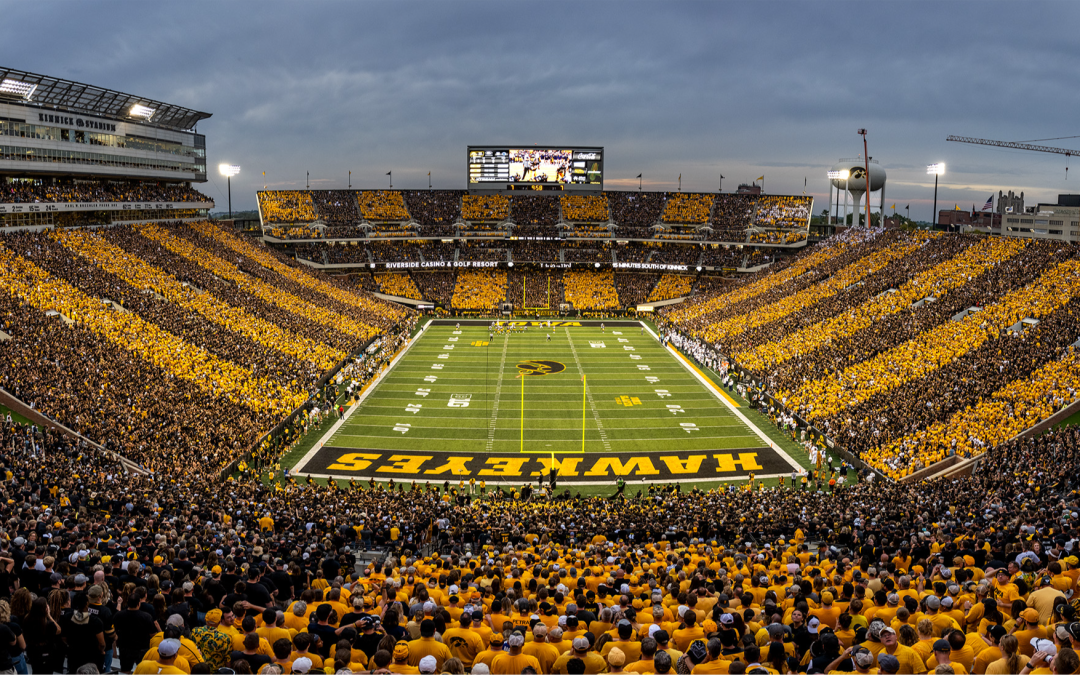
No. 4 Ohio State at No. 14 Iowa — 3:30pm ET, CBS
Line: Ohio State -14.5, O/U 45.5
Should we be a little concerned with Ohio State’s defense? First it was their 4th Quarter collapse at Texas, then last week they gave up 199 yards rushing to Illinois on 6.0 per carry. They did get stops on 6 of 14 3rd downs, but that’s an eyebrow-raising number. Of course, this is Iowa they’re playing, who have averaged just 18 ppg against power conference teams so far. The Hawkeyes win, especially at home, with their defense and field position game that tends to stress offenses used to scoring at will. But they haven’t seen anyone like WR Jeremiah Smith, who had an insane 12 receptions for 217 yards and 4 TDs against the Illini last week. The Hawkeyes must pressure QB Julian Sayin and not give him ample time to find Smith, or this one won’t be close.
Kinnick Stadium is known as the place where Top 5 teams go to die. Since 2008 the Hawkeyes have gone 5-2 against the Top 5 at home. I don’t think they will make it 6-2, but I’m not a fan of the 14.5-point spread either.
Ohio St win/Iowa cover
No. 8 Florida vs. No. 25 Missouri — 3:30pm ET, ABC
Line: Florida -5.5, O/U 57.5
Am I the only one who doesn’t understand the Missouri love? After an 8-5 ’25 season, returning just 49% of their production per SP+ (76th), they climbed to 19th after wins over Arkansas Pine-Bluff, Kansas and Troy. They played Mississippi State tight, but gave up two 4th Qtr TDs to lose yet still sit at the edge of the Top 25. They’ll be facing an offense that has averaged nearly 533 yards per game against defenses better than theirs. By the way, the Tiger D is just 104th in defensive EPA per rush and misses and average of 3.6 tackles per game. Yuk. Offensively the Tigers do move the ball well (418.8 ypg) but they struggle to finish drives (they’ve scored on only 76% of possessions in the red zone).
Could Florida experience a letdown on the road after their big thumping of Ole Miss last week? Of course. But my radar says they take care of business in Columbia.
Florida win/cover

College Football Analyst
Mike is a Baltimore native living in Portland, OR since 2007. He currently runs his own business specializing in video production and online marketing. Prior to that he was a legal technology consultant, worked for 9 years at Johns Hopkins University and served 6 years in the Air Force. He also enjoys travel, food, beer, and is a volunteer at the Oregon Humane Society.