
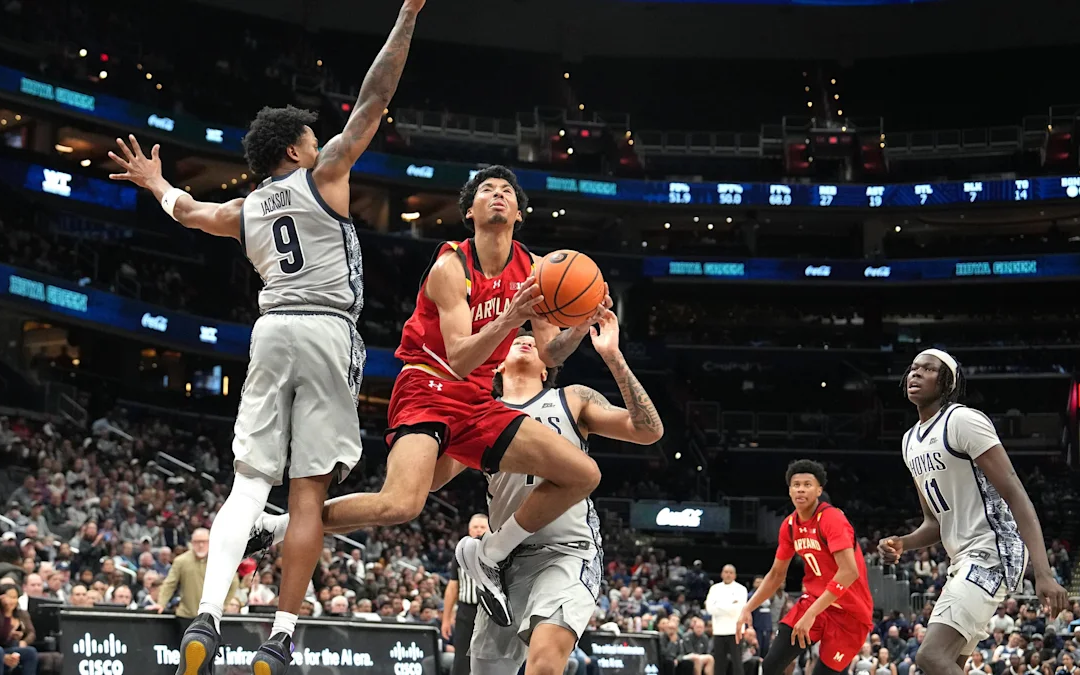
Maryland is 1-1 after a 96-67 win over Bucknell and an 86-74 loss at Georgetown. Through two games the Terps have made 10 of 48 from three. Their opponents have made 27 of 61. No. 9 Virginia comes to Xfinity Center on Friday.
The Three-Point Problem Runs Both Ways
The Georgetown game was decided from the arc, and so was the Bucknell game — Maryland just had a 32-point rebounding cushion in the first one to hide it.
| Maryland 3PT | Opponent 3PT | |
|---|---|---|
| vs Bucknell | 7-28 (25%) | 12-31 (39%) |
| at Georgetown | 3-20 (15%) | 15-30 (50%) |
| Two games | 10-48 (20.8%) | 27-61 (44.3%) |
That is a 51-point deficit from three in two games.
The Crab 5 team shot 37.3% from three on 21.7 attempts a game. Last year’s team shot 28.9% on 21 attempts. This year’s team is not going to shoot like the Crab 5, but it has to be well clear of last year’s number, and right now it is nowhere close.
The individual starts:
- DJ Wagner: 0-for-8. He made 34.6% last season on 3.1 attempts a game.
- Bishop Boswell: 1-for-7. He made 38.5% last season on 2.3 attempts.
- Andre Mills: 4-for-13. He made 34.6% last year on 4.8 attempts. Through two games he is up to 6.5 attempts. If the volume holds, the percentage has to come with it.
- Mike McNair Jr.: 2-for-4. A 41.8% career shooter on 4.8 attempts. More on him below.
- Austin Brown: 0-for-5.
A lot of these have been open looks. That is the encouraging read – the shots are there, and this group is better than 20.8% by any reasonable measure of who these players are.
The other side of the coin is less forgiving. Bucknell went 12-of-31 and Georgetown went 15-of-30, the Hoyas’ most made threes in a game since 2010. Maryland has not contested enough. That was also true in the West Virginia exhibition, when the Mountaineers made eight of their first 11 and built a 19-point lead by attacking switches. Three games running now, opponents have gotten clean looks from deep against a team that was sold on its defense.
Last season Maryland allowed 1.27 points per possession against top-50 opponents, last in Division I. The first real opponent of this season put up 86 on 52% shooting. Two games is not a verdict. It is also not evidence against the concern.
Three Things In The Box Score That Had Nothing To Do With Shooting
It is easy to write Saturday off as a hot night for Georgetown and a cold one for Maryland. Three numbers say otherwise.
Assists: Georgetown 19, Maryland 9. The Hoyas assisted on 70% of their made field goals. Maryland assisted on 35%, and turned it over 14 times against those nine assists. Georgetown ran offense. Maryland generated shots one player at a time. Pharrel Payne scored 28 points and was credited with zero assists — the ball went in to him and the possession ended one way or the other.
The rebounding edge got cut in half. Against Bucknell it was 54-22 overall and 28-6 on the offensive glass. Against Georgetown it was 37-27 and 19-10. Still a win, and 19 offensive boards is a real number. But the identity that looked overwhelming on Monday looked ordinary on Saturday against the first opponent with size. Chol Machot, the 7-footer from College of Charleston listed at 190 pounds who everyone assumed Maryland would move at will, had five blocks in 18 minutes. Georgetown blocked seven shots to Maryland’s one.
Mike McNair attempted two shots in 21 minutes. This is the most fixable thing on the list. He finished fifth nationally in three-point percentage last season with a program-record 110 makes at Boston University, where he averaged 16.9 points on 36 minutes a night. Against Georgetown he took one three, scored zero points, and picked up four fouls. He has started both games and played 21 minutes in each.
If McNair is going to start and play 21 minutes, he has to shoot. That is the entire reason he is here. Two attempts in a game decided by three-point shooting is either an offense that is not finding him or a player who is not hunting, and both are correctable in practice.
One more thing worth noting about the shape of the night: nobody except Payne played 30 minutes. Mills played 19, the fewest of any starter, with three fouls. Williams has been using mass substitutions – “hockey subs,” five at a time – and said after Bucknell he plans to keep doing it for a few more games. Against the Bison it produced an eight-minute stretch without a field goal. Against Georgetown it produced a team that never found a rhythm until the game was gone. Maryland closed on a 19-6 run, which is both encouraging and a reminder of how much was left on the floor earlier.
Two Games In, Player By Player
Pharrel Payne. How can you not love this guy? Thirteen points, six boards, two steals and two blocks against Bucknell. Twenty-eight points and eight rebounds against Georgetown on 10-of-14 shooting. After going 3-of-9 at the line in the opener, he went 8-of-8 Saturday. He works. He is the one Terp who has been exactly what was advertised.
Kaden House. Fourteen points against Bucknell, 13 against Georgetown, all in the second half. He hit both of his threes Saturday. Six free throw attempts in the opener, seven against the Hoyas. He hustles, he defends, he gets downhill. There is a lot to like, and he is already the most consistent perimeter scorer on the roster through two games. The question is whether Williams makes him more of a focal point or keeps him at 18 to 21 minutes.
Tomislav Buljan. Good first impressions. The Croatian sophomore throws his weight around without lumbering, and he has 17 rebounds in two games including six offensive boards Saturday. Three turnovers against Georgetown, a couple of them from bringing the ball down low and trying to do too much – cleanable. He averaged 13.1 a game at New Mexico and is at 7.0 through two. He will get fewer touches here, which is fine, but Maryland needs him finishing around the rim and not just rebounding.
Andre Mills. Twenty-two points and 11 rebounds against Bucknell, nine points on 4-of-15 against Georgetown. Maryland will not win many games when he is not scoring. What is good about his offensive game is the variety – he can go coast to coast, he has intermediate stuff, he can get to the line. On a night like Saturday when the outside shot is not falling, you want to see him recognize it earlier and attack. The 11 rebounds against Bucknell dropping to two against Georgetown is also worth watching.
DJ Wagner. The outside shot has not come yet, but the speed is real and he has looked good going to the basket. One number to flag: his career high in field goal attempts was 10.2 a game at Arkansas two years ago, in 34.6 minutes. Through two games as a Terp he is averaging 11.5 attempts in 25.5 minutes. That is a significantly higher usage rate than he has ever carried, and it is coming while he is 0-for-8 from deep.
Baba Oladotun. Nineteen minutes in his debut, 18 against Georgetown. Seven points, four boards, an assist and two blocks against Bucknell after missing his first few attempts. One-of-3 with two rebounds and two steals Saturday. We have seen the glimpses – the movement at his size is unusual. We have also seen a 17-year-old, 18 in December, who reclassified and then missed most of his senior season with an ankle injury, now getting acclimated to college basketball. He is 1-of-6 from the line. He does not look settled on where he wants to be on the floor yet, and he clearly wants to put it on the deck.
Williams said it better than anyone after the opener: “Any 17-year-old that’s supposed to be in high school, no matter who the opponent is, who’s playing in his hometown state in game number one, he is going to be sped up. We had some 23-year-olds that were sped up.”
The hope was that he would dominate from day one. That was always a lot to ask. The right measure is improvement game to game and month to month. He sits 37th on ESPN’s 2027 draft board, so this may be his only year in College Park – which argues for simplifying things for him as fast as possible. Start here, then add this. If everything clicks at some point this season, Maryland’s ceiling moves.
Robert Jennings II. A good reserve big. Athletic, good size, defends and rebounds, and he knocked down a surprising three against Bucknell. The 15 or so minutes he gets a night matter.
Austin Brown. Zero-for-6 in his debut and 0-for-1 against Georgetown, 0-for-5 from three combined. He played five minutes Saturday, which is about what to expect against major non-conference opponents and in Big Ten games. Two games is nothing, but Williams does seem to want him on the floor.
The end of the bench. Adama Tambedou, George Turkson Jr., Guillermo Del Pino and Maban Jabriel. None of them will play much absent injuries, but all four could matter at some point. Tambedou has the athletic body if the bigs get in foul trouble. Turkson is an energy guy who could help if Maryland is getting out-hustled. Del Pino has a year of adjusting to the country and the system behind him and should be further along — he was hurt for the opener. Jabriel’s path is showing he can rebound in practice; if he does, a 6-9 shooter who made 43.2% from three at Queens might earn a look, and this team needs shooting.
What Fixes Itself, And What Doesn’t
I do not want to overreact to a game on November 7th. But I found Saturday largely unacceptable, and I have defended Williams a lot over the last year.
Georgetown looked better than the prognostications about them. They were picked 10th in the Big East, second to last. Maybe they’ll be better than expected, but still their not likely to be Big East contender. These were two teams with a lot of new parts, and the Hoyas looked like they had a better sense of who they were. Maryland does not have to be a finished product in early November. Watching Georgetown lead by 20 for most of the night was still deflating, and it cost a resume builder that was there for the taking.
Things that will correct on their own. You play that game again today, and Georgetown is probably not shooting 50% from three again. Maryland is not shooting 20.8% from three all year – these are career 34 to 42 percent shooters taking open looks. Both of those numbers move toward the middle, and both move in Maryland’s favor. Fifteen made threes was the most by a Georgetown team in sixteen years. That is the definition of an outlier.
Things that will not. A 35% assist rate. Fourteen turnovers against nine assists. A starting shooter taking two shots in 21 minutes. Opponents getting clean looks from deep in three straight games because nobody closed out. Mass substitutions that leave the team without rhythm against an opponent that came out ready.
The first list is why I am not panicking after two games. The second list is why Saturday bothered me more than the final score suggests.
This team has good pieces. It is not hard to picture plenty of nights where Payne works inside, Mills puts in 20, and the rest of the roster contributes enough to win a good share of games. You can see further ceiling if House becomes more of a focal point and the lights come on for Oladotun.
It is also not hard to picture plenty of nights where this group simply does not shoot well enough to compete with the best teams on the schedule. You can see where these become rock fights. Which means Maryland has to get to the line in big numbers – a strength of Williams’ teams historically – and be locked in for 40 minutes.
It took too long for the defensive intensity to arrive Saturday. For this group to be good, they need to embrace a simple idea: we are going to make you hate playing against us. We are going to fight on every possession.
That is the lesson from game two, and it is available to them Friday.
Virginia, Friday, At Xfinity Center
No. 9 Virginia is 2-0 after beating Drexel 89-60 and Northeastern 97-72. ESPN’s matchup predictor gives the Cavaliers a 52.8% chance, which is close to a coin flip against a top-10 team and a fair reflection of a winnable home game.
We had Virginia seventh nationally and second in the ACC in our preseason piece, when ESPN had them 13th.
The scouting report writes itself, which cuts both ways. Virginia’s offense is extraordinarily concentrated in four returners from last year’s 30-win team. Thijs De Ridder, Johann Grunloh, Sam Lewis and Chance Mallory combined for 69 of the 97 points against Northeastern. Against Drexel, those four plus German freshman Nolan Adekunle scored Virginia’s first 37 points. De Ridder put up 12 in the first 2:22 of the opener.
That is a team you can game-plan, if you can guard four people. It is also a team that will punish you if you cannot.
Things working in Maryland’s favor. Virginia starts slow too. Against Northeastern they went 2-of-10 from the field with four turnovers in the first eight minutes, went 0-for-7 from three to open, and did not lead until 8:23 remained in the half. They committed 14 turnovers against Drexel, six by Mallory, and the two teams combined for 18 first-half turnovers against Northeastern. Grunloh played Friday on an injured right ankle and is worth tracking this week.
Things working against Maryland. Virginia can shoot it at every position, which is the exact profile that has hurt the Terps in three straight games. They went 10-for-29 from deep against Drexel and 6-for-14 in the second half against Northeastern, finishing that game at 61.3% from the floor. If Maryland closes out the way it has so far, this is not close. As we said, Virginia returned a lot of experience. They know who they are. MD is trying to figure out who they are.
The schedule note. Virginia plays No. 12 Arkansas today and then Bucknell on Tuesday before coming to College Park. The Bucknell game gives us a direct comparison point, and the Arkansas result will tell us something real about where the Cavaliers actually are. Maryland gets five days off.
What has to happen. Guard the arc. Get Payne touches – he just put 28 on a team with a shot-blocking center and did not miss a free throw. Get McNair shots. And start the game with the right intensity. Can’t spot a Top 10 team 12 points and hope to climb back.
The Non-Conference Math
Coming into the year, Maryland had six chances at quality non-conference wins: Georgetown, Virginia, Tennessee, Iowa State or San Diego State, the third Players Era game, and South Carolina.
One is gone. Five are left:
| Date | Opponent | Site |
|---|---|---|
| Nov 13 | No. 9 Virginia | College Park |
| Nov 24 | Tennessee | Las Vegas |
| Nov 26 | Iowa State or San Diego State | Las Vegas |
| Nov 27 | TBA | Las Vegas |
| Dec 19 | South Carolina | CFG Bank Arena, Baltimore |
Going 3-2 the rest of the way leaves the non-conference resume in decent shape entering Big Ten play. Going 2-3 means entering the league chasing. Going 1-4 means the margin is gone before January, with a December that opens at Ohio State and hosts Michigan State three days later.
Williams said at media day that the November slate is “more than you want as a head coach being transparent,” and framed it as a deliberate bet – the quality of competition in the first four weeks producing data and seasoning that pays off “after Valentine’s Day.” Three games in four days in Las Vegas, possibly four in five.
That is a real argument, and it is the kind of thing that looks smart in March if the team is good. It also means the margin for error in November is thin, and one of the six chances is already spent.

Owner
Chris Stoner founded Baltimore Sports and Life in 2009. He has appeared as a radio guest with 1090 WBAL, 105.7 The Fan, CBS 1300, Q1370, WOYK 1350, WKAV 1400, and WNST 1570. He has also been interviewed by The Baltimore Sun, Baltimore Business Journal, and PressBox (TV). As Owner, his responsibilities include serving as the Managing Editor, Publicist, & Sales Director.