

The Orioles’ 3.75 reliever ERA currently sits at 7th best in the MLB, but it has been a bit of a roller coaster year for the bullpen. The story of the season has really been Felix Bautista,
Yennier Cano, and then everyone else. This isn’t to discredit the likes of Danny Coulombe, Bryan Baker, and Mike Baumann, as each of them, especially Coulombe, have been important
pieces to the bullpen and have had some great performances this season. The remaining arms who have pitched considerable innings for the O’s this season include Cionel Perez, Austin Voth, and Keegan Akin, all of whom have been really disappointing. I’m still holding out some hope for Perez because the stuff is there and we saw him have success last season, but he has really struggled with his command all year. Anyways, back to the topic of this article, the two All-Stars, Felix Bautista and Yennier Cano.
Let’s start with the rock, Yennier Cano.
Cano was signed by the Minnesota Twins as an international free agent back in 2019 and worked his way up through their farm system before being called up to the big leagues in May of 2022. In August 2022 the Orioles traded their then-all-star closer Jorge Lopez for a package of minor league players including Cano. In his three appearances with the O’s, Cano allowed 9 runs on 9 hits with 7 strikeouts in 4.1 innings pitched before getting sent back down to Triple-A. And look at him now. In the 41 innings Cano has pitched this season, he has only allowed 6 runs on 29 hits while striking out 37 and walking just 6 batters. Cano’s 1.32 ERA is good for 5th best in the majors (min 30 IP).
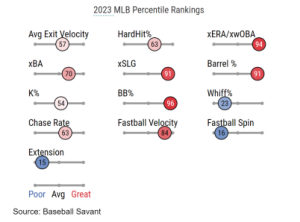
Cano is in the top 10 percent in the MLB in xEra/xwOBA, Barrel %, expected slugging % (xSLG), and BB%. More simply, Cano has really excelled at getting weak contact and limiting
walks. Besides forcing weak contact, Cano has been stellar at producing ground ball outs – his 65.1% ground ball rate is third in the MLB (min 30 IP) behind only Andre Pallante of the
Cardinals and Jhoan Duran of the Twins.
So the question is, how is Cano doing all this?
It mainly comes down to his sinker being such a dominant pitch. The vertical movement on Cano’s sinker averages 9 inches more than that of the average MLB sinker, good for best in the
league.
When this pitch, which drops an average of 32.5 inches, is thrown at its average of 95.9 MPH, it simply has too much movement at too high a speed for hitters to be able to hit consistently. While Cano mainly throws sinkers, he also has a slider and change-up which can both serve as good out-pitches despite being a little less consistent. These pitches are also significantly above league average in vertical movement, with the change-up and slider dropping 4 and 2.5 inches more than league average respectively.
Now, this can work because Cano’s command has been great virtually all season. We often see that pitchers with the best stuff have the toughest time with command simply because of the pitches breaking so far. Cano has been an incredible revelation so far, and he’ll be absolutely crucial for the O’s to continue their successful season.
Now we move to the mountain, Felix Bautista.
Bautista, by most accounts, has been the best relief pitcher in the American League if not the entire MLB. Bautista ranks first in the MLB with a 1.16 ERA (min. 30 IP), first in the MLB with an 18.39 K/9 rate, 2nd in the MLB in FIP at 1.61, first in xFIP by almost a full run (1.47 to Jacob Degrom’s 2.30) and to save some time here, is basically leading all relievers in just about every category. To put Bautista’s dominance into perspective, Bautista has struck out 51.3% of the batters he has faced, a full 8% more than the second-best rate in the MLB of 43.4% held by Aroldis Chapman.
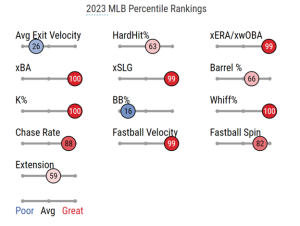
Bautista ranks in the 100th percentile in expected batting average (xBA), strikeout %, and Whiff % and ranks in the 99th percentile in xERA/xwOBA, expected slugging % (xSLG), and fastball velocity.
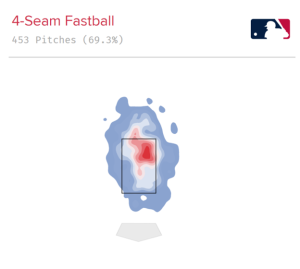
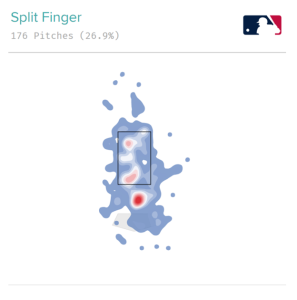
So how is Bautista doing it? Well, it’s pretty simple. He gets ahead in the count by throwing 100+ MPH fastballs up and in the corners, and then throws a nasty splitter 10 MPH slower than his fastball that hitters simply can’t make contact with. Oh, and it doesn’t hurt to be 6’7 to add some intimidation and a closer release point to give the hitter even less time to gear up for what’s coming.
Bautista is pretty much the definition of a 2-pitch pitcher, as he throws his fastball ~70% of the time and his splitter ~27% of the time. Every now and then he’ll mix in a slider, but they are few and far between. The heatmaps of these two pitches are probably the best way of showing what Bautista has been doing all season. He gets that fastball up and in or up and away on hitters and then throws his splitter low and out of the zone causing chases. Bautista’ MLB-best 45.3% whiff rate shows that he has been executing this game plan to near-perfection.
For the Orioles to continue their playoff push and potentially even go deeper in the playoffs, Cano and Bautista will need to continue their dominance. These two can’t do it on their own, so getting better performances from the lower-end of the O’s bullpen will be even more important as the season goes on. Regardless, it’s worth stopping and appreciating what these two have done as we head into the All-Star break. These two bring back fond memories of Darren O’Day, Brad Brach and of course Zack Britton when thinking back to dominant Orioles bullpens of recent years past.
Oh, and Felix Bautista’s walk-out at Camden Yards is one of the cooler things I’ve seen at OPACY in a long time. If that doesn’t get you fired up as an O’s fan, I don’t know what does.

As a Baltimore native, Zach is an avid Orioles and Ravens fan. After interning for the Baltimore Orioles, he currently works as a Senior Quantitative Risk Analyst for OneMain Financial and is a part-time graduate student studying Data Science at the University of Michigan.